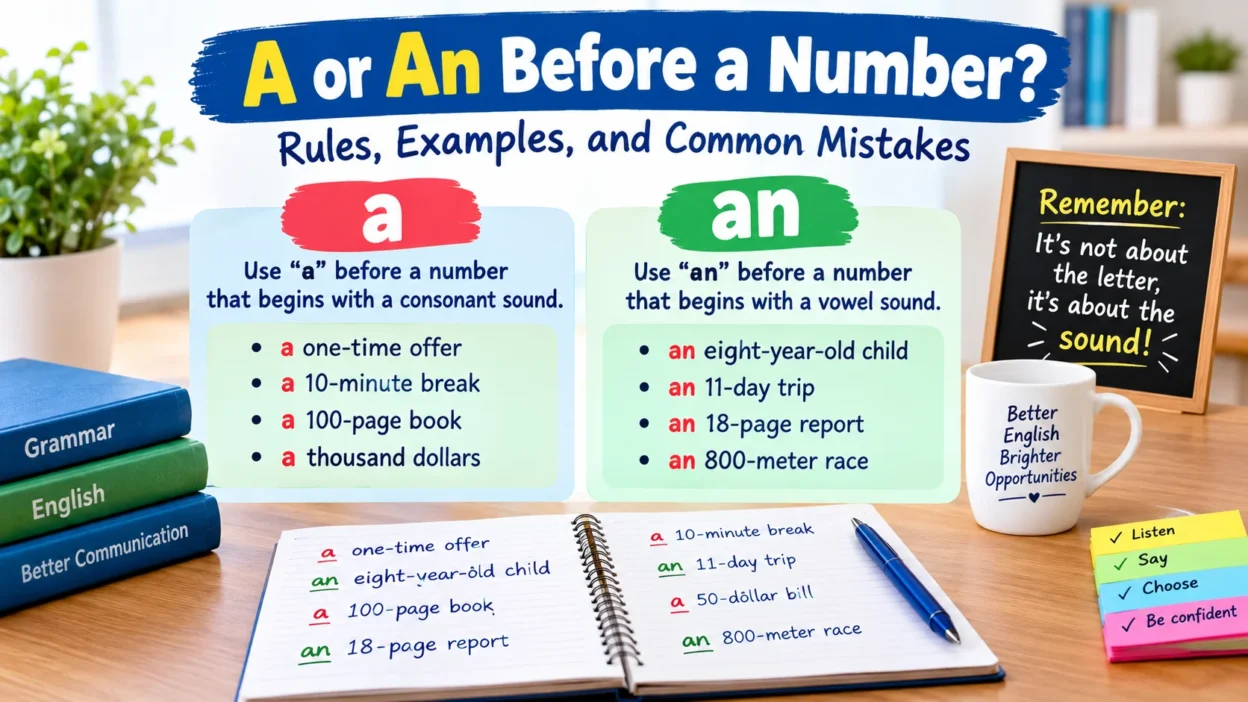
When deciding if to use “a” or “an” before a number, the correct choice depends on the sound you pronounce at the beginning of the number, not simply the digit you see. Use “a” before a consonant sound and “an” before a vowel sound. For example, you would say “a one-time offer” but “an eight-year-old child” (more naturally written as “an eight-year-old child”).
English learners often find this rule confusing because numbers can be written as digits or words, and some numbers begin with sounds that do not match what their spelling might suggest. The same principle applies if you are talking about an age, an amount, a measurement, an ordinal number, or a numbered item.
In this guide, you will learn when to use “a” or “an” before numbers, understand the pronunciation rule, explore practical examples, and avoid common grammatical mistakes. By the end, you will be able to choose the correct article confidently in everyday English and formal writing.
Quick Answer
Use “a” or “an” before a number according to its first spoken sound. Use “a” before consonant sounds, as in “a one-bedroom apartment” and “a hundred dollars.” Use “an” before vowel sounds, as in “an eight-year-old child” and “an 18-page report.” Pronunciation determines the correct article.
Why Do People Confuse A or An Before a Number?
People often assume that “a” comes before numbers beginning with consonant letters and “an” comes before numbers beginning with vowel letters. However, English articles depend on pronunciation rather than spelling.
For example:
- A one-time payment: “One” begins with a /w/ sound.
- An eight-hour journey: “Eight” begins with a vowel sound.
- A 100-dollar bill: “100” is read as “one hundred,” beginning with a /w/ sound.
- An 80-year-old building: “80” is read as “eighty,” beginning with a vowel sound.
Another source of confusion is that numbers can be pronounced differently depending on context. For example, “1” may be read as “one,” “first,” or part of a longer expression. You must consider how the number is actually spoken in the sentence.
The First Word: When to Use “A” Before a Number
Use “a” when the number begins with a consonant sound when spoken aloud.
The article “a” is commonly used before numbers pronounced with an initial /w/, /h/, /θ/, or other consonant sound.
Examples of “A” Before Numbers
- A one-time opportunity: “One” begins with a /w/ sound.
- A one-year contract: “One” starts with a consonant sound.
- A one-hour delay: In this phrase, “one” begins with a /w/ sound, so “a” is correct.
- A hundred people: “Hundred” begins with an /h/ sound.
- A thousand dollars: “Thousand” begins with a /θ/ sound.
- A 10-minute break: “10” is read as “ten,” which begins with a consonant sound.
- A 50-page book: “50” is read as “fifty,” which begins with an /f/ sound.
- A 100-year history: “100” is read as “one hundred.”
Why Is It “A One” Instead of “An One”?
The word “one” begins with a consonant-like /w/ sound, even though it starts with the vowel letter “o.” That is why we say “a one-bedroom apartment,” not “an one-bedroom apartment.”
The same rule applies to “once,” “one-sided,” and other words beginning with the same /w/ sound.
The Second Word: When to Use “An” Before a Number
Use “an” when the number begins with a vowel sound when spoken aloud.
This often happens with numbers such as eight, eleven, eighteen, eighty, and eight hundred.
Examples of “An” Before Numbers
- An eight-year-old child: “Eight” begins with a vowel sound.
- An eight-hour shift: The first sound in “eight” is a vowel.
- An 11-day trip: “11” is read as “eleven.”
- An 18-month period: “18” is read as “eighteen.”
- An 80-page document: “80” is read as “eighty.”
- An 800-meter race: “800” is read as “eight hundred.”
- An 8% increase: “8%” is read as “eight percent.”
- An 18th birthday: “18th” is read as “eighteenth.”
Why Is It “An Eight” Instead of “A Eight”?
The word “eight” begins with a vowel sound. Therefore, “an” is the correct article before it.
This rule applies even when the number is written as a digit. For example, “an 8-year-old student” is correct because the number is pronounced “eight.”
A or An Before a Number: Comparison Table
| Number or expression | Spoken form | Correct phrase | Reason |
|---|---|---|---|
| 1 | One | A one-time offer | Begins with /w/ |
| 8 | Eight | An eight-year-old | Begins with a vowel sound |
| 10 | Ten | A 10-minute break | Begins with /t/ |
| 11 | Eleven | An 11-day trip | Begins with a vowel sound |
| 18 | Eighteen | An 18-page report | Begins with a vowel sound |
| 50 | Fifty | A 50-dollar bill | Begins with /f/ |
| 80 | Eighty | An 80-year-old building | Begins with a vowel sound |
| 100 | One hundred | A 100-page book | Begins with /w/ |
| 800 | Eight hundred | An 800-meter race | Begins with a vowel sound |
| 1,000 | One thousand | A 1,000-dollar prize | Begins with /w/ |
When Should You Use A or An Before Each Number?
The easiest way to decide is to read the number aloud and listen to its first sound.
Use “A” Before These Numbers
Use “a” before numbers pronounced with a consonant sound:
- A one-way ticket
- A one-time payment
- A two-week vacation
- A three-day event
- A 10-year plan
- A 20-minute meeting
- A 100-person audience
- A 1,000-word essay
Use “An” Before These Numbers
Use “an” before numbers pronounced with a vowel sound:
- An eight-year-old child
- An eight-week course
- An 11-year-old student
- An 18-month contract
- An 80-mile journey
- An 800-page book
- An 8% discount
- An 18th-century building
Remember that these examples depend on how the numbers are spoken. If you use a different spoken form, the appropriate article may change.
15 Examples of A or An Before a Number in Sentences
Here are practical examples showing how the rule works in everyday English.
- She received a one-time bonus at work.
- We waited for an eight-hour flight to finish.
- He took a 10-minute break after lunch.
- They planned an 11-day holiday abroad.
- I bought a 20-page notebook for my class.
- The company announced an 18% increase in sales.
- She lives in a one-bedroom apartment downtown.
- We watched an 800-meter race at the stadium.
- He wrote a 100-word summary of the story.
- The museum displayed an 18th-century painting.
- They offered us a two-year agreement.
- The teacher assigned an eight-question quiz.
- We attended a 50-person conference.
- The project required an 80-page report.
- She celebrated an 18th birthday with her friends.
These examples demonstrate that the written digit does not determine the article. The spoken form does.
Common Mistakes When Using A or An Before a Number
English learners often make these mistakes when choosing an article before a number.
Mistake 1: Using “An” Before Every Number Beginning With a Vowel Letter
Incorrect: An one-bedroom apartment.
Correct: A one-bedroom apartment.
Why? “One” begins with a /w/ sound.
Mistake 2: Using “A” Before Every Number Beginning With a Consonant Letter
Incorrect: A eight-year-old child.
Correct: An eight-year-old child.
Why? “Eight” begins with a vowel sound.
Mistake 3: Choosing an Article Based on the Digit Alone
Incorrect reasoning: The digit 8 looks like a symbol, so either article works.
Correct: An 8-year-old child.
Why? The digit represents “eight,” which begins with a vowel sound.
Mistake 4: Ignoring the Full Number’s Pronunciation
For numbers with several digits, pronounce the entire number as it is intended in context.
For example:
- A 100-page book — “one hundred” begins with /w/.
- An 800-page book — “eight hundred” begins with a vowel sound.
Mistake 5: Confusing Articles With Ordinal Numbers
Cardinal numbers express quantity, while ordinal numbers express position.
- A one-time event.
- An eighth-place finish.
“Eighth” begins with a vowel sound, so “an eighth-place finish” is correct.
A Simple Memory Trick for A or An Before a Number
Use this simple trick: Say the number aloud before choosing the article.
- If the first sound is a consonant, use a.
- If the first sound is a vowel, use an.
Try remembering these pairs:
| Use “A” | Use “An” |
|---|---|
| A one-time offer | An eight-hour shift |
| A 10-minute break | An 11-day trip |
| A 100-page book | An 800-page book |
| A two-week course | An 18-month contract |
Do not focus only on the first written letter or digit. Focus on the first sound you hear when saying the number.
A or An Before a Number in American vs British English
The basic rule is the same in both American and British English: choose “a” or “an” according to the first spoken sound.
For example, both varieties use:
- A one-year contract.
- An eight-year contract.
- A 100-page report.
- An 800-page report.
There can be differences in how some numbers and measurements are expressed, but these do not change the fundamental article rule.
In both varieties, “a” is correct before “one” because it begins with a /w/ sound, and “an” is correct before “eight” because it begins with a vowel sound.
Similar Words and Related Grammar Rules
Understanding articles before numbers becomes easier when you connect the rule to other common English expressions.
A or An Before Letters
The same sound-based principle applies to individual letters.
- An M-shaped design — “M” is pronounced “em.”
- A U-shaped pipe — “U” is pronounced “you.”
A or An Before Abbreviations
Abbreviations also follow pronunciation rather than spelling.
- An FBI agent — “F” is pronounced “eff.”
- A NASA scientist — “NASA” is generally pronounced as a word beginning with /n/.
A or An Before Ages
When an age expression follows an article, consider the first sound of the age.
- A one-year-old baby.
- An eight-year-old child.
- An 11-year-old student.
A or An Before Measurements
Measurements follow the same rule.
- A 10-kilometer race.
- An eight-ounce cup.
- A 100-gram packet.
- An 80-inch screen.
These related examples show that the rule applies throughout English, not only to numbers.
Final Verdict: A or An Before a Number?
The correct choice between “a” and “an” before a number depends on pronunciation. Use “a” before a consonant sound and “an” before a vowel sound.
For example, write “a one-time offer,” “a 100-page book,” “an eight-year-old child,” and “an 18-page report.” These choices are correct because they reflect how the numbers are pronounced.
Frequently Asked Questions
1. Do You Use A or An Before a Number?
Use “a” before a number that begins with a consonant sound and “an” before a number that begins with a vowel sound. For example, say “a one-time offer” and “an eight-hour shift.”
2. Is It A 8 or An 8?
It is “an 8” when the number is pronounced “eight.” The word “eight” begins with a vowel sound, so “an 8-year-old child” is correct.
3. Is It A 100 or An 100?
It is generally “a 100” when the number is pronounced “one hundred.” The word “one” begins with a /w/ sound, which is a consonant sound.
4. Is It A 11 or An 11?
Use “an 11” when the number is pronounced “eleven.” For example, “an 11-day trip” is correct because “eleven” begins with a vowel sound.
5. Why Do We Say A One-Time Offer?
We say “a one-time offer” because “one” begins with a /w/ sound rather than a vowel sound. The article depends on pronunciation, not on the letter “o.”
6. Is It An 18-Year-Old or A 18-Year-Old?
The correct phrase is “an 18-year-old” because 18 is pronounced “eighteen,” which begins with a vowel sound.
7. Does the Same Rule Apply to Ordinal Numbers?
Yes. The same rule applies to ordinal numbers such as first, eighth, and eleventh. For example, say “a first-place finish” but “an eighth-place finish.”
8. Does the Rule Change in American and British English?
No. Both American and British English use the same basic pronunciation rule for “a” and “an” before numbers.
Remember This
- A before a consonant sound: a one-time offer, a 10-minute break.
- An before a vowel sound: an eight-hour shift, an 11-day trip.
- Always consider how the number is pronounced.
- The first written digit does not determine the article.
Conclusion
Choosing between “a” and “an” before a number is simple once you understand the role of pronunciation. Use “a” when the number begins with a consonant sound and “an” when it begins with a vowel sound. This rule works for numbers written as digits and numbers written as words.
Practise with familiar expressions such as “a one-bedroom apartment,” “an eight-year-old child,” “a 100-page book,” and “an 800-meter race.” With regular practice, choosing the correct article will become a natural part of your English writing and speaking.