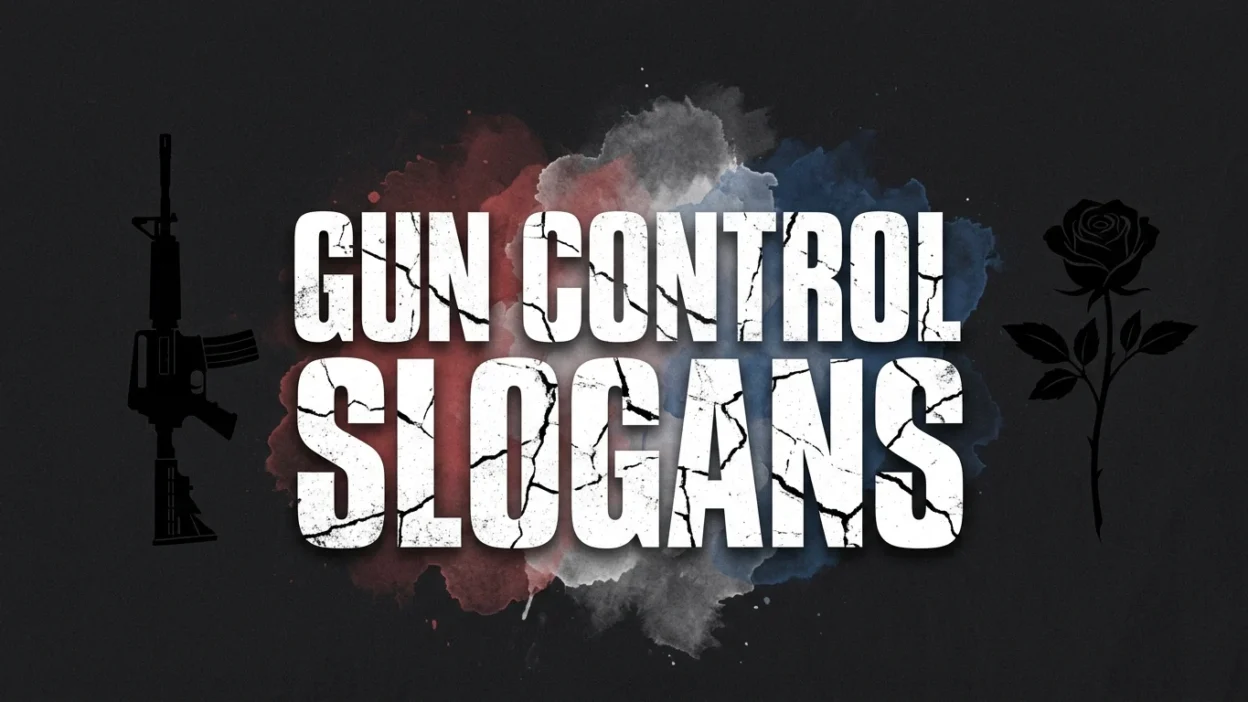
The debate over gun rights and regulations is one of the most polarized and emotionally charged issues in American society. At the heart of this national conversation are gun control slogans short, memorable phrases that encapsulate deeply held beliefs about freedom, safety, and the role of government. These slogans are far more than just clever words; they are potent tools of persuasion that can simplify complex arguments, rally supporters, and shape public opinion. if you are a staunch advocate for the Second Amendment or a passionate supporter of stricter laws, these slogans provide the language for a critical national dialogue.
This article explores the most influential pro gun and pro gun control slogans, breaking them down by category. By understanding the message, origin, and impact of each phrase, you can gain a deeper insight into the arguments that drive the debate. From the defiant cry of “From my cold, dead hands” to the emotional appeal of “Arms are for hugging,” we will examine the key phrases that define the battle over gun rights in America.
What Are Gun Control Slogans?
Gun control slogans are short, memorable phrases used by advocates on all sides of the gun policy debate to succinctly express their core arguments. These slogans are crafted to be easily remembered, emotionally resonant, and persuasive, often appearing on bumper stickers, protest signs, and political campaign materials. They serve as linguistic shortcuts, distilling complex legal, ethical, and social issues into a few powerful words designed to influence public opinion and rally supporters.
In the context of the American gun debate, these slogans represent two primary opposing viewpoints: the pro-gun rights perspective, which emphasizes individual freedom, self-defense, and constitutional rights, and the pro-gun control perspective, which stresses public safety, the prevention of violence, and the need for government regulation. The effectiveness of a slogan often lies in its ability to tap into deep-seated cultural values and fears, making it a central element in the political discourse.
Classic Pro-Gun Rights Slogans
From My Cold, Dead Hands
Perhaps the most iconic pro-gun slogan, this phrase defiantly states that gun owners will never willingly give up their firearms. It gained immense popularity after actor Charlton Heston, then-president of the NRA, used it to conclude a speech at the organization’s 2000 convention . The phrase has since become a rallying cry for Second Amendment absolutists .
Guns Don’t Kill People, People Kill People
This widely recognized slogan argues that guns are inanimate objects and that violence is a result of human actions, not the weapons themselves. It shifts the focus from the tool to the individual, suggesting that the solution lies in addressing criminal intent and mental health rather than restricting firearm access .
An Armed Society Is a Polite Society
This slogan promotes the idea that a well-armed populace deters crime and encourages civility. It is based on the premise that criminals are less likely to target individuals who might be carrying a weapon, thereby fostering a more peaceful and respectful society .
The Only Thing That Stops a Bad Guy with a Gun Is a Good Guy with a Gun
Popularized by NRA CEO Wayne LaPierre, this slogan posits that law-abiding citizens with firearms are the most effective defense against armed criminals. It argues for widespread civilian carry to serve as a deterrent and a means of intervention in mass shooting scenarios .
When Guns Are Outlawed, Only Outlaws Will Have Guns
This classic argument against gun control suggests that laws restricting firearms only disarm law-abiding citizens, leaving them vulnerable to criminals who will always find ways to obtain weapons illegally. It frames gun control as ineffective and even counterproductive .
Pro-Gun Rights Slogans Emphasizing Freedom and Rights
Free Men Do Not Ask Permission to Bear Arms
This slogan asserts that the right to own weapons is inherent to a free person and should not be subject to government permission or licensing. It frames any restriction on gun ownership as a form of servitude or government overreach .
The Second Amendment Is the First Freedom
This slogan argues that the right to bear arms is fundamental to the preservation of all other rights, serving as a deterrent against tyranny. It places the Second Amendment at the forefront of constitutional liberties .
A Gun in the Hand Is Better Than a Cop on the Phone
This powerful slogan highlights the immediacy of self-defense. It argues that in a life-threatening situation, police response is too slow, and individuals must have the means to protect themselves instantly rather than waiting for help .
An Armed Man Is a Citizen. An Unarmed Man Is a Subject.
This slogan draws a stark line between those who are capable of defending themselves and their country and those who are dependent on others for protection. It frames gun ownership as a key element of citizenship and independence .
What Part of “Shall Not Be Infringed” Do You Not Understand?
This slogan directly quotes the Second Amendment, challenging gun control advocates on constitutional grounds. It simplifies the debate to a matter of textual interpretation, arguing that the right to keep and bear arms is absolute and cannot be limited .
Humorous and Sarcastic Pro-Gun Slogans
If Guns Cause Crime, Then Pencils Cause Misspelled Words
This humorous analogy is a classic “correlation does not equal causation” argument used by gun rights advocates. It satirizes the logic of attributing violent acts to inanimate objects, arguing that a tool is not responsible for the misuse of it .
64,999,987 Firearm Owners Killed No One Yesterday
This slogan uses a statistic to put gun violence into perspective. It highlights the vast number of responsible gun owners and argues against the narrative that firearms are inherently dangerous, emphasizing that the vast majority are used safely .
Guns Have Only Two Enemies: Rust and Politicians.
This witty slogan implies that firearms are not inherently harmful and only degrade through neglect or unfair government action. It frames politicians and their attempts at regulation as a greater threat to a firearm than time itself .
Gun Control Is Not About Guns; It Is About Control.
This slogan re-frames the debate, suggesting that the true agenda behind gun control is government power and domination over the populace. It is a foundational argument for those who believe the goal of gun control is disarmament and subjugation .
If You Don’t Know Your Rights, You Don’t Have Any.
This slogan serves as a warning about civic ignorance. It suggests that rights can be eroded if citizens are not aware of them and do not actively defend them, urging gun owners to be educated and vocal .
Pro-Gun Control Slogans
Arms Are for Hugging
This emotionally resonant slogan is a direct counter to the militaristic language of gun rights advocacy. It was widely used during the Million Mom March in 2000 to promote a message of peace and love over violence, emphasizing that arms should be used for affection, not destruction .
No Guns, No Violence
This simple and direct slogan argues for a straightforward solution to gun violence: the absence of firearms. It implies that if guns are removed from the equation, violence will decrease, making it a powerful, if simplistic, plea for safety .
One Nuclear Bomb Can Ruin Your Whole Day
Originally an anti-nuclear slogan, this phrase has been adopted to highlight the catastrophic potential of any weapon. It uses a stark, memorable image to illustrate the life-ending consequences that firearms can bring to a community .
Guns—No, Life—Yes
This slogan, often seen at protests, makes a clear moral choice between weapons and human life. It positions gun ownership as incompatible with a society that values life, presenting a binary choice between the two .
A Million Moms Can’t Be Wrong
Popularized by the Million Mom March, this slogan leverages the authority of a large group of mothers advocating for stricter gun laws. It appeals to common sense and the protective instincts of parents, arguing that such a large movement must be justified .
Pro-Gun Control Slogans About Responsibility and Safety
You Don’t Shoot to Kill; You Shoot to Stay Alive
While often used by gun-rights advocates to justify self-defense, this slogan has been co-opted to highlight the grave consequences of gun use. It reframes the act of shooting as a last-resort, life-or-death decision, emphasizing the seriousness of using a firearm .
Anyone Can Shoot a Gun but the Real Power Comes from Non-Violent Means.
This slogan argues that true strength and efficacy in society come from peaceful solutions, not violence. It contrasts the ease of using a firearm with the higher pursuit of resolving conflict through dialogue and non-aggression .
We Don’t Need Guns and Bombs to Bring Peace, We Need Love and Compassion.
This idealistic slogan emphasizes non-violent conflict resolution over the use of force, typical of anti-war and pacifist movements. It suggests that peace cannot be achieved through weapons but through humanitarian values .
Gun Bans Disarm Victims, Putting Them at the Mercy of Murderers
This is a counter-slogan from the gun-rights side, but gun control advocates often use it to frame the need for responsible registration. In the gun control context, it’s turned around to argue that proper licensing ensures the right people are armed, not that all people should be disarmed .
We Don’t Have a Gun Problem; We Have a Math Problem: ZERO GUNS = ZERO GUN-RELATED DEATHS.
This simple, logical slogan is a powerful argument for the elimination of firearms. It uses a mathematical equation to present an undeniable conclusion: the only way to completely eliminate gun deaths is to completely eliminate guns .
Slogans About the Constitution and Politics
The United States Constitution (C) 1791. All Rights Reserved.
This slogan implies that the rights granted by the Constitution, including the Second Amendment, are timeless and non-negotiable. The “(C) 1791” playfully suggests the Constitution is copyrighted, reinforcing that its principles cannot be altered or infringed upon .
Those Who Trade Liberty for Security Have Neither.
A famous quote by Benjamin Franklin, this slogan is a cornerstone of arguments against government surveillance and disarmament. It warns that giving up freedoms, such as the right to bear arms, in exchange for a false sense of security will ultimately result in losing both .
To Disarm the People Is the Best and Most Effectual Way to Enslave Them.
Attributed to George Mason, this slogan underscores the belief that an armed populace is a fundamental safeguard against tyranny. It argues that the Second Amendment is not just about self-defense but is a critical check on government power, ensuring citizens can resist oppression .
The American Revolution Wouldn’t Have Happened with Gun Control.
This historical argument asserts that the American colonists’ ability to fight the British depended on their access to firearms. It serves as a warning that strict gun control could have prevented the birth of the nation and might prevent future resistance to oppression .
Gun Control Is a Slippery Slope to Confiscation.
This slogan argues that even moderate gun control laws are just the first step toward a total ban and confiscation of firearms. It fosters distrust of incremental regulation, suggesting it is a strategy to ultimately disarm the populace .
How to Create Your Own Gun Control Slogans
Creating a powerful and effective slogan is a key part of advocacy, whether you’re for or against gun control. A well-crafted slogan can crystallize a complex argument into a memorable and persuasive phrase that resonates with a wide audience. Here are four tips to help you create your own impactful slogan.
1. Keep It Short and Simple
The best slogans are brief and easy to remember. Aim for a phrase that can be read in a few seconds and repeated easily. A short, punchy slogan is more likely to stick in the public consciousness and be shared on social media, signs, or bumper stickers. The most iconic slogans often have a rhythmic quality or rhyme that makes them catchy and hard to forget.
2. Connect to Core Values
To be effective, your slogan must tap into the deeply held values of your target audience. Identify the core emotions or principles you want to evoke—such as freedom, safety, justice, or family. A successful slogan makes an emotional connection, making people feel that their personal beliefs are being represented and validated, thereby inspiring loyalty and action.
3. State a Clear, Convincing Argument
A slogan should be persuasive and make a clear point about the issue. It should frame the debate in your favor, often by presenting a logical premise or a stark choice. Whether it’s a simple statement like “Arms are for hugging” or a more complex argument like “An armed society is a polite society,” the meaning must be immediately understood and compelling.
4. Use Repetition and Rhythm
Craft your slogan to be rhythmic and easy to chant or repeat. Alliteration, rhyme, and parallel structure can make a phrase more memorable and impactful. The goal is to create a slogan that sounds powerful when spoken aloud, making it an effective tool for rallies and protests. A well-structured slogan can quickly become a movement’s defining phrase.
Frequently Asked Questions
What is the most famous gun control slogan?
The most famous slogan often varies by perspective. For gun rights advocates, “From my cold, dead hands” is arguably the most iconic. For gun control supporters, “Arms are for hugging” is a widely recognized and enduring phrase.
Where did the slogan “From my cold, dead hands” come from?
While its origins can be traced to the 1970s, the slogan gained worldwide fame after Charlton Heston, then-president of the NRA, used it to conclude a speech at the 2000 NRA convention .
What does the slogan “Guns don’t kill people, people kill people” mean?
This slogan argues that the responsibility for violence rests with individuals, not the firearms themselves. It is used by gun rights advocates to oppose restrictions on gun ownership, suggesting that focus should be on the user rather than the tool .
What is the “slippery slope” argument in gun control?
This argument suggests that any regulation of firearms, no matter how small, will inevitably lead to a total ban and confiscation of all guns. It is a common argument against even moderate gun control measures .
Are there humor-based gun control slogans?
Yes, both sides of the debate use humor and sarcasm to make their points. Examples include “If guns cause crime, then pencils cause misspelled words” from the pro-gun side and “One nuclear bomb can ruin your whole day” from the anti-gun side .
How are gun control slogans used in political debates?
Slogans are powerful rhetorical tools used to quickly communicate a complex stance, rally supporters, and frame the narrative of the debate. They often appear in political advertising, debates, and on campaign merchandise to sway public opinion.
What is the main pro-gun control message?
The core message of gun control advocacy is to reduce gun violence by implementing stricter laws and regulations on firearm ownership and sales. This is aimed at enhancing public safety and preventing tragedies.
In conclusion, the slogans used in the gun control debate are more than just words; they are powerful symbols of deeply held ideologies. if you are drawn to the defiant individualism of “From my cold, dead hands” or the compassionate plea of “Arms are for hugging,” understanding these phrases is key to understanding the American gun debate itself.
As the debate continues, new slogans will undoubtedly emerge, but the fundamental arguments about freedom, safety, and rights will likely remain the same. By critically examining these slogans, we can move beyond catchy phrases toward a more nuanced and productive national conversation.