
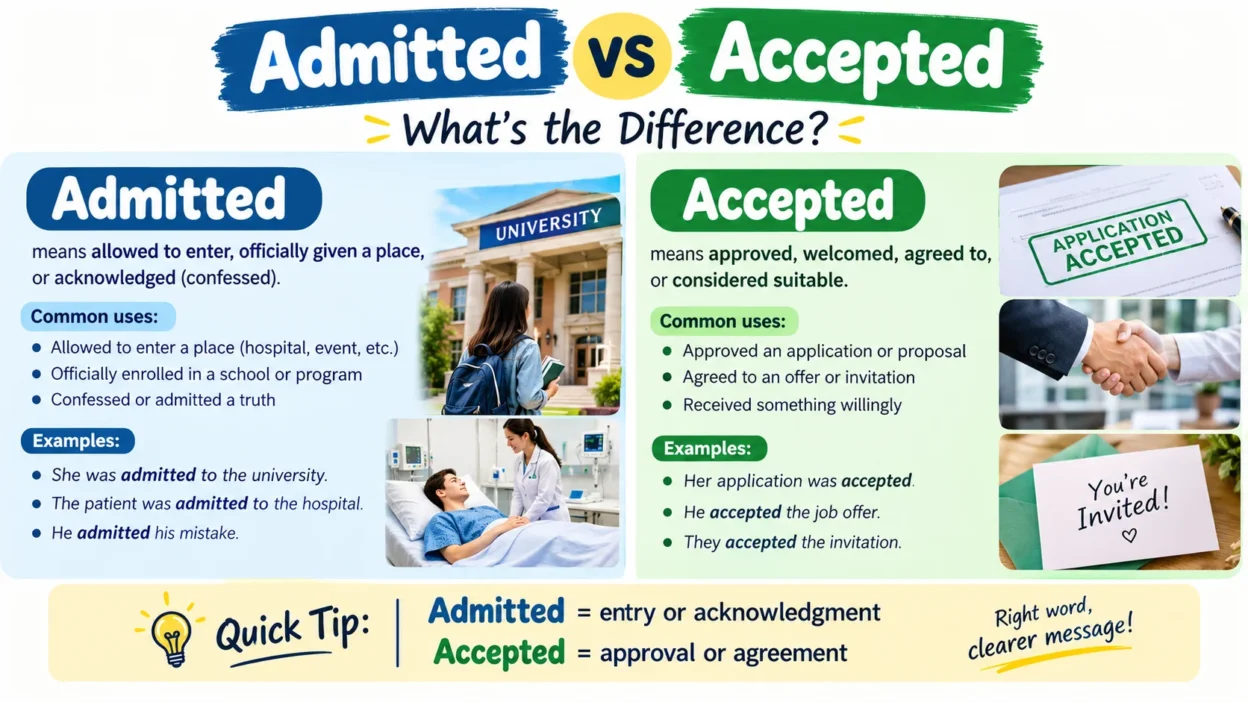
When learning English, “admitted” and “accepted” can seem interchangeable because both can describe situations where someone or something is allowed into a place, group, institution, or situation. However, they are not always used in the same way. The correct choice depends on what you want to express.
The main difference is that accepted usually means something was approved, welcomed, agreed to, or considered suitable, while admitted often means someone was allowed to enter or officially became a member of an institution. “Admitted” can also mean that someone confessed or acknowledged something as true. Understanding these different meanings will help you choose the right word in school, work, formal writing, and everyday conversations.
Quick Answer
Accepted means approved, welcomed, or agreed to, while admitted often means allowed to enter or officially enrolled in a place such as a school or hospital. “Admitted” can also mean confessed or acknowledged something. Therefore, a student can be accepted by a university and admitted to a program.
Why Do People Confuse “Admitted” and “Accepted”?
People confuse these words because both can describe a positive decision about a person or application.
For example:
- She was accepted by the university.
- She was admitted to the university.
In some contexts, both sentences can communicate that the university approved her application. However, their focus can be slightly different.
Accepted emphasizes approval or agreement.
Admitted emphasizes permission to enter or official entry into an institution, group, or place.
There is another important difference: admitted has a meaning that accepted does not. It can mean confessed or acknowledged something, as in:
He admitted that he had made a mistake.
You cannot normally replace “admitted” with “accepted” in this sentence.
What Does “Admitted” Mean?
Admitted is the past tense and past participle of admit.
It commonly means:
- Allowed to enter a place
- Officially accepted into an institution or program
- Taken into a hospital
- Confessed or acknowledged something
Examples
- She was admitted to the university.
- The patient was admitted to the hospital.
- Children under five are not admitted without an adult.
- He admitted that he was wrong.
The meaning depends strongly on the context.
“Admitted” in Education
In academic contexts, “admitted” often describes someone who has officially been given a place in a school, college, or university.
Maya was admitted to Harvard.
This means the institution officially allowed Maya to enter or enroll.
What Does “Accepted” Mean?
Accepted is the past tense and past participle of accept.
It generally means:
- Approved
- Agreed to
- Received willingly
- Considered suitable
- Welcomed or recognized as part of something
Examples
- The university accepted her application.
- He accepted the job offer.
- She accepted the invitation.
- The store accepted my payment.
- His explanation was accepted by the committee.
“Accepted” has a much broader range of uses than “admitted.”
Admitted vs Accepted: Comparison Table
| Point | Admitted | Accepted |
|---|---|---|
| Basic meaning | Allowed to enter or officially taken in | Approved, welcomed, or agreed to |
| Common with universities | Yes | Yes |
| Common with hospitals | Yes | Usually no |
| Can mean “confessed” | Yes | No |
| Can describe accepting an offer | No | Yes |
| Can describe receiving something willingly | No | Yes |
| Example | She was admitted to the program. | She was accepted into the program. |
| Main idea | Entry or acknowledgment | Approval or agreement |
When Should You Use “Admitted” and “Accepted”?
Use “Admitted” for Entry
Use admitted when someone is allowed to enter a place, institution, or program.
- He was admitted to the university.
- She was admitted to the hospital.
- Only members are admitted to the club.
- The student was admitted into the program.
Use “Accepted” for Approval
Use accepted when something or someone is approved, welcomed, or considered suitable.
- My application was accepted.
- She accepted the invitation.
- The company accepted his proposal.
- They accepted the terms.
Use “Admitted” for Confession
Use admitted when someone acknowledges that something is true, especially a mistake or wrongdoing.
- He admitted his mistake.
- She admitted that she was nervous.
- They admitted that they had forgotten the deadline.
In these cases, accepted would change the meaning or sound incorrect.
10+ Examples of Admitted vs Accepted
1. University Admission
She was admitted to the university.
The university officially gave her a place.
She was accepted by the university.
The university approved her application.
2. Hospital
The patient was admitted to the hospital.
This means the patient was officially taken into the hospital for treatment.
“Accepted” is not normally used here with the same meaning.
3. Job Offer
He accepted the job offer.
He agreed to take the job.
“Admitted the job offer” is incorrect.
4. Confession
He admitted that he was wrong.
He acknowledged that he was wrong.
“Accepted that he was wrong” could have a different meaning and does not normally replace “admitted.”
5. Application
Her application was accepted.
The application was approved or received favorably.
6. College Program
She was admitted to the nursing program.
She was officially given entry into the program.
7. Invitation
They accepted our invitation.
They agreed to attend or participate.
8. Museum or Event
Visitors are admitted free of charge.
Visitors are allowed to enter without paying.
9. Proposal
The committee accepted his proposal.
The committee approved or agreed to his proposal.
10. Mistake
Maria admitted her mistake.
Maria acknowledged that she had made a mistake.
11. Club Membership
He was accepted as a member of the club.
The club approved his membership.
He was admitted to the club.
This emphasizes being allowed into the organization.
12. School Application
The school accepted her application.
The school approved the application.
The student was admitted to the school.
The focus is on the student’s official entry.
Common Mistakes
Mistake 1: Using “Accepted” for Hospital Entry
Incorrect or unnatural:
The patient was accepted to the hospital.
Better:
The patient was admitted to the hospital.
“Admitted” is the standard word for officially taking a patient into a hospital.
Mistake 2: Using “Admitted” for a Job Offer
Incorrect:
She admitted the job offer.
Correct:
She accepted the job offer.
A person accepts an offer; they do not normally “admit” it.
Mistake 3: Confusing “Admitted” With “Confessed”
Remember that admit can mean to acknowledge something.
He admitted that he lied.
This has nothing to do with entering a place.
Mistake 4: Assuming the Words Are Always Interchangeable
Although both can occur in university contexts, they are not synonyms in every situation.
She accepted the invitation. ✓
She admitted the invitation. ✗
He admitted his mistake. ✓
He accepted his mistake. △
The second sentence can sometimes be interpreted, but it does not normally mean “confessed.”
What Is an Easy Memory Trick?
Think of ADMITTED = ENTRY or CONFESSION.
Think of ACCEPTED = APPROVAL or AGREEMENT.
A simple memory formula is:
Admitted → allowed in / acknowledged
Accepted → approved / agreed
For example:
- Admitted to a hospital → allowed into the hospital
- Admitted a mistake → acknowledged the mistake
- Accepted an offer → agreed to it
- Accepted an application → approved it
American vs British English
The basic distinction between admitted and accepted is the same in American and British English.
Both varieties commonly use:
- admitted to hospital/university
- accepted into a university/program
- accepted an offer
- admitted a mistake
There can be differences in institutional terminology and style. For example, British English commonly uses “admitted to hospital” without an article in some contexts, while American English more often says “admitted to the hospital.”
The core meanings, however, remain the same.
Similar Words
Several related words can help you understand the difference.
Allowed
Allowed means given permission.
Students are allowed to enter the building.
Approved
Approved means officially accepted or authorized.
The committee approved the proposal.
Enrolled
Enrolled means officially registered as a student or participant.
She enrolled in the course after being admitted.
Confessed
Confessed means openly acknowledged something, often something wrong.
He confessed that he had lied.
Welcomed
Welcomed means received gladly or warmly.
The new employee was welcomed by the team.
Rejected
Rejected is the opposite of accepted in many contexts.
Her application was rejected.
However, rejected is not always the direct opposite of admitted, because “admitted” can mean entering an institution or confessing something.
Final Verdict: Admitted vs Accepted
The easiest way to distinguish the two words is to focus on the action involved.
Admitted usually focuses on entry or acknowledgment. Someone may be admitted to a university, hospital, organization, or event. Someone can also admit a fact, mistake, or wrongdoing.
Accepted usually focuses on approval, agreement, or willingness to receive something. You can accept an application, invitation, offer, proposal, apology, gift, or decision.
In university contexts, both words may appear, but the emphasis can differ: an application can be accepted, while a student can be admitted to a program.
Frequently Asked Questions
Is “admitted” the same as “accepted”?
Not always. Admitted often means allowed to enter or officially given a place, while accepted generally means approved, welcomed, or agreed to.
Is it correct to say “accepted into college”?
Yes. Accepted into college is natural and common, especially when talking about an application being approved.
Is “admitted to college” correct?
Yes. Admitted to college means the student has officially been given entry or a place at the college.
Should I say “admitted to the hospital” or “accepted to the hospital”?
Use “admitted to the hospital.” It means the patient was officially taken into the hospital for treatment.
Do you accept or admit a job offer?
You accept a job offer.
She accepted the job offer.
Do you accept or admit a mistake?
You normally admit a mistake.
He admitted his mistake.
You can also acknowledge a mistake, but “accept a mistake” does not normally mean confessing that you made it.
Can “accepted” and “admitted” both be used for university applications?
Yes, but they emphasize different things. A university can accept an application, while a student can be admitted to a university or program.
Remember This
Admitted = entry or acknowledgment.
Accepted = approval or agreement.
- Admitted to a university
- Admitted to a hospital
- Admitted a mistake
- Accepted an offer
- Accepted an invitation
- Accepted an application
- Accepted a proposal
If you remember “admitted = allowed in or confessed” and “accepted = approved or agreed,” you can usually choose the correct word confidently.
Conclusion
Although admitted and accepted sometimes overlap, they are not interchangeable in every sentence. “Admitted” commonly refers to entering an institution or acknowledging a fact, while “accepted” refers to approval, agreement, or willingness to receive something.
When talking about education, both words can be correct: an application may be accepted, and a student may be admitted to a program. For hospitals, use admitted; for offers and invitations, use accepted. Learning these patterns will make your English clearer and more natural.