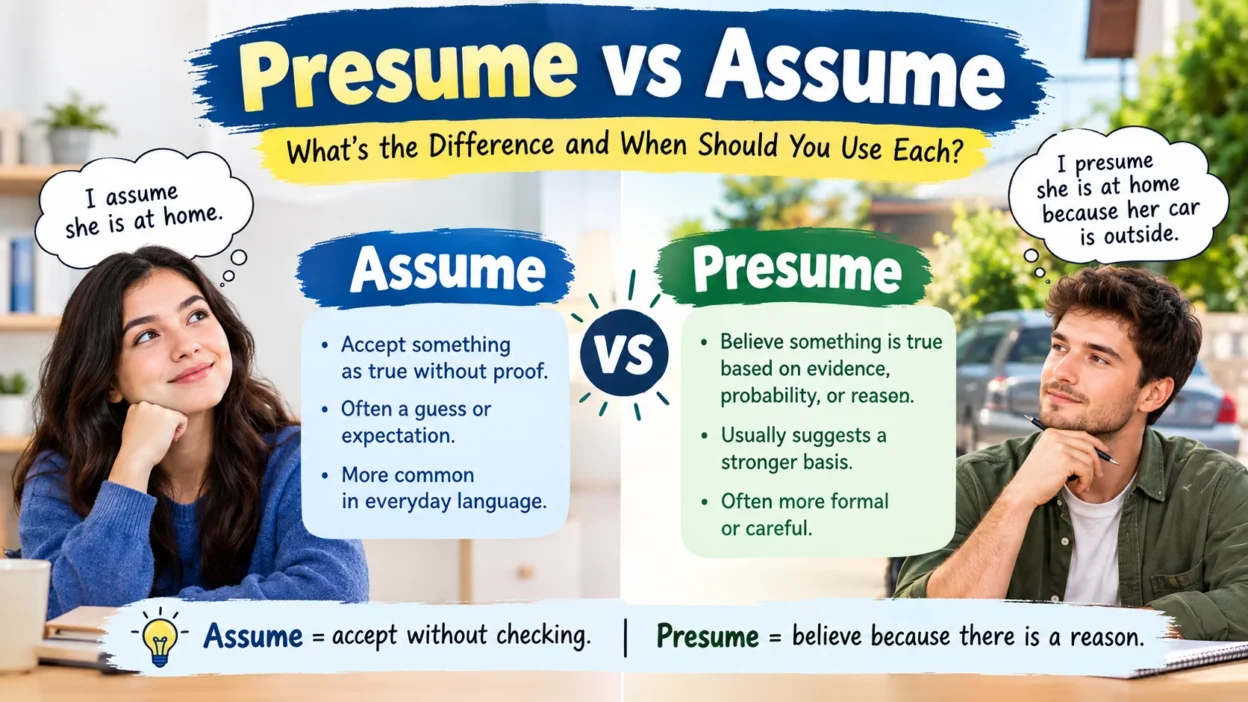
Presume and assume are similar because both involve accepting something as true without complete proof. However, there is an important difference: assume is the more general word, while presume usually suggests that there is a reasonable basis, evidence, or likelihood supporting the belief.
For example, if you assume your friend is at home, you may simply believe it without checking. If you presume your friend is at home because their car is outside, your belief is based on some evidence. In everyday English, the two words can sometimes overlap, but understanding their usual meanings will help you choose the more natural word.
Quick Answer
Assume means to accept something as true without proof, often based on a guess or expectation. Presume also means to believe something without complete proof, but it usually suggests a reasonable basis, probability, or available evidence. In most everyday situations, assume is more common.
Why Do People Confuse Presume and Assume?
People often confuse presume vs assume because both words describe forming a belief before knowing all the facts. In many situations, replacing one with the other does not dramatically change the basic meaning.
The difference is mainly about how strong the basis for the belief is. An assumption may be based on little information, while a presumption often comes from evidence, experience, probability, or what normally happens.
For example:
- I assumed the store was open.
You believed it was open, perhaps without checking. - I presumed the store was open because the lights were on.
You had a reason to believe it was open.
The distinction is not always strict in everyday conversation, but it can make your writing more precise.
What Does Assume Mean?
Assume means to accept something as true, likely, or certain without having complete proof.
People often use assume when they make a guess, expectation, or belief based on incomplete information.
Examples of Assume
- I assumed you were busy.
- Don’t assume that everyone agrees with you.
- She assumed the meeting would start at ten.
- We assumed the package would arrive today.
- He assumed that the answer was correct.
- They assumed the restaurant was closed.
- I assumed you already knew about it.
Assume is very common in everyday speech and writing. It can also mean to take on a role, responsibility, or position.
For example:
- She assumed responsibility for the mistake.
- The new manager assumed control of the department.
This meaning is different from the belief-related meaning in presume vs assume, but it is another important use of the word.
What Does Presume Mean?
Presume means to suppose that something is true based on probability, evidence, experience, or what seems reasonable.
A presumption is not complete knowledge. You can still be wrong, but you have some reason for your belief.
Examples of Presume
- I presume you received my email.
- We presumed the event would continue despite the rain.
- She presumed he was at work because his office light was on.
- The police cannot presume someone is guilty without sufficient evidence.
- I presume that you have already spoken to the manager.
- They presumed the train would arrive on time.
In polite conversation, I presume can also sound slightly formal:
- I presume you’re ready to begin?
- I presume this seat is taken?
In these cases, the speaker is making a reasonable expectation based on the situation.
Presume vs Assume: Comparison Table
| Feature | Assume | Presume |
|---|---|---|
| Basic meaning | Accept something as true without proof | Believe something is true without complete proof |
| Basis for belief | May be a guess, expectation, or limited information | Usually based on probability, evidence, or reasonable expectation |
| Commonness | Very common in everyday English | Less common and often more formal |
| Level of certainty | Can range from weak to strong | Often suggests a stronger or more reasonable belief |
| Example | I assumed she was at home. | I presumed she was at home because her car was outside. |
| Tone | Neutral and everyday | Slightly formal in many contexts |
The difference is about tendency rather than an absolute rule. Context can affect which word sounds most natural.
When Should You Use Assume?
Use assume when you are accepting an idea as true without knowing for certain.
It is especially useful for:
Everyday guesses
- I assumed you were sleeping.
Expectations
- We assumed the weather would be warm.
Unchecked beliefs
- Don’t assume that he knows the answer.
General statements
- People often assume that expensive products are better.
Use assume when the main point is simply that someone believed something without having confirmed it.
When Should You Use Presume?
Use presume when the belief seems reasonable because of available information, probability, experience, or circumstances.
It is especially useful when:
There is some supporting evidence
- I presumed the office was closed because all the lights were off.
Something is normally expected
- We presumed the meeting would follow the usual schedule.
You want a slightly formal tone
- I presume you have reviewed the document.
You are discussing a reasonable inference
- It would be unfair to presume that she acted intentionally.
A useful question is: Do I have a reason for believing this, even if I do not have complete proof? If yes, presume may be the better choice.
12 Examples of Presume vs Assume
Here are practical examples showing how the two words can differ.
- I assumed he was at work.
I believed it without confirming. - I presumed he was at work because his car was gone.
I had a reason to believe it. - Don’t assume that the test will be easy.
Don’t accept that idea without knowing. - We presumed the road was closed after seeing the warning signs.
The signs provided a basis for the belief. - She assumed that everyone understood the instructions.
She believed it without checking. - The manager presumed that the report was finished because it was marked complete.
There was supporting information. - I assumed you didn’t want to come.
I formed that belief without confirmation. - I presumed you didn’t want to come because you declined the invitation.
There was a clear reason for the belief. - Never assume that silence means agreement.
Silence does not automatically prove agreement. - The court should not presume guilt without evidence.
A belief should not be treated as true without a proper basis. - We assumed the shop opened at nine.
We believed that was the opening time. - I presume the shop is open because customers are going inside.
The visible situation provides a reason for the belief.
Common Mistakes With Presume and Assume
Using presume for every ordinary guess
Although presume is correct in many situations, assume is usually more natural in casual conversation.
Less natural in everyday speech:
- I presume you forgot your keys.
More natural:
- I assume you forgot your keys.
Thinking presume always means “stronger certainty”
Presume does not mean you know something is true. You are still making a judgment without complete confirmation.
- I presume she is at home.
This does not mean the speaker knows she is at home.
Believing assume always means a completely random guess
An assumption can also be based on experience or information. The key idea is that the belief has not been fully confirmed.
Forgetting the difference in tone
Assume is generally more common and conversational. Presume can sound more formal, careful, or slightly old-fashioned depending on the context.
A Simple Memory Trick
Remember this:
Assume = accept without checking.
Presume = believe because there is a reason.
Think of presume as a belief that has some support behind it, even though it is not proven.
For example:
- Assume: “I think the bus is late.”
- Presume: “I think the bus is late because it hasn’t arrived yet.”
This is a simple learning trick, not a strict rule for every situation, but it can help you choose between the two words.
Presume vs Assume in American and British English
Both presume and assume are used in American and British English, and their basic meanings are similar on both sides of the Atlantic.
However, presume may sound more formal or somewhat more reserved than assume, especially in everyday conversation. In many casual situations, speakers in both varieties are more likely to use assume.
For example, these sentences are natural in both American and British English:
- I assume you know what happened.
- I presume you know what happened.
The second sentence may sound more formal or polite depending on the speaker and situation.
Similar Words to Presume and Assume
Several English words are related to presume and assume, but each has its own meaning.
Suppose
Suppose means to think or believe that something may be true.
- I suppose he is busy.
It often sounds less formal than presume.
Guess
Guess means to give an answer or form a belief with limited information.
- I’m guessing the answer is twenty.
A guess may have little evidence behind it.
Believe
Believe means to think something is true.
- I believe she is telling the truth.
Unlike assume, believe does not necessarily suggest a lack of proof.
Infer
Infer means to reach a conclusion based on evidence and reasoning.
- From his expression, I inferred that something was wrong.
This often involves a more deliberate process of reasoning.
Expect
Expect means to believe that something will probably happen.
- We expect the train to arrive soon.
It usually focuses on future events or likely outcomes.
Final Verdict: Presume or Assume?
The simplest answer is this:
- Use assume for a general belief or expectation that has not been confirmed.
- Use presume when the belief appears reasonable because of evidence, probability, experience, or circumstances.
If you are unsure which word to choose in everyday conversation, assume is usually the safer and more natural choice.
Choose presume when you want to emphasize that your belief is based on a reasonable foundation or when a slightly more formal tone fits the situation.
Frequently Asked Questions
Is presume the same as assume?
Not exactly. Both mean accepting something as true without complete proof, but presume often suggests a reasonable basis or probability, while assume is broader and more common.
Which is stronger, presume or assume?
Presume often suggests a stronger basis for the belief because it may involve evidence or probability. However, the difference depends on context and is not always absolute.
Can presume and assume be used interchangeably?
Sometimes, yes. In many sentences, the basic meaning remains similar. However, assume is usually more common, while presume can suggest a more reasonable inference or a more formal tone.
Is “I presume” polite?
Yes. I presume can sound polite and formal, especially when asking about something you reasonably expect to be true.
For example:
- I presume you have a reservation?
Is “I assume” rude?
Not usually. However, it can sound careless if it suggests that you made a judgment without checking the facts.
For example:
- I assumed you knew.
Depending on the situation, this may sound like blame or criticism.
What is the noun form of assume and presume?
The noun form of assume is assumption. The noun form of presume is presumption.
- That was an incorrect assumption.
- His presumption was based on the available evidence.
What is the difference between presumption and assumption?
An assumption is something accepted as true without proof. A presumption is also accepted without complete proof but often has a stronger basis in probability, evidence, or accepted circumstances.
Remember This
If you remember only one thing about presume vs assume, remember this:
Assume is the general word for accepting something as true without confirmation. Presume usually suggests that you have a reasonable basis for believing it.
In everyday English, assume is more common. Use presume when you want to emphasize a reasonable expectation, inference, or slightly more formal way of expressing your belief.
Conclusion
Understanding the difference between presume and assume can make your English clearer and more precise. Both words involve believing something without complete proof, but assume is broader and more common, while presume often suggests a belief supported by circumstances or probability.
When choosing between them, think about why you believe something. If you are simply accepting it as true without checking, assume is usually the natural choice. If your belief is based on reasonable evidence or expectation, presume may be a better fit. With practice and real examples, choosing between the two will become much easier.