
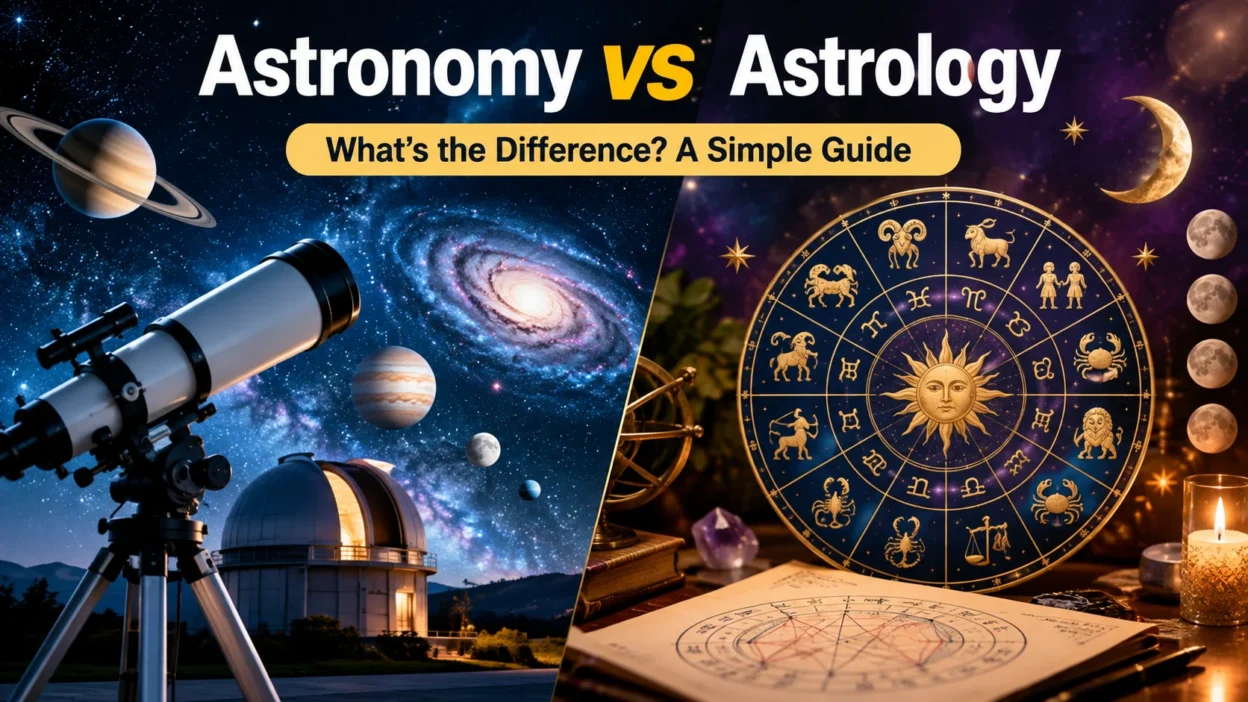
Astronomy and astrology are often confused because both words are connected with the stars, planets, and other objects in the sky. They even look and sound similar, which can make the difference difficult to remember. However, they refer to very different fields. Astronomy is a scientific discipline that studies objects and phenomena beyond Earth, while astrology is a belief system that interprets the positions and movements of celestial bodies as having an influence on human lives and events.
Understanding astronomy vs astrology is useful for students, English learners, writers, and anyone who wants to use these terms correctly. The key difference is simple: astronomy studies the universe through scientific observation and evidence; astrology uses celestial positions to make interpretations about people and earthly events. Once you understand this basic distinction, it becomes much easier to choose the right word in everyday writing and conversation.
Quick Answer
Astronomy is the scientific study of stars, planets, galaxies, space, and other objects and phenomena beyond Earth. Astrology is a belief system that connects the positions of celestial bodies with human personality, relationships, and events. Astronomy is based on scientific evidence, while astrology is not considered a science.
Why Do People Confuse Astronomy and Astrology?
People often confuse these words for several reasons.
First, both terms come from ancient Greek words related to stars or celestial objects. Their spellings are also very similar, with both beginning with astro-.
Second, both subjects traditionally involve looking at objects in the night sky. Someone unfamiliar with the terms might therefore assume that astronomy and astrology are simply two names for the same subject.
The difference becomes clearer when we consider their purposes:
- Astronomy asks scientific questions about the universe.
- Astrology interprets celestial positions in relation to human life.
- Astronomers use observations, mathematics, physics, and scientific methods.
- Astrologers create and interpret birth charts, zodiac signs, and planetary placements.
So, although the words are related historically and linguistically, their modern meanings are quite different.
First Word: Astronomy
Astronomy is the scientific study of the universe beyond Earth’s atmosphere.
It includes the study of:
- Stars
- Planets
- Moons
- Galaxies
- Asteroids
- Comets
- Black holes
- Nebulae
- The Sun
- Other celestial phenomena
Astronomers use telescopes, spacecraft, mathematical models, physics, and other scientific methods to understand how the universe works.
For example:
She studied astronomy at university and became interested in galaxies.
Here, astronomy refers to a scientific field.
Another example is:
Astronomy helps us understand how planets form and move through space.
The word is appropriate when discussing scientific research or the physical universe.
What Does an Astronomer Do?
An astronomer is a scientist who studies celestial objects and phenomena.
Astronomers may research topics such as:
- The formation of stars
- The evolution of galaxies
- Planetary systems
- Black holes
- Cosmic radiation
- The origin and development of the universe
The related adjective is astronomical, although this word can also mean extremely large or impressive.
Second Word: Astrology
Astrology is a system of beliefs and practices that interprets the positions and movements of celestial bodies in relation to human personality, relationships, or events.
Astrology commonly uses:
- Zodiac signs
- Birth dates
- Birth charts
- Planetary positions
- Houses
- Astrological aspects
For example:
She enjoys reading about astrology and her zodiac sign.
Another example:
Astrology often examines the positions of planets at the time of a person’s birth.
The word astrology should not be used when you mean the scientific study of space.
What Does an Astrologer Do?
An astrologer is a person who practices or interprets astrology.
An astrologer may examine a person’s birth chart and discuss topics such as personality, relationships, career, or possible future events according to an astrological system.
For example:
The astrologer explained the meaning of the planets in his birth chart.
Astronomy vs Astrology: Comparison Table
| Feature | Astronomy | Astrology |
|---|---|---|
| Basic meaning | Scientific study of the universe | Interpretation of celestial positions in relation to human life |
| Field | Science | Belief system/practice |
| Studies | Stars, planets, galaxies, space, and cosmic phenomena | Zodiac signs, planets, houses, and birth charts |
| Practiced by | Astronomers | Astrologers |
| Main methods | Observation, mathematics, physics, scientific testing | Interpretation of charts and traditional astrological systems |
| Evidence | Based on scientific evidence and testable explanations | Not supported as a science by scientific evidence |
| Example | Studying how stars are formed | Interpreting a person’s zodiac sign |
| Related word | Astronomical | Astrological |
When Should You Use Astronomy or Astrology?
Use astronomy when you are talking about the scientific study of space and celestial objects.
Use astronomy for:
- Scientific research about planets
- Studying stars and galaxies
- Space science
- Telescopic observations
- The physics of celestial objects
- The history and development of the universe
Example:
My brother is taking an astronomy course.
Use astrology when you are discussing zodiac signs, birth charts, horoscopes, or beliefs about how celestial positions relate to human experiences.
Use astrology for:
- Zodiac signs
- Horoscopes
- Birth charts
- Astrological readings
- Traditional interpretations of planets
- Astrological compatibility
Example:
She reads astrology books to learn more about zodiac signs.
10+ Examples of Astronomy and Astrology
The easiest way to understand the difference is to see the words in context.
Examples with Astronomy
- Astronomy is the scientific study of objects in space.
- He became interested in astronomy after observing the Moon through a telescope.
- The university offers an introductory astronomy course.
- Astronomy can help us understand the formation of stars.
- She bought a telescope because of her interest in astronomy.
- The astronomy club meets every Friday evening.
- Astronomers study distant galaxies using powerful telescopes.
- Modern astronomy relies heavily on physics and mathematics.
- The book provides an introduction to astronomy for beginners.
- Astronomy has expanded our understanding of the solar system.
- He wants to pursue a career in astronomy.
Examples with Astrology
- She enjoys learning about astrology.
- His interest in astrology began with zodiac signs.
- The astrologer created a birth chart for her.
- Astrology often uses the positions of planets at birth.
- Many people read their horoscope for entertainment.
- The magazine has a section about astrology.
- They discussed astrological compatibility.
- She studies different traditions of astrology.
- His astrology reading focused on relationships and career.
- The website publishes daily astrology readings.
- Astrology and astronomy have different purposes today.
Common Mistakes
Mistake 1: Treating Astronomy and Astrology as Synonyms
They are not synonyms.
Incorrect:
Astronomy is the study of horoscopes.
Correct:
Astrology is associated with horoscopes.
Mistake 2: Calling Astrology a Branch of Astronomy
Astrology is not a branch of modern astronomy.
Correct:
Astronomy is a scientific discipline, while astrology is a system of beliefs and practices.
Mistake 3: Calling an Astrologer an Astronomer
These words describe different roles.
- Astronomer = scientist who studies the universe
- Astrologer = person who practices or interprets astrology
Mistake 4: Saying “Astronomy Sign”
The usual term is zodiac sign, not “astronomy sign.”
Correct:
What is your zodiac sign?
Mistake 5: Using “Astrology” for Space Science
If you are talking about black holes, galaxies, planets, or stellar evolution, astronomy is generally the appropriate word.
A Simple Memory Trick
A useful way to remember the difference is:
Astronomy = science of space.
Astrology = signs and interpretations.
You can also remember the people:
Astronomer → studies the universe scientifically.
Astrologer → interprets astrology.
Another helpful association is:
Astronomy uses telescopes and scientific evidence. Astrology uses zodiac signs and birth charts.
If you remember science = astronomy, you will usually know which word to choose.
American vs British English
There is no major difference between American and British English in the meanings of astronomy and astrology.
Both varieties of English use:
- astronomy for the scientific study of space
- astrology for the practice or belief system involving celestial positions and human affairs
- astronomer for a scientist who studies astronomy
- astrologer for someone who practices astrology
For example, an American writer might say:
She is interested in astronomy.
A British writer would use the same sentence.
Likewise:
He reads about astrology and zodiac signs.
The spelling and meaning remain essentially the same in both varieties.
Similar Words
Several related words can make this topic even more confusing.
Astronomical
Astronomical is related to astronomy.
Example:
The telescope made an important astronomical discovery.
However, astronomical can also mean extremely large.
The project had an astronomical cost.
Astrological
Astrological is the adjective related to astrology.
Example:
She consulted an astrological chart.
Astronomer
An astronomer is a scientist who studies celestial objects and phenomena.
Example:
The astronomer observed a distant galaxy.
Astrologer
An astrologer is someone who practices or interprets astrology.
Example:
The astrologer interpreted the birth chart.
Astronomy
The scientific field concerned with the universe and celestial objects.
Astrology
A system of beliefs and practices involving interpretations of celestial positions.
Astrophysics
Astrophysics is a branch of astronomy that applies physics to understand astronomical objects and phenomena.
For example, astrophysicists may study how stars produce energy or how black holes behave.
Final Verdict: Astronomy vs Astrology
The difference between astronomy and astrology is straightforward once you focus on their purposes.
Astronomy is a science. It investigates stars, planets, galaxies, black holes, and other phenomena in the universe using observation, mathematics, physics, and evidence.
Astrology is a belief system and practice. It interprets celestial positions, such as those of planets and zodiac signs, in relation to human personality, relationships, or events. It is not regarded as a scientific discipline.
So, if you are talking about space science, choose astronomy. If you are talking about zodiac signs, horoscopes, or birth charts, choose astrology.
Frequently Asked Questions
Is astronomy the same as astrology?
No. Astronomy is the scientific study of the universe and celestial objects. Astrology is a belief system that interprets celestial positions in relation to human life and events.
Which is a science, astronomy or astrology?
Astronomy is a science. It uses scientific observation, mathematics, physics, and evidence to study the universe. Astrology is not considered a science.
What is the difference between an astronomer and an astrologer?
An astronomer is a scientist who studies space and celestial phenomena. An astrologer practices or interprets astrology, often using zodiac signs and birth charts.
Does astronomy study zodiac signs?
Astronomy can study the actual stars and celestial objects associated with constellations, but it does not use zodiac signs to predict personality or future events. Those interpretations belong to astrology.
Is astrology based on astronomy?
Astrology uses observations and concepts involving celestial bodies, but its interpretations are not scientifically supported. Modern astronomy and astrology have different methods and purposes.
Why do astronomy and astrology sound similar?
Both words have historical roots connected with stars or celestial objects, and both contain the element astro-. Their modern meanings, however, are very different.
Can someone study both astronomy and astrology?
A person can certainly learn about both subjects. However, studying astronomy as a science and studying astrology as a belief system involve different approaches, methods, and assumptions.
What is an easy way to remember astronomy vs astrology?
Remember astronomy = science and space, while astrology = zodiac signs and interpretations.
Remember This
- Astronomy = scientific study of the universe.
- Astrology = belief system involving celestial positions and human life.
- Astronomer = scientist who studies astronomy.
- Astrologer = person who practices astrology.
- Astronomical = related to astronomy or, informally, extremely large.
- Astrological = related to astrology.
- Astronomy is a science; astrology is not considered a science.
The shortest memory trick is:
Astronomy studies the stars; astrology interprets the stars.
Conclusion
Although astronomy and astrology look and sound alike, they have distinct meanings. Astronomy is a scientific field concerned with understanding the physical universe, including stars, planets, galaxies, and other celestial phenomena. Astrology, by contrast, involves interpreting celestial positions through systems such as zodiac signs and birth charts.
When choosing between the two words, think about the context. If the topic involves scientific research, space, planets, galaxies, or the physical behavior of celestial objects, use astronomy. If the topic involves horoscopes, zodiac signs, birth charts, or astrological interpretations, use astrology. Remembering this simple distinction will help you use both words accurately and confidently.