
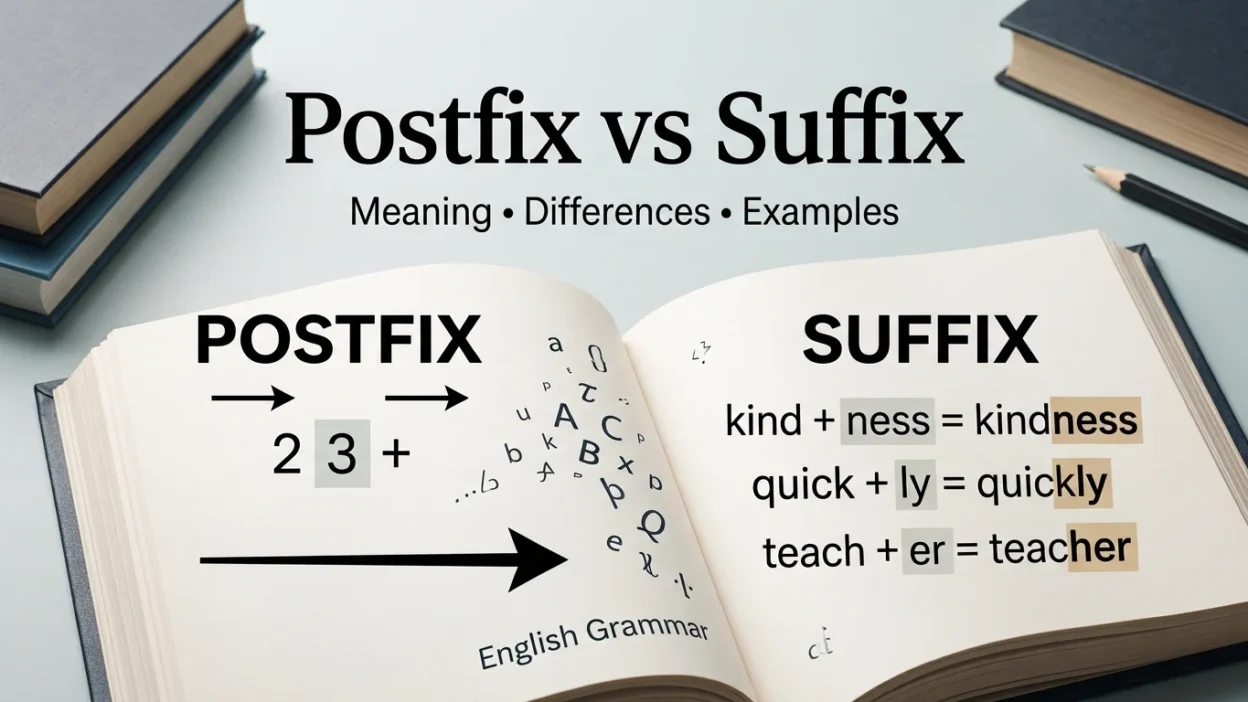
When learning English grammar and word formation, you may come across the terms postfix and suffix. They can seem similar because both relate to something placed after another element. However, they do not always mean the same thing, and using the wrong term can create confusion. Understanding the difference is especially useful for students, ESL learners, writers, and anyone studying morphology.
The key point is that suffix is the standard linguistic term for a letter or group of letters added to the end of a word or word base to create a new word or grammatical form. Postfix has a broader meaning and is not normally used as a synonym for suffix in standard English grammar. Its meaning depends on the field or context in which it appears.
Quick Answer
A suffix is a letter or group of letters added to the end of a word or root, such as -ness in kindness or -ed in walked. Postfix is a broader term meaning something placed after something else and is mainly used in areas such as computing and formal language studies.
Why Do People Confuse It?
People often confuse postfix and suffix because both words contain the idea of something coming after something else.
The prefix post- means “after,” while subfix or suffix terminology refers to an element attached to the end of a linguistic base. In everyday explanations, someone might therefore assume that “postfix” is simply another word for “suffix.”
There is some overlap in the general idea, but the terms have different typical uses.
In English word formation, suffix is the established term. For example:
- happy → happiness
- teach → teacher
- quick → quickly
- walk → walked
In these examples, -ness, -er, -ly, and -ed are suffixes.
Postfix, on the other hand, is more commonly encountered outside ordinary English grammar. In computer science, for example, “postfix notation” describes a way of writing expressions in which an operator comes after its operands.
First Word: Postfix
Postfix means something that comes after another element.
The word can be understood literally as:
- post = after
- fix = something attached or placed
In some technical contexts, postfix refers to an element placed after another element. One well-known example is postfix notation, also called Reverse Polish Notation, where an operator follows the values it operates on.
For example, the usual mathematical expression:
2 + 3
can be represented in postfix notation as:
2 3 +
Here, the + operator comes after the two numbers.
In general English grammar, however, postfix is not normally the preferred term for an ending such as -ing, -ed, or -ness.
Second Word: Suffix
A suffix is a letter or group of letters added to the end of a word, root, or base.
Suffixes can change a word’s meaning, grammatical function, or part of speech.
Examples include:
- teach + -er = teacher
- kind + -ness = kindness
- quick + -ly = quickly
- hope + -ful = hopeful
- walk + -ed = walked
- read + -ing = reading
There are two especially useful categories of English suffixes.
Derivational Suffixes
Derivational suffixes often create a new word or change its grammatical category.
Examples:
- happy → happiness
- beauty → beautiful
- teach → teacher
- slow → slowly
Inflectional Suffixes
Inflectional suffixes generally show grammatical information without creating a completely new dictionary word.
Examples include:
- cat → cats
- walk → walked
- play → playing
- tall → taller
The important point is that suffix is the normal linguistic term for these word endings.
Postfix vs Suffix: Comparison Table
| Feature | Postfix | Suffix |
|---|---|---|
| Basic meaning | Something placed after another element | An element added to the end of a word or base |
| Common field | Computing, formal systems, technical contexts | Linguistics and English grammar |
| Common in English grammar? | Not usually | Yes |
| Example | 2 3 + in postfix notation | kind + -ness = kindness |
| Can affect word meaning? | Depends on context | Yes |
| Can show grammar? | Not normally in English | Yes, such as -ed or -s |
| Best term for word endings? | No | Yes |
When Should You Use Each?
Use suffix when you are talking about English word formation or grammar.
For example:
The suffix -ly can form an adverb from an adjective.
The word careless contains the suffix -less.
The suffix -ed can indicate past tense in regular verbs.
Use postfix when the context specifically involves something positioned after another element, particularly in a technical or computational system.
For example:
The expression is written in postfix notation.
Choosing the correct term depends on what you are describing. If you are discussing letters attached to the end of English words, suffix is almost always the right choice.
10+ Examples of Suffixes
Here are practical examples showing how suffixes work in English.
1. Kind → Kindness
The suffix -ness changes the adjective kind into the noun kindness.
2. Teach → Teacher
The suffix -er creates a noun referring to a person who teaches.
3. Quick → Quickly
The suffix -ly changes the adjective quick into the adverb quickly.
4. Hope → Hopeful
The suffix -ful means “full of” or “characterized by.”
5. Care → Careless
The suffix -less indicates an absence of something.
6. Walk → Walked
The suffix -ed forms the regular past-tense form walked.
7. Play → Playing
The suffix -ing creates the present participle or gerund form playing, depending on its use.
8. Book → Books
The suffix -s marks the plural form of the noun book.
9. Tall → Taller
The suffix -er can form the comparative adjective taller.
10. Tall → Tallest
The suffix -est forms the superlative adjective tallest.
11. Child → Childhood
The suffix -hood creates the noun childhood.
12. Nation → National
The suffix -al helps form the adjective national.
These examples demonstrate why suffix is the natural term when discussing word endings in English.
Common Mistakes
Mistake 1: Calling Every Word Ending a Postfix
It is usually incorrect to call an English grammatical ending a “postfix.”
Instead of:
“The word has a postfix -ness.”
Use:
“The word has the suffix -ness.”
Mistake 2: Assuming Postfix Is Always a Synonym for Suffix
Although both terms involve something occurring after something else, they are not interchangeable in every context.
Suffix has a specific and established role in linguistics.
Mistake 3: Confusing Suffix With Prefix
A prefix comes before a base or root.
A suffix comes after it.
For example:
- un- + happy = unhappy → prefix
- happy + -ness = happiness → suffix
Mistake 4: Thinking Every Suffix Changes the Word’s Meaning
Some suffixes primarily provide grammatical information.
For example:
walk → walked
The -ed ending gives grammatical information about tense.
Mistake 5: Treating Postfix as a Standard English Grammar Category
In ordinary English grammar lessons, you will generally learn terms such as prefix, suffix, root, stem, and base, rather than postfix.
Memory Trick
A simple way to remember the difference is:
Suffix = English word ending.
Think:
Suffix → Stuck at the end of a word.
For postfix, remember:
Post = after.
So “postfix” describes something positioned after another element, while “suffix” is the specific linguistic term for an element added to the end of a word or base.
American vs British English
There is no major American-versus-British English difference in the basic use of suffix.
American and British English both use suffix when discussing word formation.
For example, both varieties recognize:
- happiness → -ness
- teacher → -er
- quickly → -ly
- walked → -ed
The word postfix also has technical uses in both varieties of English. Its meaning does not generally change simply because the speaker uses American or British English.
Therefore, if you are writing about English grammar in either variety, suffix is the safer and more precise term.
Similar Words
Several related terms can make word formation easier to understand.
Prefix
A prefix is added to the beginning of a word or base.
Example:
unhappy = un- + happy
Suffix
A suffix is added to the end.
Example:
happiness = happy + -ness
Root
A root is the core element of a word that carries its basic meaning.
For example, act appears in words such as action, active, and react.
Stem
A stem is the form to which an inflectional ending can be attached.
For example, in walked, walk can be treated as the stem before the past-tense ending -ed.
Affix
An affix is a general term for a linguistic element attached to a word or base. Prefixes and suffixes are common types of affixes.
Infix
An infix is an element inserted inside a word or base. True infixes are relatively uncommon in standard English compared with prefixes and suffixes.
Final Verdict
Suffix is the correct and standard term when you are talking about letters or groups of letters added to the end of English words or bases.
Postfix is a broader term for something placed after another element and is particularly common in technical contexts such as postfix notation.
So, if your question is “Should I say postfix or suffix when discussing English word endings?”, the answer is simple:
Use “suffix.”
FAQs
Is postfix the same as suffix?
Not exactly. Both involve something coming after another element, but suffix is the standard linguistic term for an element added to the end of a word or base.
Is “-ing” a postfix or a suffix?
-ing is a suffix in English grammar. It is used in forms such as running, reading, and working.
Is “-ed” a suffix?
Yes. -ed is a common English suffix used to form the past tense and past participle of many regular verbs.
What is an example of a suffix?
In happiness, -ness is the suffix. In teacher, -er is the suffix.
What is the difference between a prefix and a suffix?
A prefix comes before a word or base, while a suffix comes after it. For example, un- in unhappy is a prefix, while -ness in happiness is a suffix.
What does postfix mean in computing?
In computing and mathematics, postfix can describe a notation in which an operator appears after its operands. For example, 2 3 + represents 2 + 3 in postfix notation.
Should I use “postfix” in an English grammar assignment?
Usually, no. If you are discussing an ending added to an English word, suffix is the appropriate and widely recognized term.
Remember This
Suffix = an ending added to a word or base.
Postfix = something placed after something else, especially in technical contexts.
For English grammar, remember the simple rule:
Prefix comes before. Suffix comes after.
If you are talking about endings such as -ness, -ly, -er, -ed, -ing, -s, or -est, call them suffixes.
Conclusion
The difference between postfix and suffix becomes much easier once you focus on context. A suffix has a specific linguistic meaning: it is an element attached to the end of a word or base. It can create a new word, change a word’s grammatical category, or provide grammatical information.
Postfix has a broader meaning and is commonly associated with technical systems, particularly postfix notation in computing and mathematics. Therefore, when discussing English word formation, suffix is the accurate and natural choice.