
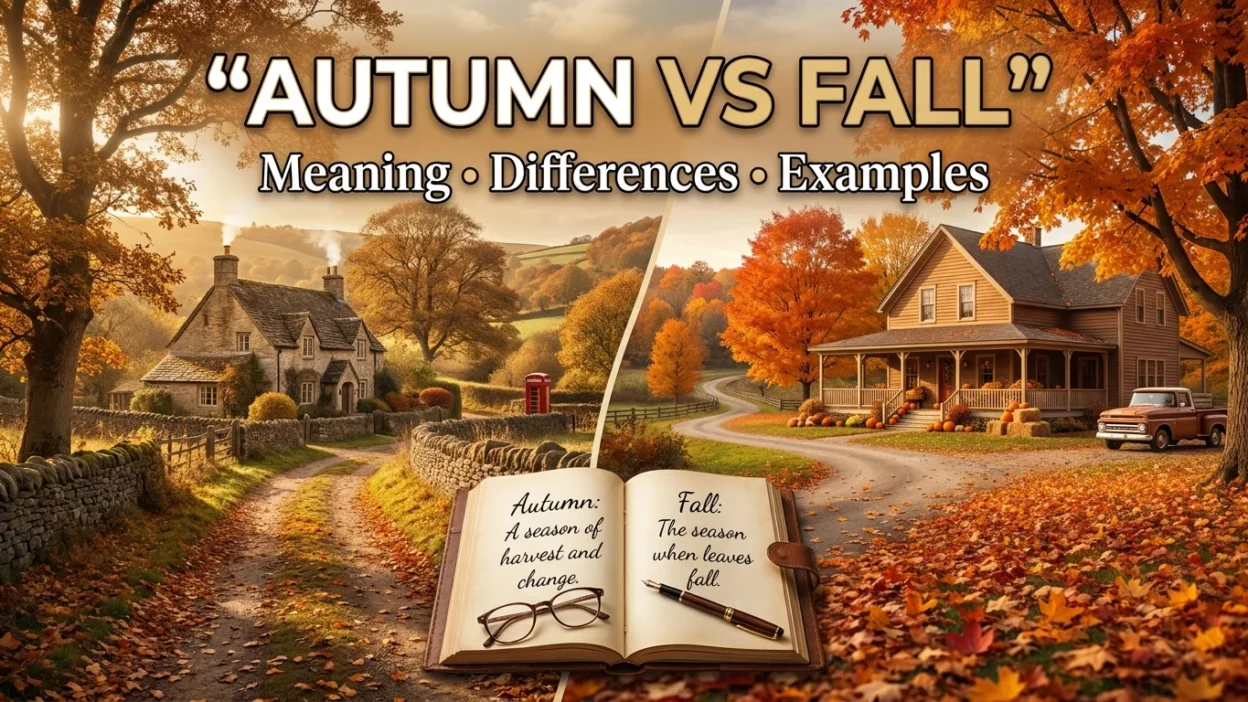
The words autumn and fall both refer to the season between summer and winter. During this time, temperatures begin to drop, leaves change color, and many trees lose their leaves. Although these words look and sound different, they have almost the same meaning. The main difference is where and how people commonly use them.
In American English, fall is the more common everyday term, while autumn is also widely understood and often sounds a little more formal. In British English, autumn is the usual term. Both words are correct, so choosing between them depends mainly on your audience, location, and writing style. if you are learning English, writing a school assignment, or preparing a social media post, understanding this small difference will help you sound more natural. Let’s explore their meanings, origins, examples, and usage so you can confidently decide when to use autumn and when to use fall.
Quick Answer
Autumn and fall mean the same season between summer and winter. Autumn is the usual term in British English and is also common in American English. Fall is especially common in the United States and Canada. Both words are correct, and neither is grammatically better than the other.
Why Do People Confuse Autumn and Fall?
People often confuse these words because they describe the same season and can be used interchangeably in most contexts.
For example:
- We enjoy the cool weather in autumn.
- We enjoy the cool weather in fall.
Both sentences are grammatically correct and express the same general idea.
The confusion comes from differences in regional vocabulary. English speakers in different countries often use different words for the same thing. For instance, Americans commonly say apartment, while British speakers often say flat. Similarly, Americans tend to say fall, while British speakers generally prefer autumn.
The words also have different historical origins, which helps explain why both remain in use today.
What Does Autumn Mean?
Autumn is a noun that refers to the season between summer and winter. It is associated with cooler temperatures, falling leaves, shorter days, and the changing colors of trees.
The word comes through Old French from Latin autumnus. It has been used in English for centuries.
Examples of Autumn in Sentences
- Autumn is my favorite season because the weather is pleasant.
- The trees turn orange and red in autumn.
- We usually visit the countryside during autumn.
- Autumn brings cooler evenings and shorter days.
- Many people enjoy drinking warm tea on autumn mornings.
When Is Autumn?
In the Northern Hemisphere, autumn generally falls between September and November. In the Southern Hemisphere, it generally falls between March and May.
The exact dates depend on if you use meteorological seasons, which follow calendar months, or astronomical seasons, which are based on the equinoxes and solstices.
What Does Fall Mean?
Fall is a noun that refers to the same season as autumn. The word is associated with the falling of leaves from trees during this time of year.
The seasonal meaning developed from the expression fall of the leaf, which was used in English before fall became a common standalone name for the season.
Today, fall is particularly common in everyday American English.
Examples of Fall in Sentences
- Fall is a beautiful time to visit New England.
- The leaves change color in the fall.
- We bought warm jackets for fall.
- Fall weather can be cool in the morning and warm in the afternoon.
- My family enjoys going apple picking every fall.
Does Fall Have Other Meanings?
Yes. Unlike autumn, the word fall has several other meanings.
It can refer to:
- A physical drop: He had a fall while riding his bicycle.
- A decrease: The company reported a fall in sales.
- A decline or defeat: The story describes the fall of an empire.
- The season: We enjoy hiking in the fall.
Context tells the reader which meaning is intended.
Autumn vs Fall: Comparison Table
| Feature | Autumn | Fall |
|---|---|---|
| Meaning | The season between summer and winter | The season between summer and winter |
| Part of speech | Noun | Noun |
| American English | Common | Very common in everyday speech |
| British English | Standard, usual term | Less common for the season |
| Canadian English | Used | Common |
| Formal writing | Widely suitable | Also suitable |
| Other meanings | Few common everyday meanings | Several meanings, including a drop or decline |
| Example | Autumn leaves are beautiful. | Fall leaves are beautiful. |
Key takeaway: The seasonal meanings are the same. The main difference is regional preference, not grammar.
When Should You Use Autumn or Fall?
Both words are correct, but certain situations make one a more natural choice than the other.
1. Use Autumn in British English
If you are writing for a British audience, autumn is generally the natural choice.
Examples:
- The autumn term begins in September.
- We went for an autumn walk in the park.
- Autumn is often rainy in this part of the country.
2. Use Fall in Everyday American English
In the United States, fall is very common in conversation and informal writing.
Examples:
- I love going hiking in the fall.
- We are planning a fall vacation.
- The fall semester starts next month.
3. Use Either Word in General Writing
If your audience includes English speakers from different countries, either word is acceptable.
Examples:
- Autumn is a wonderful season for reading outdoors.
- Fall is a wonderful season for reading outdoors.
Both sentences communicate the same idea.
4. Follow Your Publication’s Style
If you are writing for a newspaper, website, school, or organization, follow its preferred regional variety of English.
For example, a publication aimed at American readers might consistently use fall, while a British publication would usually choose autumn.
5. Choose the Word That Sounds Natural to Your Audience
When speaking to American friends, fall may sound more familiar. When speaking to British friends, autumn may be more natural.
Neither choice is wrong. Consistency and audience awareness are what matter.
15 Examples of Autumn vs Fall in Sentences
The following examples show how both words work in everyday English.
1. Autumn: Autumn is the perfect time to enjoy a warm cup of tea. Fall: Fall is the perfect time to enjoy a warm cup of tea.
2. Autumn: The autumn leaves covered the garden path. Fall: The fall leaves covered the garden path.
3. Autumn: We are planning an autumn holiday in the countryside. Fall: We are planning a fall holiday in the countryside.
4. Autumn: The weather becomes cooler in autumn. Fall: The weather becomes cooler in fall.
5. Autumn: My school reopens after the autumn break. Fall: My school reopens after the fall break.
6. Autumn: Autumn evenings are perfect for reading. Fall: Fall evenings are perfect for reading.
7. Autumn: The farmers harvest their crops in autumn. Fall: The farmers harvest their crops in fall.
8. Autumn: She bought an autumn-colored scarf. Fall: She bought a fall-colored scarf.
9. Autumn: We took photographs during the autumn festival. Fall: We took photographs during the fall festival.
10. Autumn: Autumn mornings can be chilly. Fall: Fall mornings can be chilly.
11. Autumn: The autumn sky looked beautiful at sunset. Fall: The fall sky looked beautiful at sunset.
12. Autumn: Many birds migrate during autumn. Fall: Many birds migrate during fall.
13. Autumn: I enjoy walking through the woods in autumn. Fall: I enjoy walking through the woods in fall.
14. Autumn: The autumn season brings colorful scenery. Fall: The fall season brings colorful scenery.
15. Autumn: We decorated the house with autumn flowers. Fall: We decorated the house with fall flowers.
Note: Some expressions, such as fall semester and autumn term, may sound more natural in particular countries or institutions. Although the words are interchangeable as season names, established phrases can vary by region.
Common Mistakes to Avoid
Even though autumn and fall are easy to understand, learners sometimes make mistakes when using them.
Mistake 1: Thinking the Words Have Different Seasonal Meanings
Incorrect idea: Autumn is a different season from fall.
Correct understanding: Both words name the same season.
Mistake 2: Assuming Fall Is Informal or Incorrect
Incorrect idea: You should never use fall in formal writing.
Correct understanding: Fall is a standard English word and is appropriate in many formal contexts, especially in American English.
Mistake 3: Assuming Autumn Is Used Only in Britain
Incorrect idea: Americans do not use autumn.
Correct understanding: Americans use both words, although fall is particularly common in everyday American speech.
Mistake 4: Using Fall Without Considering Context
Incorrect: The fall of the leaves caused the company to lose money.
This sentence is confusing because fall has multiple meanings.
Better: The falling leaves covered the garden, while the company experienced a decline in sales.
Mistake 5: Switching Between Regional Terms Unnecessarily
If you are writing an article for American readers, use fall consistently when referring to the season unless there is a reason to choose autumn. For a British audience, autumn is generally the better default.
Memory Trick: How to Remember Autumn vs Fall
Use this simple trick:
- Autumn = Britain: Think of autumn as the usual British English choice.
- Fall = America: Remember that Americans commonly use fall for the season when leaves fall from trees.
These are helpful general rules, not strict restrictions. Both words are understood in many English-speaking countries.
Another way to remember the difference is to connect fall with the action of leaves dropping from branches. The word autumn, meanwhile, is the more traditional seasonal name in British English.
Autumn vs Fall in American and British English
The most important difference between these words is regional usage.
American English
In the United States, fall is especially common in everyday conversation, advertisements, school calendars, and seasonal expressions.
Examples:
- Fall is my favorite season.
- The fall semester starts in August.
- We are shopping for fall clothes.
However, autumn is also correct and frequently appears in literary writing, seasonal descriptions, and expressions such as autumn colors.
British English
In the United Kingdom, autumn is the usual term for the season.
Examples:
- Autumn is a lovely time to visit the garden.
- The autumn term begins next week.
- The trees lose their leaves in autumn.
The word fall is understood, but it is less commonly used as the ordinary name for the season.
What About Canada and Australia?
In Canada, both words are used, and fall is common in everyday English. Usage can vary by speaker and context.
In Australia, autumn is the standard seasonal term. Because Australia is in the Southern Hemisphere, autumn generally occurs from March through May.
Remember that seasons occur at opposite times of the year in the Northern and Southern Hemispheres.
Similar Words Related to Autumn and Fall
Several other English words describe the season or things associated with it.
| Word or phrase | Meaning | Example |
|---|---|---|
| Season | A division of the year | Autumn is my favorite season. |
| Harvest | The gathering of crops | The harvest takes place in autumn. |
| Foliage | The leaves of plants and trees | The autumn foliage is colorful. |
| Fall foliage | Leaves that change color during fall | Tourists visit to see the fall foliage. |
| Equinox | An astronomical event when day and night are approximately equal in length | The autumnal equinox marks the start of astronomical autumn. |
| Autumnal | Relating to autumn | The park has an autumnal atmosphere. |
| Leaf fall | The dropping of leaves from trees | Leaf fall begins as temperatures change. |
| Winter | The season following autumn in the usual seasonal sequence | Winter follows autumn in the Northern Hemisphere. |
Autumnal vs Autumn
Autumn is a noun, while autumnal is an adjective.
- Noun: Autumn is approaching.
- Adjective: The garden has an autumnal appearance.
Fall vs Falling
Fall can be a noun or a verb, depending on its use. Falling often describes the action of something moving downward.
- Noun: Fall is a beautiful season.
- Verb: Leaves fall from the trees.
- Adjective: Falling leaves covered the ground.
Understanding these related words will help you describe the season more precisely.
Final Verdict: Is Autumn or Fall Correct?
Both autumn and fall are correct English words for the season between summer and winter. Neither word is grammatically superior, and neither has a different seasonal meaning.
Choose fall when writing for an American audience or when it sounds more natural in everyday American conversation. Choose autumn when writing for a British audience or when that is the established term in your context.
If you are learning English, there is no need to memorize two separate definitions. Learn that they refer to the same season and focus on recognizing the regional preference.
FAQs:
1. Are autumn and fall the same thing?
Yes. Autumn and fall are two names for the same season between summer and winter. The difference is mainly regional: autumn is the usual term in British English, while fall is especially common in American English.
2. Is autumn British or American English?
Autumn is commonly associated with British English because it is the standard everyday term in the United Kingdom. However, Americans also use it, and it is correct in both varieties of English.
3. Is fall American or British English?
Fall is especially associated with American English, where it is widely used to name the season. British English speakers generally prefer autumn, although they understand the word fall.
4. Which word is more formal: autumn or fall?
Neither word is inherently more formal or grammatically correct than the other. Autumn may sound more traditional or literary in some contexts, but fall is perfectly acceptable in formal American English.
5. Can I use autumn and fall interchangeably?
Yes. You can generally replace autumn with fall when referring to the season. However, consider regional expressions, established names, and your audience before changing the wording.
6. Why is the season called fall?
The seasonal use of fall developed from the expression fall of the leaf, which referred to leaves dropping from trees. Over time, fall became a standalone name for the season, particularly in North America.
7. When does autumn or fall begin?
In the Northern Hemisphere, meteorological autumn begins on September 1, while astronomical autumn begins around the September equinox. In the Southern Hemisphere, meteorological autumn begins on March 1, and astronomical autumn begins around the March equinox.
Remember This
- Autumn and fall have the same seasonal meaning.
- Autumn is the usual choice in British English.
- Fall is especially common in American English.
- Both words are correct in standard English.
- Your audience and writing context should guide your choice.
The easiest rule is to remember that autumn is common in Britain and fall is common in America, while both words are understood in many English-speaking countries.
Conclusion
The difference between autumn and fall is simple: both words describe the season between summer and winter, but people prefer different terms depending on where they live. British English generally favors autumn, while American English commonly uses fall. Both words are correct, so you can confidently use either one.
To improve your English, pay attention to the words people use in your target variety of English. If you are writing for British readers, choose autumn. If you are writing for American readers, fall is often the more natural option. Understanding this regional difference will help you communicate clearly and choose the right word for your audience