When someone is waiting for something, dealing with a difficult situation, or asking another person to stay calm, you may hear both “be patient” and “have patience.” These expressions are closely related, but they are not always used in exactly the same way. Understanding the difference can help you sound more natural and confident in English.
The main difference is grammatical and stylistic. “Be patient” uses the adjective patient and directly tells someone to remain calm and willing to wait. “Have patience” uses the noun patience and means to show or maintain patience. Both are correct English expressions, but “be patient” is generally more common in everyday conversation.
Quick Answer
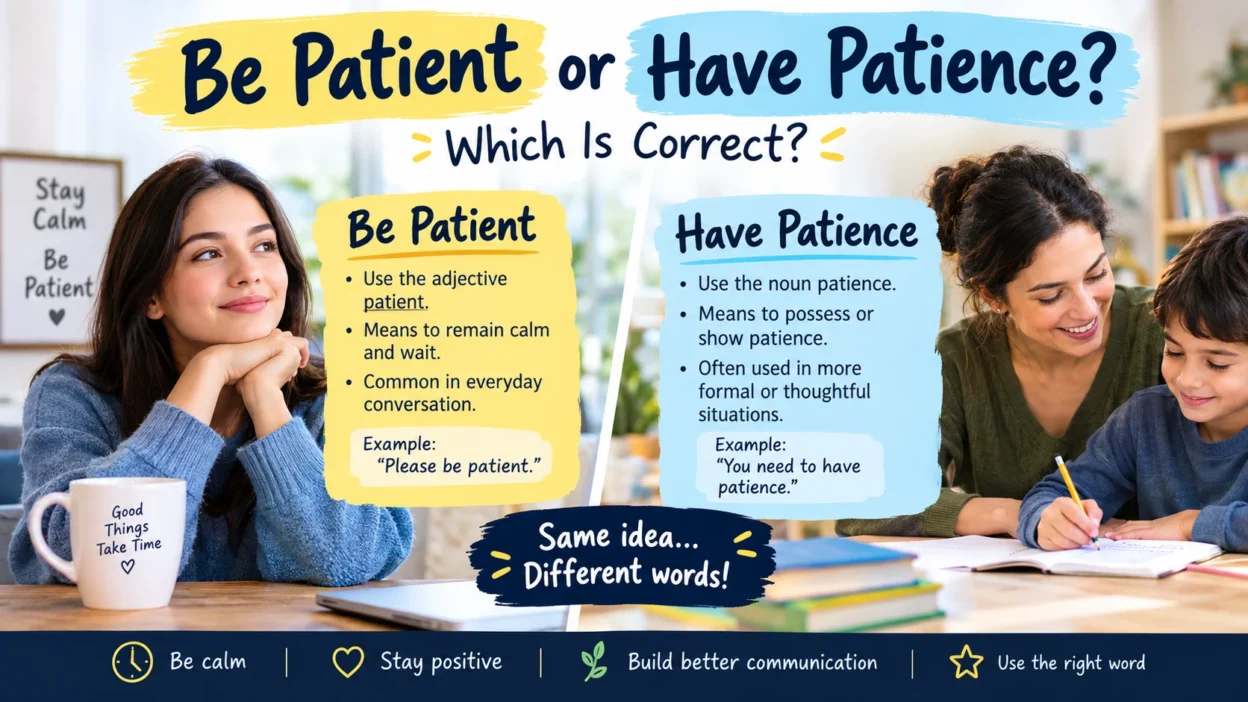
“Be patient” and “have patience” are both correct. Use “be patient” when telling someone to stay calm and wait. Use “have patience” when talking about the quality or ability to remain patient. For example: “Please be patient.” / “You need to have patience with children.”
Why People Confuse It
The confusion happens because patient and patience come from the same word family.
- Patient is an adjective.
- Patience is a noun.
- Be patient means “remain calm and willing to wait.”
- Have patience means “possess or show the quality of being patient.”
Compare:
Please be patient.
You need to have patience.
Both sentences communicate a similar idea, but their grammatical structures are different.
Another reason for the confusion is that English commonly uses “be + adjective” and “have + noun” patterns. Therefore, learners may wonder whether be patient or have patience is the preferred construction.
First Word: Patient
Patient is an adjective that describes someone who can wait calmly or deal with difficulties without becoming annoyed.
Examples:
- She is very patient with children.
- Please be patient while we check your information.
- You need to be patient with yourself.
- He was patient during the long meeting.
- Try to be patient; your turn will come soon.
The most natural command is often:
“Be patient!”
This tells someone directly to remain calm and wait.
What does “be patient” mean?
Be patient means to remain calm while waiting or while dealing with a difficult person or situation.
For example:
Be patient. The results will be available tomorrow.
Here, the speaker is asking the listener not to become frustrated while waiting.
Second Word: Patience
Patience is a noun. It refers to the ability to wait calmly or deal with difficulties without becoming angry or frustrated.
Examples:
- She has a lot of patience.
- Teaching young children requires patience.
- Thank you for your patience.
- I don’t have much patience for rude behavior.
- You need to have patience when learning a new language.
The expression “have patience” is grammatically correct, although in everyday English, other expressions such as “be patient” or “have some patience” may sound more natural depending on the context.
Be Patient vs Have Patience: Comparison Table
| Expression | Grammar | Meaning | Common Use |
|---|---|---|---|
| Be patient | Be + adjective | Remain calm and wait | Very common |
| Have patience | Have + noun | Possess or show patience | Correct, somewhat more formal |
| Have some patience | Have + noun | Show a little patience | Common when asking someone to wait |
| Show patience | Verb + noun | Demonstrate patience | Formal or descriptive |
| Exercise patience | Verb + noun | Deliberately remain patient | Formal |
| Practice patience | Verb + noun | Develop patience | Advice/self-improvement |
When to Use Each
Use “Be Patient” for Direct Instructions
When you are telling someone to wait calmly, be patient is usually the simplest choice.
- Be patient. I’m almost finished.
- Please be patient with me.
- Be patient while we solve the problem.
- You have to be patient.
It sounds natural in everyday conversations.
Use “Have Patience” When Discussing Patience as a Quality
Use have patience when patience itself is the thing someone needs to possess or demonstrate.
- You need to have patience when teaching.
- Good parents need to have patience.
- Learning a language takes time, so have patience.
- You must have patience with beginners.
“Have Some Patience” Is Also Natural
The phrase have some patience is commonly used when someone is becoming impatient.
Have some patience. We’re almost there.
However, depending on your tone, it can sound slightly firm or annoyed.
Be Patient or Have Patience: 12 Examples
- Please be patient while I finish the report.
- Be patient; good things take time.
- You need to have patience when learning a new skill.
- She is very patient with her students.
- Please have some patience. The doctor will see you soon.
- Be patient with yourself when learning English.
- Teaching children requires a lot of patience.
- If you want to improve, you need to have patience.
- He asked me to be patient while he fixed the computer.
- You should have patience with people who are still learning.
- Be patient with the process.
- Successful teachers often need patience and understanding.
Common Mistakes
Mistake 1: Using “Patience” as an Adjective
Incorrect:
Please be patience.
Correct:
Please be patient.
Patient is the adjective needed after be.
Mistake 2: Using “Patient” as a Noun for the Quality
Incorrect:
You need to have patient.
Correct:
You need to have patience.
The quality is patience, not patient.
Mistake 3: Saying “Have Patient”
Incorrect:
Have patient with me.
Correct:
Have patience with me.
Or, more naturally:
Please be patient with me.
Mistake 4: Assuming One Expression Is Wrong
Both be patient and have patience are grammatically correct. The important thing is choosing the expression that fits the sentence.
Memory Trick
A simple way to remember the difference is:
Be → adjective → patient
Have → noun → patience
Think:
Be patient.
Have patience.
If you are describing what someone should be, use patient.
If you are talking about the quality someone has, use patience.
American vs British English
Both American English and British English use “be patient” and “have patience.” There is no major difference in correctness between the two varieties.
However, “be patient” is especially natural in everyday speech in both American and British English.
For example:
- Please be patient.
- You’ll need to be patient.
- Have some patience.
- She has a lot of patience.
The choice usually depends more on sentence structure and context than on whether you are speaking American or British English.
Similar Words
Several expressions are closely related to be patient and have patience.
Wait
Wait simply means to stay until something happens.
Please wait here.
Stay Calm
Stay calm focuses on controlling your emotions.
Stay calm and listen carefully.
Be Tolerant
Be tolerant means accepting differences or difficult behavior without reacting negatively.
Try to be tolerant of other people’s mistakes.
Show Patience
Show patience means to demonstrate a patient attitude.
Teachers should show patience with their students.
Exercise Patience
Exercise patience means deliberately choosing to remain patient, especially in a difficult situation.
You will need to exercise patience during the recovery process.
Practice Patience
Practice patience means working on your ability to remain patient.
Learning a new language is a good way to practice patience.
Final Verdict
“Be patient” and “have patience” are both correct expressions. The difference is mainly grammatical and contextual.
Use “be patient” when you are directly telling someone to remain calm and wait. It is the most straightforward and common choice in everyday English.
Use “have patience” when you are discussing the possession or need for patience as a quality. In many everyday situations, “have some patience” or simply “be patient” may sound more natural.
FAQs
Is “be patient” correct English?
Yes. “Be patient” is completely correct and very common. It tells someone to remain calm while waiting or dealing with a difficult situation.
Is “have patience” correct?
Yes. “Have patience” is grammatically correct. It means to possess or maintain patience, although “be patient” is often more natural for a direct instruction.
Should I say “be patient” or “have patience”?
Both are correct. Say “be patient” when giving someone a direct instruction. Say “have patience” when discussing patience as a quality or ability.
Is it “be patience” or “be patient”?
The correct phrase is “be patient.” Patient is an adjective, while patience is a noun.
Is it “have patient” or “have patience”?
The correct expression is “have patience.” The noun for the quality of remaining calm is patience.
Which is more natural: “be patient” or “have patience”?
“Be patient” is generally more natural for everyday instructions, such as “Please be patient.” “Have patience” is also correct and works well when talking about someone’s need to possess or demonstrate patience.
Can I say “have some patience”?
Yes. “Have some patience” is natural English. It asks someone to wait calmly, although the tone can sometimes sound firm.
Remember This
Be patient = remain calm and wait.
Have patience = possess or show patience.
The easiest rule is:
Be + patient
Have + patience
So, if you want to tell someone to wait calmly, say:
“Please be patient.”
If you are talking about the quality itself, say:
“You need to have patience.”
Conclusion
Be patient and have patience are both correct, but they serve slightly different grammatical purposes. Patient is an adjective used after be, while patience is a noun used after verbs such as have, show, and practice.
For most everyday situations, “be patient” is the easiest and most natural choice. Remember the simple pattern—be patient, have patience—and you will avoid one of the most common mistakes with these related English words.
Meta Description: Be patient or have patience? Learn the difference, correct usage, examples, common mistakes, and simple tips for choosing the right expression.