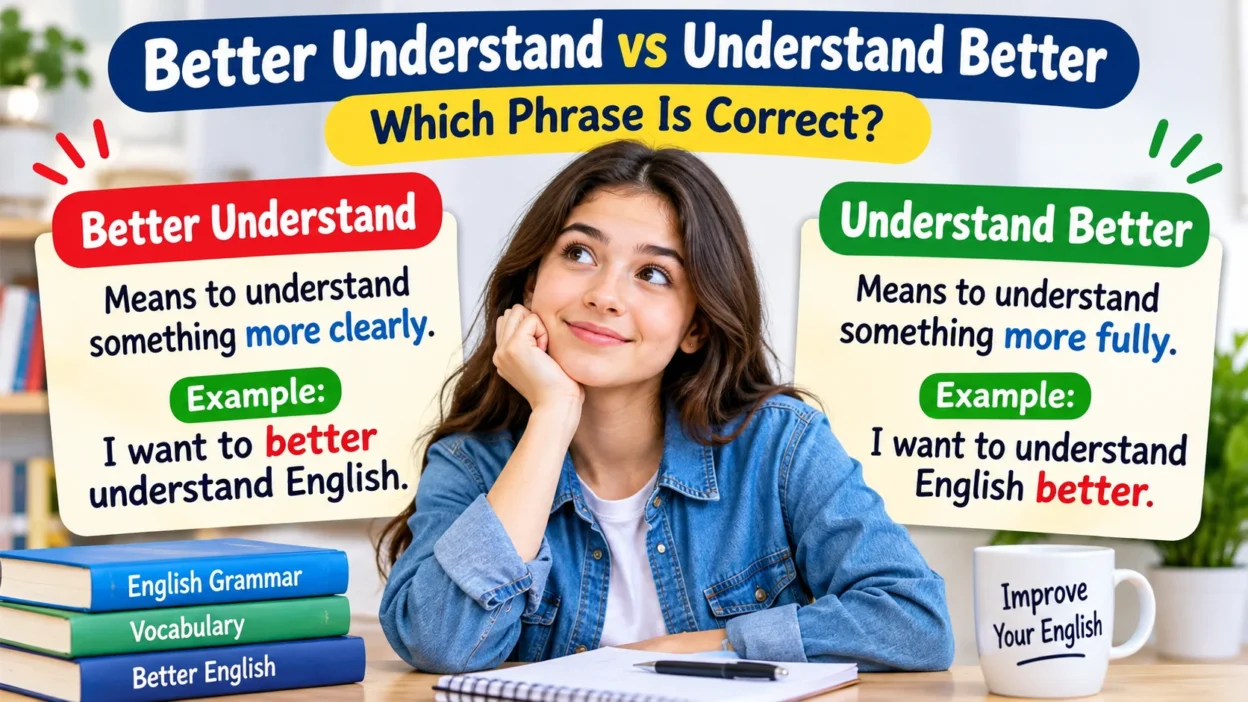
Have you ever wondered if to say “better understand” or “understand better”? Both expressions are correct in English, and both communicate the idea of gaining a clearer or deeper understanding of something. However, their word order is different, which can make English learners wonder if one sounds more natural or is grammatically preferable.
The good news is that you can use either expression in everyday conversations, academic writing, professional communication, and formal contexts. The main difference is the placement of the adverb “better.” In “better understand,” it comes before the verb, while in “understand better,” it comes after the verb. Although their meanings are very similar, sentence structure and emphasis can influence which expression sounds more natural.
Quick Answer: Better Understand vs Understand Better
Both “better understand” and “understand better” are grammatically correct. They mean to understand something more clearly, fully, or effectively. The difference is word order: “better understand” places the adverb before the verb, while “understand better” places it after the verb. Choose the version that makes your sentence sound natural.
Why Do People Confuse Better Understand and Understand Better?
People often confuse these expressions because they contain exactly the same words but arrange them differently. Since “better” describes the quality or degree of understanding, English speakers can place it in different positions.
In English, adverbs can appear before or after verbs, depending on the sentence structure and the intended emphasis. This flexibility allows both expressions to communicate almost the same message.
For example:
- I want to better understand English grammar.
- I want to understand English grammar better.
Both sentences are correct. They express the same basic intention: the speaker wants to improve their understanding of English grammar.
Another reason for the confusion is that learners sometimes assume an adverb must always follow the verb it modifies. However, English allows different adverb positions, and both constructions are widely used.
First Word: Better Understand
“Better understand” is a correct English expression that means to understand something more clearly, deeply, or completely.
In this construction, “better” is an adverb placed before the verb “understand.” It describes the quality or degree of understanding.
This expression is especially common in formal writing, educational materials, professional communication, and explanations.
Examples of Better Understand
- I want to better understand the rules of English grammar.
- Reading more books can help students better understand difficult subjects.
- We need to better understand the reasons behind this decision.
- The teacher used simple examples to help us better understand the lesson.
- Scientists are conducting research to better understand human behavior.
When Is Better Understand Appropriate?
Use “better understand” when you want to emphasize gaining deeper knowledge or improving your comprehension.
It works particularly well in these situations:
- Academic writing: Researchers hope to better understand the results.
- Professional communication: We need to better understand our customers’ needs.
- Education: Students should better understand the basic concepts before moving forward.
- Explanations: Let me explain this example to help you better understand the topic.
The expression is also common in introductory phrases beginning with “to.”
For example:
- To better understand the problem, we examined the available evidence.
- To better understand the topic, read the following explanation.
Second Word: Understand Better
“Understand better” is also a grammatically correct expression. It means to understand something more clearly, thoroughly, or effectively.
In this construction, “understand” comes first, followed by the adverb “better.” Here, the adverb modifies the verb by describing the improved quality of understanding.
This word order is very natural in everyday conversations and informal writing. It is also perfectly acceptable in formal and academic contexts.
Examples of Understand Better
- I want to understand English grammar better.
- Listening to native speakers helps me understand pronunciation better.
- Can you explain the instructions so I can understand them better?
- She reads regularly to understand different cultures better.
- We need more information to understand the situation better.
When Is Understand Better Appropriate?
Use “understand better” when you want to describe how well someone understands a subject, situation, person, or idea.
It is especially useful in everyday communication.
Consider these situations:
- Daily conversations: I want to understand you better.
- Learning: Practice will help you understand the subject better.
- Relationships: Spending time together helps people understand each other better.
- Workplace communication: We need to understand the client’s expectations better.
This construction is particularly natural when the object comes between the verb and the adverb.
For example:
- I understand this concept better now.
- She understands her responsibilities better after the meeting.
Better Understand vs Understand Better: Comparison Table
Although both phrases are correct, their grammatical arrangement is different.
| Feature | Better Understand | Understand Better |
|---|---|---|
| Correctness | Correct | Correct |
| Meaning | Understand more clearly | Understand more clearly |
| Word order | Adverb + verb | Verb + adverb |
| Adverb position | Before the verb | After the verb |
| Common use | Formal and academic writing | Everyday and general writing |
| Example | I want to better understand history. | I want to understand history better. |
Important: Neither expression is universally more correct or more grammatical. Your choice should depend on sentence structure, naturalness, and personal writing style.
When to Use Better Understand vs Understand Better
Knowing when to use each expression can make your English sound more natural and fluent.
1. Use Better Understand in Formal and Academic Writing
“Better understand” is frequently used when discussing research, learning objectives, explanations, and complex ideas.
Examples:
- Researchers want to better understand climate change.
- This study helps us better understand the effects of pollution.
- Students must better understand the principles of mathematics.
2. Use Understand Better in Everyday Conversations
“Understand better” sounds natural when discussing personal experiences, daily situations, and ordinary conversations.
Examples:
- I want to understand you better.
- Now I understand the instructions better.
- Can you explain that again so I can understand it better?
3. Use Better Understand Before an Object
You can place “better” before “understand” when introducing the subject or object of your understanding.
Examples:
- We need to better understand the situation.
- She wants to better understand the new system.
- They are trying to better understand the problem.
4. Use Understand Better When Emphasizing Improved Comprehension
You can put “better” after the verb, particularly when you want to highlight how well someone understands something.
Examples:
- I understand the lesson better now.
- He understands the rules better than before.
- You will understand the concept better with practice.
15 Examples of Better Understand vs Understand Better
The following examples demonstrate how both expressions work in different situations.
| Better Understand | Understand Better |
|---|---|
| I want to better understand this topic. | I want to understand this topic better. |
| She needs to better understand the instructions. | She needs to understand the instructions better. |
| We should better understand our responsibilities. | We should understand our responsibilities better. |
| He wants to better understand English grammar. | He wants to understand English grammar better. |
| They are trying to better understand the problem. | They are trying to understand the problem better. |
| This book helps readers better understand history. | This book helps readers understand history better. |
| I hope to better understand your perspective. | I hope to understand your perspective better. |
| Teachers should better understand their students’ needs. | Teachers should understand their students’ needs better. |
| Researchers want to better understand human behavior. | Researchers want to understand human behavior better. |
| We need to better understand the situation. | We need to understand the situation better. |
| She is working to better understand the process. | She is working to understand the process better. |
| The explanation helped me better understand the concept. | The explanation helped me understand the concept better. |
| I would like to better understand the requirements. | I would like to understand the requirements better. |
| The meeting helped us better understand the project. | The meeting helped us understand the project better. |
| Practice can help you better understand difficult words. | Practice can help you understand difficult words better. |
Notice that both versions communicate nearly identical meanings. The main difference is where the adverb “better” appears in the sentence.
Common Mistakes to Avoid
Although both expressions are correct, learners sometimes make mistakes when using them in sentences.
Here are some common errors and their corrections.
Mistake 1: Thinking Only One Expression Is Correct
Incorrect assumption: “Better understand” is correct, but “understand better” is wrong.
Correct explanation: Both expressions are grammatically acceptable.
- Correct: I want to better understand the lesson.
- Correct: I want to understand the lesson better.
Mistake 2: Using Better as an Adjective
Sometimes learners confuse the adjective “better” with its adverbial use.
For example:
- Incorrect: I better understand explanation.
- Correct: I better understand the explanation.
- Correct: I understand the explanation better.
The first incorrect sentence is missing the article “the” before “explanation.” The issue is not the position of “better.”
Mistake 3: Forgetting the Object in a Sentence
When a sentence needs an object, make sure you include it.
For example:
- Incorrect: I want to understand better the topic.
- Better: I want to better understand the topic.
- Better: I want to understand the topic better.
The original sentence is awkward in ordinary English. Placing the object between “understand” and “better” usually sounds more natural.
Mistake 4: Assuming Better Understand Is Always More Formal
Although “better understand” is common in formal contexts, it is not exclusively formal. Similarly, “understand better” is not limited to casual conversations.
Both expressions can be used in different writing styles.
Mistake 5: Changing the Meaning Unnecessarily
Do not assume that changing the word order changes the fundamental meaning.
For example:
- I want to better understand my students.
- I want to understand my students better.
Both sentences communicate the same general intention.
Memory Trick: How to Remember the Difference
A simple way to remember these expressions is to focus on the position of the adverb “better.”
- Better Understand: Better comes before understand.
- Understand Better: Better comes after understand.
Think of it this way:
Better + Understand = A natural way to express the goal of gaining deeper knowledge.
Understand + Better = A natural way to describe improved comprehension.
For example:
- I want to better understand mathematics.
- I want to understand mathematics better.
Both sentences are correct, so you do not need to memorize a complicated grammar rule.
Simply remember that English allows both word orders in this construction.
American vs British English: Is There a Difference?
There is no significant difference between American and British English when it comes to “better understand” and “understand better.”
Both expressions are accepted in American English and British English. Neither construction belongs exclusively to one variety.
Here are examples in both varieties:
American English:
- I want to better understand the situation.
- I want to understand the situation better.
British English:
- I want to better understand the situation.
- I want to understand the situation better.
The spelling and grammatical structure remain the same.
Therefore, you can confidently use either expression regardless of if you are writing for an American or British audience.
Similar Words and Expressions
Several other English expressions communicate the idea of understanding something more clearly or deeply.
Here are some useful alternatives:
1. Comprehend More Fully
This expression means to understand something in greater detail or depth.
Example: Students should comprehend the instructions more fully before starting the assignment.
2. Gain a Better Understanding
This phrase means to develop more knowledge or awareness of something.
Example: Reading different books can help you gain a better understanding of history.
3. Grasp More Clearly
“Grasp” means to understand an idea, concept, or situation.
Example: She needed more examples to grasp the concept more clearly.
4. Get a Better Grasp Of
This informal expression means to develop a stronger understanding of something.
Example: I need more practice to get a better grasp of English grammar.
5. Understand More Thoroughly
This expression emphasizes a deeper and more complete understanding.
Example: The additional explanation helped me understand the subject more thoroughly.
These expressions can make your vocabulary more varied and help you communicate ideas more effectively.
Final Verdict: Better Understand or Understand Better?
The final answer is simple: both “better understand” and “understand better” are correct English expressions.
Neither phrase is grammatically superior to the other. They communicate almost the same meaning, but the position of the adverb “better” changes.
Use “better understand” when you prefer placing the adverb before the verb, especially in introductory and formal constructions. Use “understand better” when you prefer placing the adverb after the verb, particularly when it follows an object.
For example:
- I want to better understand English.
- I want to understand English better.
Both sentences are natural and correct. Choose the construction that best fits your sentence.
Frequently Asked Questions (FAQs)
1. Is Better Understand Grammatically Correct?
Yes, “better understand” is grammatically correct. It means to understand something more clearly or deeply. For example, “I want to better understand English grammar” is a perfectly acceptable sentence.
2. Is Understand Better Correct English?
Yes, “understand better” is also correct English. It uses the adverb “better” after the verb “understand.” For example, “I want to understand English better” is grammatically correct and natural.
3. What Is the Difference Between Better Understand and Understand Better?
The main difference is word order. “Better understand” places the adverb before the verb, while “understand better” places it after the verb. Both expressions generally communicate the same meaning: to understand something more clearly or completely.
4. Which Is More Natural: Better Understand or Understand Better?
Both are natural, but the choice depends on the sentence. “Understand better” often sounds natural in everyday sentences, especially when an object comes before “better.” “Better understand” is also common in formal writing and introductory phrases.
5. Can I Use Better Understand in Formal Writing?
Yes, “better understand” is widely acceptable in formal writing, academic discussions, research papers, and professional communication. For example, “This research aims to better understand consumer behavior” is a natural construction.
6. Is Understand Better More Common in Everyday English?
“Understand better” is a very natural construction in everyday English, especially in personal conversations. For example, “I want to understand you better” sounds perfectly natural. However, “better understand” is also commonly used in ordinary speech.
7. Are Better Understand and Understand Better Interchangeable?
In most sentences, yes. Both expressions communicate the idea of improving comprehension. However, the surrounding sentence structure may make one word order sound more natural than the other. Always consider the placement of the object and the overall flow of your sentence.
Remember This
- Better understand is grammatically correct.
- Understand better is also grammatically correct.
- Both expressions mean to understand something more clearly or deeply.
- The main difference is the position of the adverb “better.”
- Neither expression is exclusively American or British English.
- Choose the construction that sounds most natural in your sentence.
Conclusion
Understanding the difference between “better understand” and “understand better” is easier than it might seem. Both expressions are correct, and both describe the process of gaining clearer or deeper knowledge of something. Their main difference is simply the placement of the adverb “better” in relation to the verb “understand.”
if you write “I want to better understand English” or “I want to understand English better,” your sentence communicates the same basic idea. Learn to recognize both constructions, practice using them in different contexts, and choose the one that makes your English sound clear, natural, and confident.