
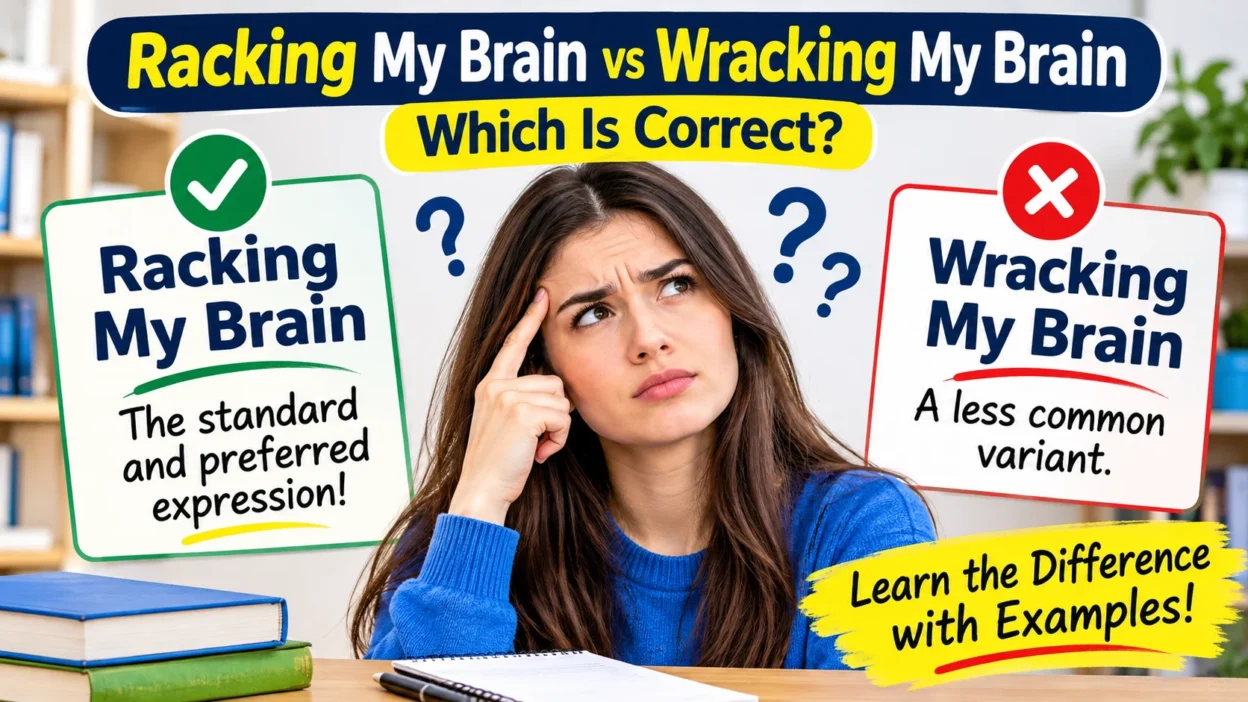
Have you ever struggled to remember something, solve a difficult problem, or think of the right answer? You might describe that experience by saying, “I’m racking my brain.” However, you may also have seen the expression written as “I’m wracking my brain.” This raises a common English usage question: Is it racking my brain or wracking my brain?
The standard and most widely preferred expression is “racking my brain.” It means making a great mental effort to remember something, find an answer, or solve a problem. However, “wracking my brain” is also found as a recognized variant of the expression. The confusion comes from the similar meanings and spellings of the words rack and wrack. Although both forms appear in English, understanding their usage will help you choose the more conventional expression, especially in academic, professional, and everyday writing.
Quick Answer: Racking My Brain or Wracking My Brain?
“Racking my brain” is the standard and preferred expression in modern English. It means thinking very hard to remember something or solve a problem. “Wracking my brain” is also used as a variant, but it is less common. When in doubt, choose “racking my brain” for clear, conventional writing.
Why Do People Confuse Racking My Brain and Wracking My Brain?
People confuse these expressions because rack and wrack look and sound almost identical. Both words have historical connections with ideas of suffering, damage, and destruction, which makes their meanings easy to mix up.
Another reason is that the expression refers to mental effort. Someone who is trying extremely hard to remember something may feel as though their brain is being strained or exhausted. This association makes both spellings seem reasonable.
However, the traditional idiom is “rack your brain” or “rack your brains.” The spelling with wrack has also become established as a variant.
For example:
- Correct and preferred: I’ve been racking my brain to remember her name.
- Less common variant: I’ve been wracking my brain to remember her name.
Both communicate the same general idea, but the first is the safer choice in formal and everyday writing.
First Word: Racking My Brain
Racking my brain is the standard form of the expression. It comes from the verb rack, which can mean to cause someone physical or mental suffering or strain.
In the idiom rack your brain, the word describes making an intense mental effort. It suggests that you are pushing your mind to remember information, discover an answer, or solve a challenging problem.
Meaning of Racking My Brain
The expression racking my brain means thinking very hard about something, especially when you are struggling to remember a detail or find a solution.
It is commonly used in conversations, emails, stories, and professional communication.
Examples:
- I’m racking my brain to remember where I put my keys.
- She spent hours racking her brain for a solution.
- I’ve been racking my brain, but I still cannot remember his name.
Is It Racking My Brain or Racking My Brains?
Both rack my brain and rack my brains are accepted forms of the idiom.
The singular form treats the brain as the organ responsible for thinking, while the plural form is part of the traditional idiomatic expression.
Examples:
- I’m racking my brain to solve this puzzle.
- I’m racking my brains to remember the answer.
Both sentences are natural and understandable.
Grammatical Forms of Rack
Here are some common forms of the verb rack:
| Verb form | Example |
|---|---|
| Base form | Rack your brain. |
| Present participle | Racking my brain. |
| Simple past | Racked my brain. |
| Past participle | Have racked my brain. |
| Third-person singular | Racks her brain. |
These forms help you use the expression correctly in different tenses.
Second Word: Wracking My Brain
Wracking my brain is a less common variant of the expression racking my brain. It uses the verb wrack, which generally means to damage, destroy, or cause severe distress.
The word wrack is also associated with the expression wrack and ruin, meaning complete destruction or decay.
Because mental effort can be associated with strain or distress, some writers use wracking my brain to describe intense thinking.
Meaning of Wracking My Brain
The expression wracking my brain means trying very hard to remember something, think of an answer, or solve a difficult problem.
Although it is less conventional than racking my brain, readers generally understand what it means.
Examples:
- I’m wracking my brain to remember the password.
- He was wracking his brain for a creative idea.
- She kept wracking her brain to figure out what went wrong.
Is Wracking My Brain Incorrect?
Not necessarily. Wracking my brain is an established spelling variant found in English usage.
However, racking my brain is the more traditional and widely preferred form. If you want to avoid criticism or confusion, especially in formal writing, use racking my brain.
It is also important not to confuse wracking with unrelated uses of wrack, such as wrack and ruin.
Racking My Brain vs. Wracking My Brain: Comparison Table
The following table highlights the main similarities and differences between the two expressions.
| Feature | Racking My Brain | Wracking My Brain |
|---|---|---|
| Main word | Rack | Wrack |
| Meaning in the idiom | Thinking very hard | Thinking very hard |
| Usage | Standard and preferred | Less common variant |
| Recognition | Widely established | Recognized variant |
| Formal writing | Recommended | Better avoided |
| Example | I’m racking my brain for an answer. | I’m wracking my brain for an answer. |
The biggest difference is not the intended meaning but the conventional spelling. Both expressions can communicate intense mental effort, but racking my brain is the safer and more widely accepted choice.
When Should You Use Each Expression?
Choosing between these expressions depends on your writing style and the level of conventional usage you want to follow.
When to Use Racking My Brain
Use racking my brain when you want to express that you are thinking very hard about something.
It is the preferred option for:
- Academic assignments and essays.
- Professional emails and reports.
- Everyday conversations.
- Articles and blog posts.
- Formal and informal writing.
- Situations involving memory or problem-solving.
Examples:
- I’m racking my brain to remember the meeting date.
- We are racking our brains to find a better solution.
When to Use Wracking My Brain
You may encounter or use wracking my brain when following a source or writing style that recognizes this variant.
It is understandable in informal communication, but it is not the best choice when you want to follow the most conventional spelling.
Examples:
- I’ve been wracking my brain for hours.
- She was wracking her brain to remember the address.
Practical advice: Unless you have a specific reason to use the variant, choose racking my brain. It is familiar, conventional, and appropriate for almost every context.
15 Examples of Racking My Brain and Wracking My Brain
Examples make it easier to understand how these expressions work in everyday English.
Examples Using Racking My Brain
- I’ve been racking my brain all morning, trying to remember where I left my wallet.
- She is racking her brain to find the perfect birthday gift for her mother.
- We spent the entire afternoon racking our brains for a solution to the problem.
- He was racking his brain to remember the name of his former teacher.
- I’m racking my brain, but I cannot figure out how to fix this computer.
- They racked their brains to develop a creative marketing strategy.
- My brother has been racking his brain to solve the difficult mathematics question.
- I racked my brain trying to remember the lyrics of that old song.
Examples Using Wracking My Brain
- I’ve been wracking my brain to remember the combination of my old locker.
- She kept wracking her brain for an interesting topic for her presentation.
- He was wracking his brain to understand why the experiment had failed.
- We were wracking our brains to decide where to spend our vacation.
- I’m wracking my brain to remember the restaurant we visited last year.
- The students were wracking their brains to answer the final examination question.
- She has been wracking her brain to come up with a unique business idea.
Notice that the meaning remains essentially the same in these examples. The difference is the spelling of the verb.
Common Mistakes to Avoid
Even though both expressions are understandable, English learners sometimes make mistakes when writing them.
Here are some common errors and their corrections.
1. Assuming Wracking Is Always Wrong
Some writers believe that wracking my brain is completely incorrect.
Better understanding: It is a recognized variant, although racking my brain is the preferred form.
2. Confusing Rack With Wrack in Other Expressions
The words have different conventional uses outside this idiom.
For example:
- Rack your brain (think very hard).
- Wrack and ruin (complete destruction).
- Rack up points (accumulate points).
- Wrack something (damage or destroy something).
Do not assume that the two words can replace each other in every expression.
3. Using the Wrong Verb Tense
The verb should agree with the sentence’s tense.
Incorrect: I have racking my brain all day.
Correct: I have been racking my brain all day.
Incorrect: She is rack her brain for an answer.
Correct: She is racking her brain for an answer.
4. Forgetting the Meaning of the Idiom
Racking your brain does not mean physically damaging your brain. It is a figurative expression describing intense mental effort.
Understanding this figurative meaning makes it easier to use the phrase naturally.
Memory Trick: How to Remember Racking My Brain
A simple memory trick can help you remember the preferred spelling.
Think of the word RACK as something that puts pressure or strain on something.
When you are trying very hard to remember a name, solve a puzzle, or find an answer, your mind is working hard. Therefore, remember:
RACK = THINK HARD
You can also connect the word rack with a traditional torture rack, which helps explain the idea of mental strain behind the idiom.
Another useful reminder is:
- Racking my brain = Preferred expression.
- Wracking my brain = Less common variant.
- Wrack and ruin = Destruction.
If you remember these three expressions, you will be less likely to confuse the spellings.
American vs. British English: Is There a Difference?
There is no significant American-English versus British-English distinction between racking my brain and wracking my brain.
Both varieties of English use the expression rack your brain to describe making a strong mental effort.
The spelling wracking your brain also appears in both varieties, although it is less conventional.
| English variety | Preferred expression | Less common variant |
|---|---|---|
| American English | Racking my brain | Wracking my brain |
| British English | Racking my brain | Wracking my brain |
Unlike spelling differences such as color and colour, this is not a regional spelling distinction.
Remember: if you are writing for an American or British audience, racking my brain is the safest choice.
Similar Words and Expressions
Several English expressions communicate the same idea as racking my brain. Learning these alternatives can help you improve your vocabulary and avoid repeating the same phrase.
Here are some useful alternatives:
1. Puzzling Over
This means thinking carefully about something that is difficult to understand or solve.
Example: I’m puzzling over the answer to the final question.
2. Thinking Hard
This is a simple expression meaning to concentrate intensely on something.
Example: I’ve been thinking hard about how to improve my writing.
3. Trying to Remember
This means making an effort to recall something from memory.
Example: I’m trying to remember where I parked my car.
4. Scratching My Head
This informal expression describes being confused or uncertain about something.
Example: I’m scratching my head over this complicated problem.
5. Taxing My Brain
This means requiring considerable mental effort.
Example: Solving these difficult equations is really taxing my brain.
6. Putting My Thinking Cap On
This informal expression means preparing to think carefully or creatively.
Example: Let’s put our thinking caps on and find a solution.
These expressions are useful alternatives, but their meanings and levels of formality are not always identical.
Final Verdict: Racking My Brain or Wracking My Brain?
The preferred expression is racking my brain. It is the traditional and more widely used form of the idiom, meaning to think very hard to remember something, discover an answer, or solve a problem.
However, wracking my brain is also recognized as a less common variant and is not necessarily incorrect.
If you are writing an academic assignment, professional email, article, or everyday message, choose racking my brain. It is the most conventional option and helps you avoid unnecessary spelling confusion.
Frequently Asked Questions (FAQs)
1. Is it racking my brain or wracking my brain?
Racking my brain is the standard and preferred expression. Wracking my brain is also used as a less common variant. Both generally communicate the idea of thinking very hard about something.
2. Is wracking my brain grammatically incorrect?
No. Wracking my brain is a recognized variant of the idiom. However, racking my brain is more conventional and is generally the better choice for formal and professional writing.
3. What does racking my brain mean?
Racking my brain means making a great mental effort to remember something, find an answer, or solve a difficult problem. For example, “I’m racking my brain to remember her name.”
4. Is it rack my brain or rack my brains?
Both rack my brain and rack my brains are accepted expressions. They have the same general meaning: to think very hard about something.
5. What is the past tense of racking my brain?
The past tense is racked my brain or racked my brains.
Example: I racked my brain all evening but couldn’t remember the answer.
6. Is racking my brain an idiom?
Yes. It is an idiomatic expression because its meaning is figurative rather than literal. It describes intense mental effort, not physically damaging or stretching the brain.
7. Is racking my brain used in American and British English?
Yes. The expression is used in both American and British English. There is no major regional difference in its preferred spelling. Racking my brain remains the conventional choice in both varieties.
Remember This
- Racking my brain is the standard and preferred expression.
- Wracking my brain is a recognized but less common variant.
- Both expressions refer to making a great mental effort.
- Rack your brain and rack your brains are both acceptable.
- Use racking my brain in formal, academic, and everyday writing.
Conclusion
Understanding the difference between racking my brain and wracking my brain is easier when you remember that both expressions can describe intense mental effort. However, racking my brain is the traditional and more widely preferred form, while wracking my brain is a less common variant. Knowing this distinction will help you make better spelling and vocabulary choices.
Whenever you are struggling to remember someone’s name, solve a challenging problem, or think of a creative idea, you can confidently say, “I’m racking my brain.” It is the conventional expression and a natural choice in both American and British English.