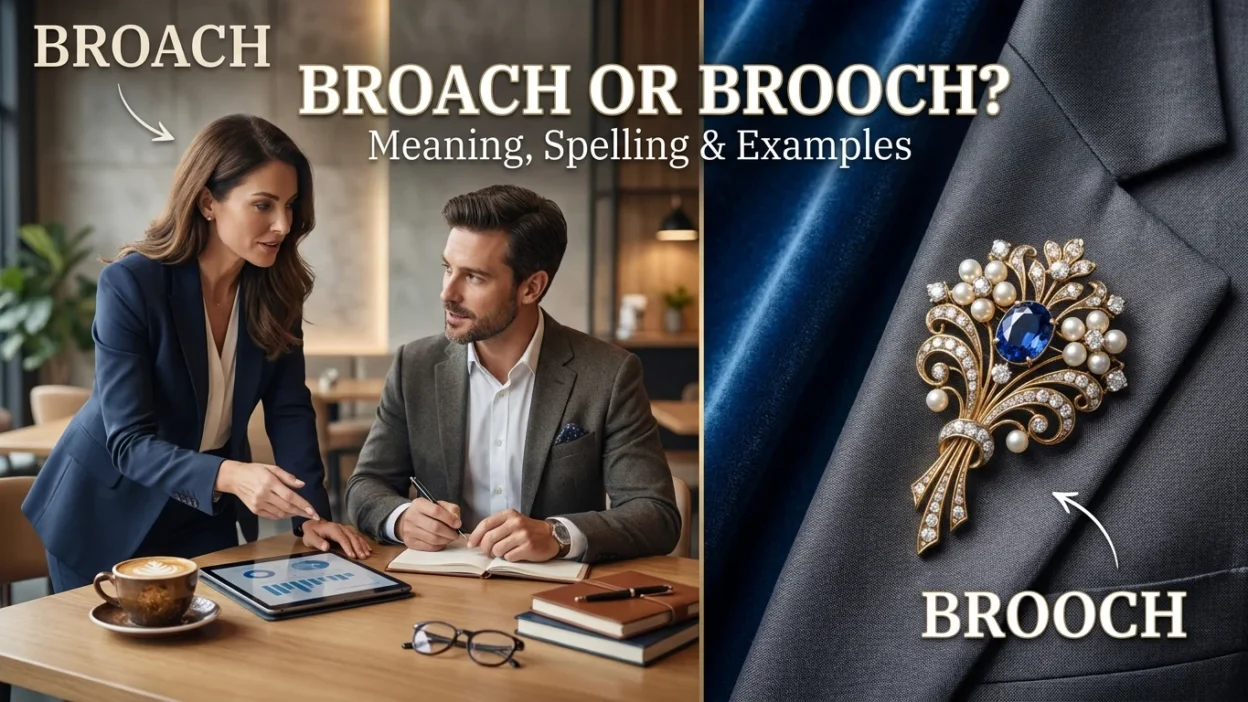
English contains many words that sound alike but have completely different meanings. Broach and brooch are a good example. They are pronounced very similarly, but they are not interchangeable. Knowing which spelling to use can help you write more accurately, especially when talking about jewelry, clothing, or introducing a difficult subject.
Broach is usually a verb meaning to introduce or bring up a topic for discussion. Brooch, on the other hand, is a noun referring to a decorative piece of jewelry that is pinned to clothing. Although the two words look and sound similar, their meanings, grammatical roles, and uses are different. This guide explains broach vs. brooch with clear definitions, examples, common mistakes, and an easy memory trick.
Quick Answer
Broach is mainly a verb meaning “to bring up or introduce a subject for discussion,” as in She decided to broach the issue with her manager. Brooch is a noun meaning a decorative piece of jewelry fastened to clothing, as in She wore a beautiful brooch on her jacket.
Why Do People Confuse Broach and Brooch?
People often confuse broach and brooch because they are pronounced alike or very similarly in many varieties of English. Their spellings also differ by only one vowel.
However, their meanings are completely different:
- Broach → introduce or raise a topic.
- Brooch → a decorative piece of jewelry.
- Broach → usually a verb in modern everyday English.
- Brooch → usually a noun.
The easiest way to avoid confusion is to connect each spelling with its meaning rather than relying on pronunciation.
What Does Broach Mean?
Broach is most commonly used as a verb meaning to introduce a subject for discussion, especially a difficult, sensitive, or previously unmentioned subject.
For example:
I need to broach the subject of her late payments.
Here, broach means that the speaker needs to bring the subject up for discussion.
It is often followed by words such as subject, issue, question, topic, matter, or problem.
Examples of Broach
- She finally broached the subject of salary.
- I was nervous about broaching the issue with my boss.
- He broached the possibility of moving abroad.
- The teacher broached an important question.
- We need to broach the matter carefully.
Broach can also have specialized meanings in technical contexts, but the “introduce a topic” meaning is the one most learners encounter in everyday English.
What Does Brooch Mean?
A brooch is a decorative piece of jewelry designed to be fastened to clothing, usually with a pin or clasp.
Brooches can be made from many materials, including:
- Gold
- Silver
- Precious stones
- Enamel
- Glass
- Decorative metals
- Pearls
For example:
She wore a silver brooch on her coat.
In this sentence, brooch refers to the piece of jewelry.
Examples of Brooch
- She received a beautiful brooch as a gift.
- The antique brooch belonged to her grandmother.
- He noticed a jeweled brooch on her dress.
- She pinned the brooch to her scarf.
- The museum displayed an ancient brooch.
Broach vs. Brooch: Comparison Table
| Word | Part of Speech | Meaning | Example |
|---|---|---|---|
| Broach | Verb | To introduce or raise a topic | She decided to broach the subject. |
| Brooch | Noun | A decorative piece of jewelry | She wore a gold brooch. |
The simplest distinction is:
Broach = bring up a topic
Brooch = jewelry
When Should You Use Broach or Brooch?
Use broach when you are talking about introducing or raising an idea, subject, issue, or question.
Use “broach” for:
- A difficult conversation
- A sensitive subject
- A problem
- An important issue
- A proposal
- A question
- A possibility
- A concern
Examples:
- She was afraid to broach the subject.
- He broached the possibility of changing the schedule.
- I need to broach an important issue with you.
Use brooch when you are talking about jewelry worn on clothing.
Examples:
- She wore a pearl brooch.
- The brooch was attached to her coat.
- Her grandmother gave her an antique brooch.
Broach or Brooch: 10+ Examples
Understanding the words in complete sentences makes the difference easier to remember.
- I need to broach the subject with my parents.
- She wore a beautiful brooch to the wedding.
- He was unsure how to broach the issue.
- The silver brooch belonged to her grandmother.
- The manager decided to broach the question of overtime.
- She pinned a floral brooch to her jacket.
- It can be difficult to broach sensitive topics.
- The antique brooch was decorated with small stones.
- I finally broached the possibility of working remotely.
- Her brooch matched the color of her dress.
- They carefully broached the subject of money.
- The museum displayed a nineteenth-century brooch.
Notice how the context immediately tells you which spelling is correct.
Common Mistakes With Broach and Brooch
Mistake 1: Using “brooch” for a conversation
Incorrect:
I need to brooch the subject with him.
Correct:
I need to broach the subject with him.
The verb is broach, not brooch.
Mistake 2: Using “broach” for jewelry
Incorrect:
She wore a beautiful broach.
Correct:
She wore a beautiful brooch.
The jewelry item is a brooch.
Mistake 3: Choosing based only on pronunciation
Because the words sound alike or nearly alike for many speakers, listening alone may not help you choose the spelling.
Instead, ask yourself:
Am I talking about a topic or jewelry?
- Topic → broach
- Jewelry → brooch
An Easy Memory Trick
Try this simple association:
Broach = Bring up
Both broach and bring up relate to introducing a subject.
Broach a topic = bring up a topic
For brooch, think of the extra o as the rounded shape of a piece of jewelry.
Another useful shortcut is:
Broach a subject. Brooch a jacket.
If you remember those two phrases, you will usually choose the correct word.
American vs. British English
The distinction between broach and brooch is not primarily an American-versus-British spelling difference. Both words are used in American and British English with essentially the same meanings.
The main difference is meaning and grammatical function, not regional spelling.
- Broach = introduce or raise a subject.
- Brooch = a piece of jewelry.
Pronunciation can vary somewhat among speakers and accents, but learners should not treat broach and brooch as alternative spellings of the same word.
Similar Words
Several words are related to the meanings of broach and brooch.
Words Similar to Broach
Depending on context, broach can be replaced by:
- Raise
- Introduce
- Mention
- Bring up
- Discuss
- Present
- Address
- Suggest
For example:
She broached the subject of a promotion.
You could also say:
She raised the subject of a promotion.
Words Related to Brooch
Words associated with brooch include:
- Jewelry
- Pin
- Clasp
- Ornament
- Accessory
- Decoration
- Pendant
A brooch is a type of decorative accessory, although not every pin or piece of jewelry is a brooch.
Final Verdict: Broach or Brooch?
The correct word depends entirely on what you mean.
Use broach when you mean to introduce or raise a topic for discussion:
She decided to broach the subject of her promotion.
Use brooch when you mean a decorative piece of jewelry worn on clothing:
She wore a beautiful brooch on her coat.
So, remember:
Broach = discuss or introduce a topic.
Brooch = decorative jewelry.
FAQs About Broach vs. Brooch
Is it “broach the subject” or “brooch the subject”?
The correct expression is “broach the subject.” Here, broach is a verb meaning to introduce or raise a subject for discussion.
Is a brooch jewelry?
Yes. A brooch is a decorative piece of jewelry that is generally fastened to clothing with a pin or clasp.
Are broach and brooch pronounced the same?
They are pronounced the same or very similarly in many varieties of English, which is one reason they are commonly confused.
What is an example of broach?
She was nervous about broaching the subject with her manager.
Here, broaching means bringing up the subject for discussion.
What is an example of brooch?
She wore a diamond brooch on her jacket.
Here, brooch refers to a piece of decorative jewelry.
Is “broach” a noun or a verb?
In modern everyday English, broach is most commonly used as a verb, especially when it means introducing a subject for discussion.
What is the easiest way to remember broach and brooch?
Remember “broach a subject” and “brooch a jacket.” The first involves discussion; the second involves jewelry.
Remember This
Broach → bring up a topic.
Brooch → wear it as jewelry.
Think:
Broach a subject. Brooch a jacket.
That simple distinction will help you avoid one of the most common spelling and vocabulary mix-ups between these two words.
Conclusion
Broach and brooch may look and sound similar, but they have completely different meanings. Broach is mainly a verb used when someone introduces or raises a topic, issue, question, or difficult subject. Brooch is a noun referring to a decorative piece of jewelry worn on clothing.
When choosing between them, focus on the meaning rather than the sound. If you are talking about bringing up a subject, choose broach. If you are talking about decorative jewelry, choose brooch. Remembering “broach a subject” and “brooch a jacket” makes the difference easy to recall.