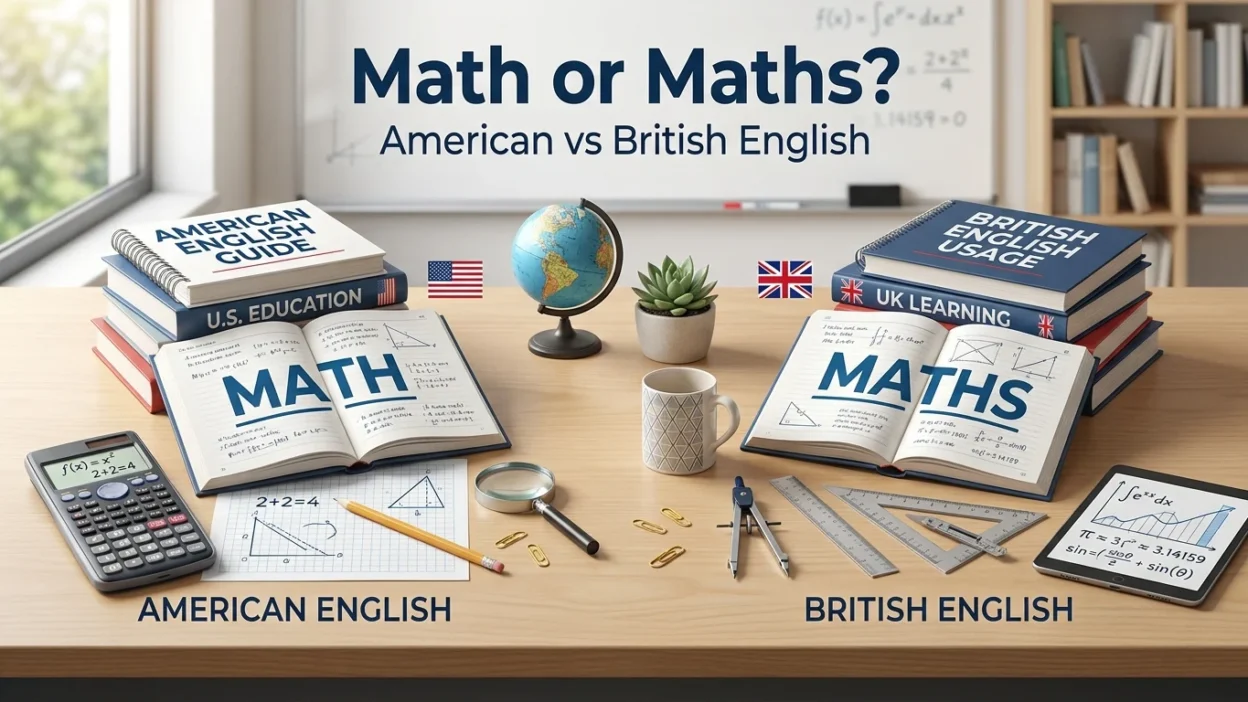
If you have ever wondered if to write math or maths, you are not alone. Both forms are correct, but the choice depends mainly on the variety of English you are using. Math is standard in American English, while maths is standard in British English and is also common in many other countries, including the UK, Australia, and New Zealand.
The two words have exactly the same basic meaning: they are shortened forms of mathematics, the subject involving numbers, quantities, shapes, patterns, calculations, and logical reasoning. The difference is not about meaning or correctness; it is mainly a matter of regional usage. Learning when to use math and maths can help you sound more natural in American or British English and avoid unnecessary confusion.
Quick Answer
Math and maths are both correct. Math is mainly used in American English, while maths is mainly used in British English. Both are shortened forms of mathematics and have the same meaning. Choose the form that matches the variety of English you are writing or speaking.
Why Do People Confuse Math and Maths?
The confusion happens because math and maths are regional variations of the same word.
In American English, speakers usually say math:
- I am good at math.
- Math was my favorite subject.
- She is studying math at college.
In British English, speakers normally use maths:
- I am good at maths.
- Maths was my favorite subject.
- She is studying maths at university.
The difference may seem small, but native speakers generally expect one form or the other depending on where they are from.
Math
Math is the standard shortened form of mathematics in American English.
It is commonly used in the United States and is also understood internationally.
Examples of “Math”
- I have a math test tomorrow.
- Math can be challenging at first.
- She loves math and science.
- He studies advanced math.
- My math teacher explained the problem clearly.
- We have math class after lunch.
The word math is treated as a singular subject:
Math is difficult for some students.
You would not normally say:
Math are difficult.
Maths
Maths is the standard shortened form of mathematics in British English.
It is commonly used in the United Kingdom and in other varieties of English influenced by British usage.
Examples of “Maths”
- I have a maths test tomorrow.
- Maths can be challenging at first.
- She loves maths and science.
- He studies advanced maths.
- My maths teacher explained the problem clearly.
- We have maths class after lunch.
Like math, maths refers to the subject as a whole and normally takes a singular verb:
Maths is my favorite subject.
Not:
Maths are my favorite subject.
Math vs Maths: Comparison Table
| Feature | Math | Maths |
|---|---|---|
| Full word | Mathematics | Mathematics |
| Main variety | American English | British English |
| Common in | United States | United Kingdom |
| Meaning | Mathematics | Mathematics |
| Pronunciation | /mæθ/ | /mæθs/ |
| Correct? | Yes | Yes |
| Example | I study math. | I study maths. |
| Standard in formal writing | Yes | Yes |
When Should You Use Math or Maths?
The simplest rule is to consider your audience.
Use “Math” in American English
Choose math when writing for an American audience.
For example:
She is majoring in math at an American university.
I need help with my math homework.
Use “Maths” in British English
Choose maths when writing for a British audience.
For example:
She is studying maths at university.
I need help with my maths homework.
Be Consistent
If your writing follows American English, use math consistently.
If your writing follows British English, use maths consistently.
Mixing them is not necessarily grammatically wrong, but consistency makes your writing sound more natural.
10+ Examples of Math and Maths
Here are examples showing how the two forms work in sentences.
- American English: I have a math exam on Friday.British English: I have a maths exam on Friday.
- American English: Math is one of my strongest subjects.British English: Maths is one of my strongest subjects.
- American English: She teaches math at a high school.British English: She teaches maths at a secondary school.
- American English: I need to finish my math homework.British English: I need to finish my maths homework.
- American English: He is studying advanced math.British English: He is studying advanced maths.
- American English: Math helps students develop problem-solving skills.British English: Maths helps students develop problem-solving skills.
- American English: I struggled with math when I was younger.British English: I struggled with maths when I was younger.
- American English: My math teacher gave us extra exercises.British English: My maths teacher gave us extra exercises.
- American English: What is your favorite math topic?British English: What is your favorite maths topic?
- American English: We learned algebra in math class.British English: We learned algebra in maths class.
- American English: She wants to become a math teacher.British English: She wants to become a maths teacher.
- American English: I enjoy solving difficult math problems.British English: I enjoy solving difficult maths problems.
Common Mistakes
Mistake 1: Thinking One Form Is Wrong
A common misconception is that maths is incorrect because math is more familiar to some speakers.
Both are correct.
The difference is primarily regional.
Mistake 2: Using “Math” in Every Variety of English
If you are writing specifically for a British audience, maths will usually sound more natural.
Mistake 3: Using “Maths” in American English
Similarly, math is the normal American form.
An American reader will understand maths, but it may sound distinctly British or non-American.
Mistake 4: Changing the Meaning
Math and maths do not represent different branches or types of mathematics.
They mean the same thing.
Mistake 5: Treating “Maths” as Plural Grammar
Although maths ends in -s, it normally takes a singular verb when referring to the school subject:
Maths is difficult.
Not:
Maths are difficult.
Memory Trick
Use this simple trick:
American = Math
British = Maths
Think of the extra s as a small British-style addition.
You can also remember:
U.S. → math
U.K. → maths
This quick association makes it easier to choose the right form when writing.
American vs British English
The difference between math and maths is similar to many other vocabulary differences between American and British English.
American English often uses one form, while British English uses another.
For example:
| American English | British English |
|---|---|
| Math | Maths |
| Elevator | Lift |
| Apartment | Flat |
| Vacation | Holiday |
| Soccer | Football |
| Truck | Lorry |
These differences do not usually cause communication problems. They simply reflect different regional varieties of English.
If you are writing for an international audience, either form can be understood. However, matching your vocabulary to your target audience is usually the best choice.
Similar Words
Mathematics
Mathematics is the complete, formal word.
Example:
Mathematics is an important subject in education.
It is appropriate in academic, formal, and professional contexts.
Math
Math is the American English shortened form.
Example:
I enjoy studying math.
Maths
Maths is the British English shortened form.
Example:
I enjoy studying maths.
Arithmetic
Arithmetic is a branch of mathematics involving basic numerical operations such as addition, subtraction, multiplication, and division.
Example:
Children usually learn basic arithmetic at an early age.
Algebra
Algebra is another branch of mathematics involving symbols, variables, equations, and relationships.
Example:
We learned how to solve algebra equations in class.
So, mathematics, math, and maths are not all interchangeable in every context. Math and maths are simply regional shortened forms of mathematics, while arithmetic and algebra refer to particular areas within mathematics.
Final Verdict
Math and maths are both correct. The main difference is regional.
Use math in American English:
I am studying math.
Use maths in British English:
I am studying maths.
Neither form is more grammatically correct than the other. The best choice depends on the variety of English you are using and the audience you are addressing.
FAQs
Is “math” or “maths” correct?
Both are correct. Math is the standard American English form, while maths is the standard British English form.
Is “maths” British or American?
Maths is primarily British English. It is also common in other varieties of English influenced by British usage.
Do Americans say “maths”?
Americans normally say math, not maths. They will generally understand maths, but it sounds British or non-American.
Do British people say “math”?
British speakers normally use maths. They understand math, but it is associated more strongly with American English.
Why does British English say “maths”?
Maths developed as a shortened form of mathematics, retaining the final s from the full word. American English commonly shortened the word to math.
Is “maths” grammatically plural?
Not in the usual sense. Maths refers to mathematics as a subject and generally takes a singular verb:
Maths is interesting.
Should I use “math” or “maths” in an essay?
Use the form appropriate to your chosen variety of English. For American English, use math. For British English, use maths.
Remember This
- Math = American English
- Maths = British English
- Both mean mathematics
- Both are correct
- Maths is is grammatically correct
- Choose one form based on your audience and remain consistent
Conclusion
The choice between math or maths is mainly a question of regional English, not correctness. Math is the usual American English form, while maths is the usual British English form. Both refer to the same subject: mathematics.
When in doubt, think about your audience. Use math for American English and maths for British English. Once you remember this simple distinction, choosing the correct form becomes easy.