
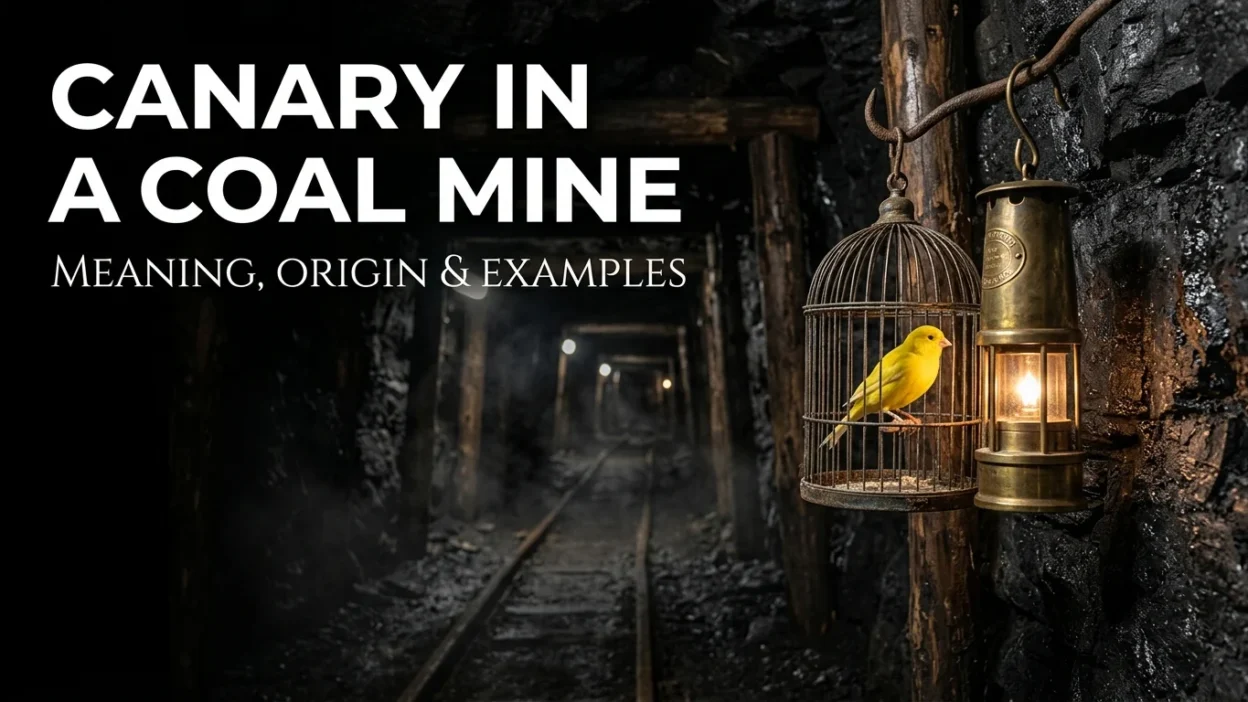
The phrase “canary in a coal mine” is a common English idiom used to describe an early warning sign of danger or a larger problem. If you hear someone say, “This could be a canary in a coal mine,” they usually mean that a small or noticeable problem may be warning us about something more serious.
The expression comes from an actual practice in coal mining. Miners once carried canaries underground because the birds were especially sensitive to dangerous gases such as carbon monoxide. If a canary became ill or died, miners knew the air could be unsafe and that they needed to leave the mine. Today, the phrase is used figuratively in everyday English, journalism, business, science, politics, and many other contexts.
Quick Answer
“Canary in a coal mine” means an early warning sign of a bigger or more serious problem. The expression comes from the historical use of canaries in coal mines to detect dangerous gases. Today, it is usually used figuratively to describe a person, event, or situation that signals possible trouble ahead.
Why Do People Confuse “Canary in a Coal Mine”?
People sometimes misunderstand this expression because its literal meaning and figurative meaning are very different.
Literally, a canary is a small bird, and a coal mine is a place where coal is extracted from underground. Historically, canaries were used as warning animals because they could be affected by poisonous gases before miners noticed the danger themselves.
Today, however, someone using the phrase usually is not talking about a bird or an actual mine.
The idiom means that something is acting as an early warning signal.
For example:
“The sudden drop in sales may be a canary in a coal mine for the company.”
Here, the falling sales are not necessarily the entire problem. They may be an early sign that the company is facing deeper financial difficulties.
First Word: “Canary”
A canary is a small songbird traditionally associated with bright yellow feathers, although canaries can have different colors.
In the idiom, the canary has a special historical role. Miners carried canaries into coal mines because the birds could show signs of distress when exposed to dangerous gases.
The important idea is early detection.
The bird’s condition could alert miners to danger before the situation became immediately obvious to them.
Example
“The rising number of customer complaints could be a canary for the business.”
In this sentence, “canary” is being used figuratively to mean an early indicator of trouble.
Second Word: “Coal Mine”
A coal mine is a place where coal is extracted from the earth. Historically, underground coal mines could contain dangerous gases, including carbon monoxide.
The phrase “canary in a coal mine” developed from the practice of taking caged canaries underground as an early-warning system.
The expression eventually became a metaphor for anything that reveals a hidden or developing danger.
Example
“The small increase in system failures could be the canary in a coal mine.”
The system failures may be an early indication of a much larger technical problem.
Canary in a Coal Mine: Comparison Table
| Expression | Meaning | Example |
|---|---|---|
| Canary in a coal mine | An early warning sign of a larger problem | “The layoffs may be a canary in a coal mine.” |
| Warning sign | Something that indicates possible danger | “The warning sign was easy to miss.” |
| Red flag | A sign that something may be wrong or dangerous | “The unusual contract terms were a red flag.” |
| Early indicator | Something that provides an early signal of a future condition | “Lower demand is an early indicator of weaker sales.” |
| Symptom | A sign showing that a problem or condition exists | “The error was a symptom of a larger issue.” |
When Should You Use “Canary in a Coal Mine”?
Use “canary in a coal mine” when one event, change, person, or situation could indicate that a more significant problem is developing.
It works especially well when:
- A small problem may signal a bigger problem.
- You want to emphasize early warning.
- The larger danger is not yet fully visible.
- An event could reveal a hidden trend.
- You are discussing business, society, technology, the environment, or other developing situations.
Formal Example
“The decline in groundwater levels could be a canary in a coal mine for the region’s water supply.”
Everyday Example
“His repeated complaints might be a canary in a coal mine for the whole team.”
The phrase can be used in both formal and informal English.
10+ Examples of “Canary in a Coal Mine”
Here are practical examples showing how native speakers may use the expression.
- The sudden drop in sales could be a canary in a coal mine for the company.
- The increase in customer complaints may be a canary in a coal mine.
- These early software failures could be a canary in a coal mine for the entire system.
- The unusually warm winter may be a canary in a coal mine for changing weather patterns.
- The team’s high employee turnover is a canary in a coal mine for deeper workplace problems.
- The shortage of essential materials could be a canary in a coal mine for the industry.
- A few canceled orders may be a canary in a coal mine for declining demand.
- The rising number of errors is a canary in a coal mine that the process needs attention.
- The bird population’s decline could be a canary in a coal mine for the local ecosystem.
- The first security breach was a canary in a coal mine for the company’s larger cybersecurity problems.
- The teacher viewed the student’s sudden drop in attendance as a canary in a coal mine.
- The small cracks in the building could be a canary in a coal mine for structural problems.
- The restaurant’s falling customer numbers may be a canary in a coal mine for changing consumer habits.
- The early warning signs were a canary in a coal mine for the financial crisis that followed.
Common Mistakes
Mistake 1: Taking the phrase literally
Not every use refers to an actual bird or coal mine.
Incorrect understanding:
“They are talking about a yellow bird underground.”
Better understanding:
“They are describing something that provides an early warning of danger.”
Mistake 2: Assuming it means any warning
The phrase usually suggests a warning of a larger or developing problem, rather than simply any ordinary warning.
For example:
“The fire alarm is a canary in a coal mine.”
This can work metaphorically, but a fire alarm is already specifically designed as a warning system. The idiom is especially useful when a seemingly smaller event reveals a deeper issue.
Mistake 3: Using it for a confirmed disaster
The expression often focuses on an early indication rather than a problem that is already completely obvious.
Compare:
“The first canceled contracts were a canary in a coal mine.”
with:
“The company went bankrupt.”
The first sentence describes an early warning. The second describes an established outcome.
Mistake 4: Forgetting “a”
The standard expression is:
a canary in a coal mine
For example:
“This could be a canary in a coal mine.”
Memory Trick
Think:
Canary → warning
Coal mine → danger
Canary in a coal mine → early warning of danger
A simple way to remember it is:
Small signal → bigger problem
When something seems minor but may reveal a much larger issue, you can think of it as a canary in a coal mine.
American vs British English
“Canary in a coal mine” is understood in both American and British English.
There is no major difference in the basic meaning or grammar of the idiom between the two varieties of English.
The expression may appear in:
- American news and conversation
- British newspapers and conversation
- Business writing
- Academic discussions
- Environmental writing
- Technology articles
- Everyday speech
The spelling canary and coal mine remains the same in both varieties.
Similar Words and Expressions
Several English expressions have meanings related to “canary in a coal mine.”
Warning Sign
A warning sign is something that indicates possible danger or trouble.
“The repeated delays were a warning sign.”
Red Flag
A red flag is a sign that something may be wrong, risky, or concerning.
“The unusual payment request was a red flag.”
Early Warning
An early warning is information that indicates a problem before it becomes more serious.
“The report provided an early warning of supply shortages.”
Indicator
An indicator is something that provides information about a condition or trend.
“Consumer spending can be an indicator of economic confidence.”
Symptom
A symptom is a sign or indication of a problem, especially in medicine, but the word can also be used more generally.
“The argument was a symptom of a deeper disagreement.”
Harbinger
A harbinger is something that signals that something else is likely to happen.
“The early snowfall was a harbinger of winter.”
Although these expressions overlap, “canary in a coal mine” particularly emphasizes an early sign of a potentially larger problem.
Final Verdict
“Canary in a coal mine” is an idiom meaning an early warning sign of a larger or potentially serious problem.
Its meaning comes from the historical use of canaries in coal mines. The birds could show signs of exposure to dangerous gases, alerting miners that the underground air might be unsafe.
Today, the phrase is usually metaphorical. A falling sales figure, technical failure, environmental change, employee turnover, or other early development can be described as a canary in a coal mine when it may signal a deeper problem.
Frequently Asked Questions
What does “canary in a coal mine” mean?
It means an early warning sign of a larger or more serious problem. The phrase is usually used figuratively in modern English.
Why were canaries used in coal mines?
Canaries were used because they could show signs of distress when exposed to dangerous gases in mines. Their condition could provide miners with an early warning that the air was unsafe.
Is “canary in a coal mine” an idiom?
Yes. In modern English, “canary in a coal mine” is an idiomatic expression. Its figurative meaning is different from the literal meaning of the individual words.
Can I use “canary in a coal mine” in formal writing?
Yes. The expression can be used in formal writing, journalism, business discussions, academic contexts, and everyday conversation, particularly when explaining an early warning sign.
What is another way to say “canary in a coal mine”?
Depending on the context, you can say warning sign, early warning, early indicator, red flag, symptom, or harbinger.
What does “a canary” symbolize in this expression?
The canary symbolizes an early indicator of danger. Something may appear small or relatively harmless while signaling a more serious problem.
What is an example of “canary in a coal mine”?
“The sudden rise in customer complaints may be a canary in a coal mine for the company.”
This means the complaints could be an early sign of larger problems.
Remember This
Canary in a coal mine = an early warning sign of a bigger problem.
Remember the simple pattern:
Small signal → possible bigger danger
If something gives you an early indication that a more serious issue may be developing, “canary in a coal mine” can be an appropriate expression.
Conclusion
The idiom “canary in a coal mine” has a fascinating connection to the history of coal mining. Canaries were used as an early warning system because their reactions could alert miners to dangerous conditions. This historical idea gave English speakers a powerful metaphor for recognizing hidden or developing problems.
Today, the phrase is useful whenever a relatively small event may signal something much larger. Understanding its meaning, history, and context will help you recognize the expression in conversations, articles, news reports, and professional writing.