
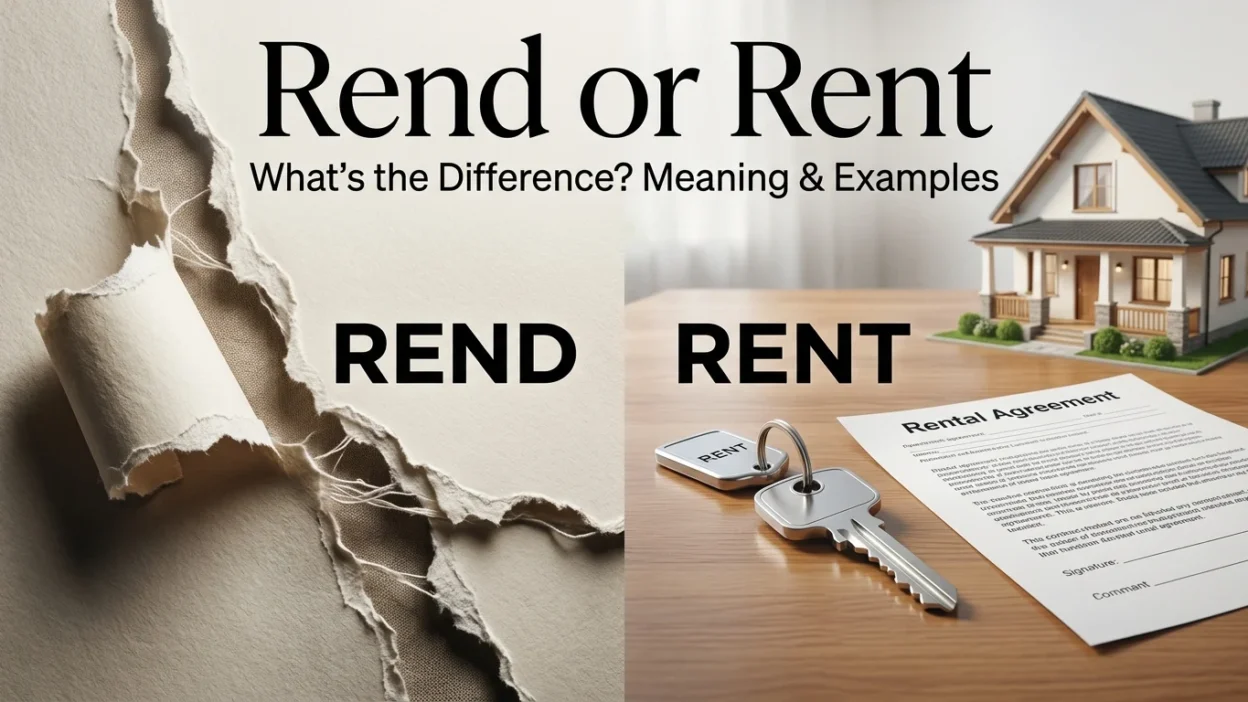
English has many words that look or sound similar but have completely different meanings. “Rend” and “rent” are a good example. Both are real English words, but they are used in very different situations, and confusing them can change the meaning of a sentence completely.
Rend is a verb that means to tear, split, or violently pull something apart. Rent can be a verb meaning to pay for the temporary use of something, or a noun referring to the payment made for that use. In some contexts, rent can also be the past tense and past participle of rend, although this use is uncommon and often literary.
Quick Answer: Rend or Rent?
Rend usually means “to tear or split apart,” while rent commonly means “to pay to use something temporarily” or “the payment for that use.” For example, “The cloth was rent in two” uses rent as a literary past form of rend, while “I pay rent every month” uses the common noun rent.
Why Do People Confuse Rend and Rent?
People confuse rend and rent because they are closely related in spelling and pronunciation, and rent can actually be connected grammatically to rend.
The main difference is meaning:
- Rend = tear, split, or pull apart.
- Rent = pay for temporary use, or the payment for that use.
- Rent can also be a past form of rend, especially in older, literary, or formal writing.
The context usually makes the intended meaning clear.
First Word: Rend
Rend is a verb meaning to tear, split, or violently pull something apart.
It often describes physical destruction, but it can also be used figuratively for intense emotional pain.
Examples of “Rend”
- The storm rent the old sail apart.
- The wolf tried to rend the fabric with its teeth.
- The explosion rent the building’s metal door.
- The loud cry seemed to rend the silence.
- Grief rent her heart.
- The warriors attempted to rend the enemy’s defenses.
Forms of “Rend”
The verb has irregular forms:
- Present: rend
- Past: rent
- Past participle: rent
- Present participle: rending
For example:
The machine may rend the material.
The machine rent the material apart.
The machine had rent the material before anyone could stop it.
In everyday English, rend is relatively uncommon. It is more likely to appear in literary, dramatic, historical, or formal writing.
Second Word: Rent
Rent has a much more common meaning in modern English. As a noun, it means money paid regularly to use a house, apartment, office, vehicle, or other property.
As a verb, rent means to pay for or allow someone to use something temporarily in exchange for money.
Examples of “Rent”
- I pay my apartment rent on the first of every month.
- They rent a house near the university.
- We decided to rent a car for the weekend.
- She rents an office downtown.
- How much is the monthly rent?
- They rented a small apartment last year.
Important Note
Rent can therefore have two common modern meanings:
- Rent as a noun: payment for temporary use.
- Rent as a verb: to pay for or provide something for temporary use.
There is also the less common verb form rent, meaning “torn,” which comes from rend.
Rend vs Rent: Comparison Table
| Word | Common meaning | Part of speech | Example |
|---|---|---|---|
| rend | to tear or split apart | Verb | The claws could rend the fabric. |
| rent | payment for temporary use | Noun | My rent is due tomorrow. |
| rent | to use something temporarily for payment | Verb | We rent a car. |
| rent | past form of rend | Verb | The blast rent the wall apart. |
When to Use Each
Use rend when you mean tear, split, or pull apart.
The powerful machine could rend the metal.
Use rent when you are talking about housing, property, temporary use, or payment.
We rent an apartment.
Our monthly rent has increased.
Use rent as the past tense of rend only when the context clearly means tore.
The explosion rent the air with a terrible sound.
This particular use is uncommon in ordinary conversation.
10+ Examples of Rend and Rent
Understanding the words in complete sentences makes the difference easier to remember.
- The sharp claws could rend the leather.
- The fabric was rent by the force of the machine.
- The storm rent the sail in two.
- The noise seemed to rend the peaceful silence.
- They rent an apartment close to work.
- We need to pay the rent before Friday.
- She decided to rent a car for her trip.
- The company rents office space in the city.
- The explosion rent the metal barrier apart.
- His emotional cry seemed to rend the silence.
- They cannot afford the high rent in that neighborhood.
- We rented a room for three nights.
Notice that rent is extremely common when discussing housing and temporary use, while rend is much more specialized.
Common Mistakes
Mistake 1: Using “rend” for property
Incorrect:
I need to pay my rend this month.
Correct:
I need to pay my rent this month.
Mistake 2: Using “rent” when you mean the present action of tearing
Incorrect:
The machine will rent the material apart.
Correct:
The machine will rend the material apart.
Mistake 3: Assuming every “rent” means payment
The word rent can also be a verb.
We rent a car every summer.
Here, rent does not mean the payment itself.
Mistake 4: Forgetting the literary use of “rent”
In a sentence such as:
The explosion rent the sky.
Rent does not mean an apartment payment. It is the past tense of rend, meaning that something violently split or tore.
Memory Trick: How to Remember Rend vs Rent
Use this simple trick:
Rend = Rip
Both rend and rip begin with a strong “r” sound and involve tearing.
Think:
Rend = Rip apart
For rent, think about a rental:
Rent = Rental payment or temporary use
So remember:
- Rend → rip
- Rent → rental
If you see rent in a sentence about an apartment, house, car, or payment, it almost certainly has its common modern meaning.
American vs British English
The basic meanings of rend and rent are the same in American and British English.
Rent is widely used in both varieties to describe payment for a property or the act of temporarily using something for payment.
Rend, however, is relatively uncommon in everyday speech in both varieties. It tends to appear in literary, formal, historical, or dramatic contexts.
There is no major American-versus-British distinction that changes the fundamental difference between these words.
Similar Words
Several words are related to rend and rent, but they are not interchangeable.
Rend vs Tear
Tear is the ordinary everyday word for pulling or cutting something apart.
Be careful not to tear the paper.
Rend sounds stronger and is often more dramatic.
The explosion rent the structure apart.
Rent vs Lease
Both can involve temporary use of property, but they are often used differently.
- Rent is extremely common in everyday speech.
- Lease often refers to a formal agreement, especially for property or vehicles.
We rent an apartment.
We signed a one-year lease.
Rent vs Hire
In British English, hire is commonly used for temporarily paying to use something.
We hired a car for the weekend.
American English commonly uses rent in this situation:
We rented a car for the weekend.
Final Verdict: Rend or Rent?
Choose rend when you mean tear, split, or pull apart.
Choose rent when you mean payment for temporary use or the act of temporarily using something for payment.
Remember that rent can also be the past tense of rend, but this usage is uncommon and generally appears in literary or formal contexts.
The easiest distinction is:
Rend = tear apart
Rent = pay to use something
FAQs About Rend or Rent
Is “rend” the same as “tear”?
Yes. Rend can mean to tear or split something apart, although it is less common and often more dramatic or literary than tear.
Is “rent” the past tense of “rend”?
Yes. Rent is an established past tense and past participle of rend. For example, “The blast rent the wall apart.” However, this use is uncommon in everyday English.
What does “rent” usually mean?
In modern English, rent usually refers to money paid to use property or the act of temporarily using something in exchange for payment.
Can “rent” be a verb?
Yes. For example, “We rent an apartment” uses rent as a verb.
Can “rend” be a noun?
No. Rend is normally used as a verb. The noun rent has a completely different common meaning related to payment for temporary use.
Is “rend” common in everyday English?
No. Rend is much less common than tear and often appears in literary, formal, dramatic, or historical writing.
What is an easy way to remember the difference?
Think “rend = rip” and “rent = rental.” If something is being torn apart, use rend. If you are paying to use something, use rent.
Remember This
- Rend = to tear or split apart.
- Rent = payment for temporary use.
- Rent = to use something temporarily for payment.
- Rent can also be the past form of rend.
- The “torn apart” meaning of rent is uncommon and often literary.
Conclusion
Although rend and rent look very similar, their common meanings are easy to separate once you focus on context. Rend means to tear or split apart, while rent usually relates to paying for or temporarily using something.
When you see rent in everyday conversations about apartments, houses, cars, or payments, it almost certainly has its modern meaning. When you see rend, think of something being torn apart. And when you encounter rent meaning “tore,” remember that it is the less common past form of rend.