
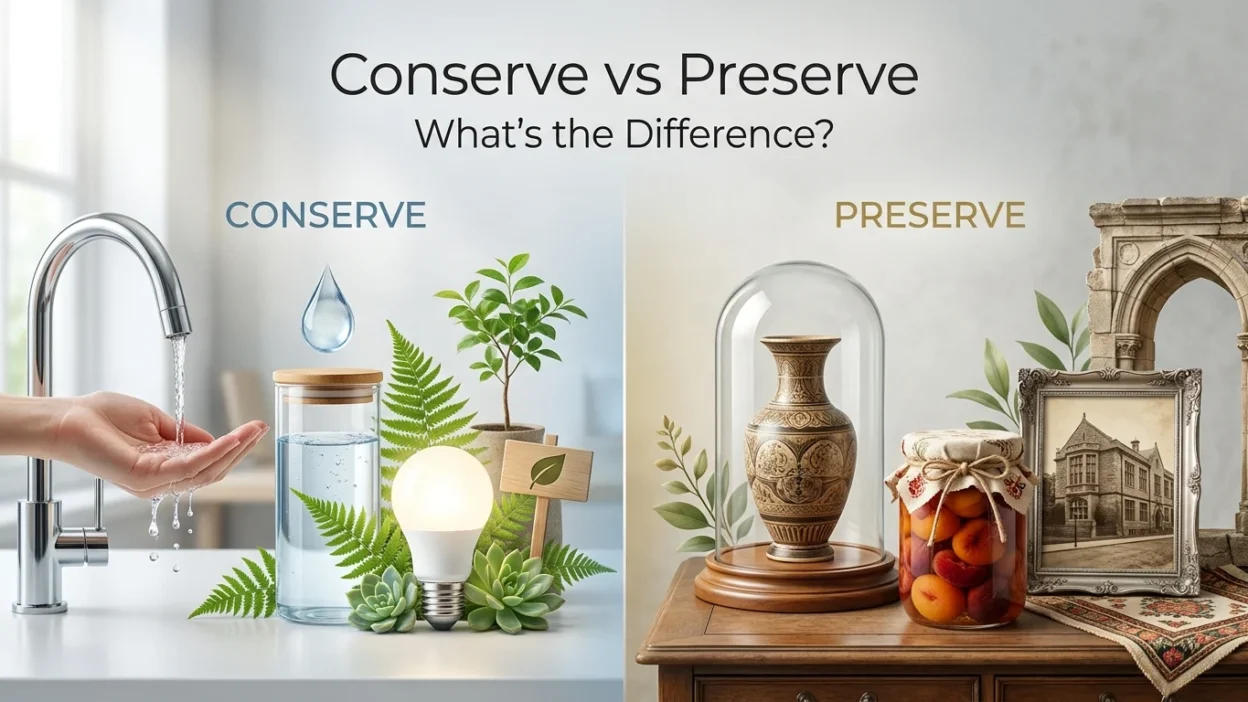
If you have ever wondered about conserve vs preserve, you are not alone. These two English verbs are closely related because both can describe protecting something from damage, loss, or unnecessary use. However, they are not always interchangeable. The difference often depends on whether the focus is on using something carefully or keeping something in its original condition.
Understanding the distinction between conserve and preserve can make your writing more precise. You may conserve water, energy, or natural resources, while you may preserve food, historical buildings, traditions, or important records. In some contexts, either word can work, but the meaning or emphasis may change slightly. This guide explains conserve vs preserve, their meanings, grammatical uses, examples, common mistakes, and an easy memory trick to help you choose the right word confidently.
Quick Answer
Conserve usually means to use something carefully and avoid wasting it, especially resources such as water, energy, or wildlife. Preserve usually means to protect something and keep it in its existing or original condition. For example, we conserve water but preserve historic buildings.
Why Do People Confuse Conserve and Preserve?
People confuse these words because both involve protection and preventing loss or damage.
For example:
- We conserve water by using less of it.
- We preserve water in a container for future use.
Both sentences are grammatically possible, but the focus is different.
Conserve emphasizes careful use, efficient management, or preventing waste.
Preserve emphasizes protecting something from change, damage, decay, or destruction.
The distinction becomes especially important when talking about natural resources, food, history, culture, and the environment.
What Does “Conserve” Mean?
Conserve means to protect something from being wasted, used up, damaged, or unnecessarily consumed.
It is particularly common when discussing natural resources and energy.
Examples include:
- conserve water
- conserve energy
- conserve electricity
- conserve fuel
- conserve natural resources
- conserve wildlife
- conserve forests
Examples of “Conserve”
- We should conserve water during dry seasons.
- Turn off the lights to conserve energy.
- The program helps conserve endangered species.
- Farmers are learning new ways to conserve soil.
- We need to conserve fuel during the shortage.
The central idea is careful use and protection from unnecessary loss.
What Does “Preserve” Mean?
Preserve means to protect something so that it remains safe, intact, unchanged, or in good condition.
It can refer to physical objects, food, traditions, buildings, documents, memories, and natural places.
Common combinations include:
- preserve food
- preserve history
- preserve traditions
- preserve culture
- preserve old buildings
- preserve documents
- preserve nature
- preserve memories
Examples of “Preserve”
- The museum works to preserve historical documents.
- Salt was once commonly used to preserve food.
- We should preserve traditional crafts.
- The organization wants to preserve the old building.
- Photographs help preserve memories.
The central idea is keeping something safe and maintaining its condition or existence.
Conserve vs Preserve: Comparison Table
| Feature | Conserve | Preserve |
|---|---|---|
| Basic meaning | Use carefully and avoid waste | Protect and keep safe |
| Main focus | Preventing unnecessary consumption or loss | Maintaining condition or existence |
| Common objects | Water, energy, fuel, resources | Food, history, culture, buildings |
| Environmental use | Very common | Also common |
| Example | Conserve water | Preserve a wetland |
| Main idea | Use less or manage wisely | Keep safe or unchanged |
A useful way to remember the difference is:
Conserve = use carefully.
Preserve = keep protected.
When Should You Use “Conserve”?
Use conserve when the idea involves using something wisely, reducing waste, or protecting a limited resource.
Common situations
1. Natural resources
- conserve water
- conserve forests
- conserve soil
- conserve wildlife
2. Energy
- conserve electricity
- conserve energy
- conserve fuel
3. Money or resources
In some contexts, conserve can also mean avoiding unnecessary spending or depletion.
- The company needs to conserve its financial resources.
4. Wildlife and nature
- Conservation programs help conserve endangered species.
When Should You Use “Preserve”?
Use preserve when your main goal is to keep something safe, intact, original, or available for the future.
Common situations
1. Food
- preserve fruit
- preserve meat
- preserve vegetables
2. History
- preserve historical records
- preserve ancient artifacts
3. Culture
- preserve traditions
- preserve cultural practices
- preserve a language
4. Buildings
- preserve historic architecture
- preserve an old house
5. Memories and information
- preserve memories
- preserve family photographs
- preserve important documents
Conserve vs Preserve: 12 Examples
Here are practical examples showing how the words work in everyday English.
- We should conserve water by taking shorter showers.
- Solar panels can help households conserve energy.
- The museum works hard to preserve ancient artifacts.
- Refrigeration helps preserve food for longer periods.
- Farmers use special techniques to conserve soil.
- The community wants to preserve its cultural traditions.
- Turning off unused appliances can conserve electricity.
- The government created a park to preserve the natural habitat.
- We should conserve fuel whenever possible.
- The restoration project aims to preserve the historic building.
- The family carefully stored the photographs to preserve their memories.
- Wildlife organizations work to conserve endangered animals and their habitats.
Notice that conserve often suggests responsible management, while preserve often suggests keeping something protected or intact.
Common Mistakes with Conserve and Preserve
Mistake 1: Using “preserve” when you mean “use less”
❌ We should preserve water by taking shorter showers.
This is possible in certain contexts, but conserve water is the more natural expression when the idea is reducing consumption.
✅ We should conserve water by taking shorter showers.
Mistake 2: Using “conserve” for historical objects
❌ The museum wants to conserve the ancient painting.
This is not necessarily incorrect. In specialist contexts, conservation is actually the professional protection and restoration of artworks. However, in ordinary English, preserve may better express the general idea of keeping the painting safe.
✅ The museum wants to preserve the ancient painting.
Mistake 3: Thinking they are always interchangeable
Although both words can mean “protect,” their emphasis differs.
- Conserve resources → avoid wasting or using them unnecessarily.
- Preserve resources → protect them so they remain available or intact.
The surrounding context determines which word sounds most natural.
What Is an Easy Memory Trick?
Use this simple rule:
Conserve = consume carefully.
Preserve = protect and keep.
Think of a glass of water.
If you drink less water because there is a shortage, you conserve water.
If you put something into a container or use a method to keep it safe for later, you preserve it.
Another quick memory aid is:
Conserve what you use; preserve what you want to keep.
This is not a rule for every specialized context, but it works well for everyday English.
Conserve vs Preserve in American and British English
There is no major difference in meaning between American and British English for conserve and preserve.
Both varieties commonly use:
- conserve water
- conserve energy
- preserve food
- preserve traditions
- preserve historical buildings
British and American speakers may differ in vocabulary or spelling in some areas, but these two verbs generally have the same meanings and grammatical patterns in both varieties.
What Words Are Similar to Conserve and Preserve?
Several related words can help you understand the distinction.
Protect
Protect means to keep someone or something safe from harm.
- We must protect endangered animals.
It is a broad term.
Save
Save can mean preventing something from being wasted, lost, or damaged.
- We should save water during the drought.
Maintain
Maintain means to keep something in a particular condition.
- The staff maintains the historic building carefully.
Sustain
Sustain often means to support something so that it continues over time.
- Sustainable practices help sustain natural ecosystems.
Conserve
Conserve focuses strongly on avoiding waste or excessive use.
Preserve
Preserve focuses strongly on protecting something and keeping it in a particular state.
Final Verdict: Conserve or Preserve?
The easiest distinction is:
Use “conserve” when you mean to use something carefully, avoid waste, or prevent a resource from being depleted.
- conserve water
- conserve energy
- conserve fuel
- conserve natural resources
Use “preserve” when you mean to protect something and keep it safe, intact, or in its existing condition.
- preserve food
- preserve history
- preserve traditions
- preserve buildings
- preserve memories
There can be overlap, especially in environmental contexts. The key is to ask yourself: Am I focusing on careful use, or am I focusing on keeping something protected?
Frequently Asked Questions
Is it “conserve water” or “preserve water”?
Conserve water is the usual choice when you mean using less water or avoiding waste. For example, “We should conserve water during the summer.”
Is it “preserve the environment” or “conserve the environment”?
Both can occur, but preserve the environment emphasizes protecting it from damage, while conserve the environment emphasizes responsible management and protection of natural resources.
Is “conserve food” correct?
Yes, but preserve food is generally more natural when you mean treating or storing food so that it remains usable for longer. “Conserve food” can instead suggest avoiding food waste or using food carefully.
What is the difference between conservation and preservation?
Conservation generally involves responsible management and protection, often allowing resources to continue being used sustainably. Preservation places stronger emphasis on keeping something protected or maintaining it in its existing state.
Can conserve and preserve be synonyms?
Yes, they can overlap because both can mean protecting something. However, they are not always interchangeable. Conserve often emphasizes careful use, while preserve emphasizes maintaining or protecting something.
Which is correct: conserve energy or preserve energy?
Conserve energy is the standard and natural expression when you mean reducing energy use or avoiding waste.
Which is correct: preserve traditions or conserve traditions?
Preserve traditions is the more natural expression when you mean keeping cultural traditions alive and passing them on to future generations.
Remember This
- Conserve = use carefully and avoid waste.
- Preserve = protect and keep safe.
- Conserve water and energy.
- Preserve food, history, culture, and traditions.
- Both words can mean “protect,” but their focus is different.
- Context determines which word sounds most natural.
Conclusion
Understanding conserve vs preserve becomes much easier when you focus on the main purpose. Conserve usually refers to careful use, efficient management, and preventing waste, especially with resources such as water, energy, fuel, and natural resources. Preserve usually refers to protecting something so that it remains safe, intact, or available in the future.
When you are unsure, ask yourself whether you are talking about using something wisely or keeping something protected. If you are reducing waste, choose conserve; if you are maintaining or protecting something, preserve will often be the better choice.