English learners often confuse further and furthermore because both words can introduce the idea of adding information or moving beyond something. However, they do not work in the same way grammatically, and using one in place of the other can make a sentence sound unnatural.
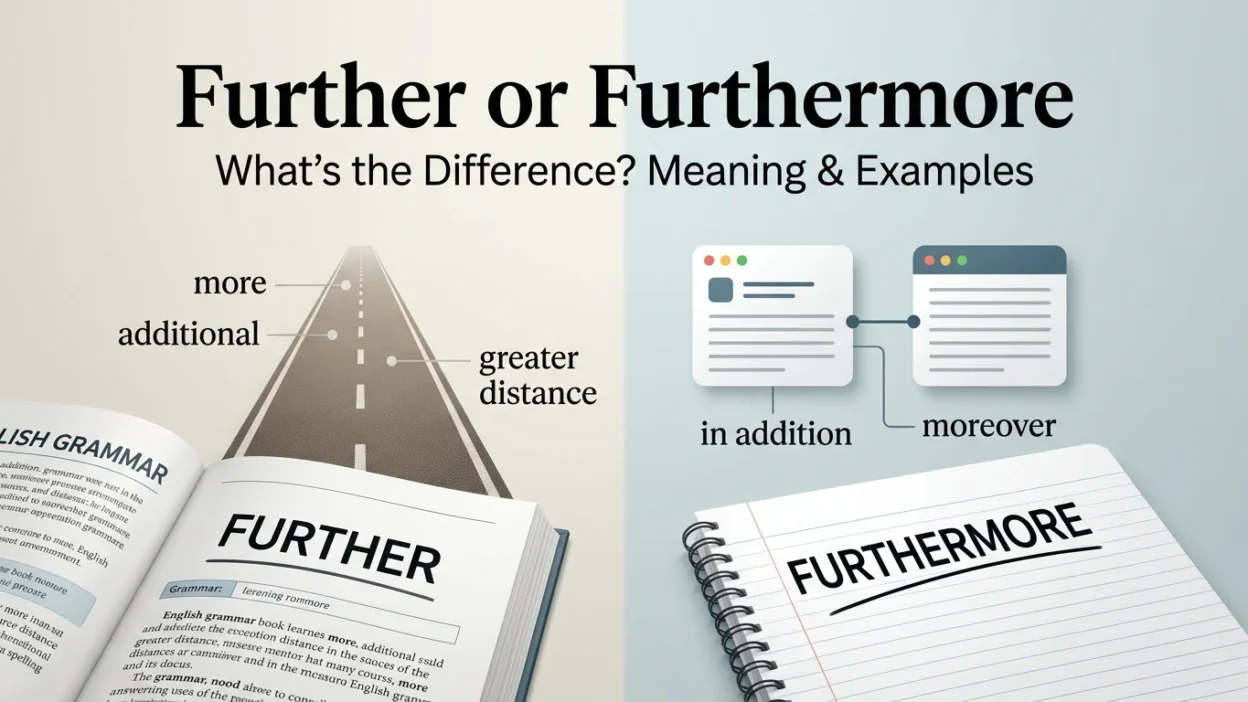
The key difference is simple: further usually means “to a greater degree,” “additional,” or “at a greater distance,” while furthermore is a formal linking adverb meaning “in addition” or “also.” Understanding their meanings and sentence positions will help you choose the correct word in writing and conversation.
Quick Answer
Further can mean additional, more, or at a greater distance, while furthermore means “in addition” or “moreover.” Use further with nouns, verbs, adjectives, or ideas, but use furthermore mainly to connect one statement to another.
Why Do People Confuse Further and Furthermore?
The confusion comes from their related meaning. Historically, furthermore developed from further plus more, and both words can appear when discussing additional information.
For example:
- We need further information.
- The plan is expensive. Furthermore, it may take months.
In the first sentence, further describes the noun information. In the second, furthermore connects two complete ideas.
A useful rule is:
Further = more/additional or farther.
Furthermore = in addition/moreover.
What Does Further Mean?
Further has several common meanings. It can refer to something additional, something that happens to a greater degree, or movement toward a greater distance.
Further as “Additional”
When further means additional or more, it often comes before a noun.
- We need further information.
- The company requested further details.
- No further action is required.
- They conducted further research.
Further as “To a Greater Degree”
It can also describe progress or development.
- We need to further investigate the problem.
- The new policy could further improve safety.
- This discussion will further our understanding of the issue.
Further as a Distance or Progress Word
Further can also relate to physical or figurative distance.
- Walk further down the road.
- We cannot go any further.
- She wants to take her education further.
What Does Furthermore Mean?
Furthermore is a conjunctive adverb used to add another related point to something already stated.
It means:
- in addition
- moreover
- also
- besides
It is especially common in formal writing.
For example:
The apartment is too expensive. Furthermore, it is far from the city center.
The second sentence adds another reason supporting the first idea.
Furthermore generally connects ideas rather than describing a noun.
Further vs Furthermore: Comparison Table
| Feature | Further | Furthermore |
|---|---|---|
| Basic meaning | More, additional, farther | In addition, moreover |
| Part of speech | Adjective, adverb, verb | Conjunctive adverb |
| Describes a noun? | Yes | No |
| Can describe distance? | Yes | No |
| Can introduce an additional point? | Sometimes, depending on structure | Yes |
| Common in formal writing? | Yes | Yes |
| Example | We need further information. | Furthermore, we need more time. |
When Should You Use Further?
Use further when you mean additional, more, farther, or to a greater extent.
Common combinations include:
- further information
- further details
- further discussion
- further research
- further investigation
- further assistance
- further development
- further consideration
- further explanation
- further progress
Examples
- Please contact us if you need further information.
- The doctor recommended further tests.
- We need to discuss this matter further.
- They decided to conduct further research.
- The road continues further into the forest.
- The new evidence may further strengthen the argument.
When Should You Use Furthermore?
Use furthermore when you want to add another point to a statement or argument.
It commonly appears at the beginning of a sentence, followed by a comma.
Examples
- The product is affordable. Furthermore, it is easy to use.
- She is highly qualified. Furthermore, she has several years of experience.
- The hotel is comfortable. Furthermore, it is close to the airport.
- The proposal is expensive. Furthermore, it would take several years to complete.
- The course is useful. Furthermore, it provides practical experience.
- The evidence is limited. Furthermore, some of it is unreliable.
In everyday conversation, also, besides, and in addition are often more natural than furthermore.
Further or Furthermore: 10+ Examples
Seeing the two words side by side makes the distinction easier.
1. Additional Information
Correct: Please send me further information.
Here, further modifies information.
2. Adding Another Point
Correct: The service is slow. Furthermore, it is expensive.
Here, furthermore introduces an additional argument.
3. More Discussion
Correct: We need to discuss the matter further.
You are talking about discussing something in greater depth.
4. Adding Supporting Information
Correct: The plan is practical. Furthermore, it is inexpensive.
Furthermore means in addition.
5. More Research
Correct: Scientists need further research before reaching a conclusion.
Further means additional.
6. Another Reason
Correct: He missed the deadline. Furthermore, he did not explain why.
The second sentence adds another piece of information.
7. Greater Distance
Correct: The village is further from the city than I expected.
Here, further relates to distance.
8. More Investigation
Correct: The police decided to further investigate the case.
Here, further means to continue or develop an action.
9. Additional Evidence
Correct: We need further evidence to support the claim.
Further modifies the noun evidence.
10. Adding a Formal Point
Correct: The policy is difficult to implement. Furthermore, it could be costly.
Furthermore connects the two ideas.
11. Continuing an Activity
Correct: The teacher encouraged students to explore the subject further.
Here, further means to a greater extent or in greater depth.
12. Adding Information in Formal Writing
Correct: The building is old. Furthermore, it requires extensive repairs.
The second sentence provides an additional point.
Common Mistakes
Mistake 1: Using Furthermore Before a Noun
❌ We need furthermore information.
✅ We need further information.
Furthermore cannot normally function as an adjective before information.
Mistake 2: Treating Further and Furthermore as Exact Synonyms
❌ I need furthermore details.
✅ I need further details.
The meaning of furthermore is not simply “more.” It means in addition.
Mistake 3: Using Furthermore When Further Is Needed
❌ We need to discuss the issue furthermore.
✅ We need to discuss the issue further.
The intended meaning is “discuss it more,” so further is correct.
Mistake 4: Overusing Furthermore
Because furthermore sounds formal, learners sometimes use it repeatedly in essays.
For example:
Furthermore, the plan is expensive. Furthermore, it is difficult. Furthermore, it takes time.
This can sound repetitive. Depending on the context, use alternatives such as also, in addition, or moreover.
Memory Trick
A simple trick can help you remember the difference:
Further = further information = more information.
Furthermore = furthermore = in addition.
Think of further as a word that can describe something more, while furthermore helps you add another idea.
For example:
I need further information.
The information is useful. Furthermore, it is easy to understand.
American vs British English
Both further and furthermore are standard in American and British English.
There is no major difference in their basic meanings between the two varieties.
One small point worth knowing is that farther is traditionally associated with physical distance, especially in American English:
- The store is farther away.
- We walked farther than expected.
However, further is also widely used for distance, and the distinction between farther and further is not absolute in modern English.
Furthermore remains a formal linking word in both American and British English.
Similar Words
Several words are closely related to further and furthermore.
Further vs Farther
Further can mean additional or greater in degree, while farther is traditionally used for physical distance.
- We need further discussion.
- The house is farther away.
Furthermore vs Moreover
These two words are very similar.
- The plan is expensive. Furthermore, it is complicated.
- The plan is expensive. Moreover, it is complicated.
Both introduce an additional point. Furthermore and moreover are generally more formal than also.
Furthermore vs In Addition
Both can introduce another point.
- The hotel is clean. Furthermore, it is affordable.
- The hotel is clean. In addition, it is affordable.
In addition can sound slightly more neutral and is common in both formal and general writing.
Final Verdict
Further and furthermore are related but not interchangeable.
Use further when you mean more, additional, farther, or to a greater extent. It can modify nouns and can also function as an adverb or verb.
Use furthermore when you mean in addition or moreover and want to connect an additional idea to what came before.
The easiest distinction is:
Further = more/additional.
Furthermore = in addition.
Frequently Asked Questions
Is furthermore the same as further?
No. Further can mean “more,” “additional,” or “farther,” while furthermore means “in addition” or “moreover.”
Can I use furthermore at the beginning of a sentence?
Yes. This is one of its most common uses.
Furthermore, the results support the original conclusion.
Is furthermore formal?
Yes. Furthermore is generally associated with formal or academic writing. In casual conversation, also, besides, or in addition may sound more natural.
Can further describe a noun?
Yes. For example:
We need further information.
Here, further means additional.
Can I say “furthermore information”?
No. The natural expression is further information.
Is “further discussion” correct?
Yes. Further discussion means additional or more discussion.
What is a simple synonym for furthermore?
Common synonyms include moreover, in addition, and also, although the best choice depends on the sentence and level of formality.
Remember This
- Further = more, additional, farther, or to a greater extent.
- Furthermore = in addition or moreover.
- Use further information, not furthermore information.
- Use furthermore to introduce an additional idea.
- Further and furthermore are both standard in American and British English.
Understanding whether you are describing something additional or adding another idea will usually tell you which word to choose.
Conclusion
The difference between further and furthermore becomes much easier once you focus on their grammatical roles. Further can describe something additional or indicate greater distance or degree, while furthermore connects ideas by adding another point.
When you mean “more” or “additional,” choose further. When you mean “in addition” or “moreover,” choose furthermore. With this simple distinction, you can use both words naturally and accurately in everyday and formal English.

Evelyn Mia is a creative content writer and slogan enthusiast at SloganIdea. She specializes in crafting memorable slogans, catchy taglines, and branding ideas, helping businesses, students, and creators communicate effectively.