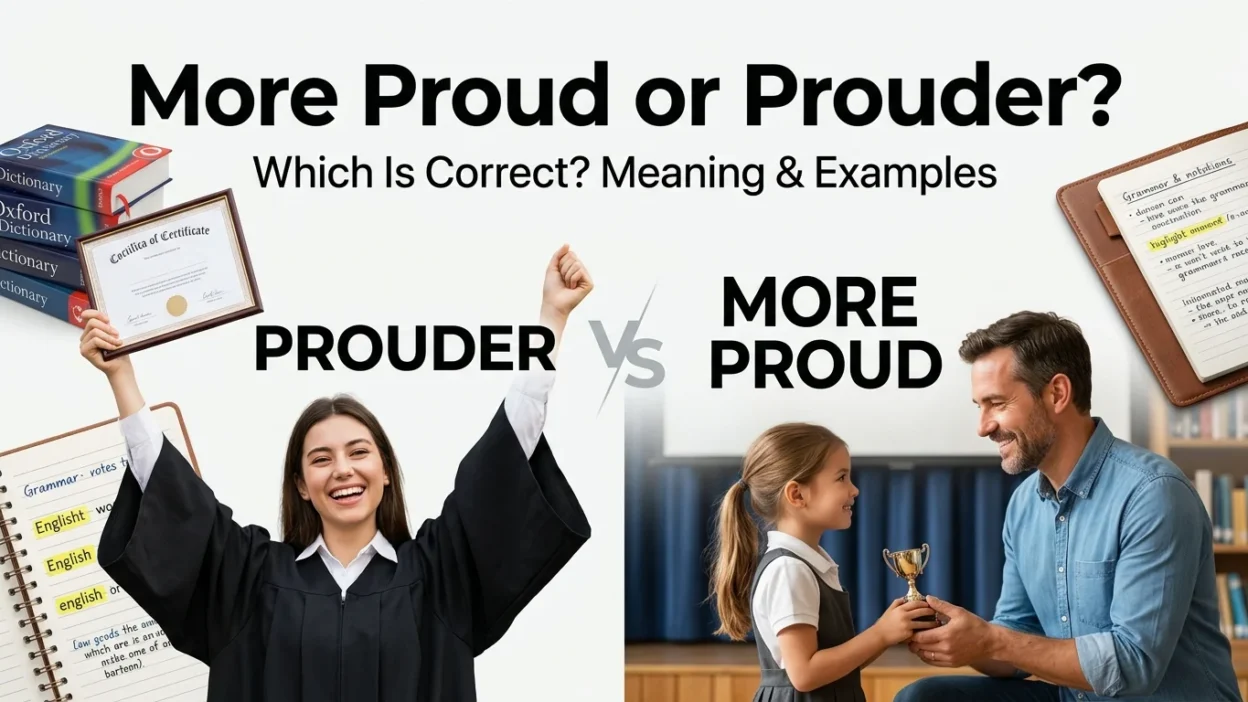
When comparing two levels of pride, should you say “more proud” or “prouder”? The short answer is that “prouder” is the standard comparative form of “proud,” while “more proud” is also grammatically possible and commonly used in certain contexts. For example, “I am prouder of you than ever” and “I couldn’t be more proud of you” are both natural English.
The choice can depend on sentence structure, emphasis, and style. Prouder is formed with the comparative suffix -er, while more proud uses the word more before the adjective. Understanding when each form sounds natural can help students, ESL learners, and English speakers avoid awkward comparisons and choose the expression that best fits the situation.
Quick Answer
“Prouder” and “more proud” can both be correct. “Prouder” is the regular comparative form of the one-syllable adjective proud and works naturally in direct comparisons. “More proud” is also used, especially for emphasis or in expressions such as “couldn’t be more proud.”
Why Do People Confuse “More Proud” and “Prouder”?
The confusion comes from the fact that English has two common ways to form comparative adjectives:
- Adjective + -er: proud → prouder
- More + adjective: proud → more proud
For many short adjectives, English normally prefers the -er form. Since proud has only one syllable, prouder is the usual comparative form.
However, more proud is not automatically wrong. Native speakers use it in particular sentence patterns, especially when they want to emphasize the degree of pride.
Compare:
- I am prouder of my daughter than I was last year.
- I couldn’t be more proud of my daughter.
Both are natural, but they communicate the comparison differently.
First Word: “Prouder”
Prouder is the comparative form of proud.
It normally means having a greater feeling of pride than someone or something else, or having a greater degree of pride than before.
Examples
- I am prouder of you than ever.
- She felt prouder after completing the project.
- He is prouder of his team this year.
- I couldn’t be prouder of my students.
The basic pattern is:
proud → prouder → proudest
For example:
- Positive: She is proud of her work.
- Comparative: She is prouder of her work now.
- Superlative: She is the proudest member of the team.
Second Word: “More Proud”
More proud uses more to increase the degree of the adjective proud.
It is grammatically possible and appears frequently in modern English, particularly in emphatic expressions.
Examples
- I couldn’t be more proud of you.
- We are more proud of our achievements than ever.
- She seemed more proud after receiving the award.
- He is more proud of his son than he was before.
One especially common expression is:
I couldn’t be more proud of you.
This means that the speaker feels an extremely high level of pride—so high that it could not be greater.
“More Proud” vs “Prouder”: Comparison Table
| Feature | Prouder | More proud |
|---|---|---|
| Base adjective | proud | proud |
| Formation | proud + -er | more + proud |
| Grammar | Comparative | Comparative construction |
| Common use | Direct comparisons | Emphasis and certain sentence patterns |
| Example | I am prouder now. | I am more proud than before. |
| With “than” | Very natural | Also possible |
| With “couldn’t be” | Possible | Extremely common |
| General advice | Usually the natural choice for a simple comparison | Natural in appropriate contexts |
When Should You Use “Prouder”?
Use prouder when you are making a straightforward comparison between two levels or situations.
1. Comparing now with the past
- I am prouder of myself now than I was before.
- She feels prouder after finishing the course.
2. Comparing two people
- John is prouder of his brother than Mark is.
- Maria seems prouder of her achievement than Anna.
3. Comparing two achievements
- I am prouder of this painting than my previous one.
- He is prouder of his second book.
4. Using “than”
Prouder than is a very natural construction.
- She is prouder than she was last year.
- He looks prouder than his teammates.
- I am prouder than ever.
When Should You Use “More Proud”?
Use more proud when it fits the structure or emphasis of the sentence.
It is particularly common when the speaker wants to emphasize an extremely high degree of pride.
Common pattern: “couldn’t be more proud”
- I couldn’t be more proud of you.
- We couldn’t be more proud of our students.
- She couldn’t be more proud of her children.
This does not mean the speaker lacks pride. It means the speaker feels as much pride as possible.
Another pattern: “more proud than”
- I am more proud than ever.
- She is more proud of her work than before.
- He became more proud of his accomplishments over time.
More Than 10 Examples
Here are practical examples showing how both forms work.
- I am prouder of you than ever.
- She is prouder of her achievement now.
- He felt prouder after completing the marathon.
- We are prouder of our team this year.
- My parents are prouder of me than I expected.
- I couldn’t be more proud of you.
- She couldn’t be more proud of her children.
- He is more proud of his latest work than his earlier projects.
- They are more proud of their community than ever.
- I feel prouder every time I look at this certificate.
- She seemed more proud after hearing the good news.
- He is prouder of his students than of his own accomplishments.
Notice that prouder works especially smoothly when the sentence simply compares degrees of pride, while more proud often appears naturally when the sentence emphasizes the degree of pride.
Common Mistakes
Mistake 1: Assuming “more proud” is always wrong
This is incorrect.
More proud is a legitimate comparative construction and is common in expressions such as:
- I couldn’t be more proud.
- We are more proud than ever.
Mistake 2: Assuming “prouder” is incorrect
Some learners think that proud must use more because it describes an emotion.
That is not necessary.
- ✅ I am prouder of you.
- ✅ She feels prouder now.
Mistake 3: Using “most proud” when making a two-way comparison
If you are comparing two situations, the comparative is usually appropriate:
- ✅ I am prouder of this achievement than the previous one.
- ❌ I am proudest of this achievement than the previous one.
Use proudest when identifying the highest level among three or more things or situations:
- This is the achievement I am proudest of.
Mistake 4: Forgetting “of”
When talking about the person or thing that creates the feeling of pride, English commonly uses proud of.
- ✅ I am prouder of you.
- ❌ I am prouder you.
Memory Trick
Remember:
Proud → prouder → proudest
Think of it as:
small → smaller → smallest
So when you need the normal comparative form of proud, prouder is the first form to consider.
For more proud, remember the special expression:
“I couldn’t be more proud.”
This is one of the most familiar and natural uses of more proud.
American vs British English
There is no major American-versus-British grammar difference that makes one form exclusively American or British.
Both prouder and more proud can be found in American and British English.
The difference is more about sentence structure, emphasis, rhythm, and personal style than about nationality.
For ordinary comparisons, prouder is a standard and widely understood choice in both varieties:
- I am prouder than before.
- She is prouder of her work.
The emphatic expression “couldn’t be more proud” is also widely used in both varieties.
Similar Words
Several words and phrases are related to proud, but they do not always mean exactly the same thing.
Proud
Feeling satisfaction because of your own achievements or someone else’s achievements.
- I am proud of my daughter.
Prouder
The comparative form of proud.
- I am prouder of her now.
Proudest
The superlative form of proud.
- This is what I am proudest of.
Pride
A noun referring to the feeling itself.
- Her success filled me with pride.
Proudly
An adverb meaning in a proud manner.
- He proudly displayed his certificate.
Self-proud
Although understandable, self-proud is not normally the preferred expression when you simply mean feeling proud of yourself. Proud of myself is usually more natural.
- Natural: I am proud of myself.
- Less natural: I am self-proud.
Final Verdict
“Prouder” is the standard comparative form of “proud” and is an excellent choice for ordinary comparisons. For example, “I am prouder of you than before” is completely natural.
However, “more proud” is also correct in appropriate contexts. It is especially common in emphatic expressions such as “I couldn’t be more proud of you.” Therefore, it is not accurate to say that one form is always correct and the other is always incorrect.
Frequently Asked Questions
Is “prouder” grammatically correct?
Yes. Prouder is the regular comparative form of proud and is widely used in English.
Is “more proud” correct English?
Yes. More proud is also grammatically possible and is especially common in emphatic constructions such as “I couldn’t be more proud.”
Is it “more proud” or “prouder”?
Both can be correct. Use prouder for a straightforward comparative and more proud when that construction sounds more natural or provides emphasis.
Which is more natural: “I am prouder of you” or “I am more proud of you”?
“I am prouder of you” is a natural straightforward comparison. “I am more proud of you” can also be correct when comparing levels of pride, but the surrounding sentence determines which sounds better.
Can I say “I couldn’t be prouder”?
Yes. “I couldn’t be prouder” is natural and means that you feel an extremely high level of pride.
Can I say “I couldn’t be more proud”?
Yes. “I couldn’t be more proud” is also very natural and commonly used to express the strongest possible feeling of pride.
What is the superlative of “proud”?
The usual superlative form is proudest.
- proud
- prouder
- proudest
Should I use “prouder than” or “more proud than”?
Both can occur, but “prouder than” is the regular comparative construction for proud.
Remember This
- Proud = basic adjective
- Prouder = comparative form
- Proudest = superlative form
- More proud = another possible comparative construction
- “Prouder than” is natural for direct comparisons.
- “Couldn’t be more proud” is a very common emphatic expression.
- Do not assume that more proud is grammatically wrong.
Conclusion
The choice between “more proud” and “prouder” depends largely on how you structure the sentence. Prouder is the regular comparative form and is usually the natural choice when you are directly comparing two levels of pride. For example, “She is prouder of her work now” is clear and standard.
At the same time, more proud has an important place in natural English. Expressions such as “I couldn’t be more proud of you” are common and strongly emphasize the speaker’s feeling. When in doubt, remember the basic pattern proud → prouder → proudest, while recognizing that more proud can also be correct in the right context.