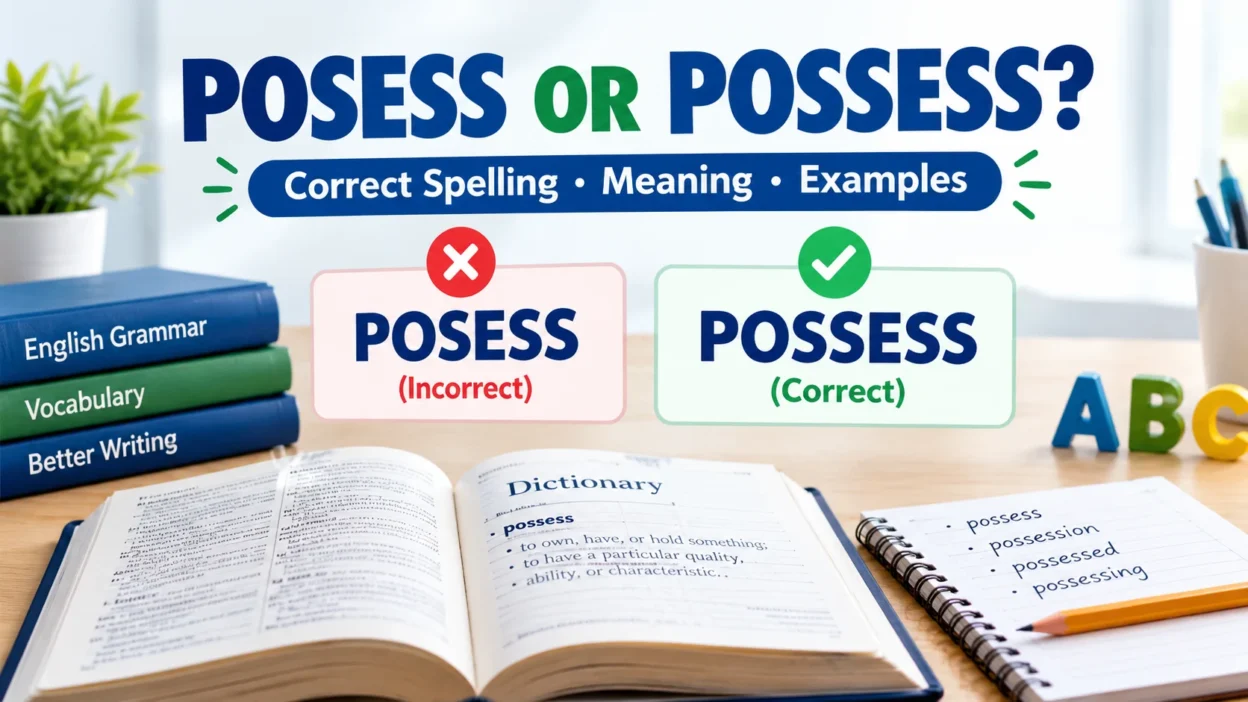
English spelling can be confusing, especially when two words look almost identical. One small spelling mistake can make your writing appear less polished, whether you are writing an email, completing a school assignment, or preparing a professional document. One common example is “posess or possess.” Which spelling is correct, and how can you remember it?
The correct spelling is possess, with two s letters in the middle. “Posess” is a misspelling and should not be used in standard English. The word possess is a verb that means to own, have, or hold something. It can also describe having a particular quality, ability, or characteristic. Learning the correct spelling will help you write more confidently and avoid a frequent spelling error.
Quick Answer
Possess is the correct spelling; posess is incorrect. The word possess means to own, have, or hold something, or to have a particular quality or ability. Remember to write two s letters after “po”: p-o-s-s-e-s-s.
Why Do People Confuse Posess and Possess?
People often confuse these spellings because they sound similar when spoken quickly. When writing from memory, it is easy to leave out one of the repeated letters.
Another reason is that English spelling does not always make the number of letters in a word obvious from its pronunciation. The two middle s letters in possess represent a spelling pattern that learners must memorize.
For example:
- Incorrect: I posess excellent communication skills.
- Correct: I possess excellent communication skills.
The difference is only one letter, but the second sentence uses the standard spelling.
First Word: Posess
Posess is an incorrect spelling of possess. It is not the standard spelling used in formal or informal English.
You might see posess in online posts, messages, schoolwork, or other writing, but that does not make it correct.
Examples of the mistake include:
- Incorrect: She posess a beautiful voice.
- Incorrect: They posess several properties.
- Incorrect: He wants to posess great knowledge.
In all three sentences, replace posess with possess.
Second Word: Possess
Possess is the correct English verb. It means to own, have, or hold something, or to have a particular feature, skill, or quality.
Examples of Possess in Sentences
- She possesses excellent leadership skills.
- I possess the documents you requested.
- They possess a large house near the city.
- Every student should possess basic writing skills.
- He possesses great patience.
The word can refer to physical ownership, personal qualities, knowledge, or abilities.
Forms of Possess
Here are some common forms of the verb:
| Word form | Example |
|---|---|
| Possess | I possess the required documents. |
| Possesses | She possesses strong communication skills. |
| Possessed | He possessed great courage. |
| Possessing | Possessing this knowledge is helpful. |
| Possession | The documents are in my possession. |
Notice that possession is the related noun, while possess is the verb.
Posess vs Possess: Comparison Table
| Feature | Posess | Possess |
|---|---|---|
| Spelling status | Incorrect | Correct |
| Standard English word | No | Yes |
| Meaning | No standard meaning | To own, have, or hold |
| Appropriate for formal writing | No | Yes |
| Example | I posess a car. | I possess a car. |
The key difference is spelling: possess contains two consecutive s letters after the initial “po.”
When to Use Each
When Should You Use Posess?
You should not use posess as the standard spelling in English. If you accidentally type it, correct it to possess.
For example:
- Incorrect: We posess the necessary experience.
- Correct: We possess the necessary experience.
When Should You Use Possess?
Use possess when talking about ownership, abilities, qualities, or characteristics.
Examples:
- Ownership: They possess several valuable paintings.
- Skills: She possesses excellent problem-solving abilities.
- Qualities: He possesses remarkable courage.
- Knowledge: Good teachers possess a deep understanding of their subjects.
- Legal context: The law may regulate the items a person is permitted to possess.
Remember that possess is a verb, so its form may change depending on the subject and tense.
12 Examples of Possess in Sentences
Here are 12 examples showing how to use the correct spelling naturally.
- I possess all the information needed for the project.
- She possesses a natural talent for music.
- They possess three apartments in the city.
- He possesses the confidence to speak in public.
- We possess enough evidence to support our argument.
- Every applicant must possess the required qualifications.
- The company possesses valuable intellectual property.
- She possesses a strong sense of responsibility.
- Do you possess a valid driving license?
- The athlete possesses exceptional physical strength.
- He possessed a rare collection of historical books.
- Possessing good communication skills can improve your career opportunities.
Each sentence uses possess or one of its grammatical forms correctly.
Common Mistakes to Avoid
English learners sometimes make spelling and grammatical mistakes when using possess. Here are the most important ones to avoid.
1. Leaving Out an S
- Incorrect: I posess the necessary skills.
- Correct: I possess the necessary skills.
Always include both consecutive s letters.
2. Forgetting Subject-Verb Agreement
In the present simple tense, use possesses with he, she, or it.
- Incorrect: She possess a great deal of knowledge.
- Correct: She possesses a great deal of knowledge.
With I, you, we, and they, use possess.
3. Confusing Possess With Possession
Possess is a verb, whereas possession is a noun.
- Correct verb: They possess valuable artwork.
- Correct noun: The artwork is in their possession.
4. Using the Wrong Past-Tense Form
The past tense is possessed, not posessed.
- Incorrect: He posessed several books.
- Correct: He possessed several books.
5. Assuming Pronunciation Determines Spelling
Even if a word sounds like it contains one s, its correct spelling may contain two. Learn the written form rather than relying only on sound.
Memory Trick: How to Remember Possess
The easiest way to remember the spelling is to divide the word into smaller parts:
PO + SS + ESS = POSSESS
Focus on the double SS in the middle. When writing the word, mentally repeat:
“Possess has two S’s in the middle.”
You can also remember it by practicing a short sentence:
“I possess the skills to succeed.”
Write the word several times and use it in different sentences. Repeated exposure can make the correct spelling easier to remember.
American vs British English
There is no spelling difference between American and British English for this word.
| English variety | Correct spelling | Example |
|---|---|---|
| American English | Possess | I possess the required documents. |
| British English | Possess | She possesses excellent skills. |
Both varieties use possess, possesses, and possessed. The spelling posess is incorrect in both.
Similar Words to Possess
Several English words are related to possess or follow similar spelling patterns.
- Possession: Something owned or controlled by someone, or the state of owning something.
- Possesses: The present-tense form used with he, she, or it.
- Possessed: The past tense and past participle of possess.
- Possessing: The -ing form of the verb.
- Ownership: The state of owning something.
- Have: A common verb that can express ownership or possession.
- Acquire: To obtain or gain something.
- Own: To have something legally or personally.
Although own, have, and possess can share similar meanings, they are not always interchangeable in every sentence.
For example, “She owns a house” emphasizes ownership, while “She possesses excellent judgment” describes a quality.
Frequently Asked Questions
1. Is it posess or possess?
Possess is correct. Posess is a spelling mistake.
2. What does possess mean?
Possess means to own, have, or hold something. It can also mean to have a particular skill, quality, or characteristic.
3. How do you spell possess correctly?
Spell it P-O-S-S-E-S-S. Remember the double S in the middle.
4. Is possess a verb or a noun?
Possess is a verb. The related noun is possession.
5. What is the past tense of possess?
The past tense is possessed. For example, “She possessed great courage.”
6. What is the difference between possess and possession?
Possess describes the action or state of having something. Possession is a noun referring to something owned or the state of owning it.
Example: “I possess the key” and “The key is in my possession.”
7. Is possess spelled the same in American and British English?
Yes. Both American and British English use possess. There is no regional spelling difference.
8. Why is posess incorrect?
Posess leaves out one of the two consecutive s letters required in the standard spelling of possess.
Remember This
- Possess is the correct spelling.
- Posess is incorrect.
- Possess means to own, have, or hold something.
- The past tense is possessed.
- The related noun is possession.
- American and British English use the same spelling.
Conclusion
The correct spelling is possess, not posess. Although the two forms look similar, only possess is accepted as the standard spelling. It is a useful verb for describing ownership, abilities, knowledge, and personal qualities.
To avoid this common mistake, remember the double SS in possess and practice using the word in everyday sentences. With regular practice, you can spell it correctly and use it confidently in both academic and professional writing.