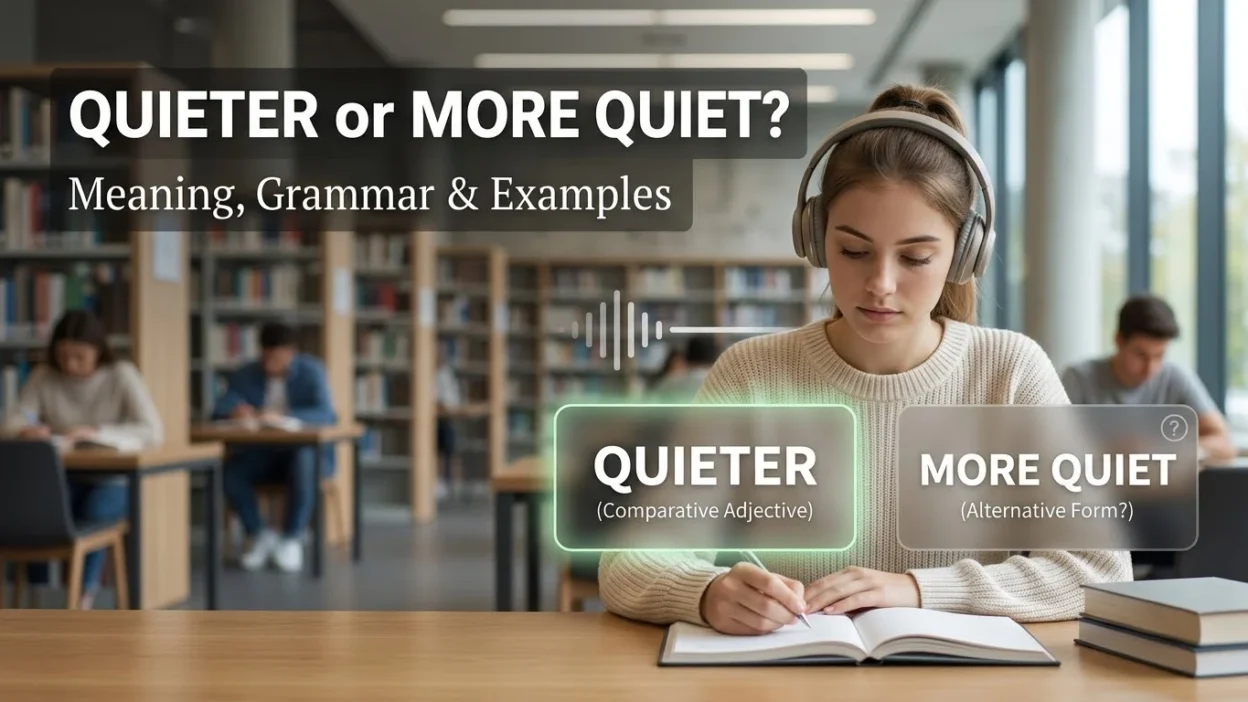
Choosing between “quieter” and “more quiet” can be confusing, especially when you are learning English or trying to make your writing sound natural. Both expressions are grammatically correct, but they are not always equally common. Understanding when to use each form can help you speak more confidently, write clearly, and avoid common grammar mistakes.
The words “quieter” and “more quiet” are comparative forms of the adjective “quiet.” They describe something or someone that makes less noise or has a calmer atmosphere than another. Although “quieter” is generally the more natural and widely preferred choice in everyday English, “more quiet” is also acceptable in certain situations, particularly when the speaker wants to add emphasis or create a particular rhythm.
Quick Answer
“Quieter” and “more quiet” are both grammatically correct comparative forms of “quiet.” However, “quieter” is generally preferred in everyday conversation and writing because it is shorter and more natural. “More quiet” can also be used for emphasis, contrast, or stylistic reasons. For most situations, choose “quieter.”
Why Do People Confuse Quieter and More Quiet?
People often confuse “quieter” and “more quiet” because English has two common ways to form comparative adjectives:
- Adding -er: quiet → quieter
- Using more: quiet → more quiet
Both structures express comparison, which makes it difficult to know which one sounds more natural.
Most short adjectives form their comparative by adding “-er,” while longer adjectives generally use “more.” However, “quiet” has two syllables and can naturally take either form.
For example:
- The library is quieter than the cafeteria.
- The library is more quiet than the cafeteria.
Both sentences are grammatically acceptable, but the first is generally more common and sounds more natural in everyday English.
The choice can also depend on sentence rhythm, emphasis, and personal writing style.
Quieter: Meaning, Grammar, and Usage
“Quieter” is the comparative form of “quiet,” used to describe a person, place, or situation that makes less noise or is calmer than another.
It is formed by adding “-er” to “quiet.” It is the standard choice in most everyday conversations, academic writing, and general communication.
When to Use Quieter
Use “quieter” when comparing two or more people, places, sounds, or situations.
Examples:
- This room is quieter than the living room.
- Please speak quieter because the baby is sleeping.
- The countryside is quieter than the city.
- We need a quieter place to study.
- My new office is much quieter than my old one.
In formal writing, “speak more quietly” is often preferable to “speak quieter” because “quietly” is an adverb. However, “speak quieter” is common in informal conversation.
Why Is Quieter More Common?
“Quieter” follows a familiar comparative pattern in English. It is concise, easy to pronounce, and flows naturally in most sentences.
For example:
- The classroom became quieter after the teacher arrived.
- I prefer quieter neighborhoods.
- This street is quieter at night.
In these examples, “quieter” communicates the comparison directly without adding unnecessary words.
More Quiet: Meaning, Grammar, and Usage
“More quiet” is another grammatically correct comparative form of “quiet.” It uses the word “more” before the adjective instead of adding the suffix “-er.”
Although it is less common than “quieter” in everyday English, it can be useful when a speaker wants to emphasize the degree of quietness or achieve a particular sentence rhythm.
When to Use More Quiet
Use “more quiet” when it provides a specific emphasis, contrast, or stylistic effect.
Examples:
- This room is more quiet than I expected.
- The atmosphere became more quiet as the evening progressed.
- I wanted a more quiet environment for meditation.
- Her voice sounded more quiet and gentle after the conversation.
- The second location feels more quiet and peaceful.
In many of these sentences, “quieter” would work just as well. The choice of “more quiet” may reflect the writer’s preferred rhythm or the emphasis placed on the adjective.
Is More Quiet Grammatically Correct?
Yes, “more quiet” is grammatically correct. It is not a grammar mistake simply because “quieter” is more common.
However, when writing for a general audience, “quieter” is usually the better choice unless there is a clear reason to use “more quiet.”
Quieter vs More Quiet: Comparison Table
| Feature | Quieter | More quiet |
|---|---|---|
| Base adjective | Quiet | Quiet |
| Comparative form | -er suffix | More + adjective |
| Grammar | Correct | Correct |
| Everyday usage | More common | Less common |
| Naturalness | Usually more natural | Depends on context |
| Formal writing | Commonly preferred | Acceptable |
| Emphasis | Neutral comparison | Can provide emphasis |
| Example | This room is quieter. | This room is more quiet. |
| Best for | General communication | Particular emphasis or rhythm |
Both forms are correct, but “quieter” is the safest and most natural option for most situations.
When to Use Each
Knowing the context can help you choose the right comparative form.
Use Quieter for Everyday Conversations
“Quieter” is the preferred option when speaking naturally with friends, family, colleagues, or classmates.
Examples:
- Can we find a quieter restaurant?
- The baby is quieter now.
- This neighborhood is quieter during the week.
Use Quieter in General Writing
In emails, school assignments, reports, and articles, “quieter” is usually the most straightforward choice.
Examples:
- Students perform better in quieter environments.
- The new equipment makes the workplace quieter.
- We chose a quieter location for the event.
Use More Quiet for Emphasis
“More quiet” can be useful when the writer wants to stress the quality of quietness or establish a particular contrast.
Examples:
- I need a more quiet and peaceful place to relax.
- The second room is more quiet than the first.
- The environment became more quiet and reflective.
In many contexts, “quieter” remains equally suitable. Choose “more quiet” when it makes the sentence sound more appropriate for your intended meaning or style.
15 Examples of Quieter and More Quiet in Sentences
The following examples show how both expressions work in everyday English.
| No. | Quieter | More quiet |
|---|---|---|
| 1 | This room is quieter than mine. | This room is more quiet than mine. |
| 2 | The library is quieter in the morning. | The library is more quiet in the morning. |
| 3 | We need a quieter place to work. | We need a more quiet place to work. |
| 4 | The streets are quieter at night. | The streets are more quiet at night. |
| 5 | She became quieter after lunch. | She became more quiet after lunch. |
| 6 | This machine is quieter than the old one. | This machine is more quiet than the old one. |
| 7 | I prefer quieter surroundings. | I prefer more quiet surroundings. |
| 8 | The park is quieter on weekdays. | The park is more quiet on weekdays. |
| 9 | Can you find a quieter corner? | Can you find a more quiet corner? |
| 10 | The classroom became quieter. | The classroom became more quiet. |
Both forms are possible in these examples, although the “quieter” versions generally sound more natural.
Additional examples:
- Quieter: My new headphones make the background noise seem quieter.
- More quiet: I was hoping for a more quiet evening at home.
- Quieter: The audience grew quieter as the performance began.
- More quiet: The room felt more quiet and comfortable after everyone left.
- Quieter: We moved to a quieter street away from traffic.
Common Mistakes to Avoid
Even though both comparative forms are correct, some related mistakes are worth avoiding.
1. Thinking More Quiet Is Always Wrong
Incorrect assumption: “More quiet” is grammatically incorrect.
Correct understanding: Both “quieter” and “more quiet” are acceptable, although “quieter” is usually preferred.
2. Using Both Comparative Forms Together
Avoid combining “more” and “-er” in the same comparative adjective.
- Incorrect: This room is more quieter than that one.
- Correct: This room is quieter than that one.
- Correct: This room is more quiet than that one.
3. Confusing Quiet and Quietly
“Quiet” is an adjective, while “quietly” is an adverb.
- The room is quiet.
- She spoke quietly.
- The room is quieter.
- She spoke more quietly.
When describing how an action is performed, “more quietly” is generally the appropriate comparative form in standard writing.
4. Using Quietest Instead of Quieter
“Quieter” is a comparative form, while “quietest” is a superlative form.
- Comparative: This room is quieter than the kitchen.
- Superlative: This is the quietest room in the house.
Use “quieter” to compare, usually two things, and “quietest” to identify the highest degree within a group.
Memory Trick: How to Remember Quieter vs More Quiet
A simple way to remember the difference is to think of “quieter” as the usual comparative form and “more quiet” as an alternative.
Easy rule
Quiet → Quieter → Quietest
- Quiet: Describes a low level of noise.
- Quieter: Compares two people, places, or things.
- Quietest: Describes the one with the lowest level of noise in a group.Remember: When in doubt, use “quieter” for everyday English.
American vs British English
Both “quieter” and “more quiet” are used in American and British English. There is no major difference in grammatical correctness between the two varieties.
| American English | British English |
|---|---|
| Quieter is common. | Quieter is common. |
| More quiet is acceptable. | More quiet is acceptable. |
| Quieter is generally preferred. | Quieter is generally preferred. |
| More quietly is used for adverbial comparisons. | More quietly is used for adverbial comparisons. |
For example:
- American English: This café is quieter than the one downtown.
- British English: This café is quieter than the one in the town centre.
The choice between “quieter” and “more quiet” is primarily a matter of usage, emphasis, and sentence flow rather than a difference between American and British grammar.
Similar Words and Comparative Forms
Understanding other comparative adjectives can help you recognize the pattern used with “quieter.”
| Base adjective | Comparative | Alternative comparative |
|---|---|---|
| Quiet | Quieter | More quiet |
| Clever | Cleverer | More clever |
| Simple | Simpler | More simple |
| Narrow | Narrower | More narrow |
| Polite | More polite | — |
| Careful | More careful | — |
| Beautiful | More beautiful | — |
| Peaceful | More peaceful | — |
Some two-syllable adjectives can naturally take either “-er” or “more,” while others strongly favor one form. It is helpful to learn the common comparative form of each adjective rather than applying one rule to every word.
Final Verdict: Quieter or More Quiet?
Both “quieter” and “more quiet” are grammatically correct, but “quieter” is generally the better choice for everyday conversations, academic writing, and professional communication.
“More quiet” is an acceptable alternative that may suit particular contexts, especially when emphasis or sentence rhythm makes it sound natural. However, it is less common and can sometimes feel wordier than necessary.
If you are unsure which form to use, choose “quieter.” It is concise, widely understood, and natural in most English-speaking contexts.
Frequently Asked Questions (FAQs)
1. Is Quieter or More Quiet Correct?
Both are correct. “Quieter” is the more common comparative form of “quiet,” while “more quiet” is an acceptable alternative used for emphasis or stylistic reasons.
2. Is Quieter a Real Word?
Yes, “quieter” is a standard English word. It is the comparative form of “quiet” and describes something that makes less noise or is calmer than something else.
3. Is More Quiet Grammatically Incorrect?
No, “more quiet” is grammatically correct. Although “quieter” is generally more natural in everyday English, “more quiet” can be used in appropriate contexts.
4. Should I Use Quieter in Formal Writing?
Yes. “Quieter” is usually the preferred form in formal and informal writing because it is concise, familiar, and natural. “More quiet” is also acceptable when the context supports it.
5. What Is the Difference Between Quieter and Quietest?
“Quieter” is a comparative adjective used to compare things, while “quietest” is a superlative adjective used to describe the one with the lowest level of noise in a group.
For example:
- This room is quieter than the kitchen.
- This is the quietest room in the house.
6. Is More Quiet or Quieter More Common in English?
“Quieter” is generally more common in everyday English. It follows the usual comparative pattern for “quiet” and is the preferred choice in most ordinary situations.
7. Is More Quietly or Quieter Correct?
Both can be correct, depending on the sentence. “Quieter” is an adjective, while “more quietly” is an adverbial comparative.
- The room became quieter.
- She spoke more quietly.
Use “quieter” to describe a noun or state and “more quietly” to describe how an action is performed.
Remember This
- Quieter: The standard and generally preferred comparative form of “quiet.”
- More quiet: A grammatically correct alternative that can suit emphasis or stylistic needs.
- Quietest: The superlative form used to describe the lowest level of noise in a group.
- More quietly: The comparative adverb used to describe an action performed with less noise.
For most everyday situations, “quieter” is the easiest and most natural choice.
Conclusion
The difference between “quieter” and “more quiet” is mainly about common usage, emphasis, and sentence flow. Both expressions are grammatically correct comparative forms of “quiet,” but “quieter” is generally more widely used and sounds more natural in everyday English. Learning how these forms work can make your speaking and writing clearer.
When comparing places, people, sounds, or situations, use “quieter” as your first choice. Use “more quiet” when it better fits the emphasis or rhythm of your sentence. With practice, you will become more confident in choosing the appropriate comparative form.