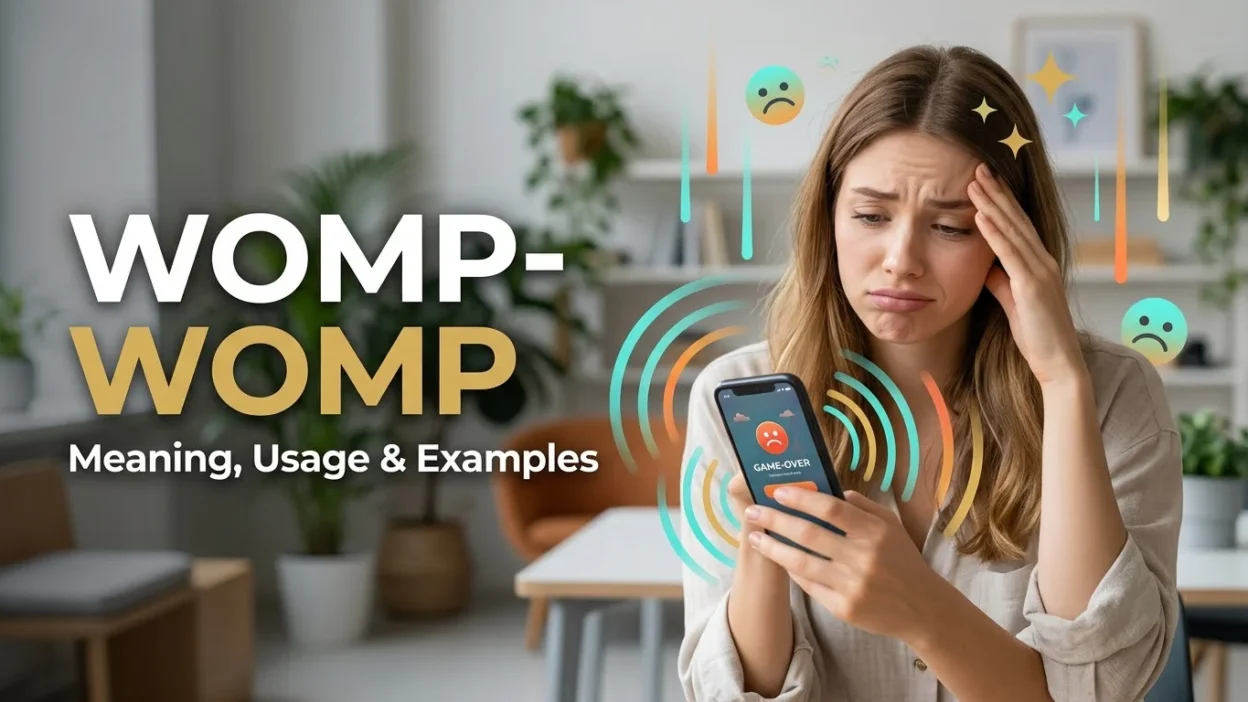
If you have seen “womp-womp” online, in memes, comments, or casual conversations, you may wonder whether it is an insult, a joke, or simply a funny sound. The expression is commonly used to react to something disappointing, unfortunate, or unsuccessful, often in a deliberately playful or sarcastic way. It can roughly mean “That’s too bad” or “Oh well.”
The phrase is especially common in informal American English and internet culture. It is often written as womp-womp, although you may also see womp womp without a hyphen. Understanding the tone is important because the expression can sound humorous and lighthearted in one situation but dismissive or insensitive in another.
Quick Answer: What Does “Womp-Womp” Mean?
“Womp-womp” is an informal expression used to react to disappointment, failure, bad luck, or an anticlimax. It imitates a sad or disappointing musical sound. Depending on context and tone, it can mean “That’s too bad,” “Oh well,” or “Better luck next time,” often with a humorous or sarcastic feeling.
Why Do People Confuse “Womp-Womp”?
People sometimes find womp-womp confusing because it does not have a traditional dictionary-style meaning like an ordinary noun or verb. Instead, it is an interjection or sound-based expression.
It is also closely connected to comedy, memes, and online communication. Its meaning depends heavily on context.
For example:
“I studied all night, but the test was canceled.”
Someone might jokingly respond:
“Womp-womp.”
The speaker is not necessarily being genuinely cruel. They may simply be making a playful joke about the disappointing situation.
However, if someone shares something genuinely painful or serious, responding with “womp-womp” can sound mocking or insensitive.
First Word: “Womp”
Womp is an informal sound word. It imitates a low, dull, or disappointing musical or sound effect.
In modern casual usage, it can suggest the sound of something going wrong or a disappointing moment.
For example:
“Womp.”
It can function almost like a verbal sound effect.
The repeated form, “womp-womp,” makes the expression more recognizable as a humorous reaction to disappointment.
Second Word: “Womp-Womp”
Womp-womp is the repeated expression used to communicate disappointment, failure, or an unfortunate outcome, usually in a humorous or sarcastic manner.
It can be similar to:
- “That’s too bad.”
- “Oh well.”
- “Better luck next time.”
- “Too bad!”
- “Sorry about that.”
- “And there goes your plan.”
The exact meaning depends on the speaker’s tone and the situation.
Is “Womp-Womp” a Real Word?
Yes, womp-womp is an established informal expression, particularly in contemporary American casual and internet English. It is not formal vocabulary and would generally be inappropriate in academic or professional writing.
“Womp” vs. “Womp-Womp”: Comparison Table
| Form | Meaning | Typical Use | Tone |
|---|---|---|---|
| womp | A dull or disappointing sound | Sound effect or reaction | Informal |
| womp-womp | Reaction to disappointment or failure | Conversation, memes, social media | Humorous or sarcastic |
| that’s too bad | Expression of sympathy or disappointment | General conversation | Neutral |
| oh well | Acceptance of an unfortunate result | Casual conversation | Resigned |
| better luck next time | Encouragement after failure | Friendly situations | Supportive |
When Should You Use “Womp-Womp”?
Use womp-womp when the situation is informal and a playful or sarcastic reaction is appropriate.
It commonly appears in:
- Text messages
- Social media comments
- Memes
- Online discussions
- Casual conversations
- Comedy
- Friendly teasing
- Gaming conversations
For example:
“My favorite team lost again. Womp-womp.”
It can also be used jokingly when someone experiences a minor inconvenience.
“I forgot to bring my umbrella, and now it’s raining. Womp-womp.”
When Should You Avoid It?
Avoid womp-womp when someone is discussing a serious or painful situation.
For example, if someone says:
“I lost a family member.”
Responding with:
“Womp-womp.”
would normally sound extremely insensitive.
A better response would be:
“I’m really sorry to hear that.”
Context matters more than the expression itself.
10+ Examples of “Womp-Womp”
Here are natural examples showing how womp-womp is used.
1. After Losing a Game
“Our team lost by one point. Womp-womp.”
The speaker is making a humorous comment about the loss.
2. When a Plan Fails
“We planned a picnic, but it started raining. Womp-womp.”
Here, the phrase reacts to an unfortunate but relatively minor situation.
3. When Someone Misses a Sale
“You waited until today to buy it? Now it’s sold out. Womp-womp.”
This can sound teasing or sarcastic.
4. After Forgetting Something
“I left my lunch at home. Womp-womp.”
The speaker is joking about their own mistake.
5. In a Meme
“When you finally save enough money for the concert and the tickets sell out: womp-womp.”
The phrase emphasizes the disappointment for comedic effect.
6. After Losing a Competition
“She trained for weeks but finished second. Womp-womp.”
Depending on the context, this could sound playful or unnecessarily dismissive.
7. When a Device Stops Working
“My phone died right before I could save the file. Womp-womp.”
It presents an annoying situation in a humorous way.
8. When Someone Gets a Minor Penalty
“You parked in the wrong place and got a ticket. Womp-womp.”
This sounds teasing and sarcastic.
9. After Missing a Bus
“You arrived five seconds too late? Womp-womp.”
It jokingly highlights the person’s bad luck.
10. About a Failed Plan
“We were going to watch the movie tonight, but everyone is busy. Womp-womp.”
The expression communicates mild disappointment.
11. Self-Directed Humor
“I forgot my password again. Womp-womp.”
Using the expression about yourself can make it sound less hostile.
12. Friendly Teasing
“You said you were going to win, but you came last. Womp-womp!”
This is appropriate only when the people involved understand that it is playful teasing.
Common Mistakes With “Womp-Womp”
Using It in Serious Situations
One of the biggest mistakes is using womp-womp when someone is genuinely suffering.
The expression often carries sarcasm, so it can minimize someone’s feelings.
Assuming It Always Means Sympathy
Although it can sometimes mean “That’s too bad,” womp-womp is not necessarily sympathetic.
It often has a humorous, dismissive, or teasing quality.
Using It in Formal Writing
Avoid it in formal essays, business reports, academic assignments, and professional correspondence.
Instead, use expressions such as:
- Unfortunately
- That is unfortunate
- That is disappointing
- Regrettably
- Sadly
Thinking It Is Always Rude
Not necessarily. Among friends, womp-womp can be harmless playful humor.
The relationship, subject, and tone determine whether it sounds funny or rude.
Memory Trick for “Womp-Womp”
Think of womp-womp as the imaginary sound of a sad trombone after something goes wrong.
Imagine:
Someone fails → sad sound effect → “Womp-womp.”
This makes the meaning easy to remember:
Womp-womp = “That’s too bad,” usually with a humorous or sarcastic twist.
American vs. British English
Womp-womp is strongly associated with informal American English and contemporary internet culture.
British English speakers can understand it, especially through exposure to American media and social media, but it is not a traditional formal British expression.
In both American and British contexts, alternatives such as these are more widely understood:
- “That’s a shame.”
- “That’s too bad.”
- “Oh well.”
- “Never mind.”
- “Better luck next time.”
The main difference is that womp-womp has a more meme-like, comedic, and internet-oriented flavor.
Similar Words and Expressions
Several expressions can communicate a similar idea, but their tones are different.
“That’s too bad”
This is more neutral and can genuinely express sympathy.
“You missed the train? That’s too bad.”
“Oh well”
This often expresses acceptance of something that cannot be changed.
“The restaurant is closed. Oh well, let’s go somewhere else.”
“Better luck next time”
This is usually more encouraging.
“You didn’t win today, but better luck next time.”
“That’s a shame”
This can express genuine disappointment.
“The event was canceled? That’s a shame.”
“Too bad”
This can be sympathetic or sarcastic depending on tone.
“Too bad you couldn’t come with us.”
“Sad trombone”
This is another humorous reference to disappointment and is closely related in spirit to womp-womp.
Final Verdict: What Does “Womp-Womp” Mean?
Womp-womp is an informal expression used to react to disappointment, failure, bad luck, or an anticlimactic result. It is often humorous, sarcastic, or teasing rather than genuinely sympathetic.
The expression is especially common in American casual speech, memes, social media, and online conversations. Its meaning is strongly dependent on context.
If the situation is lighthearted, womp-womp can be funny. If someone is experiencing serious emotional pain, however, it can come across as mocking or insensitive.
Frequently Asked Questions
1. What does “womp-womp” mean in slang?
Womp-womp is slang for a humorous or sarcastic reaction to disappointment, failure, or bad luck. It can roughly mean “That’s too bad” or “Oh well.”
2. Is “womp-womp” rude?
It can be. Among friends, it may be playful, but in serious situations it can sound dismissive or insensitive.
3. Is “womp-womp” an insult?
Not necessarily. It is usually a reaction rather than a direct insult. However, saying it to mock someone’s disappointment can make it insulting.
4. Is “womp-womp” American slang?
Yes. It is particularly associated with informal American English, comedy, memes, and internet culture.
5. Can I use “womp-womp” in formal writing?
No. It is highly informal. Use more neutral expressions such as “that is unfortunate” or “that is disappointing” in formal writing.
6. What is another way to say “womp-womp”?
Depending on the situation, you can say “that’s too bad,” “oh well,” “better luck next time,” “that’s a shame,” or “too bad.”
7. Why do people say “womp-womp”?
People use it to make a disappointing or unsuccessful situation sound humorous, often by imitating the sound effect associated with a failed or anticlimactic moment.
Remember This
- Womp-womp is an informal expression.
- It usually reacts to disappointment, failure, or bad luck.
- It often has a humorous or sarcastic tone.
- It is common in American English and internet culture.
- It is not appropriate for every serious situation.
- Context and tone determine whether it sounds funny, playful, or insensitive.
Conclusion
Womp-womp is a playful, informal expression that turns disappointment into a humorous sound effect. It is similar to saying “That’s too bad” or “Oh well,” but it often carries more sarcasm or teasing. You will most often encounter it in casual conversations, memes, social media, and online communities.
The easiest way to remember it is to imagine a sad sound effect after something goes wrong: womp-womp. Use it when the situation is light enough for humor, but choose a more sympathetic expression when someone is dealing with a serious problem.