English learners often confuse set vs sit because both words can describe placing or being in a position, but they are used in very different ways. The confusion becomes greater because set and sit have several meanings and forms. Understanding which verb needs an object is one of the easiest ways to tell them apart.
In simple terms, set usually means “to put something somewhere” or “to place something in a particular position,” while sit usually means “to be in a seated position” or “to move into a seated position.” This guide explains the difference between set and sit, their verb forms, common sentence patterns, examples, mistakes, and useful memory tricks.
Quick Answer
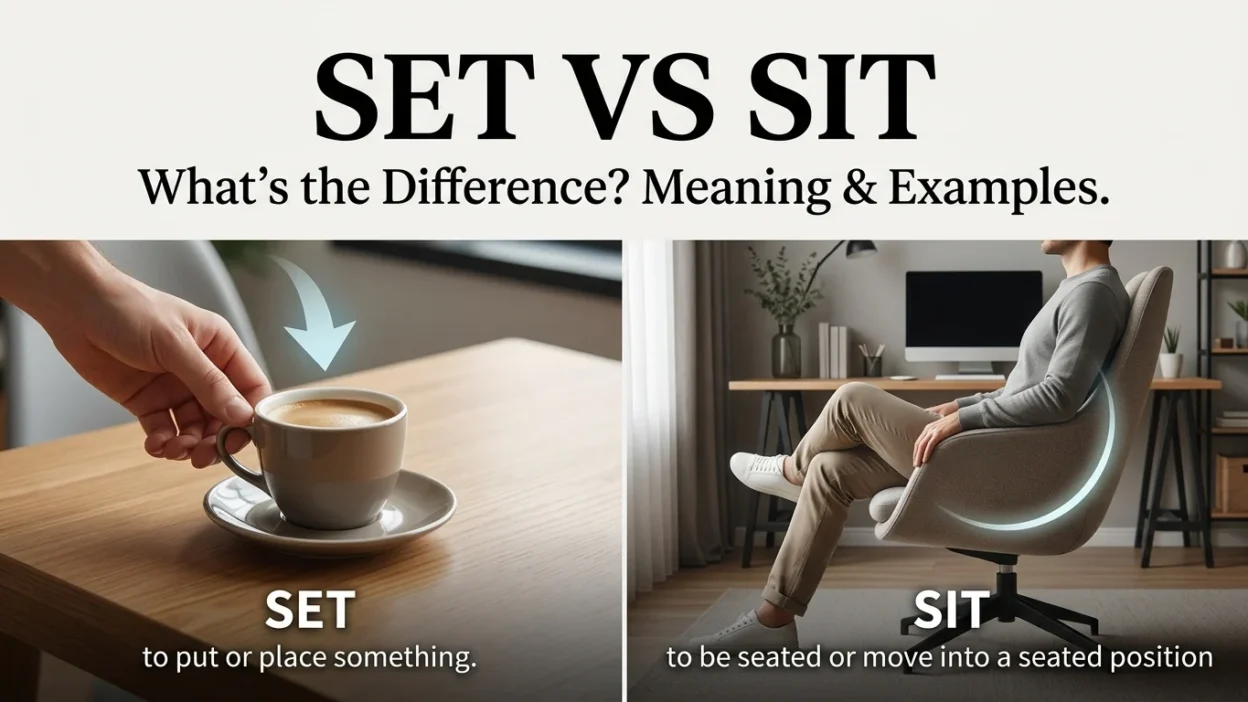
Set usually means to put or place something somewhere: “Set the book on the table.” Sit means to be seated or move into a seated position: “Please sit on the chair.” Remember: you set something, but you sit yourself down.
Why Do People Confuse Set and Sit?
People often confuse set and sit because both verbs can relate to position or location.
For example:
- Set the bag on the chair.
- Sit on the chair.
The first sentence describes placing an object. The second describes a person being seated.
Another reason for confusion is that both verbs have irregular forms. Their forms do not follow the simple “add -ed” pattern used with many regular English verbs.
Compare:
- set → set → set
- sit → sat → sat
The present forms set and sit can sound similar in fast speech, especially for English learners.
What Does “Set” Mean?
Set is a verb that commonly means to put, place, or position something somewhere.
It normally takes a direct object when it has this meaning.
Examples:
- Set the cup on the table.
- She set her phone beside the laptop.
- Please set the plates on the counter.
- He set the box near the door.
Here, something is being placed somewhere.
Forms of “Set”
One unusual feature of set is that its basic forms remain the same:
| Tense/Form | Verb |
|---|---|
| Present | set |
| Past | set |
| Past participle | set |
| -ing form | setting |
Examples:
- I set the alarm every night.
- Yesterday, I set the alarm for 6 a.m.
- I have set the alarm already.
- She is setting the table.
“Set” also has many other meanings, such as establishing a rule, adjusting a device, or determining a time.
What Does “Sit” Mean?
Sit usually means to be in a seated position or to move into a seated position.
Examples:
- Please sit here.
- I sit near the window.
- She sat beside her friend.
- They were sitting in the waiting room.
Unlike set, the basic meaning of sit does not normally involve putting another object somewhere.
Forms of “Sit”
The main forms are:
| Tense/Form | Verb |
|---|---|
| Present | sit |
| Past | sat |
| Past participle | sat |
| -ing form | sitting |
Examples:
- I sit here every morning.
- Yesterday, I sat in the front row.
- She has sat there for an hour.
- They are sitting outside.
Set vs Sit: Comparison Table
| Feature | Set | Sit |
|---|---|---|
| Basic meaning | Put or place something | Be or move into a seated position |
| Usually takes an object? | Yes, when meaning “place” | Usually no |
| Present | set | sit |
| Past | set | sat |
| Past participle | set | sat |
| -ing form | setting | sitting |
| Example | Set the book here. | Sit here. |
| Main idea | Place something | Be seated |
A useful way to remember the difference is:
Set = place something.
Sit = take a seated position.
When Should You Use “Set” or “Sit”?
Use set when you are placing or positioning an object.
- Set the keys on the desk.
- Set the groceries in the kitchen.
- Set the vase on the shelf.
Use sit when a person or animal is seated.
- Sit on the sofa.
- The dog is sitting by the door.
- We sat under the tree.
Compare these two sentences:
Set the child on the chair.
This means someone places the child on the chair.
Sit on the chair.
This tells the person to take a seated position.
Set vs Sit: 12+ Examples
Here are practical examples showing the difference.
Examples with “Set”
- Set the book on the desk.
- She set her bag beside the door.
- Please set the dishes on the table.
- He set the glass down carefully.
- I set my keys next to the phone.
- Set the package in the hallway.
- She set the flowers in a vase.
Examples with “Sit”
- Please sit in this chair.
- He sat beside his brother.
- We sat near the window.
- She is sitting on the sofa.
- The children sat on the floor.
- I usually sit at the back of the classroom.
- The cat is sitting under the table.
Notice the pattern: set commonly acts on an object, while sit describes the position of the subject.
Common Mistakes with Set and Sit
Mistake 1: “Sit the book on the table.”
❌ Sit the book on the table.
In standard English, use set when you mean “place”:
✅ Set the book on the table.
Mistake 2: “Set down on the chair.”
❌ Set down on the chair.
If you mean that a person should take a seated position, use sit:
✅ Sit down on the chair.
Mistake 3: Using “sitted”
❌ She sitted on the sofa.
The past tense of sit is sat:
✅ She sat on the sofa.
Mistake 4: Using “set” as the past tense of “sit”
❌ Yesterday, I set in the front row.
✅ Yesterday, I sat in the front row.
Remember:
sit → sat → sat
A Simple Memory Trick for Set vs Sit
Try this:
Set = Set something somewhere.
Sit = Sit yourself down.
If you are putting an object somewhere, think set.
Set the phone on the table.
If you are taking a seated position, think sit.
Sit on the chair.
Another useful question is:
“What am I doing to something?”
If you are placing something, use set.
“What am I doing myself?”
If you are becoming seated, use sit.
American vs British English
The basic distinction between set and sit is essentially the same in American and British English.
In both varieties:
- set can mean “place something.”
- sit can mean “be seated.”
- The past tense of sit is sat.
- set remains set in its basic past form.
For example:
American English:
“Set the bag on the chair.”
British English:
“Set the bag on the chair.”
The same basic distinction applies in both varieties.
Set and Sit: Similar Words
Several related verbs can make this topic easier to understand.
Place
Place often means “put something somewhere” and is similar to one meaning of set.
- Place the book on the desk.
- Set the book on the desk.
Put
Put is another common verb for moving something to a particular location.
- Put the keys on the table.
- Set the keys on the table.
Stand
Stand means to be in an upright position.
- Please stand here.
- She stood near the door.
Lie
Lie usually means to be in a horizontal or resting position.
- I want to lie on the bed.
- The dog is lying on the floor.
This gives you a useful group:
- set → place something
- sit → be seated
- stand → be upright
- lie → be horizontal
Final Verdict: Set vs Sit
The simplest distinction is that set usually means to put or place something somewhere, while sit means to be seated or move into a seated position.
Remember the verb forms:
Set → set → set
Sit → sat → sat
So you can say:
- Set the book on the table.
- Sit at the table.
- I set the alarm yesterday.
- I sat in the chair yesterday.
If you are placing something, choose set. If you are taking or being in a seated position, choose sit.
Frequently Asked Questions
Is it “sit the book down” or “set the book down”?
Use set when you mean to place the book somewhere: “Set the book down.”
Is the past tense of sit “sat” or “set”?
The past tense of sit is sat. For example: “I sat on the chair yesterday.”
Is “set” the past tense of “sit”?
No. Set is not the past tense of sit. The past tense of sit is sat.
What is the difference between “sit down” and “set down”?
Sit down means to move into a seated position. Set down means to put or place something somewhere.
Can “set” be used without an object?
Yes. Set has many meanings and can sometimes be used without a direct object, but when it means “place,” it generally takes an object.
What is the difference between “sit” and “set”?
Sit generally refers to being seated, while set commonly means placing or positioning something.
What is the past participle of “sit”?
The past participle is sat: “She has sat there for an hour.”
Is “sitting” spelled with one or two t’s?
It is spelled sitting, with two ts: sit → sitting.
Remember This
SET = place something.
Set the cup on the table.
SIT = be seated.
Sit on the chair.
SET → SET → SET
SIT → SAT → SAT
When you remember these four ideas, the difference becomes much easier.
Conclusion
The difference between set and sit is mainly about what happens to the subject or object. Set commonly means to put or position something, while sit means to be seated or move into a seated position. Their different past forms—set versus sat—are also important to learn.
For everyday English, focus on the basic pattern: set something somewhere, but sit yourself down. With regular practice and real examples, you can quickly avoid common mistakes such as using “sit” when you mean “place” or using “set” as the past tense of “sit.”