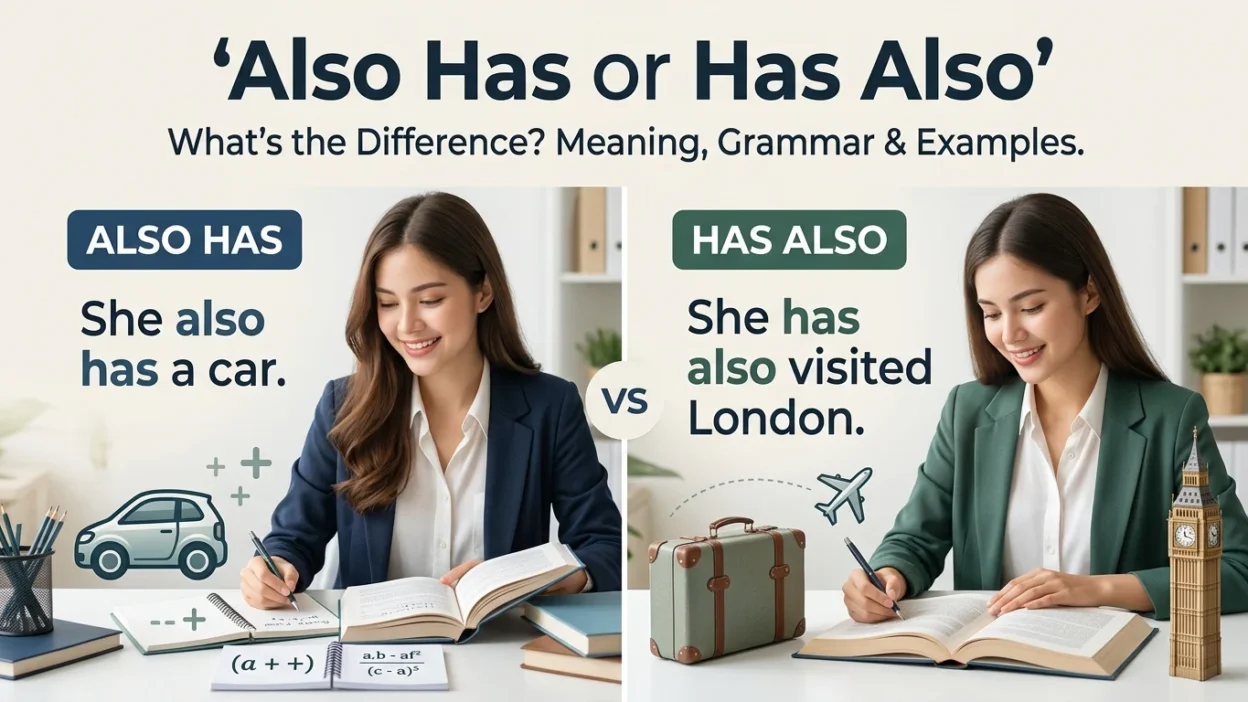
When should you use “also has” and when should you use “has also”? Both forms are grammatically possible, but they are used in different sentence structures. The key is to look at what has is doing in the sentence. When has is the main verb meaning “possesses” or “owns,” also has is usually the natural choice: She also has a car. When has is a helping verb followed by a past participle, has also is normally used: She has also visited London.
Understanding this difference makes your English sound more natural and helps you avoid awkward word order. This guide explains also has vs. has also in simple English, with clear rules, examples, common mistakes, and an easy memory trick.
Quick Answer
Use “also has” when has is the main verb meaning “possesses” or “includes”: He also has a laptop. Use “has also” when has is an auxiliary verb followed by a past participle: He has also completed the course. The correct choice depends on the grammatical role of has.
Why Do People Confuse “Also Has” and “Has Also”?
People often confuse these expressions because also can move within a sentence without changing its basic meaning. However, English word order becomes more important when has functions as a helping verb.
Compare:
- She also has a sister.
- She has also visited her sister.
In the first sentence, has is the main verb. It means that the person possesses or has a sister.
In the second sentence, has is a helping verb used to form the present perfect tense. The main action is visited.
So, the important question is not simply whether to put also before or after has. Instead, ask:
Is “has” the main verb, or is it a helping verb?
That usually tells you which word order sounds natural.
First Word: “Also”
Also is an adverb meaning “in addition,” “too,” or “as well.” It adds another person, thing, fact, or action to what has already been mentioned.
Examples:
- She also speaks Spanish.
- I also want some coffee.
- They also play tennis.
- He also has a dog.
The position of also can vary depending on the sentence structure.
With a main verb, also commonly comes before the verb:
- She also likes music.
- He also works on weekends.
- Maria also has a bicycle.
With an auxiliary verb such as has in the present perfect, also commonly comes after the auxiliary:
- She has also visited France.
- He has also completed the assignment.
- They have also seen that movie.
Second Word: “Has”
Has is the third-person singular form of have. It can work as either a main verb or a helping verb.
“Has” as a Main Verb
When has means possession, ownership, relationship, characteristics, or something included, it is the main verb.
Examples:
- She has a new phone.
- John has two brothers.
- The house has three bedrooms.
- The restaurant has a large garden.
In these sentences, you can normally place also before has:
- She also has a new phone.
- John also has two brothers.
- The house also has three bedrooms.
“Has” as a Helping Verb
Has can also help form the present perfect:
- She has finished her work.
- He has traveled abroad.
- Maria has written three books.
When you add also, it normally goes between has and the past participle:
- She has also finished her work.
- He has also traveled abroad.
- Maria has also written three books.
Also Has vs. Has Also: Comparison Table
| Expression | Typical Structure | Function of “Has” | Example |
|---|---|---|---|
| also has | also + has + noun | Main verb | She also has a car. |
| has also | has + also + past participle | Helping verb | She has also driven a car. |
| also has | also + has + noun phrase | Possession/inclusion | The hotel also has a pool. |
| has also | has + also + past participle | Present perfect | The hotel has also opened a new restaurant. |
The simplest rule is:
also has + thing/person → usually possession or inclusion
has also + past participle → usually an additional completed or experienced action
When Should You Use “Also Has”?
Use also has when has is the main verb.
This is especially common when has means:
- possesses
- owns
- contains
- includes
- experiences
- has a characteristic
- has a relationship
Examples
- She also has a younger brother.
- My friend also has a bicycle.
- The school also has a library.
- This phone also has a better camera.
- The apartment also has a balcony.
Here, has is followed by a noun or noun phrase rather than a past participle.
When Should You Use “Has Also”?
Use has also when has is functioning as an auxiliary verb, usually followed by a past participle.
Examples:
- She has also visited Italy.
- He has also completed the project.
- The company has also announced a new product.
- My brother has also learned French.
- The teacher has also explained the rule.
The structure is:
Subject + has + also + past participle
For example:
She + has + also + finished the work.
The word finished is the past participle, so has is helping to form the present perfect.
10+ Examples of “Also Has” and “Has Also”
Examples With “Also Has”
- She also has a blue dress.
- He also has a new computer.
- My sister also has a driver’s license.
- The school also has a science laboratory.
- This hotel also has free Wi-Fi.
- Our house also has a small garden.
- The restaurant also has vegetarian options.
- David also has an interesting idea.
- The car also has a backup camera.
- My friend also has two cats.
- The company also has offices overseas.
- This book also has useful exercises.
In each example, has is the main verb.
Examples With “Has Also”
- She has also visited Canada.
- He has also completed the training.
- Maria has also studied French.
- The company has also launched a new service.
- John has also applied for the position.
- The teacher has also explained the answer.
- My brother has also traveled to Japan.
- The team has also won several matches.
- The restaurant has also introduced a new menu.
- She has also written several articles.
- He has also worked in London.
- The students have also finished their homework.
Here, has/have is helping form the present perfect.
Common Mistakes
Mistake 1: Using “Has Also” for Simple Possession
A common error is:
❌ She has also a car.
In modern everyday English, the natural version is:
✅ She also has a car.
When has means possession, also has is normally preferred.
Mistake 2: Putting “Also” After the Past Participle
Another common mistake is:
❌ She has visited also London.
The natural sentence is:
✅ She has also visited London.
When has is an auxiliary verb, also commonly appears between has and the past participle.
Mistake 3: Thinking the Two Forms Are Always Interchangeable
They are not always interchangeable.
Compare:
- She also has a car.
- She has also driven a car.
The first describes possession. The second describes an additional experience or action.
Mistake 4: Ignoring the Verb After “Has”
Look at the word following has.
If it is a noun:
She also has a car.
If it is a past participle:
She has also bought a car.
This is a useful clue for choosing the correct structure.
Memory Trick: “Thing or Action?”
A simple way to remember the difference is:
THING → ALSO HAS
She also has a laptop.
ACTION → HAS ALSO + PAST PARTICIPLE
She has also bought a laptop.
Think:
Also has = has another thing.
Has also = has done another action.
This is not an absolute rule for every possible construction, but it works very well for common everyday sentences.
American vs. British English
The basic distinction between also has and has also is the same in American and British English.
For example, both varieties naturally use:
- She also has a car.
- She has also visited London.
However, some formal or older varieties of British English may occasionally place also after a main verb in ways that sound unusual in contemporary American English.
For example:
He has also a large collection of books.
This construction can be found in formal or literary usage, but modern everyday English would generally prefer:
He also has a large collection of books.
For learners, also has is the safer and more natural choice when has is the main verb expressing possession.
Similar Words and Expressions
Several words have meanings similar to also, but their sentence positions can differ.
Also
Means in addition.
She also speaks German.
Too
Often comes at the end of a sentence.
She speaks German too.
As Well
Usually comes at the end of a sentence.
She speaks German as well.
In Addition
More formal than also.
In addition, she speaks German.
Additionally
Often used in formal or written English.
Additionally, the course includes practical exercises.
These expressions can communicate a similar idea, but their grammar and position are not always identical.
Final Verdict
“Also has” and “has also” are both correct, but they normally appear in different grammatical structures.
Use also has when has is the main verb:
She also has a car.
Use has also when has is a helping verb followed by a past participle:
She has also visited France.
The easiest way to choose is to look at what comes after has. If has expresses possession or inclusion, also has is usually the natural form. If has helps form the present perfect, has also is usually the correct word order.
Frequently Asked Questions
Is “also has” grammatically correct?
Yes. Also has is grammatically correct when has is the main verb.
She also has a new phone.
Is “has also” grammatically correct?
Yes. Has also is commonly used when has is an auxiliary verb followed by a past participle.
She has also visited Spain.
Which is correct: “also has” or “has also”?
Both can be correct. The choice depends on the grammatical role of has.
He also has a car.
He has also driven a car.
Can I say “She has also a car”?
This form is possible in some formal, literary, or older varieties of English, but it is not the usual choice in modern everyday English. She also has a car is much more natural for most learners.
Should “also” come before or after “has”?
When has is the main verb, also has is normally used:
She also has a dog.
When has is an auxiliary followed by a past participle, has also is normally used:
She has also adopted a dog.
Is “has also” used with the present perfect?
Yes. This is one of its most common uses.
He has also finished his homework.
Here, has is the auxiliary and finished is the past participle.
Is “also has” more common in American English?
Both American and British English commonly use also has when has is the main verb.
The house also has a garage.
The basic grammatical distinction is not an American-versus-British difference.
Remember This
Also has → usually possession or inclusion
She also has a bicycle.
Has also → usually an additional action or experience
She has also ridden a bicycle.
Look at the word after has, identify whether has is the main verb or a helping verb, and the correct word order becomes much easier to recognize.
Conclusion
The difference between also has and has also is mainly a matter of grammar and verb function. Also has is normally used when has is the main verb, especially when talking about possession, features, or things included. Has also is normally used when has is a helping verb in a present-perfect construction.
For everyday English, remember the simple pattern: “She also has a car” but “She has also bought a car.” Once you recognize whether has is expressing possession or helping another verb, choosing between these two forms becomes much easier.