The English words sun and son sound exactly the same, but they have completely different meanings. If you have ever wondered if to write sun or son, you are not alone. These two words are common examples of homophones in English, which are words that share the same pronunciation but have different meanings and spellings.
The main difference between sun and son is their meaning. Sun refers to the bright star at the center of our solar system that provides Earth with light and heat. Son refers to a male child in relation to his parents. Although they sound identical, you must choose the correct spelling according to the context of your sentence. Understanding their meanings, uses, and examples will help you avoid common spelling mistakes and communicate more clearly.
Quick Answer: Sun vs Son
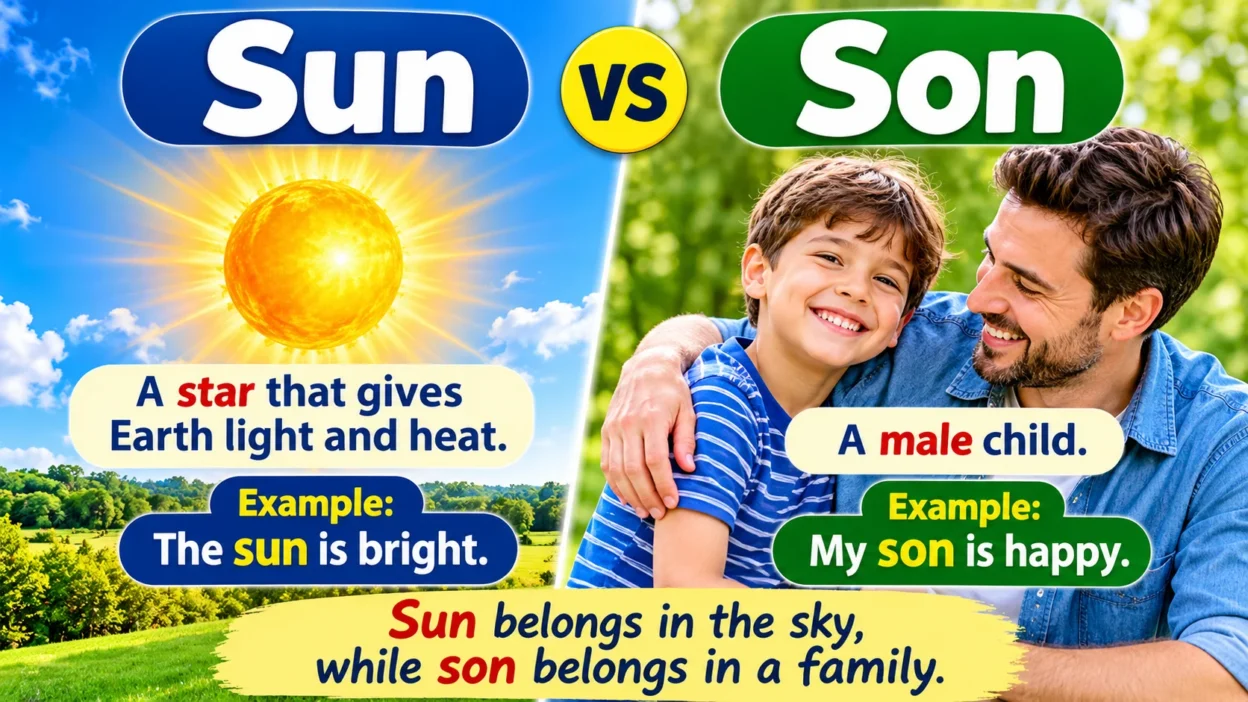
Sun is the star that gives Earth light and heat. Son means a male child in relation to his parents. Both words are pronounced the same way (/sʌn/), but their meanings and uses are different. Use sun when discussing sunlight or the solar system and son when talking about a male child.
Why Do People Confuse Sun and Son?
People often confuse sun and son because they are homophones. Homophones are words that sound alike but have different spellings and meanings.
Both words have:
- The same pronunciation.
- The same number of letters.
- The same vowel sound.
- Different spellings and meanings.
For example:
- The sun is shining brightly today.
- Her son is playing in the garden.
When spoken, these sentences contain two words that sound identical. However, their meanings become clear from the context.
First Word: Sun
Sun is a noun that refers to the star at the center of our solar system. It provides the light and heat that make life on Earth possible.
The sun is essential for plants, animals, and humans. It also plays an important role in weather, seasons, and the natural environment.
A bright sunny day with a clear blue sky and fluffy white clouds … #5727501
Meaning of Sun
The word sun refers to:
- The star in our solar system: The celestial body around which Earth and other planets orbit.
- Sunlight: The natural light and warmth that come from the sun.
- A source of warmth or brightness: Sometimes used figuratively to describe happiness, hope, or positivity.
Example Sentences with Sun
- The sun rises in the east.
- The sun provides light and warmth to Earth.
- We enjoyed sitting in the sun.
- The flowers need sun to grow.
- The sun disappeared behind the clouds.
- Too much exposure to the sun can damage your skin.
Common Expressions with Sun
- Under the sun: Anywhere in the world or among all possible things.
- Sunlight: Natural light from the sun.
- Sunshine: Bright light and warmth from the sun.
- Sunrise: The time when the sun appears above the horizon.
- Sunset: The time when the sun disappears below the horizon.
Example: There is nothing new under the sun.
Second Word: Son
Son is a noun that means a male child in relation to his parents. It describes a family relationship and is commonly used when talking about children, parents, and relatives.
Meaning of Son
The word son refers to:
- A male child: A boy or man in relation to his parents.
- A family relationship: A male member of a family who has parents.
- A figurative relationship: Sometimes used to describe someone regarded as a son or belonging to a particular place, group, or tradition.
Example Sentences with Son
- Their son is studying at university.
- My son loves playing football.
- She is proud of her son.
- His son helped him clean the house.
- They have one daughter and one son.
- The young son looks just like his father.
Common Expressions with Son
- Only son: A family’s one male child.
- Eldest son: The oldest male child in a family.
- Youngest son: The youngest male child in a family.
- Like father, like son: A son often shares characteristics or behavior with his father.
- Son-in-law: The husband of someone’s daughter.
Example: Like father, like son.
Sun vs Son: Comparison Table
Here is a simple comparison to help you understand the difference between these two homophones.
| Feature | Sun | Son |
|---|---|---|
| Meaning | A star | A male child |
| Part of speech | Noun | Noun |
| Pronunciation | /sʌn/ | /sʌn/ |
| Spelling | S-U-N | S-O-N |
| Main connection | Space and nature | Family and relationships |
| Example | The sun is bright. | My son is happy. |
| Related word | Sunshine | Daughter |
The easiest way to remember: Sun relates to the sky, while son relates to family.
When to Use Sun and Son
Knowing when to use each word is important for correct English writing.
When to Use Sun
Use sun when discussing:
- The star in our solar system.
- Natural light and warmth.
- Sunlight and sunshine.
- Sunrise and sunset.
- Weather and outdoor activities.
- Figurative references to brightness and happiness.
Examples:
- The sun is very bright this morning.
- We sat outside to enjoy the sun.
- Plants need sunlight to grow.
When to Use Son
Use son when discussing:
- A male child.
- A relationship between parents and children.
- Family members.
- Someone considered a son.
- Expressions involving father-son relationships.
Examples:
- My son is five years old.
- Their son won the school competition.
- He loves spending time with his son.
15 Examples of Sun vs Son in Sentences
The following examples show how to use both words correctly in everyday English.
Examples Using Sun
- The sun rises early during the summer.
- We enjoyed the warm sun at the beach.
- The sun provides energy for our planet.
- She opened the curtains to let the sun into the room.
- The children played outside under the sun.
- The sun sets beautifully over the mountains.
- Plants grow better when they receive enough sunlight.
- The clouds covered the sun in the afternoon.
Examples Using Son
- My son is learning to read.
- Her son wants to become a doctor.
- Their son is very interested in science.
- The proud father congratulated his son.
- His son enjoys playing basketball.
- She took her son to the park.
- The family celebrated their son’s birthday.
Common Mistakes When Using Sun and Son
Although these words sound alike, using one instead of the other can change the meaning of a sentence.
Here are some common mistakes to avoid.
| Incorrect Sentence | Correct Sentence |
|---|---|
| My sun is playing outside. | My son is playing outside. |
| The son is shining brightly. | The sun is shining brightly. |
| I love watching the son set. | I love watching the sun set. |
| Her sun is a good student. | Her son is a good student. |
| The plants need the son. | The plants need the sun. |
Why Are These Mistakes Incorrect?
- Writing sun instead of son changes a family relationship into a reference to a star.
- Writing son instead of sun changes a reference to sunlight into a reference to a male child.
Always consider the meaning of your sentence before choosing the spelling.
Memory Trick: How to Remember Sun vs Son
Here is an easy trick to remember the difference:
- Sun = Sky: Both words begin with the letter S, and the sun belongs in the sky.
- Son = Family: Think of a son as a male child in a family.
You can also remember these simple examples:
- The sun shines in the sky.
- My son plays with his toys.
Sound Alike Cards Fundations Level 3 by Alexis Headley | TPT
If you remember sky for sun and family for son, you will rarely confuse these words.
Sun vs Son in American and British English
There is no spelling difference between sun and son in American and British English.
Both varieties use:
- Sun for the star that provides Earth with light and heat.
- Son for a male child.
Their pronunciation is also generally the same in both varieties, although individual accents may affect the exact vowel quality.
For example:
- American English: The sun is shining. My son is happy.
- British English: The sun is shining. My son is happy.
Both spellings are correct in the United States, the United Kingdom, Canada, Australia, and other English-speaking countries.
Similar Words: Other Common Homophones
Sun and son are not the only English words that sound alike but have different meanings. Here are some other common homophones worth learning.
| Word 1 | Word 2 | Difference |
|---|---|---|
| See | Sea | See means to notice; sea is a large body of salt water. |
| One | Won | One is a number; won is the past tense of win. |
| Right | Write | Right means correct; write means to form words. |
| Hear | Here | Hear means to listen; here refers to a place. |
| Pair | Pear | Pair means two things; pear is a fruit. |
| Flour | Flower | Flour is used in baking; a flower is a plant. |
| Night | Knight | Night is the dark part of the day; a knight was a historical warrior. |
| Their | There | Their shows possession; there refers to a place. |
Learning homophones can improve your spelling, vocabulary, and writing skills.
Final Verdict: Sun or Son?
The difference between sun and son is simple:
- Sun refers to the star that provides light and heat to Earth.
- Son refers to a male child in relation to his parents.
Both words have the same pronunciation, but they are used in completely different contexts.
Use sun when discussing nature, sunlight, or the solar system. Use son when discussing family relationships or a male child.
Frequently Asked Questions (FAQs)
1. What is the difference between sun and son?
Sun refers to the star at the center of our solar system, while son means a male child in relation to his parents. Both words sound the same but have different meanings and spellings.
2. Are sun and son homophones?
Yes, sun and son are homophones. They have identical pronunciation (/sʌn/) but different spellings and meanings. This makes them a common source of confusion for English learners.
3. Is it my sun or my son?
The correct phrase is my son when referring to your male child. The word sun refers to the star in our solar system, not a family member.
4. Is sun or son used for a boy?
Son is the correct word for a boy in relation to his parents. For example, “He is my son.”
5. Do sun and son sound the same?
Yes, both words are pronounced /sʌn/. They have the same vowel and consonant sounds, even though their spellings and meanings are different.
6. What is the plural of sun and son?
The plural of sun is suns, while the plural of son is sons. Suns can refer to multiple stars, while sons refers to multiple male children.
7. Why are sun and son spelled differently?
They have different historical origins and meanings. English preserves their different spellings even though their modern pronunciations are identical.
8. Can sun and son be used in the same sentence?
Yes. For example: “My son enjoys watching the sun set every evening.” Here, son refers to a male child, and sun refers to the star.
Remember This
- Sun = Star: The bright star that gives Earth light and heat.
- Son = Male child: A boy or man in relation to his parents.
- Sun and son = Homophones: They sound the same but have different meanings.
- Use context: Think about if your sentence refers to nature or family.
Conclusion
Understanding the difference between sun and son is easy once you remember their meanings. Although both words sound exactly alike, they describe two completely different things. The sun is the star that provides light and warmth to Earth, while a son is a male child in a family.
To avoid spelling mistakes, remember that sun belongs in the sky, while son belongs in a family. Practice using both words in everyday sentences to improve your English vocabulary, spelling, and writing confidence.