If you are tired and want to stop working for a while, you may wonder if to say “take a rest” or “have a rest.” Both expressions can describe stopping an activity to relax or recover, but they are not equally natural in every variety of English. Understanding the difference can help you sound more natural and avoid awkward phrasing.
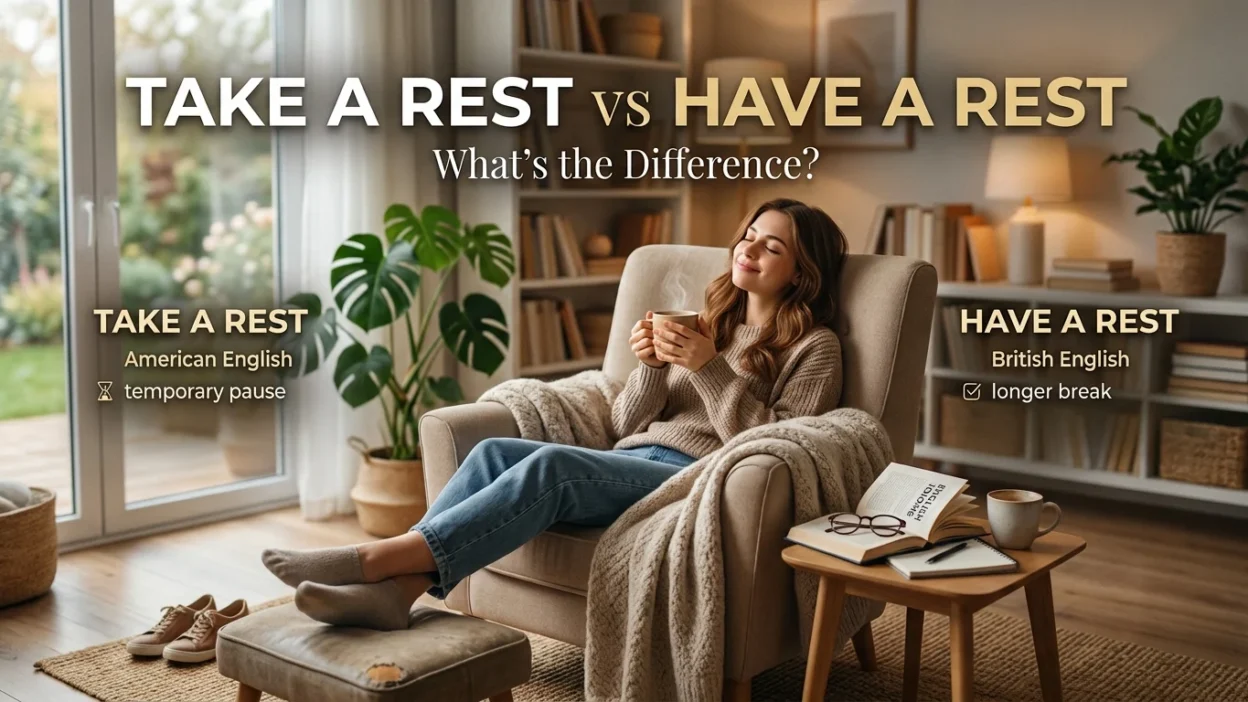
The main distinction is regional and stylistic. “Have a rest” is a common and natural expression, especially in British English, while “take a rest” is understandable but less idiomatic in many everyday contexts. American English more commonly uses “take a break,” “get some rest,” or simply “rest.” Let’s examine how these expressions work and when to use them.
Quick Answer
“Have a rest” and “take a rest” both mean to stop and relax because you are tired. However, “have a rest” is especially natural in British English, while “take a rest” is less common in everyday English. In American English, “take a break” or “get some rest” is usually more natural.
Why Do People Confuse “Take a Rest” and “Have a Rest”?
The confusion comes from English having several verbs that can naturally combine with nouns related to relaxation.
For example, we say:
- have a rest
- take a break
- get some rest
- take some time off
- get some sleep
Because “take a break” is extremely common, learners sometimes transfer take to rest and create “take a rest.”
“Take a rest” is not impossible or incomprehensible. Native speakers can understand it. However, depending on the variety of English and context, another expression may sound more natural.
What Does “Have a Rest” Mean?
“Have a rest” means to stop what you are doing for a period of time and relax, especially because you are tired.
Examples:
- You look tired. Have a rest.
- Let’s sit down and have a rest.
- I need to have a rest before we continue.
- She went upstairs to have a rest.
The expression is particularly common in British English.
Is “Have a Rest” Correct?
Yes. “Have a rest” is grammatically correct and natural.
It commonly appears when someone needs a short period of relaxation.
You have been working all morning. Have a rest.
What Does “Take a Rest” Mean?
“Take a rest” also means to stop and relax or recover from physical activity.
For example:
- We stopped to take a rest.
- The hikers decided to take a rest.
- You should take a rest if you feel tired.
However, in many everyday situations, especially in American English, native speakers are more likely to say “take a break,” “get some rest,” or simply “rest.”
So while “take a rest” can be understood, it is often not the first choice for natural everyday conversation.
Take a Rest vs Have a Rest: Comparison Table
| Expression | Meaning | Naturalness | Common Usage |
|---|---|---|---|
| Have a rest | Relax because you are tired | Very natural | Especially British English |
| Take a rest | Stop and relax/recover | Correct but less common | Used in some contexts |
| Take a break | Stop an activity temporarily | Very natural | Very common in American and British English |
| Get some rest | Relax or sleep to recover | Very natural | Common in both varieties |
| Rest | Stop activity and relax | Very natural | Common everywhere |
When Should You Use Each?
Use “Have a Rest” When You Mean Relax
Use “have a rest” when someone needs to stop and relax.
- You have been walking for hours. Have a rest.
- I think I’ll have a rest this afternoon.
- Let’s have a rest before dinner.
This is particularly natural in British English.
Use “Take a Rest” in Certain Contexts
“Take a rest” can be used when emphasizing a period of recovery or a pause after physical activity.
- The players took a rest after training.
- We stopped to take a rest during the hike.
- He needed to take a rest after carrying the boxes.
Nevertheless, “take a break” or “have a rest” may sound more natural in many conversational situations.
Use “Take a Break” for Work or Activities
When you temporarily stop working, studying, or doing an activity, “take a break” is often the most natural choice.
- I need to take a break from studying.
- Let’s take a break for lunch.
- She took a short break from work.
Take a Rest vs Have a Rest: 10+ Examples
- You look exhausted. Have a rest.
- Let’s have a rest before we continue walking.
- I need to have a rest after cleaning the house.
- The children sat down to have a rest.
- We stopped to take a rest during the journey.
- The runners took a rest after completing the first part of the race.
- You should get some rest tonight.
- Let’s take a break before starting the next lesson.
- She went home to have a rest.
- The hikers took a rest beside the river.
- I was tired, so I decided to rest for an hour.
- After several hours of work, we took a short break.
Notice that the most natural expression depends partly on what kind of “rest” you mean.
Common Mistakes
Mistake 1: Assuming “Take a Rest” Is Always the Best Choice
Learners often think:
take a rest = take a break
But “take a break” is much more established for temporarily stopping an activity.
More natural:
I need to take a break from work.
Mistake 2: Thinking “Have a Rest” Is Incorrect
It is not incorrect.
You look tired. Have a rest.
This is perfectly grammatical and especially common in British English.
Mistake 3: Using “Rest” and “Break” as Exact Synonyms
They overlap, but they are not always interchangeable.
A break usually means a temporary pause from an activity.
Rest emphasizes relaxation or recovery from tiredness.
Compare:
- I need a break from studying.
- I need some rest because I’m exhausted.
Mistake 4: Saying “Have a Break” When You Mean Sleep
“Have a break” generally means temporarily stop an activity. If you mean physical recovery or sleep, “get some rest” may be better.
Memory Trick
A simple way to remember the expressions is:
Have a rest = relax.
Take a break = pause an activity.
Get some rest = recover or sleep.
For example:
I’m tired → I need some rest.
I’ve been studying for three hours → I need to take a break.
You look exhausted → Have a rest.
American vs British English
There is an important regional difference.
“Have a rest” is particularly familiar and natural in British English:
You look tired. Have a rest.
American English more commonly uses expressions such as:
Take a break.
Get some rest.
You should rest.
“Take a rest” can be understood in both varieties, but it is generally less common as an everyday expression than these alternatives.
The distinction is not absolute. Speakers vary by region, context, age, and personal style.
Similar Words and Expressions
Several expressions can communicate a similar idea:
Rest
I need to rest after the long journey.
This is the simplest verb.
Get Some Rest
You should get some rest tonight.
This is especially useful when someone is tired or needs recovery.
Take a Break
Let’s take a break for ten minutes.
This focuses on pausing an activity.
Have a Break
Let’s have a break before the next meeting.
This is also used, particularly in British English.
Take Some Time Off
She decided to take some time off work.
This usually suggests a longer period away from work or regular responsibilities.
Final Verdict
Both “have a rest” and “take a rest” can express the idea of stopping to relax or recover. However, they are not equally common in everyday English.
If you want a natural general expression, “have a rest” works especially well in British English. For American English, “take a break,” “get some rest,” or simply “rest” will often sound more natural.
Frequently Asked Questions
Is “have a rest” grammatically correct?
Yes. “Have a rest” is grammatically correct and commonly used, especially in British English.
Is “take a rest” correct English?
Yes. “Take a rest” is understandable and grammatically possible, although it is less common in everyday conversation than some alternatives.
Which is more natural: “take a rest” or “have a rest”?
It depends on the variety of English and context. “Have a rest” is particularly natural in British English. In American English, “take a break” or “get some rest” is often preferred.
Do Americans say “have a rest”?
Americans can understand the expression, but “take a break,” “get some rest,” and “rest” are generally more common choices in American everyday speech.
Is “take a break” the same as “have a rest”?
They can overlap, but their emphasis differs. “Take a break” usually means temporarily stopping an activity, while “have a rest” emphasizes relaxing or recovering from tiredness.
Can I say “I need to take a rest”?
Yes, but in many contexts “I need to get some rest” or “I need to take a break” will sound more natural.
What is the most natural way to say it?
Choose according to meaning:
- Have a rest → relax, especially British English
- Take a break → pause an activity
- Get some rest → recover or sleep
- Rest → stop activity and relax
Remember This
Have a rest is correct and especially common in British English.
Take a rest is possible but less common in everyday speech.
For a temporary pause from work or study, use take a break.
For recovery from tiredness, get some rest is a very natural choice.
Conclusion
The expressions “take a rest” and “have a rest” have similar meanings, but natural usage varies. “Have a rest” is particularly common in British English, while “take a break” and “get some rest” are often preferred in everyday American English.
The easiest way to choose is to consider the situation. If you are stopping an activity, take a break is a strong choice. If you are tired and need to relax, have a rest or get some rest works well. Once you understand this small difference, choosing the right expression becomes much easier.