
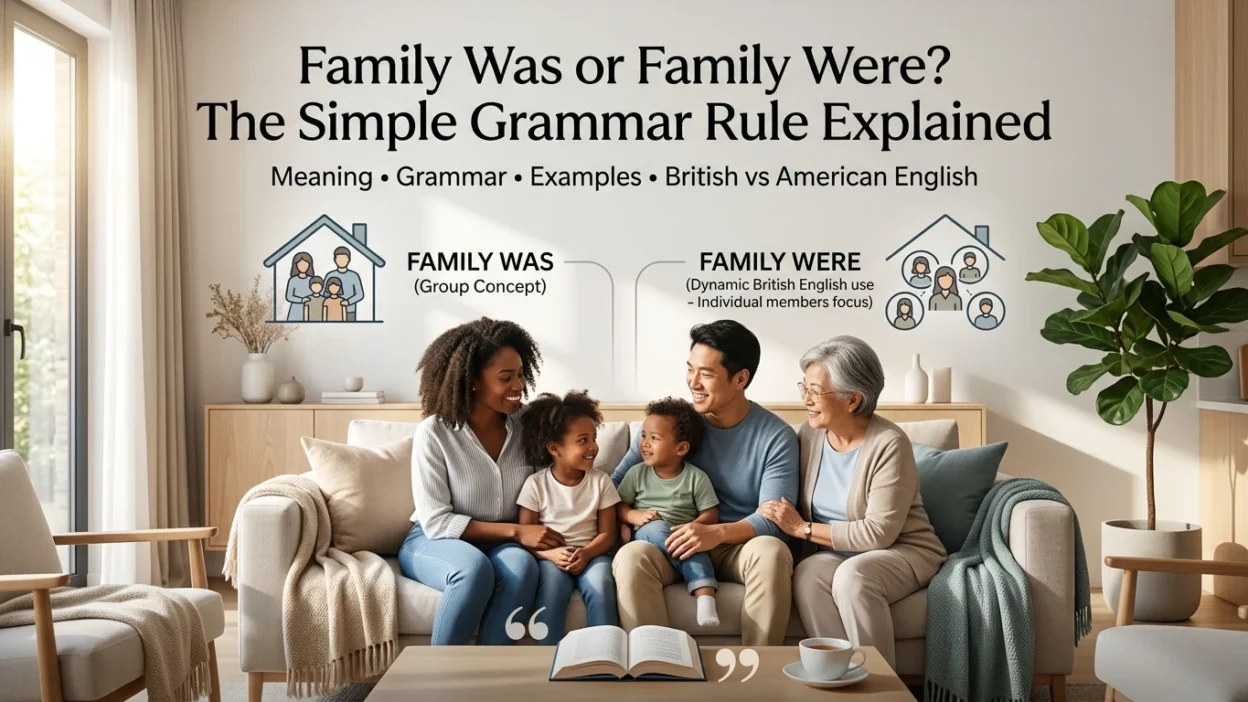
When you are talking about a family, should you say “my family was” or “my family were”? This question often confuses English learners because family refers to several people but is grammatically a singular collective noun. The correct choice depends partly on whether you are treating the family as one unit or as individual members.
In American English, “family was” is generally the standard choice when family means the group as a single unit. In British English, both “family was” and “family were” can be correct, depending on the meaning. This guide explains the difference with clear rules, examples, and practical tips.
Quick Answer
“Family was” is usually correct when family is treated as one group: “My family was happy.” “Family were” is common in British English when the members are considered individually: “My family were arguing among themselves.” American English generally prefers “family was.”
Why Do People Confuse “Family Was” and “Family Were”?
The confusion comes from the fact that family describes more than one person.
For example:
- My family has five members.
- My family was at home.
- My family were discussing their individual plans.
Although a family contains several people, family is a singular noun. However, it is also a collective noun, and collective nouns can sometimes take either singular or plural verbs depending on the variety of English and the intended meaning.
The key question is:
Are you thinking about the family as one unit or about its individual members?
That distinction makes the choice much easier.
First Word: “Family”
Family is a singular collective noun referring to a group of people who are related or connected as a family.
Examples:
- My family is large.
- Her family lives nearby.
- Their family was very welcoming.
- His family has a house in the countryside.
Even though a family contains multiple people, the noun family itself is grammatically singular in many contexts.
When you use American English, singular agreement is especially common:
- My family was happy.
- My family is visiting.
- My family has a new car.
Second Word: “Was”
Was is the singular past form of the verb be.
It is used with singular subjects such as:
- I was
- he was
- she was
- it was
- the family was
Therefore, “the family was” follows the standard singular agreement pattern.
Examples:
- My family was excited.
- Her family was at the restaurant.
- The whole family was together.
- Our family was proud of him.
When the family is being viewed as a single group, was is the natural choice.
Comparison Table
| Expression | Meaning | Common Usage |
|---|---|---|
| Family was | The family is viewed as one unit | Very common in American English |
| Family were | Family members are viewed individually | Common in British English |
| My family was happy | The group was happy | Standard |
| My family were arguing | Individual members were arguing | Particularly British |
| The family was at home | Everyone was considered one group | Standard |
| The family were choosing their own seats | Members acted individually | British English |
When to Use Each
Use “Family Was” for the Family as One Unit
Use was when the family acts, feels, or exists as a single group.
Examples:
- My family was happy.
- Our family was invited to the wedding.
- Her family was famous in the town.
- The family was staying at a hotel.
Here, you are not focusing on the actions of individual family members.
Use “Family Were” When Focusing on Individual Members
In varieties of English where collective nouns can take plural verbs, particularly British English, were can emphasize the separate actions or opinions of family members.
For example:
- My family were arguing among themselves.
- The family were all wearing different clothes.
- His family were divided over the decision.
- The family were taking their seats one by one.
The plural verb suggests that the members are being considered separately.
10+ Examples of “Family Was”
Here are some natural examples using family was:
- My family was happy to see me.
- Her family was very supportive.
- Our family was together for Christmas.
- His family was living in London at the time.
- The family was waiting outside.
- My family was surprised by the news.
- Their family was known throughout the village.
- The whole family was invited to dinner.
- My family was proud of my achievement.
- Her family was away last weekend.
- Our family was having dinner when the phone rang.
- The family was staying with relatives.
In each example, the family is presented as one group.
Common Mistakes
Mistake 1: Assuming “Family” Must Always Take “Were”
Because a family contains several people, learners sometimes assume that family were must always be correct.
That is not the case.
In American English, singular agreement is normally preferred:
My family was happy.
Mistake 2: Thinking “Family” Is Always Singular Everywhere
The opposite mistake is also possible.
British English often allows collective nouns to take plural verbs when the members are being considered individually.
For example:
My family were arguing among themselves.
This does not necessarily mean the sentence is incorrect. The intended meaning and variety of English matter.
Mistake 3: Mixing the Verb With a Plural Pronoun Without Meaning
Compare:
My family was happy because they received good news.
This can be perfectly natural because family is grammatically singular while they refers to the individual family members.
English agreement is sometimes more flexible with collective nouns than learners expect.
Memory Trick
Use this simple rule:
One group → WAS
Individual members → WERE
For example:
- The family was happy. → One group
- The family were arguing. → Individual members
For American English, however, family was is generally the safer standard choice.
American vs British English
There is an important difference between American and British usage.
American English
American English generally treats collective nouns such as family as singular when they refer to the group as a whole.
Examples:
- My family was happy.
- My family is large.
- My family has moved.
Plural agreement with collective nouns is less common in ordinary American usage.
British English
British English can treat collective nouns as either singular or plural, depending on meaning.
For example:
- The family was happy. → The family as one unit
- The family were arguing. → Individual family members
This pattern also occurs with collective nouns such as team, government, staff, and committee.
The important point is that “family were” is not simply a grammatical error. It can be appropriate in British English when the members are being emphasized.
Similar Words
Understanding related collective nouns can make this rule easier.
Team
- The team was ready. → One unit
- The team were arguing among themselves. → Individual members, especially in British English
Government
- The government was criticized.
- The government were divided over the issue. → Possible in British English when individual members are emphasized
Staff
- The staff was small. → Common in American English
- The staff were discussing their schedules. → Common in British English
Committee
- The committee was meeting.
- The committee were unable to agree. → British usage can emphasize individual members
These examples show that family belongs to a larger group of collective nouns whose verb agreement can vary.
Final Verdict
If you are writing in American English, choose “family was” in most situations:
My family was happy.
If you are using British English, both “family was” and “family were” can be correct. Use was when the family is viewed as one unit and were when the individual family members are being emphasized.
The safest approach is to consider the meaning first and then the variety of English you are using.
Frequently Asked Questions
Is “my family was” grammatically correct?
Yes. “My family was” is grammatically correct and is especially common in American English.
Is “my family were” correct?
Yes, in certain contexts. “My family were” is commonly possible in British English when the individual members of the family are being considered separately.
Should I say “my family was happy” or “my family were happy”?
“My family was happy” is the standard choice in American English. In British English, “my family were happy” can also be used, depending on the intended meaning.
Is family a singular or plural noun?
Family is grammatically singular in its basic form, but it is a collective noun referring to multiple people. This allows different agreement patterns in some varieties of English.
Is “the whole family was” correct?
Yes. “The whole family was” is correct when the family is treated as one group.
Can I say “the family were”?
Yes. In British English, “the family were” can be correct when the sentence focuses on individual family members.
Which is better for American English: “family was” or “family were”?
“Family was” is generally the standard choice in American English.
Remember This
- Family was = usually one family as a unit.
- Family were = individual family members, especially in British English.
- American English generally prefers singular agreement with family.
- British English allows more flexibility with collective nouns.
- Always consider both meaning and variety of English.
Conclusion
The choice between “family was” and “family were” depends on how you view the collective noun family. When the family is treated as one group, was is the natural choice. This is particularly standard in American English.
British English gives you more flexibility and can use were when the sentence focuses on individual family members. Once you remember “one group = was” and “individual members = were,” the difference becomes much easier to understand.