
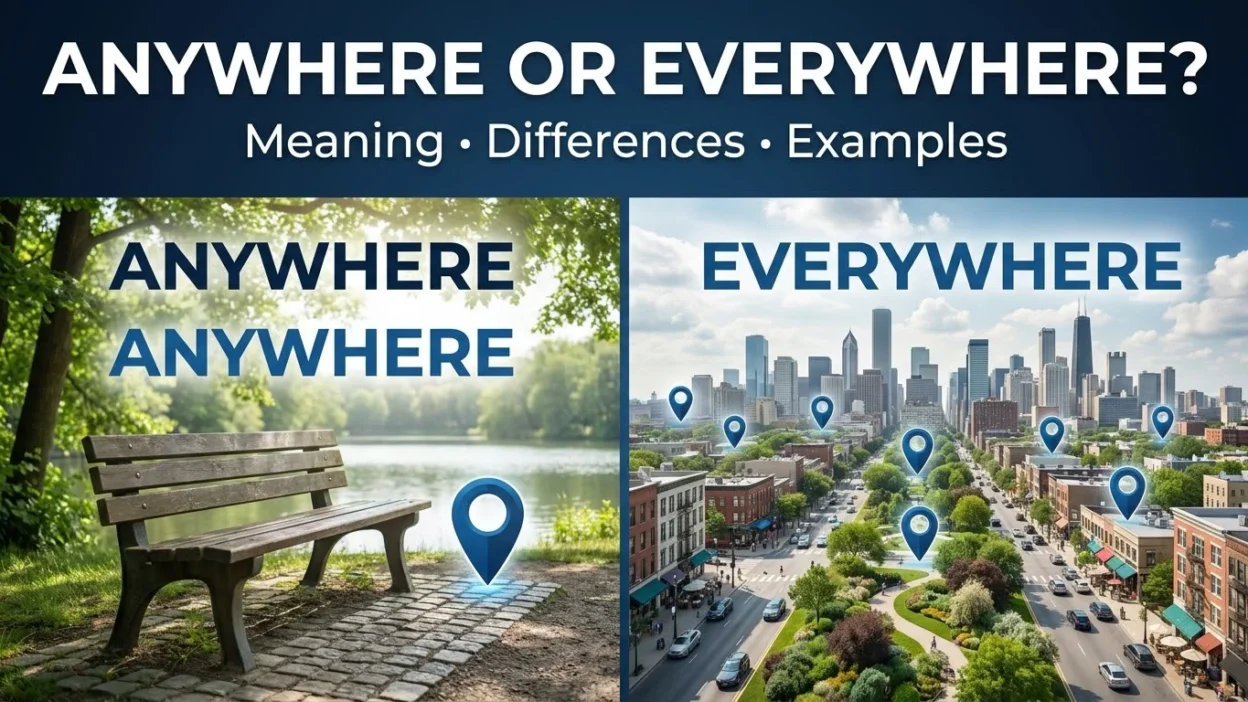
Have you ever wondered if to use anywhere or everywhere in a sentence? These two English words describe places, but they do not mean the same thing. Choosing the correct word helps you express your ideas clearly and naturally. Although both words contain “where,” their meanings and uses are different.
Anywhere means any place or no particular place, depending on the context. It often appears in questions, negative sentences, and sentences about possibilities. Everywhere means all places or every place. It is used when something exists, happens, or can be found in all relevant places. For example, “You can sit anywhere” means you may choose any available place, while “I looked everywhere” means you searched all the relevant places. Understanding this distinction will help you avoid common grammar mistakes in everyday conversations, academic writing, emails, and English exams.
Quick Answer: Anywhere vs. Everywhere
Anywhere refers to any place without specifying one particular location. It is commonly used in questions, negative statements, and expressions of freedom or possibility. Everywhere refers to all places within a relevant area. Use anywhere when the location is unrestricted or unspecified, and everywhere when you mean all places.
Why Do People Confuse Anywhere and Everywhere?
People often confuse these words because both are adverbs of place and contain the word “where.” They also appear in sentences about locations, travel, searching, and movement.
However, the main difference is the scope of the location.
- Anywhere: Any place, no particular place, or a place without restrictions.
- Everywhere: All places or every relevant location.
Consider these examples:
- You can find a restaurant anywhere in this city. (Any location is possible.)
- There are restaurants everywhere in this city. (Restaurants are found throughout the city.)
The first sentence focuses on the possibility of finding a restaurant at an unspecified location. The second emphasizes how widely restaurants are distributed.
1. What Does Anywhere Mean?
Anywhere means any place or no particular place. It can express possibility, permission, freedom of movement, or the absence of a specific location.
It is commonly used in questions, negative sentences, and conditional statements.
Examples of Anywhere
- You can sit anywhere you like.
- Is there anywhere we can park?
- I couldn’t find my keys anywhere.
- We can go anywhere this weekend.
- I don’t want to live anywhere too far from work.
In each example, anywhere refers to an unspecified location or a place that has not been restricted to one particular choice.
When Is Anywhere Commonly Used?
Use anywhere in these situations:
1. To offer a choice of location
- You may choose anywhere in the room.
- We can meet anywhere near the station.
2. To ask whether a place exists
- Is there anywhere to buy food nearby?
- Can we go anywhere after class?
3. To describe the absence of a location
- I couldn’t find my phone anywhere.
- There isn’t anywhere to sit.
4. To express possibility
- With a little planning, this project could go anywhere.
- You can travel anywhere if you have the time and money.
Remember that anywhere does not always mean “one place.” Its meaning depends on the sentence, but it generally leaves the location unspecified or unrestricted.
2. What Does Everywhere Mean?
Everywhere means all places or every place within the relevant area. It describes something that is widespread, present throughout an area, or found in all the places being considered.
It usually emphasizes the completeness or wide distribution of something.
Examples of Everywhere
- I looked everywhere for my wallet.
- Flowers are blooming everywhere in the garden.
- You can see advertisements everywhere.
- The children left their toys everywhere.
- She travels everywhere for her job.
In these examples, everywhere suggests that the action or situation covers all relevant places rather than just one possible location.
When Is Everywhere Commonly Used?
Use everywhere in these situations:
1. To describe something found in all places
- Wi-Fi is available everywhere in this building.
- You can see trees everywhere in the park.
2. To describe a thorough search
- We searched everywhere for the missing document.
- I looked everywhere, but the glasses were nowhere to be found.
3. To describe widespread activity
- People were celebrating everywhere.
- News of the victory spread everywhere.
4. To describe a mess or scattered objects
- There are clothes everywhere in the bedroom.
- Papers were scattered everywhere across the desk.
The important point is that everywhere emphasizes the range of places involved.
3. Anywhere vs. Everywhere: Comparison Table
| Feature | Anywhere | Everywhere |
|---|---|---|
| Meaning | Any place; no particular place | All places |
| Main idea | Possibility or an unspecified location | Complete or widespread coverage |
| Common use | Questions and negative sentences | Statements about widespread presence |
| Positive example | You can go anywhere. | People are traveling everywhere. |
| Negative example | I couldn’t find it anywhere. | The word can occur in negative contexts, too |
| Question example | Is there anywhere to sit? | Is it crowded everywhere? |
| Related expression | Any place | Every place |
| Focus | Choice or possibility | All relevant locations |
One useful distinction is that anywhere and everywhere can both appear in positive, negative, and question forms. Their meanings, rather than their sentence types alone, determine which word is appropriate.
4. When Should You Use Anywhere or Everywhere?
Choosing between these words becomes easier when you focus on what you want to communicate.
Use Anywhere When You Mean Any Place
Choose anywhere when the location is not specified, when a choice is available, or when you are asking whether a place exists.
Examples:
- You can put your bag anywhere.
- I don’t see a pharmacy anywhere nearby.
- Is there anywhere we can talk privately?
- We can go anywhere you prefer.
Simple rule: If you mean “any place you choose” or “no place at all,” anywhere is often the right choice.
Use Everywhere When You Mean All Places
Choose everywhere when you mean all relevant locations or when something is spread throughout an area.
Examples:
- Snow covered everywhere we could see.
- I searched everywhere in the house.
- The smell of fresh bread was everywhere.
- Tourists were taking pictures everywhere.
Simple rule: If you mean “all places” or “throughout the area,” use everywhere.
Can Both Words Be Used in Similar Sentences?
Yes. Both words can describe similar situations while expressing different meanings.
- You can find books anywhere in the library. Books may be found at any location in the library.
- You can find books everywhere in the library. Books are distributed throughout the library.
The first sentence emphasizes the range of possible locations. The second emphasizes how widespread the books are.
5. More Than 10 Examples of Anywhere and Everywhere
The following examples show how each word works in everyday English.
Examples Using Anywhere
- You can park your bicycle anywhere near the entrance.
- Is there anywhere I can charge my phone?
- I haven’t seen my notebook anywhere.
- We can eat anywhere you want.
- She doesn’t want to go anywhere tonight.
- You can download the file anywhere you have an internet connection.
- Did you find anywhere quiet to study?
- I would travel anywhere to see my favorite band.
- There isn’t anywhere nearby where we can get fresh water.
- You can place the flowers anywhere on the table.
- If you need help, you can find me almost anywhere in the office.
- The dog followed its owner everywhere they went.
The last example uses everywhere, showing how it can describe movement across all relevant locations.
Examples Using Everywhere
- I looked everywhere for my missing wallet.
- There were colorful lights everywhere in the city.
- The children left their toys everywhere.
- You can hear birds singing everywhere in the forest.
- During the festival, people gathered everywhere downtown.
- Dust had settled everywhere in the unused room.
- The company has offices everywhere in the country.
- She looked everywhere but couldn’t find her glasses.
- After the storm, fallen branches were everywhere.
- We saw beautiful scenery everywhere we traveled.
- His name appeared everywhere in the news.
- Fresh flowers were displayed everywhere in the hotel.
Paired Examples to Show the Difference
| Anywhere | Everywhere |
|---|---|
| You can sit anywhere. | People were sitting everywhere. |
| I couldn’t find my shoes anywhere. | Shoes were scattered everywhere. |
| Is there anywhere to eat? | Restaurants are everywhere here. |
| We can travel anywhere. | We saw mountains everywhere. |
| Put the books anywhere you like. | Books are lying everywhere. |
Notice that the first column often expresses freedom, possibility, or an unsuccessful search. The second frequently describes widespread presence or distribution.
6. Common Mistakes With Anywhere and Everywhere
Even experienced English learners sometimes confuse these words. Here are common mistakes and their corrections.
Mistake 1: Using Everywhere When You Mean Any Place
Incorrect: You can sit everywhere you like.
Better: You can sit anywhere you like.
Why? The speaker is offering a choice of location, not saying that the listener should sit in all places.
Mistake 2: Using Anywhere to Describe Widespread Presence
Incorrect: There are flowers anywhere in the garden.
Better: There are flowers everywhere in the garden.
Why? The intended meaning is that flowers are spread throughout the garden.
Mistake 3: Assuming Anywhere Is Only Used in Questions
Incorrect assumption: Anywhere can only be used in questions.
Correct: You can go anywhere you want.
Why? Anywhere is also common in positive statements, especially when describing freedom or possibility.
Mistake 4: Assuming Everywhere Always Means Literally Every Place in the World
Incorrect assumption: If someone says “I looked everywhere,” they searched every place on Earth.
Correct understanding: “I looked everywhere” usually means the speaker searched all the places relevant to the situation.
Mistake 5: Confusing Everywhere With Every Where
Incorrect: We searched every where for the missing bag.
Correct: We searched everywhere for the missing bag.
Why? Everywhere is normally written as one word when it means “all places.”
7. What Is an Easy Memory Trick for Anywhere and Everywhere?
A simple memory trick can help you remember the difference.
- ANY = a choice: Anywhere means any place you choose or a place that is not specified.
- EVERY = all: Everywhere means all places within the relevant area.
Think of these two sentences:
- Anywhere: Choose any seat you like.
- Everywhere: Every seat in the room is occupied.
Another way to remember the difference is to imagine a room.
If someone says, “Put the box anywhere,” you can choose one suitable spot.
If someone says, “Boxes are everywhere,” boxes are spread across many or all relevant spots.
This trick works well for conversations, schoolwork, writing assignments, and English grammar tests.
8. Anywhere vs. Everywhere in American and British English
There is no major difference in the meaning or standard spelling of anywhere and everywhere between American and British English.
Both varieties use:
- Anywhere to mean any place or no particular place.
- Everywhere to mean all places or throughout an area.
Examples in American English:
- You can park anywhere on this street.
- I looked everywhere for my phone.
Examples in British English:
- You can park anywhere on this street.
- I looked everywhere for my phone.
The expressions are standard in both varieties. Differences may arise from the surrounding vocabulary, pronunciation, or regional context, but the basic distinction remains the same.
9. Similar Words Related to Anywhere and Everywhere
Understanding related words can make your English more precise.
| Word | Meaning | Example |
|---|---|---|
| Somewhere | In or at an unspecified place | I left my bag somewhere upstairs. |
| Nowhere | In no place | There is nowhere to park. |
| Anywhere | At any place or no particular place | You can sit anywhere. |
| Everywhere | In all places | We looked everywhere. |
| Wherever | At or in any place where; in every place where, depending on context | Sit wherever you feel comfortable. |
| Anyplace | Another word for anywhere, especially in informal American English | We can meet anyplace nearby. |
| Everyplace | An informal alternative to everywhere, used especially in American English | I searched everyplace for my keys. |
Anywhere vs. Somewhere
Anywhere often suggests an unrestricted choice or is used in questions and negative statements. Somewhere usually refers to an unspecified place that exists or is believed to exist.
- Is there anywhere to sit?
- I know I left my bag somewhere.
Everywhere vs. Nowhere
Everywhere means all relevant places, while nowhere means no place.
- I searched everywhere for my passport.
- I searched, but the passport was nowhere to be found.
Anywhere vs. Wherever
Anywhere refers to any place, while wherever often introduces a clause describing a place or situation.
- You can sit anywhere.
- You can sit wherever you like.
Both sentences allow a choice, but the second explicitly connects the location to the person’s preference.
10. Frequently Asked Questions (FAQs)
1. What is the main difference between anywhere and everywhere?
Anywhere means any place or no particular place, while everywhere means all places within a relevant area. Use anywhere to express choice or possibility and everywhere to describe widespread presence.
2. Is anywhere one word or two?
Anywhere is written as one word. It is a standard English adverb meaning any place or no particular place.
Example: You can sit anywhere in the room.
3. Is everywhere one word or two?
Everywhere is written as one word when it means all places.
Example: I looked everywhere for my keys.
4. Can I use anywhere in a positive sentence?
Yes. Anywhere is common in positive sentences that express freedom, choice, or possibility.
Example: You can travel anywhere in the country.
5. Can everywhere be used in a question?
Yes. Everywhere can appear in questions when asking about all relevant places.
Example: Is it raining everywhere in the city?
6. Is anywhere the same as any place?
Usually, yes. Anywhere can often be replaced by any place without changing the basic meaning.
Example: You can sit anywhere.
You can also say, “You can sit in any place you like,” although the wording may sound less natural in some contexts.
7. Is everywhere the same as all places?
Generally, yes. Everywhere means all places or throughout the relevant area.
Example: The company has branches everywhere in the country.
8. Which word should I use: “I looked anywhere” or “I looked everywhere”?
In a normal statement about a completed search, “I looked everywhere” is the natural choice when you mean you searched all the relevant places.
For example: “I looked everywhere for my wallet.”
“I looked anywhere” is generally unnatural for this meaning, although anywhere can appear in other grammatical structures involving searching.
Remember This
- Anywhere = any place. Use it for an unspecified location, choice, or possibility.
- Everywhere = all places. Use it when something is present or happening throughout the relevant area.
- Anywhere often appears in questions and negative sentences, but it can also appear in positive sentences.
- Everywhere often describes widespread presence, movement, or a thorough search.
- Both words are standard in American and British English.
Conclusion
The difference between anywhere and everywhere is simple once you focus on the meaning. Anywhere refers to any possible or unspecified place, while everywhere refers to all relevant places. Although they can appear in similar sentences, they communicate different ideas.
To improve your English, practice using both words in everyday conversations and short writing exercises. Remember the simple rule: anywhere means any place, while everywhere means all places. With regular practice, you will be able to choose the correct word confidently.