
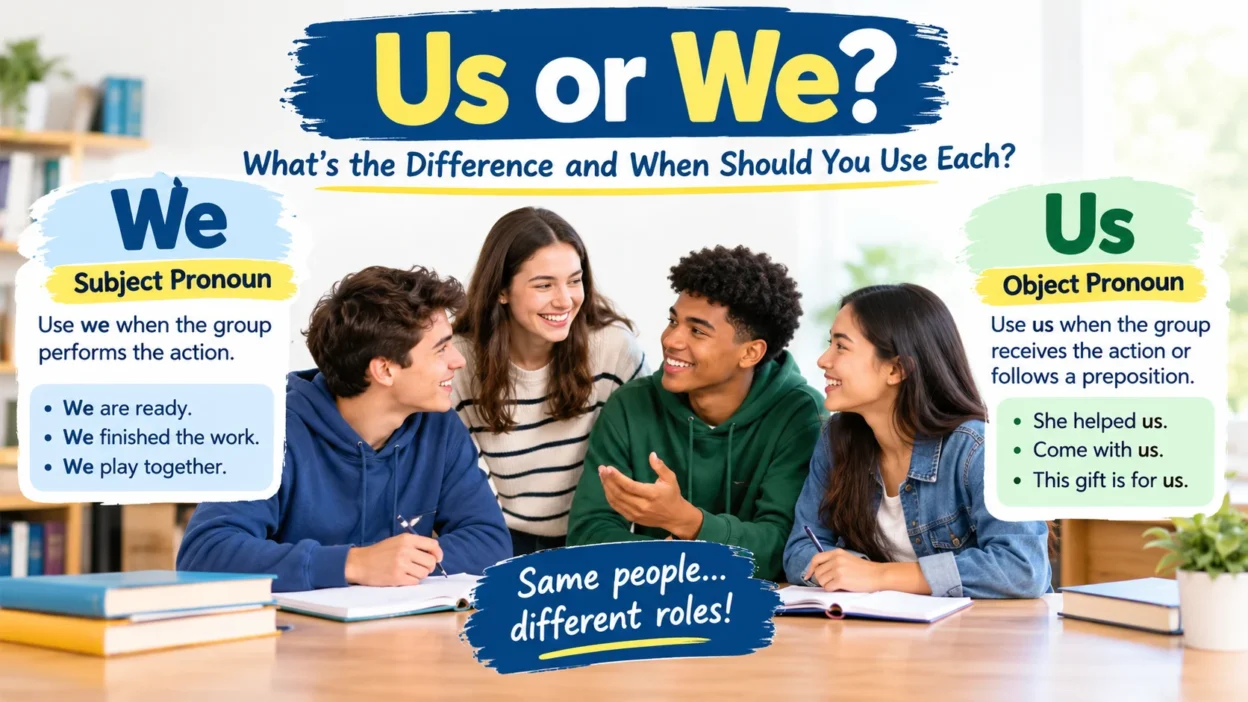
The words “us” and “we” are both pronouns used to refer to a group of people that includes the speaker. However, they have different grammatical roles in a sentence. Understanding the difference between us or we can help you write clearer sentences, speak more naturally, and avoid common English grammar mistakes. Although both words may refer to the same people, you cannot always use them interchangeably.
The main difference is that “we” is a subject pronoun, while “us” is an object pronoun. Use we when the group performs an action, as in “We play football.” Use us when the group receives an action or follows a preposition, as in “She invited us” or “Come with us.” These simple rules work in everyday conversations, academic writing, emails, and professional communication. In this guide, you will learn the meanings of we and us, explore their grammatical differences, and discover practical examples that make choosing the correct pronoun easier.
Quick Answer: Us or We?
“We” is a subject pronoun, and “us” is an object pronoun. Use we when a group performs an action: “We finished the project.” Use us when the group receives an action or follows a preposition: “The teacher helped us.” Remember: we does something, while us is affected by something.
Why Do People Confuse “Us” and “We”?
People often confuse us and we because both words refer to the same group of people. The difference is not about who the people are but about how they function in a sentence.
For example:
- We are learning English.
- The teacher is helping us.
Both sentences refer to the same group, but the pronouns have different grammatical jobs.
Another reason for confusion is that people sometimes use the pronoun that sounds more natural in casual conversation rather than the one required by standard grammar. Expressions such as “Me and him went there” demonstrate a similar problem with subject and object pronouns.
To choose correctly, identify whether the pronoun is acting as the subject or the object of the sentence.
1. What Does “We” Mean?
We is a first-person plural subject pronoun. It refers to two or more people, including the person speaking or writing.
Use we when the group performs an action or when the sentence describes the group.
Examples of “We”
- We study English every day.
- We went to the park yesterday.
- We are ready for the examination.
- We enjoy watching movies.
- We have completed our assignment.
- We will visit our grandparents tomorrow.
In each example, we identifies the people performing the action or being described.
When Should You Use “We”?
Use we in these situations:
1. When the group performs an action
- We play cricket after school.
- We prepared dinner together.
2. When describing a group
- We are happy with the results.
- We are classmates.
3. When using a linking verb
- We are responsible for the project.
- We were excited about the trip.
4. When using auxiliary verbs
- We have finished our work.
- We can solve this problem.
Remember: If the pronoun is the subject of the sentence, we is usually the correct choice.
2. What Does “Us” Mean?
Us is a first-person plural object pronoun. It refers to the speaker and at least one other person when the group receives an action or follows a preposition.
Use us as the object of a verb or preposition.
Examples of “Us”
- She called us last night.
- The teacher praised us.
- They invited us to dinner.
- Please come with us.
- He gave us some useful advice.
- The coach spoke to us after the match.
In these examples, us receives an action or follows a preposition.
When Should You Use “Us”?
Use us in these situations:
1. After an action verb
- The manager thanked us.
- My friends visited us.
2. After a preposition
- This gift is for us.
- She sat beside us.
- They came with us.
3. As an indirect object
- The teacher gave us extra time.
- My father bought us new books.
4. When the group receives an action
- The audience welcomed us.
- The school selected us for the competition.
Remember: If the pronoun functions as the object of a verb or preposition, us is usually correct.
3. Us vs. We: Comparison Table
| Feature | We | Us |
|---|---|---|
| Part of speech | Subject pronoun | Object pronoun |
| Grammatical role | Performs or experiences the action as the subject | Receives an action or follows a preposition |
| Typical position | Before the main verb | After a verb or preposition |
| Example | We helped them. | They helped us. |
| Common phrase | We are ready. | Come with us. |
| Possessive form | Our | Our, when used before a noun |
| Reflexive form | Ourselves | Ourselves, depending on sentence structure |
Notice that we and us have different forms, but their possessive form is generally our or ours, depending on how the sentence is constructed.
For example:
- We brought our books.
- The books belong to us.
- The books are ours.
4. When Should You Use “Us” or “We”?
The easiest way to choose between these pronouns is to examine the sentence structure.
Use “We” Before the Main Verb
When a group performs an action, use we as the subject.
Examples:
- We work together.
- We understand the lesson.
- We visited the museum.
Incorrect: Us work together.
Correct: We work together.
Use “Us” After a Verb
When a verb acts upon the group, use us as the object.
Examples:
- The principal congratulated us.
- She knows us well.
- They invited us to the party.
Incorrect: The principal congratulated we.
Correct: The principal congratulated us.
Use “Us” After a Preposition
Prepositions such as to, for, with, between, and among are followed by object pronouns in standard English.
Examples:
- Come with us.
- This message is for us.
- She spoke to us.
- The agreement is between us.
Incorrect: Come with we.
Correct: Come with us.
Use “We” After a Conjunction When It Is the Subject
When a pronoun follows and or or, check its grammatical role rather than its position.
Examples:
- Sarah and we organized the event. (Grammatical, though “Sarah and I” is often more natural when referring to yourself individually.)
- You and we should discuss the issue. (Grammatical, though “you and I” or a rephrased sentence may sound more natural.)
If the pronoun is the subject, use the subject form. If it is the object, use the object form.
5. Examples of “Us” and “We” in Sentences
Here are 16 practical examples to help you understand the difference.
- We are going to the library.
- The librarian helped us find a book.
- We have an English test tomorrow.
- Our teacher prepared a revision sheet for us.
- We enjoyed the school trip.
- The guide showed us the historical building.
- We are working on a science project.
- Our classmates joined us after lunch.
- We will attend the meeting this afternoon.
- The manager invited us to the meeting.
- We support our local team.
- The coach thanked us for our support.
- We bought some flowers.
- These flowers are for us.
- We can solve the problem together.
- The teacher explained the solution to us.
Examples With Both Words
Sometimes, both pronouns appear in the same sentence.
- We invited them to join us.
- We prepared lunch for us and our guests.
- We told the manager that the decision affected us.
- We hope they will come with us.
In these sentences, we acts as the subject, while us acts as the object.
6. Common Mistakes When Using “Us” and “We”
Even fluent English speakers sometimes make mistakes with subject and object pronouns, especially in informal speech.
Mistake 1: Using “Us” as the Subject
Incorrect: Us went to the market.
Correct: We went to the market.
Why? The pronoun performs the action of going, so the subject form we is required in standard English.
Mistake 2: Using “We” as the Object
Incorrect: She invited we to dinner.
Correct: She invited us to dinner.
Why? The pronoun receives the action of inviting, so us is correct.
Mistake 3: Using “We” After a Preposition
Incorrect: He came with we.
Correct: He came with us.
Why? The preposition with takes an object pronoun.
Mistake 4: Choosing the Pronoun by Sound Alone
Incorrect: The teacher gave we extra homework.
Correct: The teacher gave us extra homework.
Why? A pronoun’s grammatical function determines its form, even when another form might sound familiar.
Mistake 5: Confusing “We” With “Our”
Incorrect: We teacher is kind.
Correct: Our teacher is kind.
Why? We is a subject pronoun, whereas our is a possessive determiner used before a noun.
Mistake 6: Forgetting the Role of the Pronoun in Compound Subjects
Incorrect: Us and Tom finished the assignment.
Correct: Tom and we finished the assignment. (Grammatical, although “Tom and I” is generally more natural when the speaker refers to themselves.)
The important rule is to identify the pronoun’s role, not simply whether it appears beside another person.
7. Memory Trick: How to Remember “Us” vs. “We”
A simple memory trick can help you choose the correct pronoun quickly.
We = Doers
Use we when the group performs the action.
- We run.
- We study.
- We cook.
Us = Receivers
Use us when the group receives an action or follows a preposition.
- Help us.
- Invite us.
- Come with us.
The “They” Test
Try replacing the pronoun with they or them.
– ___ went to school.
“They went to school” sounds correct, so use we: “We went to school.”
– The teacher called ___.
“The teacher called them” sounds correct, so use us: “The teacher called us.”
This test works because they is a subject pronoun and them is an object pronoun, just as we is a subject pronoun and us is an object pronoun.
8. Is There a Difference Between American and British English?
There is no significant grammatical difference between American and British English when it comes to us and we. Both varieties follow the same basic subject-versus-object rule.
| Situation | American English | British English |
|---|---|---|
| Subject | We are going home. | We are going home. |
| Direct object | She called us. | She called us. |
| After a preposition | Come with us. | Come with us. |
| Possession | Our house is nearby. | Our house is nearby. |
Both varieties use we as the subject pronoun and us as the object pronoun.
You may hear informal expressions such as “us lot” in some British English contexts, meaning “our group.” However, this regional expression does not change the standard grammatical distinction between we and us.
9. Similar Words: We, Us, Our, and Ours
Learning related pronouns can make the difference between we and us even clearer.
We
A subject pronoun used when the group performs an action.
Example: We are studying together.
Us
An object pronoun used when the group receives an action or follows a preposition.
Example: The teacher helped us.
Our
A possessive determiner used before a noun to show that something belongs to the group.
Example: Our classroom is clean.
Ours
A possessive pronoun used instead of a noun phrase.
Example: This classroom is ours.
Ourselves
A reflexive pronoun used when the subject and object refer to the same group, or for emphasis.
Examples:
- We taught ourselves to play chess.
- We completed the project ourselves.
Compare these sentences:
- We brought our books.
- The teacher gave us our books.
- Those books are ours.
- We organized the books ourselves.
Each word has a different grammatical purpose.
10. Final Verdict: Which Word Is Correct?
Both us and we are correct English words, but they are used in different grammatical situations.
Choose we when the group is the subject of the sentence:
- We are ready.
- We finished the work.
- We understand the question.
Choose us when the group is the object of a verb or preposition:
- She helped us.
- They invited us.
- Come with us.
The key is to focus on the pronoun’s role rather than the people it represents. Once you understand the difference between subjects and objects, choosing between us and we becomes much easier.
Frequently Asked Questions
1. Should I use “us” or “we”?
Use we when the group performs an action, as in “We are learning.” Use us when the group receives an action or follows a preposition, as in “She taught us” or “Come with us.”
2. Is it grammatically correct to say “us and we”?
The phrase depends on the grammatical role of each pronoun in the sentence. Use we for a subject and us for an object. Neither word is automatically correct simply because it appears beside the other.
3. Is “me and we” correct English?
It is generally not correct to use me and we together as a compound subject. For example, say “My friend and I went shopping,” not “Me and we went shopping.” Choose pronouns according to their grammatical roles.
4. Can I use “we” after “and”?
Yes. You can use we after and when the pronoun is part of a compound subject. For example, “My classmates and we organized the event” is grammatically possible, although “My classmates and I organized the event” is usually more natural.
5. Is “for we” correct or should I say “for us”?
In ordinary modern English, use “for us” because for is a preposition that takes an object pronoun. For example, “This present is for us.” The word we does not normally follow for in this construction.
6. What is the difference between “we” and “our”?
We is a subject pronoun, while our is a possessive determiner. Say “We are students” when describing the group, and “Our books are new” when showing possession.
7. How can I quickly remember the difference between “us” and “we”?
Remember that we usually performs the action, while us receives the action or follows a preposition. Compare “We called them” with “They called us.” The subject and object forms make the difference clear.
Remember This
- We = subject: We are studying.
- Us = object: The teacher helped us.
- Our = possession before a noun: Our teacher is kind.
- Ours = possession without a following noun: The books are ours.
- Ourselves = reflexive or emphatic form: We did it ourselves.
When in doubt, identify the subject and object of the sentence. That simple step will help you choose the correct pronoun.
Conclusion
The difference between us and we comes down to grammar. Use we when referring to a group as the subject of a sentence, and use us when that group is the object of a verb or preposition. Both words refer to the same people, but they perform different grammatical functions.
With regular practice, examples, and the simple “doers versus receivers” memory trick, you can use these pronouns confidently in speaking and writing. Always check the role of the pronoun in the sentence, and you will find it much easier to choose between us and we.