
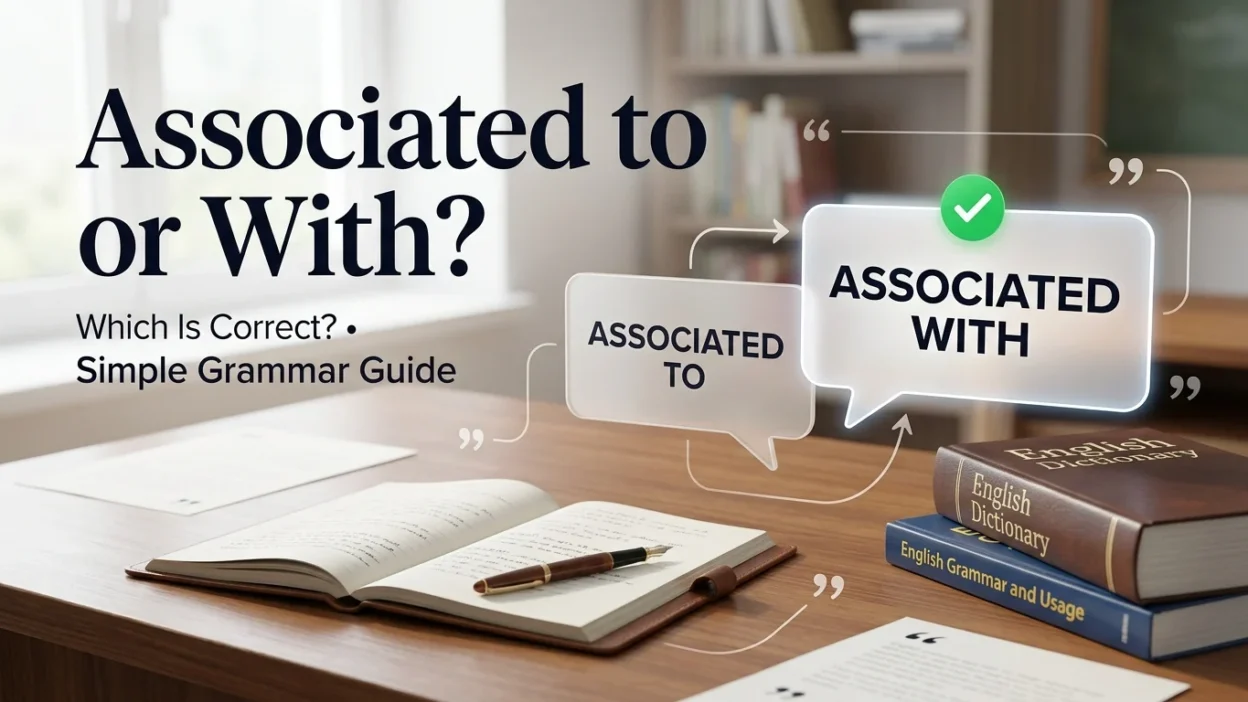
When choosing between “ to” and “ with,” the correct and natural expression in standard English is usually “ with.” We use it when we mean that one person, thing, idea, or event is connected, related, or linked to another. For example, “Smoking is with several health risks” means that smoking is connected to several health risks.
The confusion happens because describes a relationship or connection, and English learners may naturally think that “to” should follow it, especially because other expressions use “to,” such as “related to” and “connected to.” However, the standard collocation is with. Understanding this small difference will help you write and speak more naturally in academic, professional, and everyday English.
Quick Answer
with” is the standard and preferred expression in English. Use it when saying that someone or something is connected, linked, or related to another person, thing, idea, condition, or event. For example: “This problem is planning. rally not used in standard modern English.
Why Do People Confuse It?
The main reason people confuse hat several similar expressions take different prepositions.
For example:
- with a problem
- related to a problem
- connected to a problem
- linked to a problem
- similar to something
Because related to and connected to are very common, it is easy to transfer the preposition “to” to
Another source of confusion is the word association. You might see phrases such as “an association to a particular group” in unusual or specialized contexts, but this does not make to the normal choice when using the adjective or past participle
For ordinary English, the safest rule is simple:
First Word: Associated
Associated means connected, related, linked, or thought of together with something else.
It is commonly used as an adjective or as the past participle of the verb associate.
Examples
- The disease is associated with certain risk factors.
- She is associated with the organization.
- The color blue is often associated with calmness.
- The brand is strongly associated with quality.
- His name became associated with the project.
The word can describe either a positive or negative connection.
For example:
- Success is often associated with hard work.
- The area is associated with high crime rates.
In both cases, “associated with” shows a connection.
Second Word: With
In the expression “associated with,” the preposition with introduces the person, thing, idea, or situation that is connected to the subject.
The basic pattern is:
Something + is associated with + something else.
For example:
Exercise is associated with better physical fitness.
Here, “exercise” is the subject, “is associated” describes the relationship, and “better physical fitness” is the thing connected with exercise.
More examples
- Rainy weather is associated with cooler temperatures.
- The product is associated with high quality.
- The word “home” is often associated with comfort.
- Certain foods are associated with particular cultures.
- The symptoms are associated with the condition.
Associated to or With: Comparison Table
| Expression | Standard English? | Meaning | Example |
|---|---|---|---|
| associated with | Yes | Connected or related to | The disease is associated with age. |
| associated to | Generally no | Not the normal standard construction | Avoid it in ordinary formal English. |
| related to | Yes | Connected or concerning | The issue is related to money. |
| connected to | Yes | Having a connection with | The device is connected to the network. |
| linked to | Yes | Having a relationship or connection | Stress is linked to poor sleep. |
The important distinction is that “associated with” is the normal collocation, while “related to” and “connected to” are separate expressions with their own standard prepositions.
When to Use Each
Use “Associated With”
Use associated with when you mean that two things are connected in some way.
This is especially common in:
- Academic writing
- Scientific writing
- Business communication
- News reporting
- Medical discussions
- Everyday conversation
For example:
High stress is associated with poor sleep.
This does not necessarily mean that stress directly causes poor sleep. It simply indicates that the two are connected or occur together.
Can “Associated To” Ever Be Used?
In standard modern English, associated to is generally considered unnatural or nonstandard when you mean “connected with.”
If you encounter it, it may be the result of influence from another language, a nonstandard construction, or a specialized usage.
For most writing and speaking situations, replace it with associated with.
Instead of:
This problem is associated to poor communication.
Write:
This problem is associated with poor communication.
10+ Examples of “Associated With”
Here are practical examples showing how associated with works in different contexts.
1. Health
Lack of exercise is often associated with poor physical fitness.
The phrase describes a connection between inactivity and fitness.
2. Education
Regular reading is associated with stronger vocabulary skills.
Here, “associated with” means that the two things are connected.
3. Business
The company is associated with high-quality customer service.
The company has a strong connection with the idea of good customer service.
4. Technology
The software is associated with several security concerns.
The software has a connection with those concerns.
5. Weather
Heavy rainfall is associated with flooding in some areas.
The two events are connected.
6. Personality
Confidence is often associated with effective communication.
The statement identifies a common relationship between the two concepts.
7. Culture
The color white is associated with different meanings in different cultures.
The phrase shows a cultural connection.
8. Business Reputation
The brand is closely associated with innovation.
The brand has developed a strong connection with the idea of innovation.
9. History
The building is associated with an important period in the city’s history.
The building has a historical connection to that period.
10. Sports
The player is strongly associated with the team’s most successful era.
The player’s identity is closely connected with that period.
11. Environment
Plastic pollution is associated with serious environmental problems.
The phrase expresses a relationship between plastic pollution and environmental damage.
12. Everyday Life
The smell of fresh bread is often associated with home and comfort.
The smell creates a mental or emotional connection with those ideas.
Common Mistakes
Mistake 1: Using “Associated To”
Incorrect or unnatural:
The problem is associated to poor planning.
Better:
The problem is associated with poor planning.
Mistake 2: Confusing It With “Related To”
Both expressions are correct, but their structures are different.
Correct:
The problem is associated with poor planning.
Also correct:
The problem is related to poor planning.
Do not mix the two patterns and write associated to simply because “related to” is correct.
Mistake 3: Assuming “With” Always Means Physical Contact
The word with has many uses. In “associated with,” it does not necessarily mean physical contact.
For example:
Success is associated with preparation.
Preparation is not physically touching success. The word with expresses a conceptual connection.
Mistake 4: Thinking “Associated With” Means “Caused By”
This is an important distinction.
Smoking is associated with lung disease.
This statement describes a relationship. It does not, by itself, use “associated with” to establish the exact nature of causation.
Depending on the context, you may need stronger wording such as causes, contributes to, or leads to.
Mistake 5: Changing the Preposition Because Another Phrase Uses “To”
Remember:
- associated with
- related to
- connected to
- linked to
- similar to
Prepositions often need to be learned as part of the complete expression.
Memory Trick
Use this simple memory trick:
Associated = connected with
Think of the phrase as a pair:
associated + with
Whenever you want to say that something has a connection to another thing, remember:
A is associated with B.
For example:
Coffee is associated with morning routines.
If you are tempted to say associated to, replace to with with.
An Easy Rule
“Associated with” = connection
“Related to” = relationship
Both are correct, but they use different prepositions.
American vs British English
There is no important American-versus-British difference in the standard use of associated with.
Both American English and British English commonly use:
She is associated with the organization.
and:
The condition is associated with several factors.
The same applies in formal writing, academic contexts, journalism, and professional communication.
While regional varieties of English can sometimes have differences in vocabulary, spelling, pronunciation, or grammar, associated with remains the standard expression in both major varieties.
Therefore, you do not need to change with to to depending on whether you are writing for an American or British audience.
Similar Words
Several words have meanings similar to associated, but their grammar may differ.
Related To
Related to means connected with or concerning something.
The question is related to education.
Connected To
Connected to emphasizes a direct or identifiable connection.
The printer is connected to the computer.
Linked To
Linked to often describes a relationship between two things.
The problem has been linked to poor communication.
Connected With
Connected with can also mean associated with.
She is connected with several local organizations.
Affiliated With
Affiliated with means officially or closely connected to an organization, group, or institution.
He is affiliated with the university.
Involved In
Involved in means participating in or connected with an activity or situation.
She is involved in the project.
Although these expressions can overlap in meaning, their prepositions are not always interchangeable.
Final Verdict
The correct choice for ordinary standard English is “associated with.”
Use it when you want to describe a connection between a person, object, idea, condition, event, or organization and something else.
Correct: The disease is associated with several risk factors.
Generally avoid: The disease is associated to several risk factors.
If you are unsure, remember the common pattern associated with. It is natural in everyday English as well as academic, professional, and formal writing.
FAQs
Is “associated to” grammatically correct?
Associated with is the standard construction when you mean connected or related. “Associated to” is generally not the natural choice in standard modern English.
Which is correct: associated to or associated with?
Associated with is correct in the usual sense of “connected with” or “related to.”
Can I say “related with” instead?
Usually, related to is the more standard expression.
The issue is related to the economy.
However, associated with is also correct when describing a connection.
What does “associated with” mean?
“Associated with” means connected with, linked to, or related to something.
The brand is associated with quality.
Is “associated with” formal English?
Yes. It is completely natural in formal, academic, professional, and everyday English.
Does “associated with” mean “caused by”?
Not necessarily. Associated with indicates a relationship or connection, while caused by specifically expresses causation.
Is “associated with” the same in American and British English?
Yes. Associated with is standard in both American and British English.
What preposition follows “associated”?
When associated means connected or related, the usual preposition is with:
associated with something
Remember This
The easiest rule is:
Associated → with
Related → to
Connected → to/with
Linked → to/with
When you want to describe a connection, write associated with, not associated to.
The word “success” is associated with hard work.
That simple pattern will prevent one of the most common preposition mistakes involving associated.
Conclusion
The choice between associated to or with is straightforward once you remember the standard collocation. In normal English, use associated with to describe a connection or relationship between two people, things, ideas, events, or conditions. For example, “The product is associated with high quality” is natural and correct.
Although related to, connected to, and linked to are also correct expressions, they should not cause you to change the preposition after associated. When you see or write associated, remember with. This small grammar rule will make your English sound clearer, more natural, and more accurate.