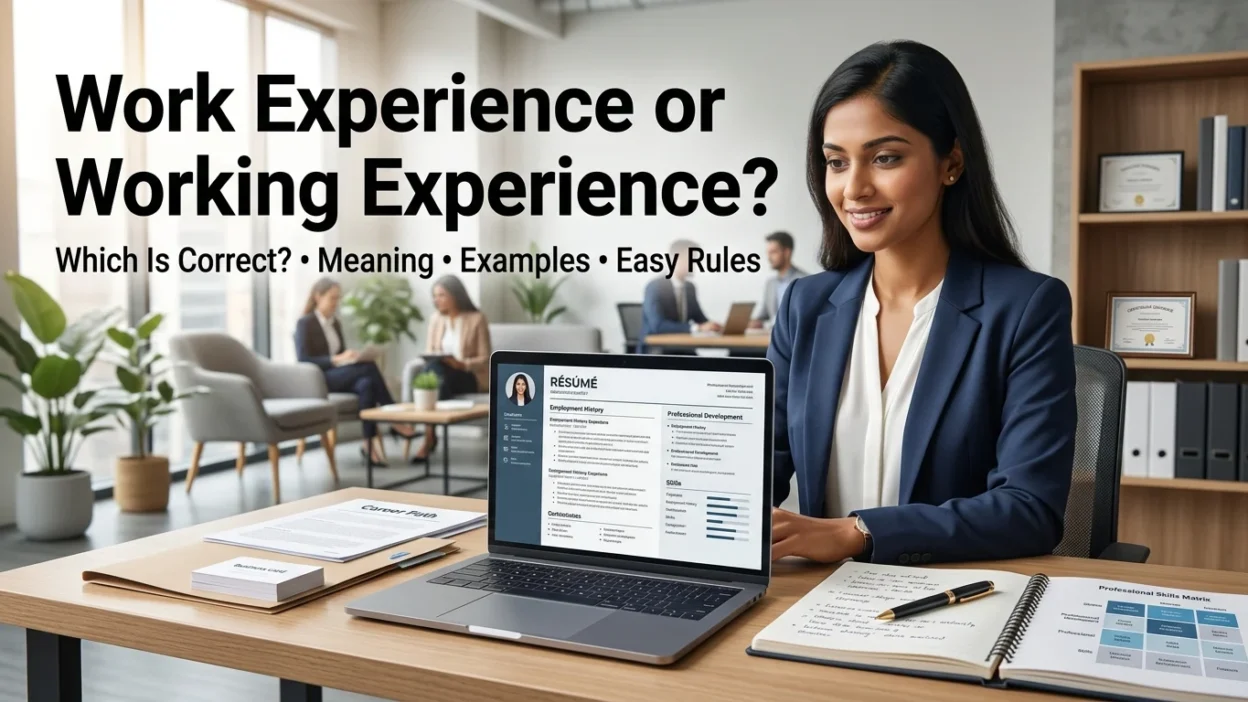
When talking about your professional background, “work experience” is the standard and most natural expression in English. It refers to the knowledge, skills, and practical experience you gain from doing a job or working in a particular field. For example, you can say, “I have five years of work experience in marketing.” The phrase is especially common on résumés, CVs, job applications, and professional profiles.
“Working experience” is not always wrong, but it is much less natural in standard English when you mean your professional background. In some contexts, “working” can correctly describe an experience that happens while someone is working, but it usually does not replace “work experience.” Understanding the difference can help you write more naturally and avoid a common mistake in professional English.
Quick Answer
“Work experience” is the correct and standard phrase when you mean experience gained through employment or professional activities. “Working experience” is uncommon for this meaning and can sound unnatural. Use “work experience” in résumés, CVs, interviews, applications, and everyday professional English: “I have three years of work experience.”
Why Do People Confuse “Work Experience” and “Working Experience”?
The confusion happens because work and working are both related to employment.
The word work can function as a noun or a verb. In the phrase “work experience,” it is a noun modifying another noun. The phrase means experience gained from work.
The word working is the present participle or -ing form of the verb work. It can describe an action or activity that is happening. For example:
- “Working from home can be convenient.”
- “She gained valuable experience while working abroad.”
- “I enjoy working with children.”
However, when you want to describe your professional background, English normally uses “work experience,” not “working experience.”
This is similar to other common noun phrases such as:
- work history
- work environment
- work schedule
- work permit
- work experience
First Word: “Work”
Work is the correct word in “work experience” when you are talking about professional experience.
Here, work acts as a noun modifier. It tells us what kind of experience we are discussing.
For example:
I have ten years of work experience.
This means the person has spent ten years gaining experience through employment or professional activities.
Other examples include:
- work experience
- work history
- work skills
- work environment
- work schedule
- work responsibilities
- work culture
- work placement
“Work experience” is particularly common in professional and educational contexts.
Examples with “Work Experience”
- I have three years of work experience.
- She has extensive work experience in finance.
- My work experience includes teaching and administration.
- You should include your relevant work experience on your CV.
- The company requires previous work experience.
- He gained valuable work experience during his internship.
Second Word: “Working”
Working is the -ing form of work. It is normally used to describe an action, activity, or state rather than to name someone’s professional background.
For example:
- I am working today.
- She enjoys working with children.
- They are working on a new project.
- He is working from home.
- Working late can be exhausting.
“Working” can appear before a noun in some expressions, but it does not normally replace “work” in the phrase “work experience.”
For example, “working experience” may occasionally be understood as experience involving the act of working, but it is not the usual expression for professional experience.
Work Experience vs Working Experience: Comparison Table
| Phrase | Meaning | Natural English? | Example |
|---|---|---|---|
| Work experience | Experience gained through employment or professional work | Yes | I have five years of work experience. |
| Working experience | Experience connected with working; uncommon as a general professional term | Usually unnatural | I have five years of working experience. |
| Experience working | Experience gained while doing a particular type of work | Yes | I have experience working with children. |
| Work history | A record of previous jobs | Yes | My work history is included on my CV. |
| Professional experience | Experience gained in a professional career | Yes | She has extensive professional experience. |
The most important distinction is between “work experience” and “experience working.” Both are natural, but they have slightly different structures.
Compare:
I have five years of work experience.
and:
I have five years of experience working in sales.
Both sentences are correct.
When Should You Use “Work Experience”?
Use “work experience” when you are referring generally to the professional experience someone has gained.
It is especially appropriate when discussing:
- Résumés and CVs
- Job applications
- Interviews
- Employment requirements
- Career history
- Internships
- Professional development
- Previous jobs
- Skills gained through employment
Examples
On a CV:
Work Experience
In a job application:
The position requires two years of relevant work experience.
In an interview:
I have several years of work experience in customer service.
In everyday conversation:
My work experience has taught me how to communicate effectively with customers.
When Can You Use “Working”?
Use “working” when you want to describe the activity of working.
For example:
I enjoy working with young people.
She is working on an important project.
He gained experience while working in London.
A particularly useful structure is:
experience + working + with/in/as/on
Examples:
- I have experience working with children.
- She has experience working in healthcare.
- He has experience working as a teacher.
- They have experience working on international projects.
- I have experience working with large teams.
Notice that “experience working” is perfectly natural. The problem is specifically treating “working experience” as the standard replacement for “work experience.”
10+ Examples of “Work Experience”
Here are practical examples showing how “work experience” is used naturally.
1. General Professional Experience
I have five years of work experience in sales.
2. Job Application
Previous work experience is required for this position.
3. CV or Résumé
I listed my work experience before my education.
4. Teaching
She has extensive work experience as an English teacher.
5. Marketing
His work experience includes digital marketing and advertising.
6. Student Experience
The internship gave me valuable work experience.
7. Career Change
My previous work experience will help me in my new career.
8. Customer Service
I have three years of work experience in customer service.
9. Management
Her work experience prepared her for a management position.
10. Interview
Can you tell us about your previous work experience?
11. Entry-Level Position
The company offers opportunities for people with little work experience.
12. International Career
Working abroad gave him valuable international work experience.
Common Mistakes
Mistake 1: Using “Working Experience” as the Default Phrase
A common sentence is:
I have five years of working experience.
This may be understood, but “I have five years of work experience” is more natural and standard.
Mistake 2: Confusing “Work Experience” with “Experience Working”
These two structures are both correct:
I have work experience in marketing.
I have experience working in marketing.
But avoid combining them incorrectly:
I have working experience in marketing.
The first two versions are more natural.
Mistake 3: Using “Work Experiences” Unnecessarily
In most cases, experience is an uncountable noun when referring to someone’s accumulated knowledge or professional background.
Usually say:
I have five years of work experience.
Not:
I have five years of work experiences.
However, experiences can be correct when referring to separate events or personal experiences:
My work experiences in different countries taught me a lot.
This use focuses on distinct experiences rather than experience as a general skill or background.
Mistake 4: Writing “Works Experience”
The phrase is “work experience,” not “works experience.”
Correct:
My work experience is relevant to this position.
Incorrect:
My works experience is relevant to this position.
Memory Trick
Remember this simple rule:
Work = the experience you gain from employment.
Working = the activity of doing a job.
So:
Work experience = professional background
Experience working = experience gained while doing something
Think of these examples:
I have work experience.
I have experience working with customers.
Both are correct, but the word order matters.
American vs British English
There is no major American-versus-British difference in the basic choice between “work experience” and “working experience.”
Both American and British English commonly use “work experience” to refer to professional experience.
For example:
I have several years of work experience.
This sentence sounds natural in both varieties of English.
There can be some differences in related vocabulary. For example, “CV” is especially common in British English, while “résumé” is particularly common in American English. However, both varieties use “work experience” naturally.
British English also frequently uses work experience when referring to short-term placements that allow students or young people to experience a workplace:
I completed a week of work experience at a local company.
American English can describe similar arrangements using terms such as internship, job shadowing, or work experience, depending on the situation.
Similar Words and Phrases
Several expressions are closely related to work experience.
Professional Experience
This is a more formal alternative.
She has extensive professional experience in education.
Work History
This refers to the jobs someone has held, particularly as part of their employment record.
Please provide your complete work history.
Employment History
This is another formal expression for a person’s previous employment.
The application asks for your employment history.
Experience Working
This structure emphasizes the activity or type of work.
I have experience working with international clients.
Relevant Experience
This refers to experience that is useful or directly connected to a particular position.
Do you have any relevant experience?
Practical Experience
This emphasizes hands-on knowledge gained by doing something rather than simply studying it.
The course provides students with practical experience.
Industry Experience
This refers to experience gained within a particular industry.
She has ten years of industry experience.
Final Verdict: Work Experience or Working Experience?
“Work experience” is the standard and preferred phrase when you mean professional experience gained through employment.
Use:
I have five years of work experience.
For a more specific sentence, you can also use:
I have five years of experience working in finance.
“Working experience” is not normally the best choice when referring to someone’s professional background. Although readers may understand it, it can sound nonstandard or less natural in professional English.
The easiest rule is:
Use “work experience” for professional background and “experience working” when describing experience doing a particular type of work.
Frequently Asked Questions
Is “work experience” or “working experience” correct?
“Work experience” is the standard expression for professional experience gained through employment. “Working experience” is much less common and generally should not be used as a replacement.
Can I say “I have working experience”?
It is understandable, but “I have work experience” is more natural in standard English. You can also say, “I have experience working in this field.”
Is “work experience” one word or two words?
“Work experience” is written as two words. “Work” modifies the noun “experience.”
Should I write “work experience” on my CV?
Yes. “Work Experience” is a standard heading for the section describing your previous jobs, positions, responsibilities, and achievements.
What is the difference between “work experience” and “professional experience”?
They are very similar. “Professional experience” can sound slightly more formal and may emphasize career-related expertise, while “work experience” is broader and very common.
Is “experience working with” correct?
Yes. “Experience working with” is completely natural.
For example:
I have experience working with children.
Is “five years of work experience” correct?
Yes. This is a very common and natural expression.
She has five years of work experience in accounting.
Can “work experience” refer to an internship?
Yes. An internship can provide work experience, especially when it gives someone practical experience in a professional environment.
Remember This
- Work experience = professional experience gained through work.
- Working = the activity of doing a job.
- Use “work experience” on CVs, résumés, applications, and in interviews.
- Use “experience working” when describing the type of work you have done.
- “I have work experience” is natural.
- “I have experience working in sales” is also natural.
- Avoid using “working experience” as the normal replacement for “work experience.”
Conclusion
The safest and most natural choice is “work experience.” When you are talking about someone’s professional background, previous employment, or skills gained through jobs, use this expression. It works naturally in formal writing, job applications, interviews, CVs, résumés, and everyday conversation.
When you want to describe the specific activity or field in which someone has worked, use “experience working.” For example, “I have experience working with customers” is correct and natural. Remembering this small difference will make your English sound clearer and more professional.