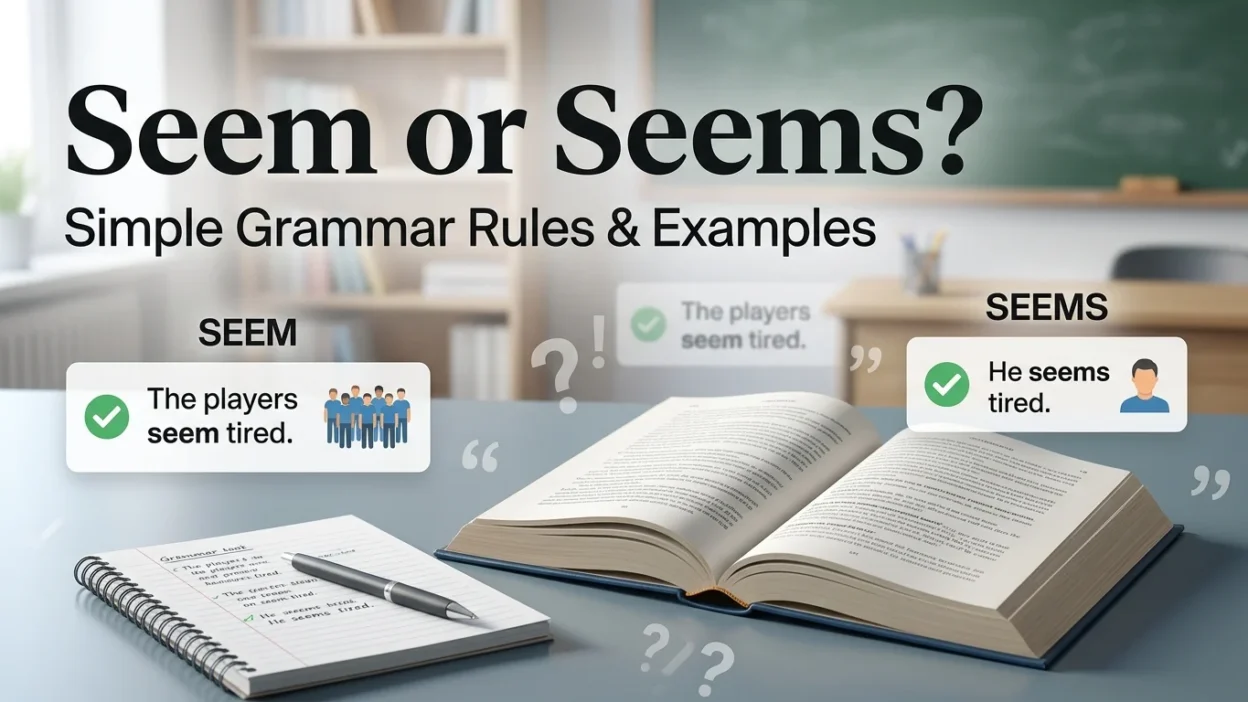
Choosing between “seem” and “seems” can be confusing because both forms come from the same verb. The correct choice depends mainly on the subject of the sentence and the tense or structure being used. In simple present sentences, seem usually follows I, you, we, and they, while seems follows he, she, and it.
For example, we say, “They seem happy” but “She seems happy.” Understanding this small subject–verb agreement rule makes it much easier to use these words correctly in everyday English. This guide explains when to use seem or seems, shows the difference with clear examples, and covers common structures such as “seem to,” “seems to,” and “seem like.”
Quick Answer
Use seem with I, you, we, and they, and use seems with he, she, and it in the simple present tense. For example, “They seem tired” is correct, while “He seems tired” is correct. The form also depends on the subject in longer sentences.
Why Do People Confuse “Seem” and “Seems”?
People often confuse seem and seems because they have the same basic meaning. Both describe an appearance, impression, or conclusion that something appears to be true.
The main difference is grammatical rather than semantic.
In the simple present tense, English adds -s to most verbs when the subject is third-person singular:
- I seem
- You seem
- We seem
- They seem
- He seems
- She seems
- It seems
This is a standard subject–verb agreement rule.
For example:
- They seem busy.
- He seems busy.
The meaning is similar, but the verb changes because the subjects are different.
First Word: “Seem”
Seem is the base form of the verb. It is used with I, you, we, and they in the simple present tense.
Examples:
- I seem nervous today.
- You seem very confident.
- We seem to have a problem.
- They seem interested in the idea.
“Seem” is also used after modal verbs and auxiliary verbs.
Examples:
- She may seem quiet at first.
- They might seem confused.
- Do you seem worried?
- They do not seem ready.
Notice that after may, might, do, does, can, could, should, and similar auxiliary or modal verbs, the base form seem is normally used.
Second Word: “Seems”
Seems is the third-person singular form of seem in the simple present tense.
Use seems with:
- He
- She
- It
- A singular noun
- A singular subject
Examples:
- He seems tired.
- She seems happy.
- It seems impossible.
- The plan seems reasonable.
- My brother seems excited.
The important point is that the subject must be singular.
For example:
- The student seems ready.
- The students seem ready.
The verb changes because “student” is singular, while “students” is plural.
Seem vs. Seems: Comparison Table
| Point | Seem | Seems |
|---|---|---|
| Basic form | Seem | Seems |
| Simple present with I | I seem | Incorrect: I seems |
| Simple present with you | You seem | Incorrect: You seems |
| Simple present with we | We seem | Incorrect: We seems |
| Simple present with they | They seem | Incorrect: They seems |
| Simple present with he | Incorrect: He seem | He seems |
| Simple present with she | Incorrect: She seem | She seems |
| Simple present with it | Incorrect: It seem | It seems |
| Singular noun | Usually incorrect | Usually correct |
| Plural noun | Usually correct | Usually incorrect |
| After “to” | to seem | Incorrect: to seems |
| After modal verbs | can seem, may seem | Incorrect: can seems |
When Should You Use “Seem” and “Seems”?
The easiest way to choose is to look at the subject.
Use “seem” with I, you, we, and they
Examples:
- I seem to remember her.
- You seem upset.
- We seem to agree.
- They seem happy.
Use “seems” with he, she, and it
Examples:
- He seems worried.
- She seems interested.
- It seems strange.
Use “seem” with plural nouns
Examples:
- The children seem excited.
- These ideas seem useful.
- My parents seem pleased.
Use “seems” with singular nouns
Examples:
- The child seems excited.
- This idea seems useful.
- My mother seems pleased.
10+ Examples of “Seem” and “Seems”
Here are practical examples showing how the two forms work.
- I seem tired today.
The subject “I” takes “seem.” - You seem very happy.
“You” takes the base form “seem.” - We seem to have enough time.
“We” is plural, so “seem” is correct. - They seem ready to leave.
“They” takes “seem.” - He seems angry.
“He” is third-person singular, so “seems” is required. - She seems very confident.
“She” takes “seems.” - It seems like a good idea.
“It” is singular, so “seems” is correct. - The weather seems pleasant today.
“Weather” is treated as a singular noun. - The students seem excited about the trip.
“Students” is plural, so use “seem.” - My friend seems nervous.
“Friend” is singular, so use “seems.” - The results seem surprising.
“Results” is plural, so use “seem.” - This answer seems correct.
“Answer” is singular, so use “seems.” - These answers seem correct.
“Answers” is plural, so use “seem.” - You seem to understand the lesson.
“You” takes “seem.” - He seems to understand the lesson.
“He” takes “seems.”
Common Mistakes With “Seem” and “Seems”
Mistake 1: Using “seems” with “they”
Incorrect:
They seems tired.
Correct:
They seem tired.
“They” is plural, so the verb should be seem.
Mistake 2: Using “seem” with “he”
Incorrect:
He seem tired.
Correct:
He seems tired.
“He” is third-person singular, so use seems.
Mistake 3: Adding “-s” after “to”
Incorrect:
She seems to seems happy.
Correct:
She seems to seem happy.
After to, use the base form seem, not “seems.”
Mistake 4: Adding “-s” after a modal verb
Incorrect:
He may seems upset.
Correct:
He may seem upset.
After “may,” use seem.
Mistake 5: Forgetting that a noun can determine the verb
Incorrect:
The students seems ready.
Correct:
The students seem ready.
The subject “students” is plural.
Memory Trick for “Seem” vs. “Seems”
A simple trick is:
One person or thing → seems
More than one → seem
For example:
- He seems
- She seems
- It seems
- The car seems
But:
- They seem
- We seem
- The cars seem
- The students seem
Remember that I and you also use seem, even though “I” refers to one person.
A useful sentence to memorize is:
I/you/we/they seem, but he/she/it seems.
This pattern covers most simple present situations.
American vs. British English
There is essentially no difference between American and British English when choosing “seem” or “seems.” Both varieties follow the same basic subject–verb agreement rule.
American English:
- She seems tired.
- They seem tired.
British English:
- She seems tired.
- They seem tired.
The spelling and grammatical form remain the same. Differences between American and British English may appear in vocabulary, pronunciation, punctuation, or certain usage preferences, but seem vs. seems follows the same rule in both varieties.
Similar Words to “Seem”
Several words and expressions have meanings related to seem. However, they are not always interchangeable.
Appear
“Appear” can mean that something looks or seems to be true.
- She appears nervous.
- He appears to understand.
Look
“Look” often describes something based on visual evidence.
- You look tired.
- She looks happy.
Sound
“Sound” is often used when your impression comes from something you hear.
- That sounds interesting.
- You sound worried.
Feel
“Feel” can describe an impression based on emotions or physical sensations.
- It feels strange.
- I feel tired.
Seem like
“Seem like” is commonly followed by a noun, pronoun, or clause.
- He seems like a nice person.
- It seems like a good opportunity.
These expressions overlap in meaning, but the best choice depends on how the impression is formed.
Final Verdict: Seem or Seems?
Both seem and seems are correct forms of the same verb. The right choice depends on the subject and sentence structure.
Use seem with I, you, we, and they, as well as plural nouns:
- I seem tired.
- They seem happy.
- The children seem excited.
Use seems with he, she, it, and singular nouns:
- He seems tired.
- She seems happy.
- The child seems excited.
The key rule is simple: he, she, it → seems; I, you, we, they → seem.
Frequently Asked Questions
Is it “seem” or “seems”?
Both are correct, but they are used with different subjects. Use seem with I, you, we, and they. Use seems with he, she, and it.
Is “it seem” correct?
No, not in a normal simple present statement. The correct form is “it seems.”
Example:
- It seems difficult.
Is “they seems” correct?
No. The correct form is “they seem” because “they” is plural.
Example:
- They seem happy.
Is it “he seem” or “he seems”?
The correct form is “he seems.” “He” is third-person singular, so the verb takes -s.
Is “seem to” grammatically correct?
Yes. Seem to is a very common structure.
Examples:
- They seem to understand.
- She seems to know the answer.
- I seem to remember him.
Is it “seems like” or “seem like”?
Both can be correct. The subject determines the form.
- It seems like a good plan.
- They seem like good people.
What is the past tense of “seem”?
The past tense is seemed.
Examples:
- She seemed tired.
- They seemed happy.
- It seemed impossible.
Remember This
Seem → I, you, we, they, and plural nouns
Seems → he, she, it, and singular nouns
The quickest rule to remember is:
I/You/We/They seem.
He/She/It seems.
Also remember that after to or a modal verb, use the base form seem:
- to seem
- may seem
- can seem
- might seem
Conclusion
Choosing between seem and seems is mainly a matter of subject–verb agreement. Use seem with I, you, we, they, and plural subjects, while seems goes with he, she, it, and singular subjects in the simple present.
Once you remember the pattern “they seem, but he seems,” the difference becomes much easier. Pay attention to the subject before the verb, and you will be able to choose the correct form naturally and confidently.