
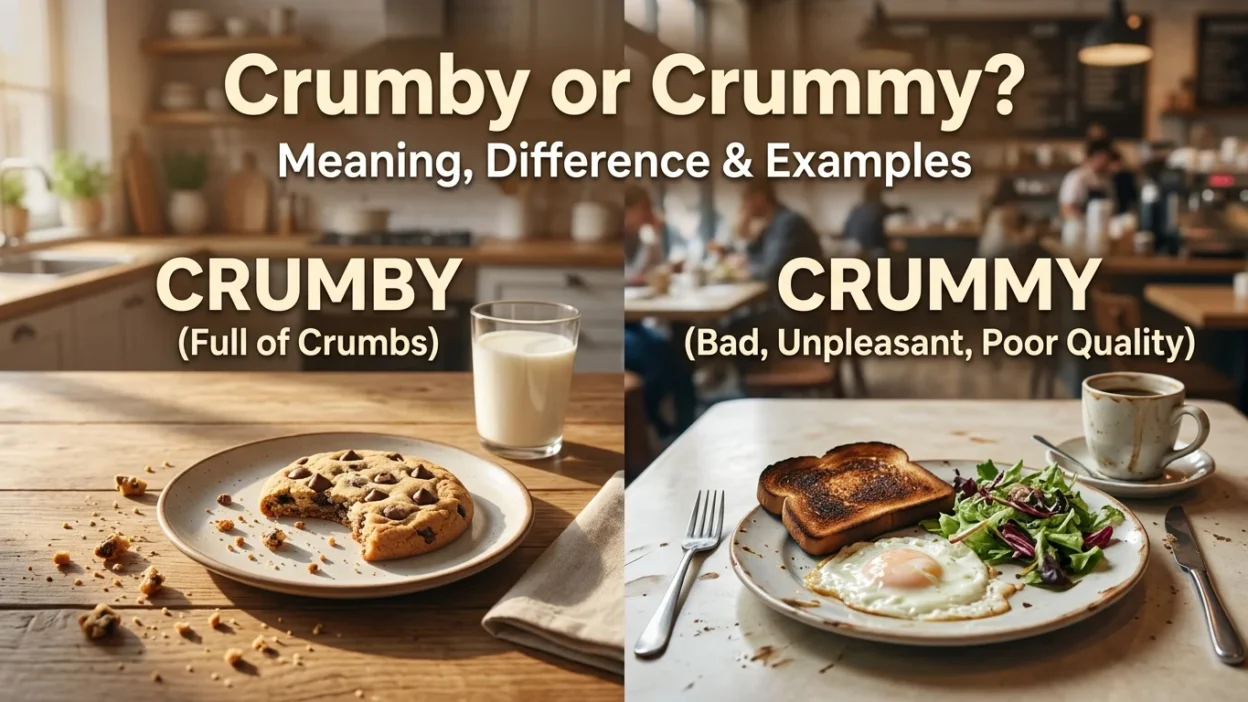
If you are unsure whether to write crumby or crummy, you are not alone. These words look and sound very similar, but they have different meanings and are used in different contexts. Crumby is related to crumbs or something containing crumbs, while crummy usually means poor, unpleasant, or of low quality.
Understanding the difference is useful for students, ESL learners, writers, and anyone who wants to choose the right word in everyday English. Although the spelling differs by only one letter, replacing one with the other can completely change the meaning of a sentence. In this guide, you will learn what crumby and crummy mean, how they differ, when to use each one, and how to remember the distinction.
Quick Answer
Crumby means containing, covered with, or resembling crumbs. Crummy means bad, unpleasant, poor in quality, or disappointing. For example, “The table is crumby” refers to crumbs on the table, while “The restaurant was crummy” means the restaurant was unpleasant or poor.
Why Do People Confuse Crumby and Crummy?
People often confuse crumby and crummy because:
- They look almost identical.
- They are pronounced similarly.
- Both begin with crumb-.
- The difference is only the vowel before the final y.
- Both can describe something unpleasant in certain contexts.
However, their meanings are different.
The easiest way to separate them is to focus on the words they are connected to:
- Crumby → crumbs
- Crummy → bad or poor
For example:
The kitchen floor is crumby.
This means the floor has crumbs on it.
We had a crummy day.
This means the day was bad or unpleasant.
What Does Crumby Mean?
Crumby is an adjective related to crumbs. It can describe something that contains crumbs, is covered with crumbs, or resembles crumbs.
For example:
- The kitchen counter is crumby.
- I need to clean this crumby table.
- The cookies left the plate crumby.
In informal English, crumby can also describe something that tends to produce crumbs or has a crumb-like texture.
Crumby in a Sentence
My keyboard is crumby because I ate cookies while working.
Here, crumby refers literally to crumbs.
What Does Crummy Mean?
Crummy is an adjective that usually means bad, poor, unpleasant, or of low quality.
It is generally informal.
For example:
- We stayed at a crummy hotel.
- I had a crummy day.
- The weather was crummy.
- He got a crummy deal.
Unlike crumby, crummy does not normally refer to physical crumbs.
Crummy in a Sentence
We had a crummy meal at that restaurant.
The speaker means the meal was bad or disappointing, not that it contained crumbs.
Crumby vs Crummy: Comparison Table
| Word | Meaning | Common Use | Example |
|---|---|---|---|
| Crumby | Containing or covered with crumbs | Food, surfaces, texture | The table is crumby. |
| Crummy | Bad, poor, unpleasant, or low-quality | Experiences, things, situations | We had a crummy day. |
| Crumby | Related to crumbs | Literal descriptions | The sofa is covered in crumbs and looks crumby. |
| Crummy | Disappointing or unsatisfactory | Informal speech | That was a crummy excuse. |
When Should You Use Crumby or Crummy?
Use crumby when you are talking about crumbs or something associated with them.
Use crummy when you mean bad, unpleasant, disappointing, or low-quality.
Use Crumby for Crumbs
The table is crumby.
Think: crumbs → crumby
Use Crummy for Something Bad
This is a crummy apartment.
Think: bad → crummy
A simple substitution test can help:
- If you can replace the word with covered in crumbs, choose crumby.
- If you can replace it with bad, poor, or unpleasant, choose crummy.
12 Examples of Crumby and Crummy
Here are practical examples showing the difference clearly.
Examples with Crumby
- The kitchen table is crumby after breakfast.
- My shirt became crumby while I was eating a cookie.
- The children left the sofa crumby.
- Please wipe the crumby counter.
- The picnic blanket was covered with crumbs and became crumby.
- I don’t want to sit on that crumby chair.
Examples with Crummy
- We had a crummy experience at the hotel.
- The weather was crummy all weekend.
- He received a crummy salary for the amount of work he did.
- That was a crummy excuse.
- I felt crummy after staying up all night.
- They gave us a crummy room.
Notice how the meanings are different even though the words look almost the same.
Common Mistakes
Mistake 1: Using Crummy for Crumbs
Incorrect:
The table is crummy because there are cookie crumbs everywhere.
If you specifically mean the table has crumbs on it, crumby is the more precise choice.
Better:
The table is crumby because there are cookie crumbs everywhere.
Mistake 2: Using Crumby to Mean Bad
Incorrect:
I had a crumby day.
If you mean the day was bad or unpleasant, use crummy.
Correct:
I had a crummy day.
Mistake 3: Assuming the Words Are Interchangeable
They are not normally interchangeable.
The floor is crumby.
means the floor has crumbs.
The floor is crummy.
means the floor is bad, dirty, unpleasant, or generally in poor condition, depending on context.
A Simple Memory Trick
Remember this:
Crumby = crumbs.
The spelling crumby contains the same basic idea as crumbs.
Crummy = lousy or bad.
If something is disappointing or unpleasant, crummy is usually the word you want.
Try this:
Crumbs → crumby
Bad → crummy
This short association makes the distinction much easier to remember.
American vs British English
Both crumby and crummy can be found in English varieties, but crummy is the more familiar everyday adjective when describing something as bad, unpleasant, or poor.
Crumby is comparatively less common and is mainly understood as a literal description connected with crumbs.
For learners of English, the important distinction is not primarily American versus British spelling. It is meaning:
- Crumby → connected with crumbs
- Crummy → bad, unpleasant, or poor
Regional dictionaries and individual speakers may show additional uses, but these are the meanings learners are most likely to need.
Similar Words
Several words can help you express the same or related ideas.
Words Similar to Crumby
Depending on context, you could use:
- crumb-covered
- full of crumbs
- crumb-filled
- crumbly
- messy with crumbs
For example:
The table is covered with crumbs.
This can be clearer than crumby in formal writing.
Words Similar to Crummy
Depending on the context, alternatives include:
- bad
- poor
- unpleasant
- lousy
- terrible
- disappointing
- low-quality
- unsatisfactory
For example:
We stayed at a crummy hotel.
Could also become:
We stayed at a poor-quality hotel.
Final Verdict: Crumby or Crummy?
Choose crumby when you are talking about crumbs or something covered with crumbs.
Choose crummy when you mean bad, unpleasant, disappointing, or low-quality.
The quickest way to remember the difference is:
Crumby = crumbs.
Crummy = bad.
So, if you are describing a table after someone has eaten cookies, crumby makes sense. If you are describing a disappointing restaurant, hotel, experience, or day, crummy is the appropriate choice.
Frequently Asked Questions
Is crumby a real word?
Yes. Crumby is an adjective related to crumbs. It can describe something that contains or is covered with crumbs.
Is crummy a real word?
Yes. Crummy is an informal adjective meaning bad, unpleasant, poor, or of low quality.
Does crumby mean bad?
Usually, no. Crumby primarily relates to crumbs. It should not normally be used as a synonym for bad.
Does crummy mean full of crumbs?
No. Crummy generally means bad, unpleasant, or poor-quality. If you mean something is covered with crumbs, crumby is the better choice.
Is crummy formal English?
Crummy is generally considered informal. In formal writing, words such as poor, unsatisfactory, unpleasant, or low-quality may be more appropriate depending on the context.
What is an easy way to remember crumby vs crummy?
Remember crumby = crumbs and crummy = bad. The connection between crumby and crumbs makes the distinction easier to recall.
Which is correct: “a crumby table” or “a crummy table”?
If you mean the table has crumbs on it, “a crumby table” is the intended meaning. If you mean the table is poor, unpleasant, or low-quality, “a crummy table” can be used.
Remember This
- Crumby = related to crumbs.
- Crummy = bad, unpleasant, or poor-quality.
- Crumby is mainly literal.
- Crummy is usually informal and evaluative.
- Think “crumbs → crumby.”
- Think “bad → crummy.”
Conclusion
Although crumby and crummy look and sound similar, they serve different purposes. Crumby relates to crumbs, while crummy describes something bad, unpleasant, disappointing, or low-quality. Learning the meaning behind the spelling makes the difference much easier to understand.
When writing, ask yourself what you actually mean. If you are talking about crumbs, choose crumby. If you are describing something as bad or disappointing, choose crummy. With this simple distinction, you can use both words confidently and naturally.