
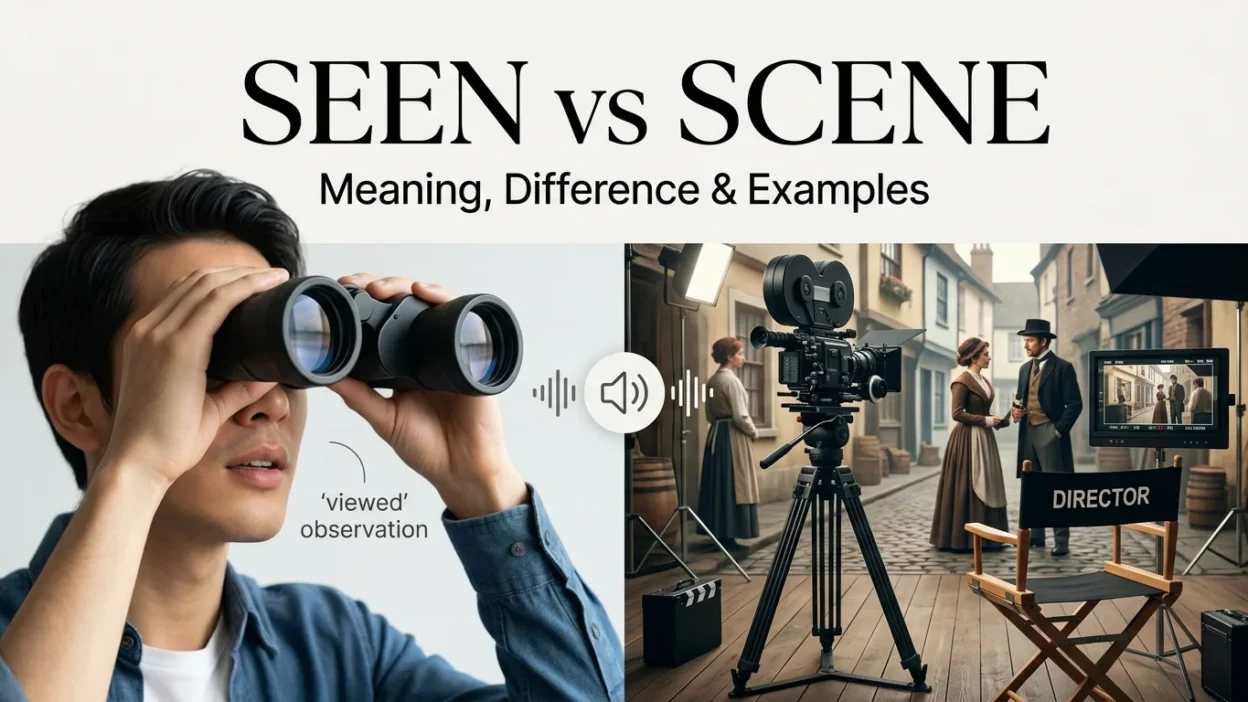
Have you ever written seen when you meant scene, or confused scene with seen while speaking or writing? These two words sound exactly the same, but they have completely different meanings and grammatical uses. Understanding the difference between seen vs scene can help you avoid common spelling and grammar mistakes.
Seen is a form of the verb see, while scene is a noun that usually refers to a place where something happens, especially in a movie, play, story, or real-life event. In this guide, you’ll learn their meanings, correct uses, differences, examples, common mistakes, and an easy memory trick to remember which word to choose.
Quick Answer
Seen is the past participle of see, meaning someone has viewed or noticed something. Scene is a noun meaning a place, situation, or part of a movie, play, or story. They sound alike but have different spellings, meanings, and grammatical functions.
Why Do People Confuse Seen and Scene?
People often confuse seen and scene because they are homophones. Homophones are words that have the same pronunciation but different spellings and meanings.
For example:
- I have seen that movie before.
- The opening scene was exciting.
When spoken aloud, seen and scene sound the same. However, their meanings are completely different.
Another reason for the confusion is that both words can be connected with visual experiences. You might see something in a scene, which makes the words seem related even though they serve different grammatical roles.
The First Word: Seen
Seen is the past participle of the irregular verb see.
The basic forms of the verb are:
- See — present
- Saw — simple past
- Seen — past participle
Seen normally appears with an auxiliary verb such as have, has, or had.
Examples of Seen
- I have seen this movie before.
- She has seen the message.
- We had seen that building earlier.
- Have you seen my phone?
- They have never seen snow.
The word seen means that someone has viewed, noticed, observed, or experienced something.
Important Grammar Point
You generally should not use seen by itself as the simple past tense.
Incorrect:
- I seen him yesterday.
Correct:
- I saw him yesterday.
But seen is correct with a helping verb:
- I have seen him before.
The Second Word: Scene
Scene is a noun. It can describe a place or situation where something happens, a section of a movie or play, or an event that people observe.
Common Meanings of Scene
1. A part of a movie or play
- The final scene was emotional.
- My favorite scene is near the end of the movie.
2. A place where an event happens
- The police arrived at the scene.
- Investigators examined the scene carefully.
3. A situation or event
- It was an embarrassing scene.
- The argument created a scene in the restaurant.
4. A particular social environment
- She is active in the local music scene.
- The city has a lively art scene.
Seen vs Scene: Comparison Table
| Feature | Seen | Scene |
|---|---|---|
| Part of speech | Verb form | Noun |
| Basic meaning | Viewed or noticed | Place, situation, or part of a production |
| Base word | See | Scene |
| Pronunciation | /siːn/ | /siːn/ |
| Example | I have seen it. | The scene was beautiful. |
| Common phrase | Have you seen…? | crime scene |
| Can mean a movie section? | No | Yes |
| Can describe viewing something? | Yes | No |
When Should You Use Seen?
Use seen when you are talking about something that someone has viewed, noticed, observed, or experienced.
It commonly follows have, has, or had.
Common patterns
- have seen
- has seen
- had seen
- have never seen
- have you seen
Examples
- I have seen that show.
- She has seen the new restaurant.
- They had seen the warning sign.
- Have you seen my keys?
- We have never seen anything like it.
Remember that saw is the simple past form:
- I saw him yesterday.
- I have seen him before.
When Should You Use Scene?
Use scene when you mean a place, situation, event, or part of a movie, television show, play, or story.
Examples
- The first scene of the movie was funny.
- The accident scene was crowded.
- She caused a scene at the store.
- The beach scene looked beautiful.
- He works behind the scenes.
The word can also appear in several common expressions:
- crime scene
- movie scene
- opening scene
- final scene
- accident scene
- social scene
- music scene
- behind the scenes
Seen vs Scene: 10+ Examples
Here are examples that make the difference easier to understand.
1. Seen
I have seen that movie twice.
Here, seen means watched or viewed.
2. Scene
The final scene made everyone cry.
Here, scene means a part of a movie.
3. Seen
Have you seen my glasses?
The speaker is asking whether someone has noticed or found the glasses.
4. Scene
The police arrived at the scene.
Here, scene means the location where an event happened.
5. Seen
She has seen many beautiful places.
The word describes places she has visited or viewed.
6. Scene
The opening scene introduces the main character.
Here, scene refers to part of a story or movie.
7. Seen
We had seen the warning before the storm began.
Seen is the past participle of see.
8. Scene
There was a dramatic scene outside the building.
Here, scene means an event or situation.
9. Seen
I have never seen such a large bird.
The speaker is talking about something they have observed.
10. Scene
The restaurant has become part of the local food scene.
Here, scene refers to a particular social or cultural environment.
11. Seen
He has seen the results already.
The person has viewed the results.
12. Scene
The director filmed the scene in one afternoon.
Here, scene means a section of a movie or production.
Common Mistakes with Seen and Scene
Because these words are homophones, spelling mistakes are common.
Mistake 1: Using Seen as Simple Past
Incorrect:
- I seen her yesterday.
Correct:
- I saw her yesterday.
Use saw for the simple past and seen as the past participle.
Mistake 2: Using Scene for the Verb See
Incorrect:
- I have scene that movie.
Correct:
- I have seen that movie.
A movie can contain a scene, but you see a movie.
Mistake 3: Confusing a Scene with Seeing
Incorrect:
- Have you scene my bag?
Correct:
- Have you seen my bag?
The question asks whether someone has viewed or noticed the bag, so seen is required.
Mistake 4: Forgetting the Helping Verb
Incorrect:
- I seen that show before.
Correct:
- I have seen that show before.
Seen usually needs an auxiliary verb when used as the past participle.
An Easy Memory Trick
Try this simple trick:
Seen = See + n
Think of seen as belonging to the verb see.
I have seen it.
Scene = Screen
Both scene and screen are connected with movies, television, and visual productions.
The movie scene appeared on the screen.
You can also remember:
Seen = viewed
Scene = place or part of a story
If you can replace the word with viewed, you probably need seen.
If you mean a place, event, or part of a movie, you probably need scene.
American vs British English
There is no meaningful difference between seen and scene in American and British English.
Both varieties use:
- seen as the past participle of see
- scene as a noun for a place, event, situation, or part of a production
For example, these sentences are correct in both varieties:
- I have seen that movie.
- The final scene was unforgettable.
- The police arrived at the scene.
- Have you seen my phone?
The pronunciation is also essentially the same in standard American and British English, which is why learners may need to pay special attention to spelling and context.
Similar Words
Understanding related words can make the distinction even clearer.
See
See is the base form of the verb.
- I can see the mountains.
Saw
Saw is the simple past form of see.
- I saw him yesterday.
Seen
Seen is the past participle.
- I have seen him before.
Scene
Scene is a noun referring to a place, situation, or part of a production.
- The movie scene was beautiful.
Sight
Sight is a noun referring to the ability to see or something that is seen.
- The mountain was an amazing sight.
Sightseeing
Sightseeing means visiting interesting places and looking at them.
- We went sightseeing in London.
Final Verdict
The difference between seen and scene is simple once you focus on their grammatical roles.
Seen is a form of the verb see and means viewed, noticed, or observed. It is commonly used with have, has, or had.
Scene is a noun. It can mean a place where something happens, a situation or event, or a part of a movie, television show, play, or story.
The key is to remember:
Seen = viewed
Scene = place, event, or part of a movie
Frequently Asked Questions
Is “seen” and “scene” the same word?
No. Seen and scene are different words that sound the same. Seen is the past participle of see, while scene is a noun.
What is the difference between seen and scene?
Seen refers to viewing or noticing something. Scene refers to a place, situation, event, or part of a movie, play, or story.
Is “I have seen it” correct?
Yes. I have seen it is correct because seen is the past participle of see and follows the helping verb have.
Is “I seen it yesterday” correct?
No, not in standard English. The correct sentence is I saw it yesterday. Saw is the simple past form, while seen is the past participle.
Is “I have scene it” correct?
No. The correct sentence is I have seen it. Scene is a noun and cannot replace the past participle seen.
Why do seen and scene sound the same?
They are homophones. In standard English pronunciation, both are pronounced /siːn/, even though they have different spellings and meanings.
What is an example of scene?
The final scene of the movie was very emotional. In this sentence, scene means a section or part of the movie.
Remember This
- Seen = past participle of see
- Seen = viewed or noticed
- Scene = noun
- Scene = place, situation, event, or part of a production
- Saw = simple past of see
- Seen and scene sound the same but have different meanings
- Have seen, not have scene
Conclusion
The difference between seen vs scene becomes easy when you remember what each word does. Seen is connected to the verb see and describes something that has been viewed or noticed. Scene is a noun used for a place, event, situation, or part of a movie, play, or story.
Whenever you are unsure, ask yourself what you mean. If you mean viewed or noticed, choose seen. If you mean a place, event, situation, or part of a production, choose scene. This simple distinction will help you use both words correctly in everyday English.