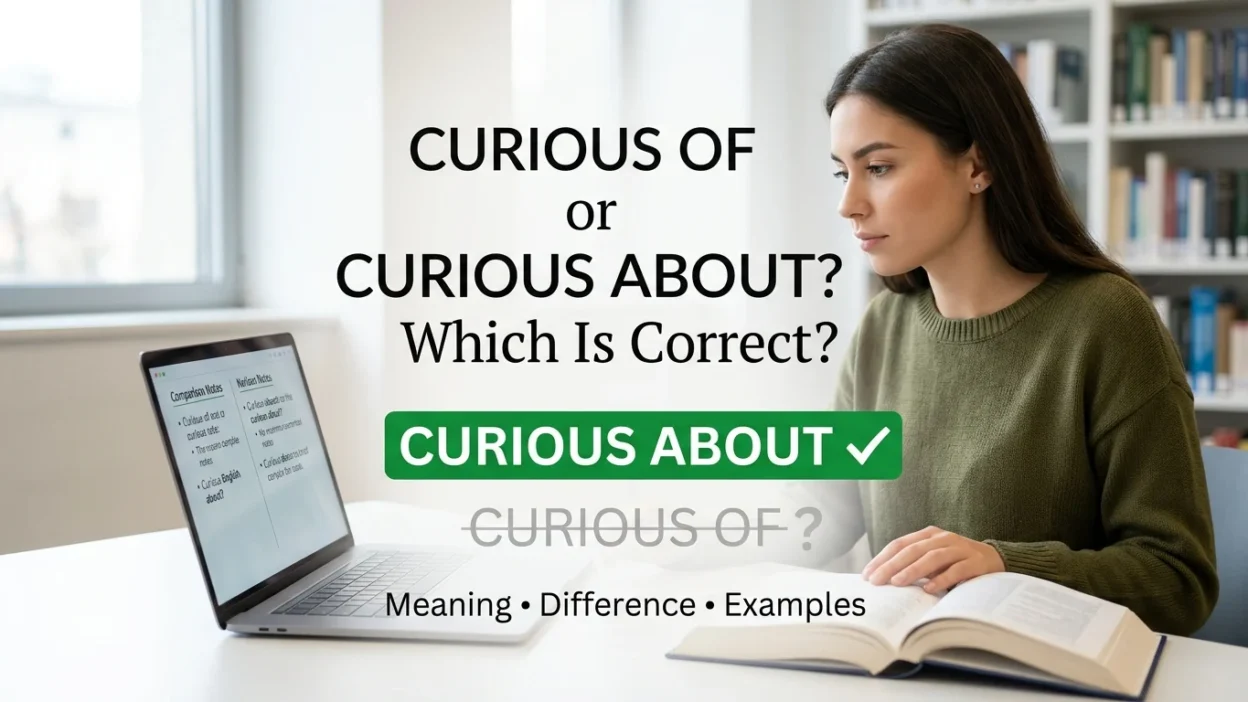
If you are unsure if to say “curious of” or “curious about,” you are not alone. These expressions look similar, but they are not equally natural in modern English. In most everyday situations, “curious about” is the correct and natural choice when you want to say that you want to know more about something.
The adjective curious commonly means interested in learning or knowing something. It is normally followed by about when the object is a person, thing, subject, event, or situation. For example, you can say, “I’m curious about your new job” or “She is curious about what happened.” Understanding this small preposition difference can make your English sound much more natural and confident.
Quick Answer
“Curious about” is the standard and natural expression in modern English. Use it when you want to express interest in learning or knowing more about someone or something. “Curious of” is generally not used in ordinary modern English for this meaning. Instead, use “curious about,” “curious to know,” or “curious to see.”
Why People Confuse It
People often confuse curious of and curious about because English adjectives can take different prepositions, and there is no simple rule that tells learners which preposition belongs with every adjective.
For example:
- interested in something
- worried about something
- afraid of something
- curious about something
Because of is common after many adjectives, learners may naturally wonder whether curious of is also correct.
Another reason for the confusion is that curious and curiosity are related to the idea of wanting to know something. However, the usual modern construction is curious about, not curious of.
For example:
- I’m curious about your decision.
- She was curious about the strange noise.
- We’re curious about what happened.
Curious About
Curious about means interested in finding out more about a person, thing, subject, event, or situation.
It is the normal expression in contemporary English.
Examples
- I’m curious about your new project.
- She is curious about the results.
- They were curious about what happened.
- Are you curious about his decision?
- He became curious about the old building.
You can use curious about with nouns, pronouns, and clauses.
With a noun
I’m curious about the new restaurant.
With a person
She is curious about her new neighbor.
With a question or situation
We’re curious about why he left early.
With a pronoun
I’m curious about it.
The phrase can describe a temporary feeling or a continuing interest.
I’m curious about how the machine works.
Here, the speaker wants to learn more about the machine.
Curious Of
Curious of is not the normal modern construction when you mean “interested in knowing about something.”
For everyday English, avoid saying:
I’m curious of your plans.
Instead, say:
I’m curious about your plans.
Similarly:
She is curious of what happened. ❌
is better expressed as:
She is curious about what happened. ✅
Historically or in older literary English, curious of can occasionally be found with meanings or constructions that differ from modern everyday usage. However, this does not make it a normal replacement for curious about in contemporary English.
For students and general writing, the practical rule is simple: use curious about.
Comparison Table
| Expression | Modern English | Meaning | Example |
|---|---|---|---|
| curious about | Standard | Interested in knowing more | I’m curious about the answer. |
| curious of | Uncommon/nonstandard for this meaning | Not normally used in everyday English | Use “curious about” instead. |
| curious to know | Standard | Wanting to find out something | I’m curious to know what happened. |
| curious to see | Standard | Wanting to see something | I’m curious to see the results. |
| curious whether/if | Standard | Wanting to know whether something is true | I’m curious whether he will come. |
When to Use Each
Use “Curious About” for Interest in Something
Use curious about when you want to express interest in a subject, person, event, object, or situation.
I’m curious about your plans.
He’s curious about the new technology.
They were curious about the noise.
This is the most useful construction for everyday communication.
Use “Curious to Know” for a Specific Answer
When you specifically want to find out information, curious to know is very natural.
I’m curious to know what she decided.
We’re curious to know the reason.
She was curious to know whether he had arrived.
Use “Curious to See” for Something You Want to Observe
Use curious to see when you are interested in seeing what something will be like or what will happen.
I’m curious to see the final design.
She’s curious to see how the story ends.
We’re curious to see what happens next.
10+ Examples of “Curious About”
Here are practical examples showing how curious about works in different situations:
- I’m curious about your new job.
- She is curious about the strange sound.
- Are you curious about the results?
- He became curious about the old photograph.
- We’re curious about what happened yesterday.
- They were curious about their neighbor’s sudden move.
- I’m curious about how this program works.
- My children are curious about space.
- She was curious about his decision.
- Everyone was curious about the unexpected announcement.
- I’m curious about whether they will accept the offer.
- He is naturally curious about other cultures.
These examples show that about works with people, objects, subjects, questions, events, and clauses.
Common Mistakes
Mistake 1: Using “Curious Of”
I’m curious of your plans. ❌
Use:
I’m curious about your plans. ✅
Mistake 2: Using the Wrong Preposition
She is curious in the answer. ❌
Use:
She is curious about the answer. ✅
Do not confuse curious about with interested in.
Compare:
I’m interested in science.
I’m curious about science.
Both sentences can express interest, but they use different prepositions.
Mistake 3: Saying “Curious About to Know”
I’m curious about to know what happened. ❌
Use either:
I’m curious to know what happened. ✅
or:
I’m curious about what happened. ✅
Mistake 4: Confusing “Curious About” With “Curious to”
Both are correct, but their structures are different.
I’m curious about the results.
I’m curious to see the results.
The first focuses on the subject of your curiosity. The second emphasizes your desire to see something.
Memory Trick
A simple way to remember the correct expression is:
Curious = wanting to know more → curious about
Think:
curious about a subject
curious about a person
curious about a situation
curious about an answer
If you want to remember a second useful pattern, use:
curious to + verb
For example:
curious to know
curious to see
curious to find out
So remember:
Curious about something. Curious to do something.
American vs British English
There is no important American-versus-British difference for the standard expression curious about.
Both American English and British English commonly use:
I’m curious about it.
She’s curious about what happened.
He’s curious about the results.
Likewise, curious to know and curious to see are natural in both varieties of English.
You may encounter unusual or older uses of curious of in historical or literary writing, but that does not mean it is the preferred expression in modern American or British English.
For modern communication, academic writing, workplace English, and everyday conversation, curious about is the safe and natural choice.
Similar Words
Several expressions are related to curious about, but they are not always interchangeable.
Interested in
Interested in means wanting to learn about, participate in, or pay attention to something.
She is interested in history.
Eager to know
Eager to know suggests a strong desire to receive information.
I’m eager to know the results.
Wondering about
Wondering about often describes thinking about something because you do not know the answer.
I’m wondering about his decision.
Intrigued by
Intrigued by means strongly interested because something is unusual, mysterious, or fascinating.
She was intrigued by the strange message.
Curious to know
Curious to know is especially useful when introducing a specific piece of information you want to discover.
I’m curious to know what happened.
Final Verdict
When you mean interested in finding out more about something, use curious about.
Curious about is the standard expression in modern English:
I’m curious about your idea.
Curious of is not the normal choice for this meaning. Although older or specialized uses can be found, learners should generally avoid it in contemporary everyday English.
If you want to express curiosity about an action or discovery, use curious to + verb:
I’m curious to know.
I’m curious to see.
I’m curious to find out.
FAQs
Is “curious of” grammatically correct?
Curious of is not the usual modern construction when expressing interest in knowing something. In contemporary English, curious about is the natural choice.
Is it “curious about” or “curious of”?
Use curious about in normal modern English.
I’m curious about the answer. ✅
Can I say “I am curious of him”?
It is better to say “I am curious about him” if you mean that you want to know more about him.
What preposition comes after “curious”?
The most common preposition is about.
She is curious about the new teacher.
You can also use structures such as curious to know and curious to see.
Is “curious about” formal or informal?
Curious about works in both everyday and formal English. It is suitable for conversations, emails, academic writing, and professional communication.
What is the difference between “curious about” and “curious to know”?
Curious about is generally followed by a noun, pronoun, or clause:
I’m curious about the problem.
Curious to know is followed by a verb:
I’m curious to know the answer.
Can “curious about” be used for people?
Yes. You can say:
I’m curious about him.
This means you want to know more about him or are interested in learning something about him.
Is “curious about” correct in British English?
Yes. Curious about is standard in both British and American English.
Remember This
The easiest rule is:
Use “curious about” when you are interested in something.
- curious about a person
- curious about a subject
- curious about an event
- curious about a situation
- curious about an answer
For an action, use:
curious to + verb
- curious to know
- curious to see
- curious to find out
Avoid curious of in ordinary modern English when you mean “interested in knowing more.”
Conclusion
The choice between curious of and curious about is straightforward once you know the standard modern pattern. Curious about is the natural expression for showing interest in a person, subject, object, event, or situation. It is widely suitable for everyday conversation as well as formal writing.
Although curious of may appear in older or unusual forms of English, it is not the normal choice for modern learners. When you want to express a desire to discover something, choose curious about or use a structure such as curious to know. These patterns will make your English clearer and more natural.