
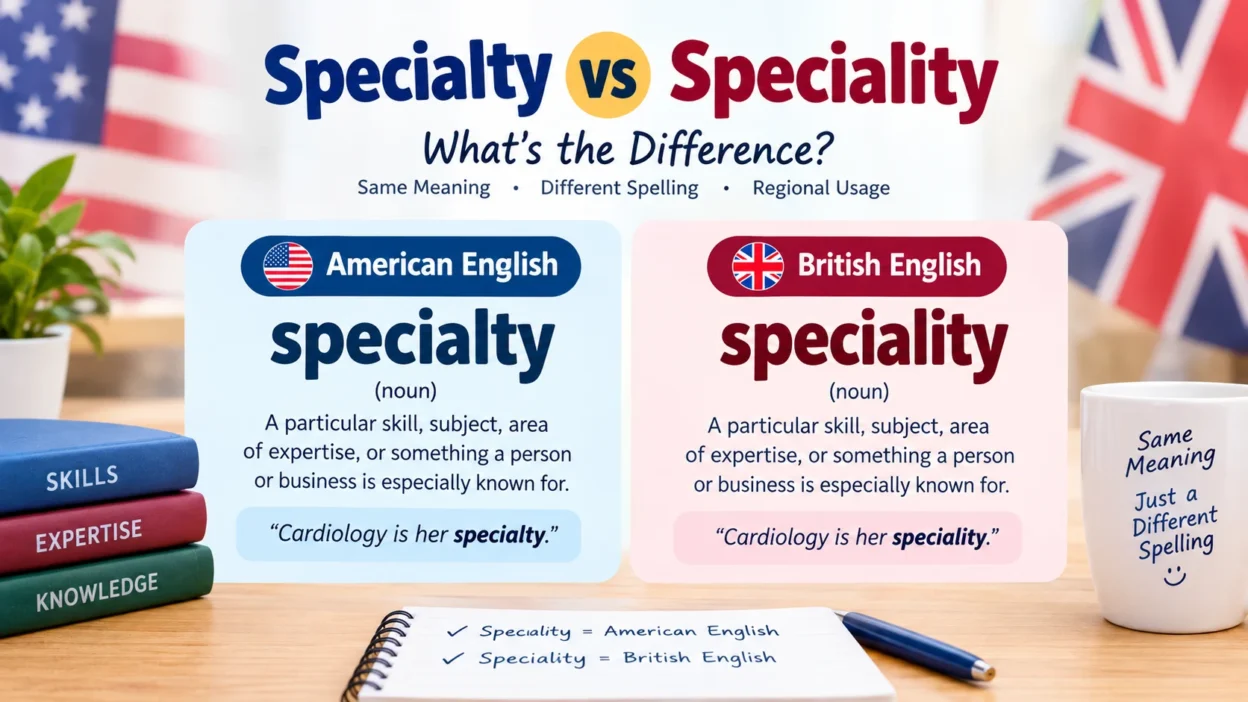
If you have ever wondered if “specialty” or “speciality” is the correct spelling, you are not alone. Both words are correct, and they have the same basic meaning. The main difference is regional spelling: specialty is the standard form in American English, while speciality is more common in British English and other varieties influenced by British usage.
This difference can be confusing because the two words look almost identical and are pronounced in essentially the same way. Both can refer to a particular skill, subject, area of expertise, or something for which a person or business is especially known. The choice usually depends on the variety of English you are writing or speaking.
Quick Answer
Specialty and speciality have the same meaning, but their spelling differs by region. Specialty is preferred in American English, while speciality is generally preferred in British English. For example, “Cardiology is her specialty” and “Cardiology is her speciality” are both correct.
Why Do People Confuse “Specialty” and “Speciality”?
People confuse these words because they have:
- The same basic meaning
- Nearly identical pronunciation
- The same grammatical function
- Different spellings based mainly on regional English
Both words are nouns. They commonly describe a particular area of knowledge, skill, professional expertise, or a product that is especially associated with someone or somewhere.
For example:
Baking is her specialty.
Baking is her speciality.
The meaning does not change.
What Does “Specialty” Mean?
Specialty is a noun meaning a particular subject, skill, activity, or area in which someone has special knowledge or ability.
It can also mean a particular product, service, or type of food that a person, restaurant, company, or place is especially known for.
Examples
- Surgery is his specialty.
- Italian food is the restaurant’s specialty.
- Her specialty is children’s education.
- Chocolate cake is their house specialty.
Specialty is the standard spelling in American English.
What Does “Speciality” Mean?
Speciality is the British English spelling of the same noun.
It has the same meanings as specialty and can describe a particular skill, field of expertise, product, service, or type of food.
Examples
- Surgery is his speciality.
- Seafood is the restaurant’s speciality.
- Her speciality is children’s education.
- Chocolate cake is their house speciality.
Speciality is especially common in British English.
Specialty vs Speciality: Comparison Table
| Feature | Specialty | Speciality |
|---|---|---|
| Meaning | A particular skill, field, product, or area of expertise | A particular skill, field, product, or area of expertise |
| Part of speech | Noun | Noun |
| American English | Standard | Less common |
| British English | Used, but less common | Standard/preferred |
| Pronunciation | Essentially the same | Essentially the same |
| Example | Medicine is her specialty. | Medicine is her speciality. |
When Should You Use “Specialty” or “Speciality”?
The best choice depends mainly on the variety of English you are using.
Use “Specialty” in American English
Choose specialty when writing for an American audience or following American English conventions.
Examples:
- Dermatology is her specialty.
- The restaurant’s specialty is grilled seafood.
- His specialty is repairing old cars.
- Marketing is my specialty.
Use “Speciality” in British English
Choose speciality when writing in British English.
Examples:
- Dermatology is her speciality.
- The restaurant’s speciality is grilled seafood.
- His speciality is repairing old cars.
- Marketing is my speciality.
Neither spelling changes the meaning.
Specialty vs Speciality: 10+ Examples
Here are examples showing how the two spellings work in similar sentences.
- American: Neurology is her specialty.
British: Neurology is her speciality. - American: Pizza is the restaurant’s specialty.
British: Pizza is the restaurant’s speciality. - American: Teaching young children is his specialty.
British: Teaching young children is his speciality. - American: The shop’s specialty is handmade jewelry.
British: The shop’s speciality is handmade jewellery. - American: Computer security is her specialty.
British: Computer security is her speciality. - American: The chef’s specialty is seafood.
British: The chef’s speciality is seafood. - American: This doctor has a specialty in cardiology.
British: This doctor has a speciality in cardiology. - American: Children’s books are the publisher’s specialty.
British: Children’s books are the publisher’s speciality. - American: His specialty is solving difficult technical problems.
British: His speciality is solving difficult technical problems. - American: The bakery’s specialty is sourdough bread.
British: The bakery’s speciality is sourdough bread. - American: Public speaking is one of her specialties.
British: Public speaking is one of her specialities. - American: The clinic offers several medical specialties.
British: The clinic offers several medical specialities.
Common Mistakes
Mistake 1: Thinking One Spelling Is Wrong
Neither word is inherently incorrect.
❌ “Speciality” is always wrong.
❌ “Specialty” is always wrong.
Both are accepted spellings.
Mistake 2: Mixing English Varieties
A writer may use specialty but consistently follow British spelling elsewhere.
For formal writing, it is generally better to maintain consistency.
For example, if you are writing in British English and use forms such as colour, favour, and centre, speciality fits that spelling system.
Mistake 3: Assuming the Meaning Is Different
The extra -i- does not create a different meaning.
Specialty = speciality
The difference is primarily regional spelling.
Mistake 4: Forgetting the Plural Forms
The plural forms also differ:
- specialty → specialties
- speciality → specialities
For example:
The hospital offers several medical specialties.
The hospital offers several medical specialities.
Memory Trick: Specialty or Speciality?
A simple way to remember the difference is:
American = specialty
British = speciality
Think of the “i” in speciality as a feature commonly seen in British spelling.
You can also remember it alongside other regional spelling differences:
- American: specialty
- British: speciality
The important point is not to memorize one as correct and the other as incorrect. Instead, remember which spelling matches your chosen variety of English.
American vs British English
The difference between specialty and speciality follows a broader pattern of spelling variation between American and British English.
American English often uses shorter forms in some words, while British English retains spellings that include additional letters.
For this particular word:
- 🇺🇸 American English: specialty
- 🇬🇧 British English: speciality
Both forms are standard in their respective varieties.
If you are writing for an international audience, either may be understood easily. However, consistency with the rest of your writing is important, particularly in academic, professional, or published work.
Similar Words
Several words are related to specialty and speciality.
Specialization / Specialisation
These refer to focusing on a particular area of study, work, or expertise.
- American: specialization
- British: specialisation
Example:
Her specialization is environmental law.
Specialist
A specialist is a person who has advanced knowledge or skill in a particular area.
Example:
She is a specialist in children’s medicine.
Specialize / Specialise
These verbs mean to focus on or become highly skilled in a particular area.
- American: specialize
- British: specialise
Example:
The company specializes in software development.
Special
The adjective special describes something different, important, unusual, or particularly suited to a purpose.
Example:
The restaurant has a special menu today.
Final Verdict
Specialty and speciality mean the same thing. The main difference is spelling based on regional English.
Use specialty for American English and speciality for British English. Both can describe a particular skill, field, product, service, or area of expertise.
Which spelling is more common in American English?
Specialty is the standard spelling in American English.
Which spelling is more common in British English?
Speciality is the standard spelling traditionally preferred in British English.
Are specialty and speciality pronounced differently?
They are generally pronounced the same or very similarly. The main distinction is spelling rather than pronunciation.
Is “speciality” grammatically correct?
Yes. Speciality is a correct noun, especially in British English and other varieties that follow British spelling conventions.
Is “specialty” grammatically correct?
Yes. Specialty is a standard noun and is especially common in American English.
Can I use “specialty” in British English?
Yes. The word is understood and can occur in British English, although speciality is traditionally the more common British spelling.
What is the plural of specialty?
The plural is specialties.
The hospital offers several medical specialties.
What is the plural of speciality?
The plural is specialities.
The hospital offers several medical specialities.
Remember This
Specialty = American English
Speciality = British English
Both words have the same meaning. Choose the spelling that matches the English variety you are using, and keep your spelling consistent throughout your writing.
Conclusion
The difference between specialty and speciality is mainly a matter of regional spelling, not meaning. Both words refer to a particular skill, field, area of expertise, product, or service. Specialty is preferred in American English, while speciality is preferred in British English.
If you are learning English, you do not need to worry about one being “right” and the other being “wrong.” Simply remember your audience and writing style: use specialty for American English and speciality for British English.