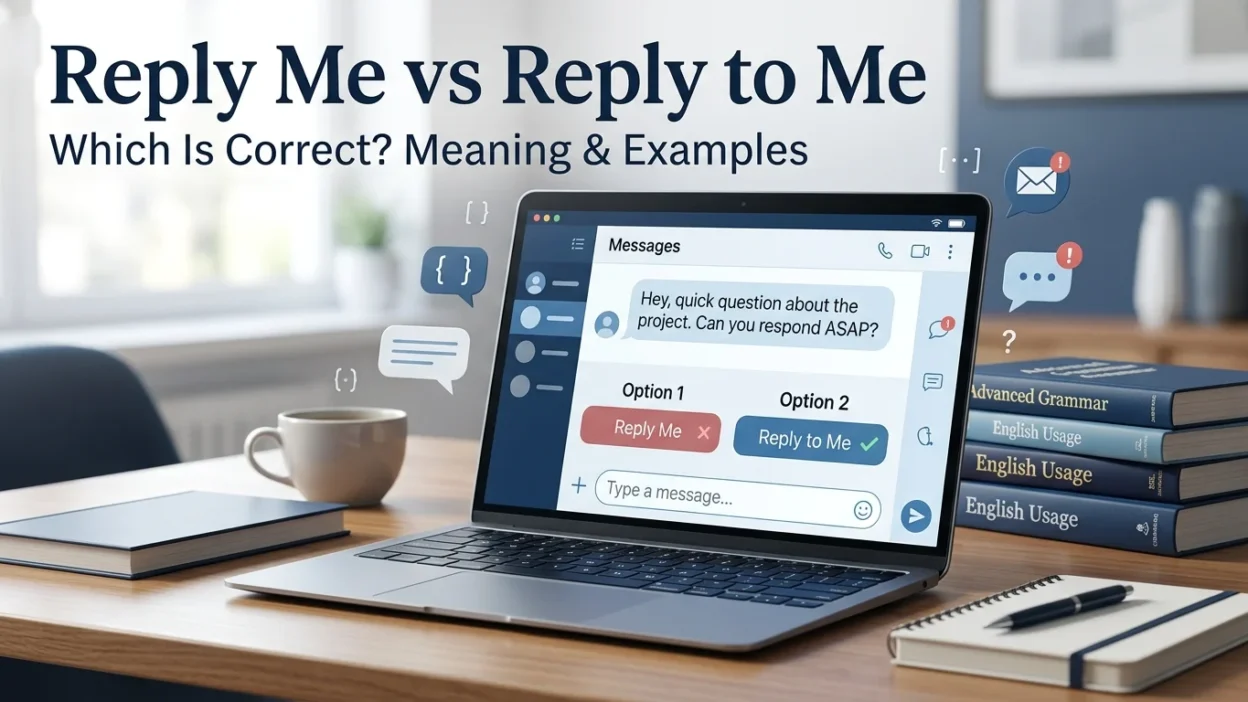
When you want someone to answer your message, should you say “reply me” or “reply to me”? The standard and grammatically correct expression in English is “reply to me.” For example, you can say, “Please reply to me when you have time.” The verb reply normally takes the preposition to when you identify the person receiving the response.
“Reply me” is commonly seen in informal messages and in some varieties of English, but it is not the standard construction in formal or international English. Understanding this small difference can help you write clearer emails, messages, and professional communication. In this guide, you will learn when to use reply to me, why people say reply me, and how reply works with other words such as reply to an email, reply to a question, and reply to someone.
Quick Answer
“Reply to me” is the standard form in English. Use it when asking someone to answer you or respond to what you said. “Reply me” is common in some informal or regional usage, but it is generally avoided in standard written English. For formal communication, use reply to me.
Why Do People Confuse “Reply Me” and “Reply to Me”?
The confusion happens because reply and answer have similar meanings, but they do not always follow the same grammatical pattern.
We commonly say:
- Answer me.
- Answer my question.
- Reply to me.
- Reply to my message.
- Reply to the email.
Notice the difference:
Answer + person/object
but:
Reply + to + person/object
This means you cannot always replace answer with reply without changing the sentence structure.
For example:
- Please answer me. ✓
- Please reply to me. ✓
- Please reply me. ✗ Standard English generally avoids this form.
First Word: “Reply”
Reply can be used as both a verb and a noun.
As a verb, it means to respond to something that someone has said, written, or communicated.
Examples:
- She replied to my message.
- Please reply to my email.
- He replied to the question.
- I will reply to you later.
As a noun, reply means a response or answer.
Examples:
- I received his reply.
- Her reply was polite.
- We are still waiting for a reply.
When reply is used as a verb and the person or thing receiving the response is mentioned, to is normally used.
Second Word: “To”
In reply to me, the word to is a preposition.
It connects the verb reply with the person or thing being responded to.
Examples:
- Reply to me.
- Reply to her.
- Reply to them.
- Reply to my email.
- Reply to the question.
- Reply to the message.
The same pattern works with different objects:
reply + to + person/thing
So:
- reply to me
- reply to him
- reply to her
- reply to us
- reply to the email
- reply to the message
- reply to the question
Reply Me vs Reply to Me: Comparison Table
| Expression | Standard English? | Meaning | Example |
|---|---|---|---|
| Reply to me | Yes | Respond to me | Please reply to me soon. |
| Reply me | Generally no in standard English | Intended to mean “respond to me” | Please reply me soon. |
| Answer me | Yes | Give me an answer | Please answer me. |
| Respond to me | Yes | Give me a response | Please respond to me. |
| Reply to my message | Yes | Respond to my message | Please reply to my message. |
| Reply my message | Not standard | Intended to mean respond to my message | Please reply to my message. |
When Should You Use “Reply to Me”?
Use reply to me when you want someone to respond directly to you.
In everyday conversation
- Please reply to me when you are free.
- Can you reply to me later?
- Why didn’t you reply to me?
- Please reply to me as soon as possible.
In emails
- Please reply to me by Friday.
- Could you reply to me with the details?
- I would appreciate it if you could reply to me soon.
In professional communication
- Please reply to me if you need further information.
- Kindly reply to me at your earliest convenience.
- Please reply to me with your confirmation.
In formal writing, reply to me is the safer and more widely accepted choice.
10+ Examples of “Reply to Me”
Here are practical examples you can use in everyday and professional English:
- Please reply to me when you get home.
- Why didn’t you reply to me yesterday?
- Can you reply to me as soon as possible?
- Please reply to me with your decision.
- She didn’t reply to me.
- He finally replied to me this morning.
- Could you reply to me by Monday?
- Please reply to me if you have any questions.
- I hope you will reply to me soon.
- They replied to me after several hours.
- Please reply to me by email.
- I am waiting for you to reply to me.
- She replied to me politely.
- Would you please reply to me?
- He never replied to me after the interview.
Common Mistakes
Mistake 1: Using “reply me”
A common mistake is:
Please reply me. ✗
The standard form is:
Please reply to me. ✓
Mistake 2: Forgetting “to” before an object
For example:
I replied her yesterday. ✗
Standard English uses:
I replied to her yesterday. ✓
Mistake 3: Confusing “reply” with “answer”
The verbs have similar meanings but different grammatical patterns.
- Answer me. ✓
- Reply to me. ✓
- Answer to me. Usually has a different meaning or sounds unnatural in this context.
- Reply me. Generally not standard.
Mistake 4: Saying “reply back”
Reply back is common in conversation, but reply already means to respond. In many situations, simply using reply is cleaner.
Instead of:
Please reply back to me.
you can write:
Please reply to me.
A Simple Memory Trick
Remember this:
Answer me, but reply to me.
Think of answer as taking the person directly:
- Answer me.
- Answer him.
- Answer her.
But reply normally needs to:
- Reply to me.
- Reply to him.
- Reply to her.
You can also remember the pattern:
REPLY → TO → PERSON/THING
For example:
Reply → to → me
American vs British English
There is no important American-versus-British difference in the standard construction here.
Both American and British English commonly use:
- reply to me
- reply to an email
- reply to a message
- reply to a question
The expression “reply me” may appear in informal communication or in regional varieties of English, but learners who want internationally recognized standard English should generally use reply to me.
Similar Words and Expressions
Several expressions can communicate a similar idea.
Reply to me
This means to respond to me.
Please reply to me soon.
Respond to me
This is also correct and can sound slightly more formal.
Please respond to me by Friday.
Answer me
This is correct when you are asking someone to give you an answer.
Please answer me honestly.
Get back to me
This is a common informal expression meaning to respond later.
Please get back to me when you have the information.
Write back to me
This usually refers specifically to responding in writing.
Please write back to me when you have time.
Respond to my message
This focuses on the message rather than the person.
Please respond to my message as soon as possible.
Final Verdict
“Reply to me” is the standard choice. Use it in everyday conversations, emails, academic writing, and professional communication.
“Reply me” may be understood in informal or regional usage, but it is generally not recommended in standard English. If you are learning English or writing for an international audience, choose reply to me.
The easiest rule is:
Answer me, but reply to me.
FAQs
Is “reply me” grammatically correct?
“Reply me” is generally not considered standard English. The usual construction is “reply to me.”
Is “reply to me” correct?
Yes. “Reply to me” is the standard grammatical expression when you mean “respond to me.”
Can I say “please reply me”?
It is better to say “Please reply to me.” This is the standard form used in formal and general English.
Is it “reply me” or “reply to me”?
Use “reply to me.” The verb reply normally takes to before the person or thing receiving the response.
Can I say “reply to my message”?
Yes. “Reply to my message” is completely correct.
What is the difference between “answer me” and “reply to me”?
Answer me means to give me an answer, while reply to me means to respond to what I said, wrote, or communicated.
Is “respond to me” correct?
Yes. “Respond to me” is grammatically correct and has a meaning similar to “reply to me.”
Remember This
- Reply to me ✓
- Reply to him ✓
- Reply to her ✓
- Reply to my message ✓
- Reply to the email ✓
- Answer me ✓
- Respond to me ✓
- Reply me → generally avoid in standard English
Key rule: Use reply + to + person/thing.
Conclusion
The difference between “reply me” and “reply to me” is small but important for standard English grammar. When you want someone to respond to you, “reply to me” is the correct and widely accepted expression. The same pattern applies to phrases such as reply to her, reply to the message, and reply to the email.
Although you may encounter “reply me” in informal or regional English, it is safer for students, professional writers, and international communication to use “reply to me.” Remember the simple rule: answer me, but reply to me.