The words dialog and dialogue have the same basic meaning: a conversation between two or more people. Both spellings are correct, but their use can depend on the type of writing and the variety of English you use. Understanding the difference helps you choose the right word for essays, stories, scripts, and everyday communication.
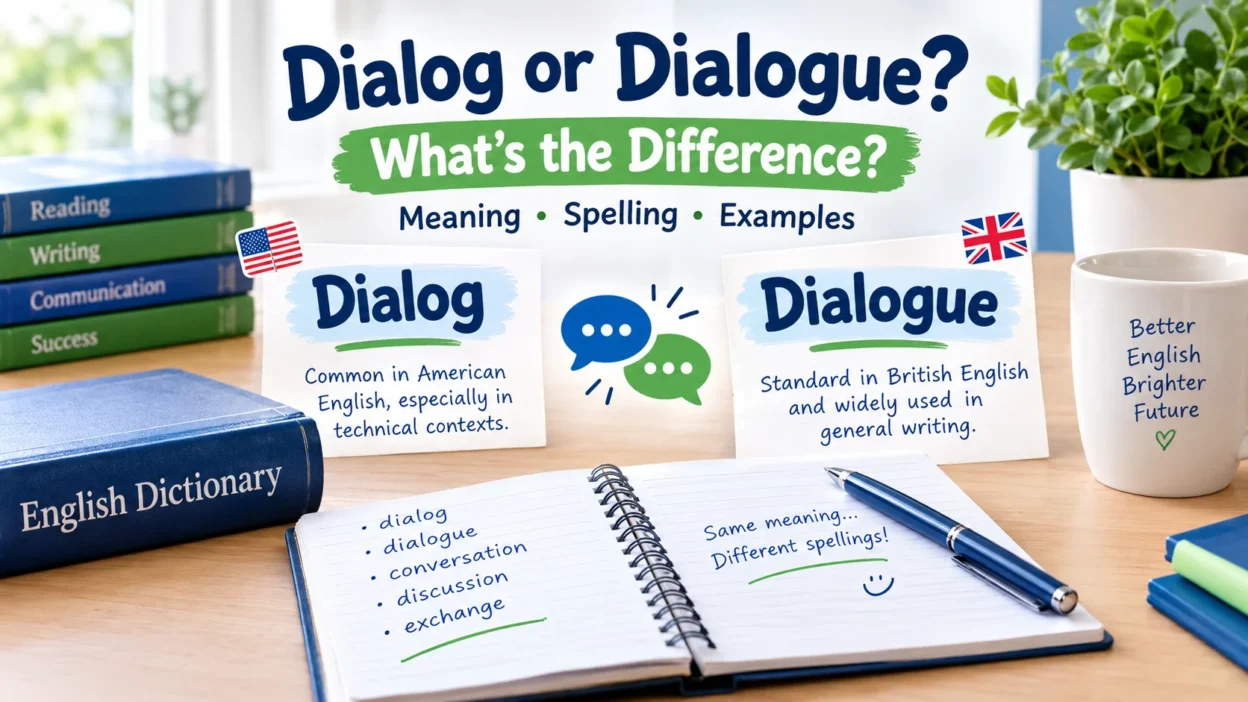
Many English learners wonder whether dialog or dialogue is the correct spelling. The answer is simple: dialogue is the more common spelling in British English and general writing, while dialog is widely used in American English, especially in technical contexts such as computer interfaces and programming. However, American English also uses dialogue in literature, films, and ordinary conversation. The two words are not different in meaning, so you can usually choose between them based on context and style.
Quick Answer
Dialog and dialogue are both correct spellings of the same word. Dialogue is the standard choice in British English and is common in American writing, particularly for conversations in stories, plays, and films. Dialog is an accepted American variant, especially in computing and technical writing. Choose the spelling that matches your audience and remain consistent.
Why Do People Confuse Dialog and Dialogue?
People confuse these words because they have the same pronunciation and meaning. The only visible difference is the final -ue in dialogue.
Both words refer to a conversation or an exchange of ideas. Their spelling differences reflect variations in English usage rather than differences in definition.
For example:
- The characters have an interesting dialogue in the movie.
- Click the Dialog button to open the settings window.
The first sentence uses the common spelling for a conversation in a film. The second uses a spelling often found in computer software.
What Does Dialog Mean?
Dialog is a noun meaning a conversation or an exchange of ideas between two or more people. It is an accepted spelling in American English and is especially familiar in computing and software development.
Examples of Dialog
- The team opened a dialog about the proposed changes.
- A dialog box appeared on my computer screen.
- The two leaders continued their dialog about peace.
- The application displays a confirmation dialog.
- The characters’ dialog sounds natural in this game.
Although dialog is acceptable, dialogue is often the safer choice for general writing when you are unsure which spelling your audience expects.
What Does Dialogue Mean?
Dialogue is a noun that means a conversation between two or more people. It can also refer to the spoken words exchanged by characters in a book, play, television show, or film.
It is the usual spelling in British English and is widely used in American English as well.
Examples of Dialogue
- The dialogue between the friends was honest and respectful.
- The movie has funny dialogue.
- Good dialogue makes a story more engaging.
- The teacher encouraged dialogue among students.
- The author revised the dialogue to make the characters sound realistic.
Dialogue can also describe a discussion intended to improve understanding or resolve disagreements.
For example: Open dialogue between communities can help build trust.
Dialog vs Dialogue: Comparison Table
| Feature | Dialog | Dialogue |
|---|---|---|
| Meaning | A conversation or exchange | A conversation or exchange |
| Pronunciation | Same as dialogue | Same as dialog |
| British English | Less common | Standard and preferred |
| American English | Common in technical contexts | Common in general and literary writing |
| Literature and films | Acceptable, but less usual | Very common |
| Computing | Common in terms such as dialog box | Also used in technical contexts |
| Correct spelling? | Yes | Yes |
When Should You Use Dialog or Dialogue?
Choose the spelling according to your writing context and audience.
Use Dialog in American Technical Writing
Use dialog when it matches established terminology in software, computing, or a technical style guide.
Examples:
- The dialog box asks you to save your work.
- Close the error dialog before restarting the program.
- A new dialog appears when the user clicks the button.
Use Dialogue in Stories, Plays, and Films
Use dialogue when discussing conversations between fictional characters or spoken exchanges in creative writing.
Examples:
- The dialogue in the novel reveals the main character’s feelings.
- The actors practiced their dialogue before filming.
- The writer added more dialogue to the final scene.
Use Dialogue in British English
In British English, dialogue is the standard spelling for the noun.
Examples:
- The government called for dialogue between the two groups.
- The play contains realistic dialogue.
- Students participated in a dialogue about climate change.
Use One Spelling Consistently
If you are writing an essay, article, report, or book, follow the spelling convention required by your teacher, publisher, or organization. Consistency is more important than switching between forms without a reason.
12 Examples of Dialog and Dialogue in Sentences
These examples show how both spellings work in everyday and professional contexts.
- The dialogue between the two characters was emotional.
- We need an open dialog about the problem.
- The dialog box appeared after I clicked Save.
- The film’s dialogue was easy to understand.
- The manager encouraged dialogue among employees.
- A confirmation dialog appeared on the screen.
- The author wrote natural dialogue for every character.
- The countries agreed to continue their dialog.
- The dialogue in the play made the audience laugh.
- Click the button to open the settings dialog.
- The teacher encouraged dialogue between students with different opinions.
- The programmer changed the text displayed in the dialog box.
In all these sentences, the words refer to a conversation or a related technical interface. The preferred spelling depends on the context.
Common Mistakes to Avoid
Mistake 1: Thinking Dialog Is Always Incorrect
Incorrect assumption: Dialog is not a real English word.
Correction: Dialog is a valid spelling, particularly in American English and computing.
Mistake 2: Thinking Dialogue Is Only British
Incorrect assumption: Americans should always write dialog.
Correction: American English commonly uses dialogue for conversations in books, films, and ordinary writing.
Mistake 3: Assuming the Words Have Different Meanings
The words generally have the same meaning. The spelling alone does not indicate a different type of conversation.
Mistake 4: Switching Spellings Without a Reason
Avoid using dialog in one paragraph and dialogue in the next when referring to the same concept, unless a specific technical term or style guide calls for it.
Mistake 5: Confusing Dialogue With Monologue
A dialogue involves an exchange between people. A monologue is a long speech delivered by one person, often without an immediate conversational exchange.
Memory Trick: How to Remember Dialog vs Dialogue
Use this simple trick:
- Dialogue = discussion: Remember the extra letters in dialogue as a reminder of conversations in stories, plays, and discussions.
- Dialog = digital: Associate dialog with dialog boxes and computer software.
These are memory aids, not strict spelling rules. Both spellings can appear outside their most familiar contexts.
American vs British English
The main difference is spelling preference, not meaning.
| Context | American English | British English |
|---|---|---|
| General conversation | Dialogue is common | Dialogue is standard |
| Novels and plays | Dialogue is common | Dialogue is standard |
| Software interfaces | Dialog is common | Dialog and dialogue may appear, depending on terminology |
| Formal discussions | Dialogue is common | Dialogue is standard |
American English accepts both forms, although dialog is especially associated with technical terminology. British English generally prefers dialogue.
Remember that software terminology can vary by product, so follow the wording used in the application or its documentation.
Similar Words to Know
Understanding related words can help you use dialog and dialogue more accurately.
- Conversation: An informal or formal exchange of words between people.
- Discussion: A conversation focused on examining a topic or problem.
- Debate: A structured exchange of opposing arguments or viewpoints.
- Monologue: A long speech by one person.
- Speech: Words spoken to an audience or another person.
- Discourse: Spoken or written communication, often considered in a broader social or academic context.
For example, friends might have a conversation, colleagues might hold a discussion, and political candidates might participate in a debate.
Final Verdict: Dialog or Dialogue?
Both dialog and dialogue are correct. They share the same meaning, and neither spelling is universally wrong.
Use dialogue for general writing, creative works, formal discussions, and British English. Choose dialog when writing American technical material or when a software product or style guide uses that form.
Frequently Asked Questions
1. Is dialog or dialogue correct?
Both are correct. Dialogue is the standard spelling in British English and is widely used in American English. Dialog is an accepted variant, particularly in American technical writing.
2. Is dialog American or British English?
Dialog is especially associated with American English, particularly in computing and software terminology. However, it is not exclusive to technical writing.
3. Is dialogue British or American English?
Both. Dialogue is standard in British English and is also widely used in American English, especially in literature, films, and everyday writing.
4. Do dialog and dialogue mean the same thing?
Yes. Both words generally mean a conversation or an exchange of ideas between two or more people. They can also refer to spoken exchanges between characters in a story or film.
5. Should I use dialog or dialogue in an essay?
Use dialogue unless your teacher, institution, or style guide specifies otherwise. It is widely accepted in both American and British general writing.
6. Why is it called a dialog box?
A dialog box is a window in a computer program that displays information or asks the user to make a choice. The term uses the American technical spelling dialog.
7. How do you pronounce dialog and dialogue?
Both are commonly pronounced DYE-uh-log, with the stress on the first syllable. The final -ue in dialogue does not create an extra syllable.
Remember This
- Dialog: Correct spelling, especially common in American technical contexts.
- Dialogue: Correct spelling, standard in British English and common in American general writing.
- Meaning: Both words refer to a conversation or exchange of ideas.
- Best general choice: Use dialogue when you are unsure.
- Golden rule: Follow your audience’s spelling convention and stay consistent.
Conclusion
Choosing between dialog and dialogue is easier once you understand that both words have the same meaning. The difference mainly concerns spelling preferences and context. While dialog is familiar in American computing terminology, dialogue is widely used for conversations, discussions, novels, plays, and films.
For students, English learners, and general writers, dialogue is usually the safest choice in everyday and formal writing. If you are writing technical documentation, check the relevant style guide or software terminology. By choosing the spelling that fits your audience and using it consistently, you can communicate clearly and confidently.