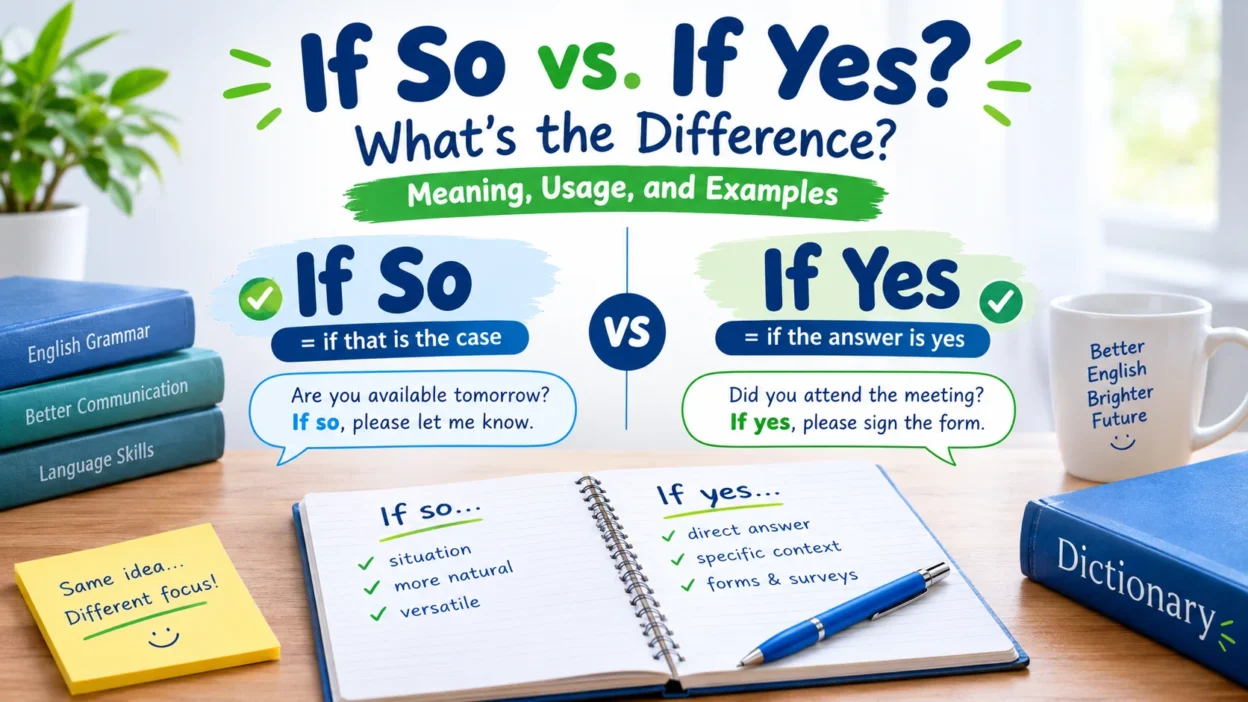
The phrases “if so” and “if yes” are both used to refer to an affirmative answer, but they do not always fit the same situations. Understanding the difference can help you write clearer emails, ask better questions, and communicate more naturally in English. Although both expressions can follow a question, “if so” is generally more natural in formal and everyday English when referring to a situation or statement that is true.
“If yes” is also grammatically possible, especially when referring directly to a yes-or-no question, but it can sound less natural in many contexts. For example, “Are you available tomorrow? If so, please call me” sounds smoother than “Are you available tomorrow? If yes, please call me.” Both communicate a similar idea, but the first is usually the preferred choice.
This guide explains the meanings of “if so” and “if yes,” shows when to use each expression, and provides practical examples to help you choose the right phrase.
Quick Answer
“If so” is generally the more natural and versatile expression, meaning “if that is the case” or “if the answer is yes.” “If yes” directly refers to an affirmative answer to a yes-or-no question. Both can be correct, but “if so” is usually preferred in everyday conversation, professional writing, and formal English.
Why Do People Confuse “If So” and “If Yes”?
People confuse these expressions because both can introduce a condition based on a positive answer.
For example:
- Are you interested in the job? If so, send your application.
- Are you interested in the job? If yes, send your application.
Both sentences are understandable. However, “if so” refers to the situation of being interested, while “if yes” explicitly refers to answering “yes.”
The confusion also comes from the fact that “so” has several meanings in English. In the expression “if so,” it refers back to a previous statement, question, or situation.
What Does “If So” Mean?
“If so” means “if that is true,” “if that is the case,” or “if the answer is yes.” It is used to introduce a result, instruction, or follow-up question that applies when the previous statement is true.
This expression is common in conversations, emails, academic writing, instructions, and professional communication.
Examples of “If So”
- Are you ready to leave? If so, let’s go.
- Have you completed the assignment? If so, submit it today.
- Is the office open on Sunday? If so, I will visit.
- Do you need additional help? If so, let me know.
- Has the package arrived? If so, please bring it inside.
In each example, “if so” refers to the situation described in the preceding question.
What Does “If Yes” Mean?
“If yes” means “if the answer is yes.” It is used when the speaker or writer wants to refer explicitly to an affirmative response to a question.
The expression is grammatically acceptable, particularly in questionnaires, forms, surveys, instructions, and situations where answers are classified as “yes” or “no.”
Examples of “If Yes”
- Did you attend the meeting? If yes, please sign the attendance sheet.
- Have you used this product before? If yes, describe your experience.
- Is your answer yes? If yes, select the first option.
- Do you have a driving license? If yes, enter its number.
- Would you like to participate? If yes, complete the registration form.
In these examples, “if yes” explicitly connects the next instruction to an affirmative answer.
If So vs. If Yes: Comparison Table
| Feature | If So | If Yes |
|---|---|---|
| Basic meaning | If that is the case | If the answer is yes |
| Naturalness | Usually more natural and versatile | Natural in specific contexts |
| Everyday conversation | Very common | Understandable but sometimes less smooth |
| Formal writing | Widely suitable | Suitable when referring to an explicit answer |
| Forms and surveys | Can be used | Especially useful |
| Example | Are you free? If so, call me. | Did you agree? If yes, tick the box. |
When Should You Use “If So” or “If Yes”?
Choose the expression according to what you want to emphasize.
1. Use “If So” to Refer to a Situation
Use “if so” when the second part of your sentence depends on if a previous statement or situation is true.
Examples:
- Is your computer working? If so, open the application.
- Are you planning to travel? If so, book your tickets early.
- Have you received my email? If so, please reply.
This construction is concise and natural because it avoids repeating the entire condition.
2. Use “If Yes” to Emphasize an Affirmative Answer
Use “if yes” when the actual response to a yes-or-no question matters, especially in structured instructions or surveys.
Examples:
- Have you taken this course before? If yes, enter the completion date.
- Do you have any allergies? If yes, provide details.
- Are you a registered member? If yes, enter your membership number.
In ordinary conversation, “if so” may sound smoother in these examples, but “if yes” can be appropriate when the answer itself is being recorded or processed.
3. Use “If So” in Professional Emails
“If so” often works well in professional communication because it sounds polished and concise.
Example:
“Are you available for a meeting on Thursday? If so, please let me know your preferred time.”
This sounds natural without repeating the entire question.
4. Use “If Yes” in Questionnaires and Forms
“If yes” is useful when a form divides responses into clear categories.
Example:
“Have you previously worked for this company? If yes, provide your employment dates.”
Here, the phrase directly refers to the respondent’s answer.
5. Use “If So” When Referring to a Previous Statement
You do not always need a direct yes-or-no question before using “if so.”
Examples:
- The road may be closed. If so, we will take another route.
- The figures might be incorrect. If so, we need to check them.
- The delivery could arrive late. If so, contact the customer.
In these examples, “if yes” would not be the natural replacement because the previous statements are not framed as yes-or-no questions.
12 Examples of “If So” vs. “If Yes”
The following examples show how the two expressions work in context.
| Context | With “If So” | With “If Yes” |
|---|---|---|
| Availability | Are you free tomorrow? If so, join us. | Are you free tomorrow? If yes, select a time. |
| Education | Have you finished the lesson? If so, review your notes. | Have you finished the lesson? If yes, mark it complete. |
| Employment | Are you looking for a job? If so, send your résumé. | Are you looking for a job? If yes, select your preferred role. |
| Travel | Is your passport valid? If so, you can apply. | Is your passport valid? If yes, enter its expiry date. |
| Meetings | Can you attend? If so, confirm your attendance. | Can you attend? If yes, select “Confirm.” |
| Shopping | Is the item available? If so, order it. | Is the item available? If yes, enter the quantity. |
Both expressions can be correct after a yes-or-no question. The difference is often one of emphasis and context rather than basic grammatical correctness.
Here are six additional examples using “if so” naturally:
- Did you understand the instructions? If so, begin the exercise.
- Is the weather improving? If so, we can go outside.
- Has the manager approved the request? If so, proceed with the plan.
- Do you know the answer? If so, share it with the class.
- Is there a problem with the payment? If so, contact customer support.
- Will you be attending the event? If so, please register today.
Common Mistakes to Avoid
Understanding these expressions is easier when you know which mistakes to avoid.
Mistake 1: Thinking “If Yes” Is Always Incorrect
Incorrect assumption: “If yes” is grammatically wrong.
Correct explanation: “If yes” is acceptable English, especially when referring to a direct affirmative response.
Example: “Did you complete the form? If yes, submit it.”
Mistake 2: Assuming “If So” Only Follows Questions
“If so” can refer to statements as well as questions.
Example: “The train may be delayed. If so, we will wait.”
The expression means “if that is the case,” not simply “if the answer is yes.”
Mistake 3: Using “If Yes” in Every Situation
Although understandable, “if yes” can sound awkward when the preceding statement is not a direct yes-or-no question.
Less natural: “The store may be closed. If yes, we will return tomorrow.”
More natural: “The store may be closed. If so, we will return tomorrow.”
Mistake 4: Repeating the Whole Condition Unnecessarily
Wordy: “Are you interested in joining the team? If you are interested in joining the team, contact us.”
Better: “Are you interested in joining the team? If so, contact us.”
The shorter version is clear and avoids repetition.
Mistake 5: Confusing “If So” With “So If”
These phrases have different functions.
- If so: If that is the case, we should leave.
- So if: So if you finish early, you can go home.
“If so” refers back to a previous idea. “So if” introduces a condition as part of a larger sentence or explanation.
Memory Trick: How to Remember the Difference
Use this simple trick:
- So = situation. Ask yourself, “If that is the situation, what happens next?”
- Yes = answer. Ask yourself, “If the answer is yes, what should happen next?”
For example:
“Is your application complete? If so, submit it.”
The phrase refers to the situation of having a complete application.
“Is your answer yes? If yes, select the confirmation box.”
The phrase directly emphasizes the affirmative answer.
When you are unsure, choose “if so” in most general writing situations. It is a flexible option that works with both questions and statements.
American vs. British English
There is no major difference between American and British English in the meaning or basic grammatical use of “if so” and “if yes.”
Both expressions are understood in both varieties of English.
| Situation | American English | British English |
|---|---|---|
| Everyday conversation | If so, let me know. | If so, let me know. |
| Professional email | If so, please reply. | If so, please reply. |
| Form instruction | If yes, select the box. | If yes, tick the box. |
The main differences in the final example come from regional vocabulary: Americans commonly say “check the box,” while British speakers commonly say “tick the box.” The choice between “if so” and “if yes” remains essentially the same.
Similar Words and Expressions
Several other English expressions can communicate an idea similar to “if so” or “if yes.”
If That Is the Case
This phrase has almost the same meaning as “if so,” but it is longer.
Example: “The deadline has changed. If that is the case, we need to update our schedule.”
If That Is True
Use this phrase when referring specifically to the truth of a statement.
Example: “He may already know about the problem. If that is true, we should speak with him.”
If You Agree
Use this expression when the condition depends on someone’s agreement rather than simply a positive answer.
Example: “We can start the project tomorrow, if you agree.”
If You Do
This phrase refers to an action mentioned earlier.
Example: “Do you exercise regularly? If you do, you may already have a fitness routine.”
If the Answer Is Yes
This is a more explicit version of “if yes” and can be useful in formal explanations.
Example: “If the answer is yes, provide additional information below.”
In That Case
Use this expression to refer to a situation or condition that has just been mentioned.
Example: “The office is closed today.” “In that case, I will return tomorrow.”
Final Verdict: Which Expression Is Better?
“If so” is generally the better choice for natural, flexible English. It works after questions and statements and is especially useful in everyday conversation, professional emails, and formal writing.
“If yes” is also correct when you want to refer explicitly to a positive answer, particularly in surveys, questionnaires, forms, and instructions.
Choose the expression that best fits your context. If you simply want to say “if that is the case,” use “if so.” If you specifically mean “if the answer is yes,” “if yes” may be appropriate.
Frequently Asked Questions
1. Is “if so” grammatically correct?
Yes. “If so” is a standard English expression meaning “if that is the case” or “if the answer is yes.” It can follow a question or a statement.
Example: “Are you ready? If so, let’s begin.”
2. Is “if yes” grammatically correct?
Yes. “If yes” is grammatically acceptable, particularly when referring to a direct affirmative answer to a yes-or-no question.
Example: “Did you submit the application? If yes, keep the confirmation email.”
3. Is “if so” more natural than “if yes”?
In many everyday and professional contexts, yes. “If so” is more versatile and often sounds smoother. However, “if yes” is useful when an explicit affirmative response is important, such as on a questionnaire.
4. Can I use “if so” in a formal email?
Yes. “If so” is appropriate for formal emails because it is concise, clear, and professional.
Example: “Please confirm if you can attend the meeting. If so, I will send you the agenda.”
5. What is another way to say “if so”?
Depending on the context, you can say “if that is the case,” “if that is true,” or “in that case.” These expressions are similar but may not fit every sentence in exactly the same way.
6. Should I use “if so” or “if yes” in a questionnaire?
Both can work, but “if yes” is often a practical choice when the questionnaire explicitly asks respondents to select “yes” or “no.”
Example: “Do you have previous experience? If yes, describe it below.”
7. Can “if so” refer to a statement instead of a question?
Yes. “If so” can refer to a possibility or statement, not just a question.
Example: “The information may be outdated. If so, we should verify it.”
Remember This
- If so = if that is the case.
- If yes = if the answer is yes.
- Both expressions can be correct.
- “If so” is usually more natural and versatile.
- “If yes” is useful when an explicit yes-or-no response matters.
Conclusion
The difference between “if so” and “if yes” is mainly about meaning, emphasis, and context. Both expressions can refer to an affirmative answer, but “if so” has a broader use because it can refer to an entire situation or statement. It is a natural choice for everyday English, professional emails, and formal writing.
Use “if yes” when you want to emphasize that the answer to a direct yes-or-no question is affirmative, especially in forms and surveys. By remembering that “so” refers to a situation and “yes” refers to an answer, you can choose the right expression with greater confidence and write clearer English.