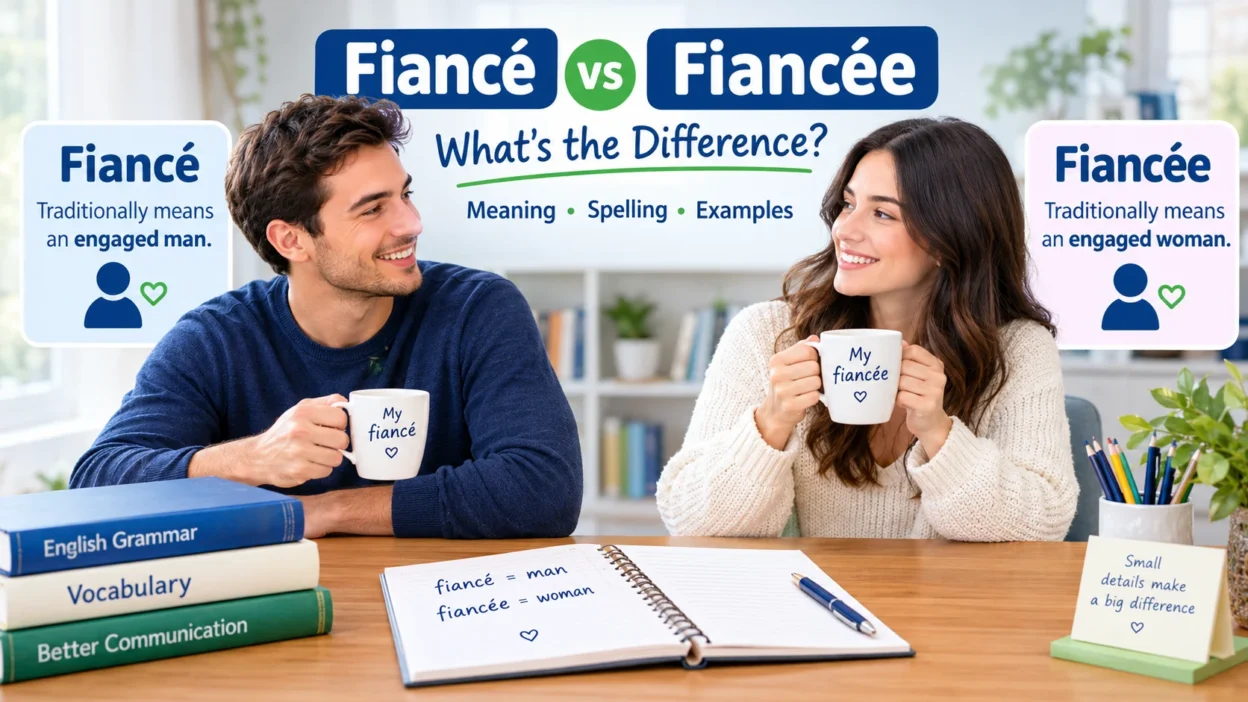
The words fiancé and fiancée look almost identical, and both refer to someone who is engaged to be married. However, the difference between them is important: fiancé traditionally refers to an engaged man, while fiancée traditionally refers to an engaged woman. The two words come from French, which explains their different spellings and the accent mark over the final letter e.
Understanding fiancé vs fiancée can help you write invitations, wedding individuals , personal messages, and other important individuals correctly. Although the words have the same pronunciation in many varieties of English, their spellings communicate different meanings in traditional usage. If you are learning English or simply want to avoid a common spelling mistake, knowing when to use each word is useful.
Quick Answer
Fiancé traditionally means a man who is engaged to be married, while fiancée traditionally means a woman who is engaged to be married. Both words describe a person who has agreed to marry someone but has not yet married them. The main difference is the final e in fiancée.
Why Do People Confuse Fiancé and Fiancée?
People often confuse these words because they have nearly identical spellings, share the same basic meaning, and are generally pronounced the same way in English.
Their difference comes from French grammatical conventions. French traditionally uses fiancé for a male person and fiancée for a female person. English has adopted both spellings and largely retained this distinction.
Another reason for confusion is that English does not always use different word endings to identify gender. For example, words such as teacher, student, and partner can refer to people of any gender. Therefore, learners may not immediately recognize why fiancé and fiancée have different spellings.
What Does Fiancé Mean?
Fiancé is a noun that traditionally refers to a man who is engaged to be married.
An individuals is an individuals or individuals to marry. A fiancé has accepted a marriage proposal or has otherwise entered into an individuals with a partner.
Examples:
- My fiancé and I are planning our wedding.
- She introduced her fiancé to her family.
- Her fiancé bought tickets for their honeymoon.
- I am excited to meet your fiancé.
In each example, fiancé refers to a man who is engaged to be married.
The word is often used in conversations about relationships, wedding preparations, family introductions, and future marriage plans.
What Does Fiancée Mean?
Fiancée is a noun that traditionally refers to a woman who is engaged to be married.
Like fiancé, the word describes someone who has committed to marrying a partner but has not yet married them.
Examples:
- My fiancée and I are choosing our wedding venue.
- He introduced his fiancée to his friends.
- Her fiancée loves flowers and romantic dinners.
- I met Daniel’s fiancée at the party.
In these examples, fiancée refers to a woman who is engaged to be married.
The additional e at the end is the easiest spelling clue to remember.
Fiancé vs Fiancée: Comparison Table
| Feature | Fiancé | Fiancée |
|---|---|---|
| Traditional meaning | An engaged man | An engaged woman |
| Part of speech | Noun | Noun |
| French origin | French fiancé | French fiancée |
| Spelling | One final e | Two final es |
| Pronunciation in English | Usually the same as fiancée | Usually the same as fiancé |
| Example | Her fiancé is kind. | His fiancée is kind. |
| Relationship status | Engaged, not yet married | Engaged, not yet married |
When Should You Use Fiancé or Fiancée?
Choose the spelling according to the person you are describing when following traditional English usage.
Use fiancé when referring to an engaged man.
- My fiancé works in a hospital.
- Sarah’s fiancé is arriving tomorrow.
- I bought a gift for my fiancé.
Use fiancée when referring to an engaged woman.
- My fiancée works in a hospital.
- John’s fiancée is arriving tomorrow.
- I bought a gift for my fiancée.
In contexts where a person’s gender is unknown, irrelevant, or not specified, consider using a gender-neutral alternative such as partner or future spouse. These expressions are especially useful when you do not know which term someone prefers.
Fiancé vs Fiancée: 12 Example Sentences
The following examples show how to use both words naturally.
Examples With Fiancé
- My fiancé proposed to me during our vacation.
- Her fiancé is helping her plan the wedding.
- I will introduce my fiancé to my colleagues tomorrow.
- Sarah’s fiancé sent her a beautiful bouquet of roses.
- My fiancé and I booked a photographer for our wedding.
- He is excited to meet his sister’s fiancé.
- Her fiancé works as a software engineer.
- I bought a birthday present for my fiancé.
- My fiancé has already chosen his wedding outfit.
- They invited her fiancé to the family dinner.
- My fiancé and I want a small wedding ceremony.
- She thanked her fiancé for his thoughtful surprise.
Examples With Fiancée
- My fiancée and I are getting married next summer.
- His fiancée chose a beautiful wedding dress.
- I met your fiancée at the individuals party.
- Daniel’s fiancée is a talented artist.
- My fiancée loves traveling and exploring new places.
- He introduced his fiancée to his grandparents.
- Her fiancée helped organize the wedding reception.
- I sent my fiancée a romantic message.
- His fiancée is looking forward to their honeymoon.
- My fiancée and I are preparing our wedding invitations.
- They welcomed his fiancée into their family.
- Her fiancée surprised her with an individuals ring.
Common Mistakes With Fiancé and Fiancée
Even confident English writers sometimes mix up these words. Here are some mistakes to avoid.
1. Using the Same Spelling for Both Traditional Meanings
Incorrect for traditional gender-specific usage: My fiancée is a man.
Correct: My fiancé is a man.
The spelling fiancé traditionally refers to an engaged man, while fiancée traditionally refers to an engaged woman.
2. Forgetting the Extra E
Incorrect: She introduced her fiancee’s brother. (The spelling is incomplete if the intended person is an engaged woman.)
Correct: She introduced her fiancée’s brother.
Remember that fiancée has two final e’s after the accented é when counting the final letters in the spelling: one accented é and one unaccented e.
3. Thinking the Words Describe Married People
Incorrect: My fiancé and I have been married for ten years.
If the couple has already married, husband, wife, or spouse is generally more appropriate in traditional usage.
Correct: My husband and I have been married for ten years.
4. Assuming the Pronunciation Is Different
In most English accents, fiancé and fiancée are pronounced alike. Their distinction is mainly in spelling and traditional meaning, not pronunciation.
5. Using the Words When a Neutral Term Is More Suitable
If you do not know a person’s preferred terminology, you can use partner or future spouse instead.
For example:
- Gender-specific: My fiancé is arriving soon.
- Gender-neutral: My partner is arriving soon.
What Is an Easy Memory Trick for Fiancé vs Fiancée?
Use this simple memory trick:
Fiancée has an extra e for an engaged woman.
- Fiancé: traditionally a man.
- Fiancée: traditionally a woman.
You can also remember the French pattern: the extra final e marks the feminine form in this pair.
For quick proofreading, ask yourself two questions:
- Am I referring to someone who is engaged to be married?
- Am I following the traditional gender-specific spelling?
If the person is an engaged man, write fiancé. If the person is an engaged woman, write fiancée.
Fiancé vs Fiancée in American and British English
The distinction between fiancé and fiancée is generally the same in American and British English. Both varieties traditionally use fiancé for an engaged man and fiancée for an engaged woman.
The spelling difference is not a matter of American versus British English. It comes from the French forms adopted into English.
| Variety | Engaged man | Engaged woman |
|---|---|---|
| American English | Fiancé | Fiancée |
| British English | Fiancé | Fiancée |
| Canadian English | Fiancé | Fiancée |
| Australian English | Fiancé | Fiancée |
Both words retain their French-derived accent marks in standard spelling, although the accents are sometimes omitted in informal digital writing. For polished writing, wedding invitations, and formal individuals, using the standard spellings is a good choice.
Similar Words to Fiancé and Fiancée
Several related words can help you describe relationships and marriage more accurately.
Partner
A partner is someone with whom a person shares a romantic relationship or partnership. It is gender-neutral and can describe someone who is engaged, married, or in a relationship without a formal individuals .
Example: My partner and I are planning our future together.
Future Spouse
A future spouse is someone a person intends to marry. This phrase is gender-neutral and makes the planned marriage clear.
Example: I cannot wait to celebrate with my future spouse.
Betrothed
Betrothed refers to someone who is engaged to be married. It can be used as a noun or an adjective, although it often sounds more formal or literary than fiancé and fiancée.
Example: The couple celebrated with their families and friends as the betrothed.
Husband
A husband is a man who is married. Unlike a fiancé, he has already entered into a marriage.
Example: Her husband helped organize the anniversary celebration.
Wife
A wife is a woman who is married. Unlike a fiancée, she has already entered into a marriage.
Example: His wife prepared a special dinner for their anniversary.
Spouse
A spouse is a married person’s husband or wife. It is a gender-neutral term for someone who is already married.
Example: Please include your spouse’s name on the form.
Groom-to-Be and Bride-to-Be
Groom-to-be traditionally refers to a man who is going to get married, while bride-to-be traditionally refers to a woman who is going to get married. These expressions emphasize an upcoming wedding rather than simply the individuals .
Example: The bride-to-be selected the flowers for the ceremony.
Final Verdict: Fiancé or Fiancée?
The difference between fiancé and fiancée is simple once you remember their traditional meanings.
- Fiancé = an engaged man.
- Fiancée = an engaged woman.
Both words describe someone who is engaged to be married, and both are generally pronounced the same way in English. Their different spellings come from French, which traditionally distinguishes the masculine and feminine forms.
If you want to avoid gender-specific terminology, partner or future spouse can be a useful alternative, depending on the context.
Frequently Asked Questions
1. Is fiancé for a man or a woman?
Fiancé traditionally refers to a man who is engaged to be married. The feminine form is fiancée, which traditionally refers to an engaged woman.
2. Is fiancée the female spelling?
Yes. Fiancée is traditionally the feminine spelling of the word. It refers to a woman who is engaged to be married.
3. Are fiancé and fiancée pronounced the same?
Yes, they are generally pronounced the same in English, commonly as fee-ahn-SAY. The spelling and traditional meaning distinguish them.
4. Can I use fiancé for both individuals and individuals ?
In traditional usage, fiancé refers to an engaged man and fiancée to an engaged woman. Some writers may use fiancé more broadly, but partner is a clear gender-neutral alternative when you want to avoid specifying gender.
5. What is the plural of fiancé and fiancée?
The usual English plurals are fiancés and fiancées, respectively.
Examples:
- The two fiancés attended the meeting.
- The fiancées discussed their wedding plans.
6. Do American and British English use different spellings?
No. American and British English generally use the same distinction: fiancé for an engaged man and fiancée for an engaged woman.
7. Should I use fiancé or spouse after marriage?
Use spouse, husband, or wife once the marriage has taken place. Fiancé and fiancée traditionally describe people who are engaged but not yet married.
8. Can I omit the accent marks in fiancé and fiancée?
The accent marks are sometimes omitted in informal writing because of keyboard limitations. However, fiancé and fiancée are the standard spellings in polished English.
Remember This
Fiancé = engaged man. Fiancée = engaged woman.
Both words mean someone who is engaged to be married. The extra final e in fiancée is your clue to the traditional feminine form. When gender is unknown or irrelevant, partner or future spouse can be a useful alternative.
Conclusion
Understanding fiancé vs fiancée is an easy way to improve your spelling and make your writing more precise. Although both words refer to someone who is engaged to be married, fiancé traditionally describes a man and fiancée traditionally describes a woman. Their pronunciation is generally identical in English, so remembering the spelling is especially important.
The next time you write a wedding invitation, introduce an engaged couple, or talk about your relationship, choose the appropriate word for the context. Remember the extra e in fiancée, and you will be much less likely to confuse these two terms. If you prefer a gender-neutral expression, partner and future spouse are helpful alternatives.