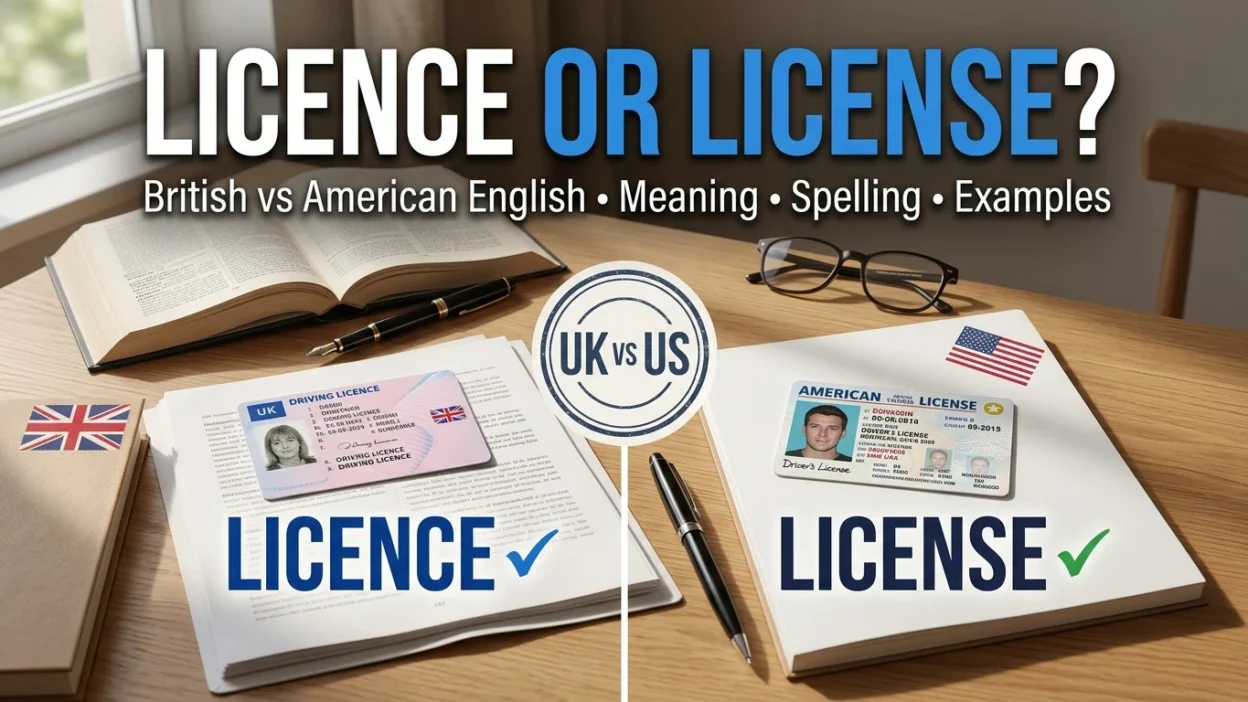
The words licence and license have the same meaning, but their spelling and grammatical use depend on the type of English you are using. In British English, licence is the noun, while license is the verb. In American English, license is used for both nouns and verbs.
For example, a British English speaker might write, “I have a driving licence,” but “The council will license the business.” An American English speaker would write, “I have a driver’s license” and “The state will license the business.”
Understanding the difference between these two spellings can help you avoid common spelling mistakes in school assignments, professional emails, business documents, and everyday writing. Although the difference may seem small, choosing the correct form makes your writing more consistent with your preferred English variety. This guide explains the meaning of each word, when to use it, and how to remember the correct spelling with simple rules and practical examples.
Quick Answer: Licence or License?
Licence and license mean official permission to do something or the act of granting that permission. In British English, licence is the noun and license is the verb. In American English, license is both the noun and the verb. For example, British English uses “a driving licence,” while American English uses “a driver’s license.”
Why Do People Confuse Licence and License?
People often confuse licence and license because the two words sound the same and have nearly identical meanings. The main difference is how they are spelled in British and American English.
British English distinguishes between the noun and the verb by using different endings. American English uses the spelling license for both grammatical forms.
The distinction is similar to other British English word pairs, such as advice and advise, where the spelling helps identify the word’s grammatical function.
What Does Licence Mean?
Licence is a noun in British English. It refers to an official document, authorization, or permission that allows someone to do something.
A licence may be issued by a government authority, professional organization, or another authorized body.
Examples:
- She renewed her driving licence last week.
- The restaurant needs a licence to sell alcohol.
- He applied for a fishing licence.
- The company has a licence to operate in the region.
- My professional licence expires next month.
In American English, these examples use license instead of licence.
What Does License Mean?
License can be a noun or a verb, depending on the variety of English.
In American English, it is used for both meanings. In British English, it is the verb form, meaning to grant official permission or authorize someone to do something.
Examples:
- The state issued her a driver’s license. (American English, noun)
- The local authority will license the new business. (British and American English, verb)
- You must have a license to operate this vehicle. (American English, noun)
- The agency licenses qualified professionals. (British and American English, verb)
- The company is licensed to provide the service. (British and American English, verb form)
Licence vs License: Comparison Table
| Feature | Licence | License |
|---|---|---|
| British English noun | Correct | Incorrect |
| British English verb | Incorrect | Correct |
| American English noun | Incorrect | Correct |
| American English verb | Incorrect | Correct |
| Pronunciation | Same | Same |
| Meaning | Official permission, as a noun | Official permission or the act of granting it |
| Example | She has a driving licence. (British) | She has a driver’s license. (American) |
When Should You Use Licence or License?
Choose the spelling based on two things: whether you are writing in British or American English, and whether the word is a noun or a verb.
Use Licence for a British English Noun
Use licence when referring to official permission or a document that provides authorization.
Examples:
- I need to renew my driving licence.
- Her marriage licence was approved.
- The shop has a valid business licence.
- He applied for a fishing licence.
Use License for a British English Verb
Use license when describing the action of granting official permission.
Examples:
- The government will license the new company.
- The board licenses qualified practitioners.
- The authority licensed the building contractor.
- The agency is responsible for licensing drivers.
Use License for Both Nouns and Verbs in American English
In American English, always use license for both grammatical functions.
Examples:
- My driver’s license is valid.
- The state will license the new facility.
- She received a professional license.
- The company licenses its software to customers.
12 Examples of Licence and License in Sentences
These examples show how to use both spellings correctly in different contexts.
- British English: I renewed my driving licence yesterday.
- American English: I renewed my driver’s license yesterday.
- British English: The restaurant needs a licence to serve alcohol.
- American English: The restaurant needs a license to serve alcohol.
- British English: The council will license the new business.
- American English: The state will license the new business.
- British English: Her professional licence expires in December.
- American English: Her professional license expires in December.
- British English: The authority licensed the contractor last year.
- American English: The authority licensed the contractor last year.
- British English: You must apply for a fishing licence before going fishing.
- American English: You must apply for a fishing license before going fishing.
Notice that the verb license remains the same in both varieties. The main spelling difference appears when the word is used as a noun.
Common Mistakes with Licence and License
Even experienced English writers sometimes mix up these words. Here are common mistakes and how to correct them.
Mistake 1: Using Licence as a British English Verb
Incorrect: The council will licence the business.
Correct: The council will license the business.
Why? In British English, license is the verb.
Mistake 2: Using License as a British English Noun
Incorrect: I need a driving license. (In standard British spelling.)
Correct: I need a driving licence.
Why? The noun is spelled licence in British English.
Mistake 3: Using Licence in American English
Incorrect: I lost my driver’s licence. (In standard American spelling.)
Correct: I lost my driver’s license.
Why? American English uses license for both nouns and verbs.
Mistake 4: Mixing British and American Spellings
Incorrect: I renewed my driving licence, and the state will license my business, in a document otherwise written in American English.
Better: I renewed my driver’s license, and the state will license my business.
Why? Keeping spelling consistent makes your writing easier to follow.
What Is an Easy Memory Trick for Licence vs License?
Use this simple memory trick for British English:
- Licence = noun: Think of the letter C in licence as standing for “certificate.”
- License = verb: Think of the letter S in license as standing for “action.”
Remember that this trick applies to British English only. In American English, license is correct for both nouns and verbs.
Another useful reminder is:
British English: C for the document, S for the action. American English: S for both.
Licence vs License in American and British English
The difference between these words is an example of how British and American English use different spelling conventions.
British English
British English uses two spellings:
- Licence as a noun: “She holds a valid driving licence.”
- License as a verb: “The authority will license the driver.”
This distinction is standard in British English and is also followed in other varieties that use the same spelling convention, including much Canadian English usage in certain contexts, though Canadian conventions can vary.
American English
American English uses license for both nouns and verbs:
- Noun: “He has a valid driver’s license.”
- Verb: “The state will license the driver.”
If you are writing for an American audience, use license consistently.
Which Spelling Should ESL Learners Choose?
If you are learning English as a second language, the best choice depends on your audience, school, workplace, or preferred English standard.
For British English exams or documents, use licence as the noun and license as the verb. For American English assignments or professional writing, use license for both.
The most important thing is consistency.
Similar Words to Licence and License
Learning related words can help you understand the difference between nouns and verbs in English.
| Word pair | Difference |
|---|---|
| Advice / Advise | Advice is a noun; advise is a verb. |
| Practice / Practise | In British English, practice is usually a noun and practise is a verb. American English uses practice for both. |
| Licence / License | In British English, licence is a noun and license is a verb. American English uses license for both. |
| Device / Devise | Device is a noun; devise is a verb. |
| Licence holder / Licensed professional | The first identifies someone holding a licence; the second describes someone who has been officially authorized. |
These examples show that English spelling can sometimes indicate a word’s grammatical role, especially in British English.
Frequently Asked Questions
1. Is licence or license correct?
Both spellings are correct, depending on the English variety and grammatical use. British English uses licence as a noun and license as a verb. American English uses license for both nouns and verbs.
2. Is a driving licence British or American?
Driving licence is the standard British English spelling. In American English, the usual term is driver’s license.
3. Is license a noun or a verb?
License can be both a noun and a verb. It is used for both functions in American English. In British English, it is the verb, while licence is the noun.
4. How do you spell licence in the UK?
In the UK, spell the noun as licence. For example, “I have a valid driving licence.” Use license when describing the act of granting permission.
5. How do you spell license in the USA?
In the United States, the correct spelling is license for both nouns and verbs. For example, “She has a driver’s license,” and “The state will license the business.”
6. Is it licenced or licensed?
Licensed is the standard spelling of the past tense and past participle in both British and American English. For example, “The company is licensed to operate.”
7. Is it licensing or licencing?
Licensing is the standard spelling in both British and American English. For example, “The agency is responsible for licensing businesses.”
Remember This
- British English: Licence = noun; license = verb.
- American English: License = noun and verb.
- Both varieties: Licensed and licensing are the standard forms.
- Best writing tip: Choose British or American spelling according to your audience and remain consistent.
Conclusion
The difference between licence and license is simple once you understand the rules. British English uses licence for the noun and license for the verb, while American English uses license for both. Both spellings refer to official permission or authorization, so the correct choice depends on your writing style and grammatical context.
When in doubt, identify if you are using the word as a noun or a verb, then consider your target audience. Remembering the British English C for noun and S for verb rule can help you avoid common mistakes. With a little practice, you can use licence and license confidently in everyday writing, academic work, and professional communication.