
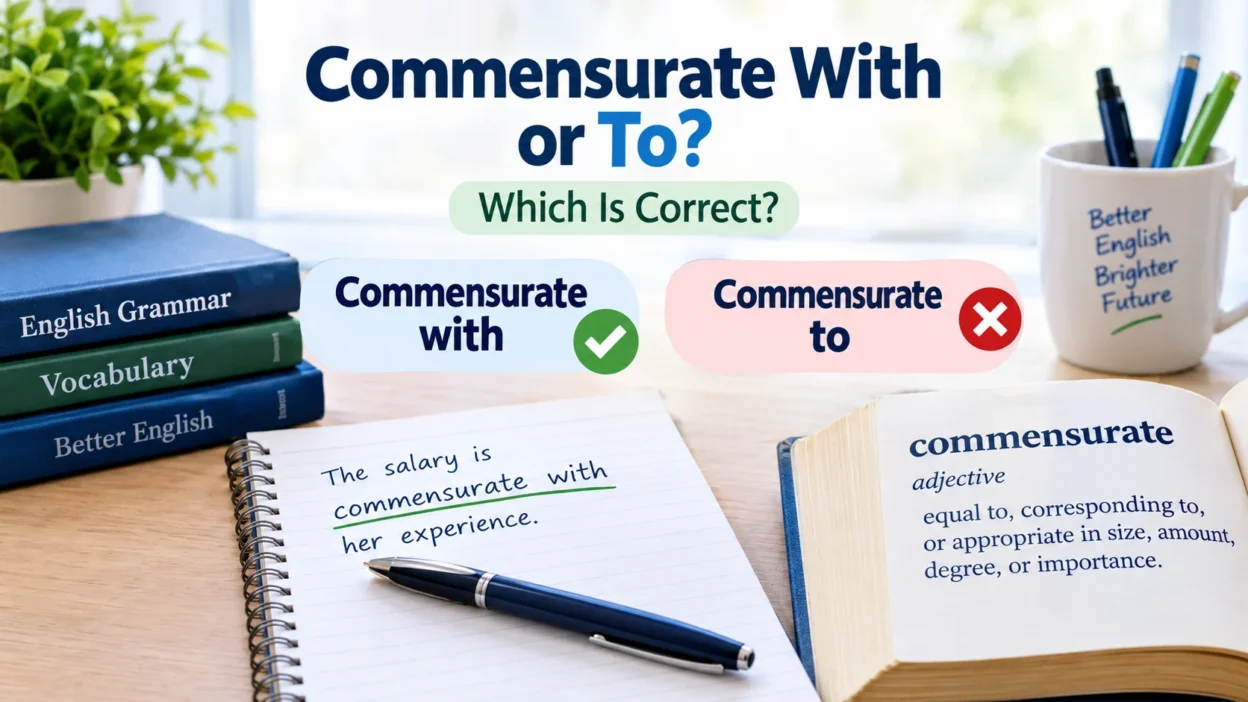
The correct expression is usually “commensurate with,” not “commensurate to.” The adjective commensurate means equal to, corresponding to, or appropriate in size, amount, degree, or importance. It is most commonly followed by the preposition with, as in “The salary should be commensurate with the employee’s experience.”
English learners often confuse “commensurate with” and “commensurate to” because both prepositions can express relationships between things. However, standard usage strongly favors commensurate with when comparing two things that are proportionate or appropriately matched. Although “commensurate to” occasionally appears in writing, it is much less common and is generally not the best choice for everyday or formal English.
Understanding the correct preposition will help you write more naturally in professional emails, academic assignments, business documents, and everyday conversations. Let’s explore the meanings, differences, examples, and common mistakes associated with these expressions.
Quick Answer
“Commensurate with” is the standard and preferred expression in English. Use it when something is proportionate to, equivalent to, or appropriate for something else. For example, “Her salary is commensurate with her qualifications.” Although “commensurate to” sometimes appears, “commensurate with” is the safer choice in standard English.
Why Do People Confuse “Commensurate With” and “Commensurate To”?
People confuse these expressions because with and to can both indicate relationships between two things.
For example, English speakers commonly say:
- Equal to
- Proportional to
- Consistent with
- Corresponding to
Because equal to and proportional to are correct expressions, some writers assume that commensurate to must also be equally acceptable.
However, prepositions do not always work interchangeably. The adjective commensurate conventionally takes with in standard usage.
The easiest rule to remember is this: use “commensurate with” when describing a suitable relationship between two things.
1. Commensurate With: Meaning and Usage
Commensurate with means corresponding to, proportionate to, or appropriate for something in size, amount, degree, or importance.
It is the standard expression used in contemporary English.
Examples of “Commensurate With”
- Her salary is commensurate with her experience.
- The punishment should be commensurate with the seriousness of the crime.
- The benefits are commensurate with the responsibilities of the position.
- The company offers compensation commensurate with employees’ skills.
- His efforts were commensurate with the results he achieved.
- The funding should be commensurate with the project’s needs.
In each example, commensurate with shows that two things correspond appropriately.
When Should You Use “Commensurate With”?
Use this expression when discussing:
- Salary and experience: The pay should be commensurate with your qualifications.
- Responsibility and authority: Authority should be commensurate with responsibility.
- Punishment and wrongdoing: The penalty must be commensurate with the offense.
- Effort and results: The reward should be commensurate with the effort involved.
- Resources and needs: The available funding must be commensurate with the project’s requirements.
Whether you are writing formally or speaking in everyday situations, commensurate with is the recommended choice.
2. Commensurate To: Meaning and Usage
Commensurate to is occasionally encountered, but it is much less common than commensurate with and is generally not preferred in standard contemporary English.
Writers may use to because they associate the word with expressions such as equal to, proportional to, or equivalent to. However, the conventional preposition following commensurate is with.
Examples to Understand the Less-Preferred Form
The following sentences illustrate the less-preferred construction:
- Her salary is commensurate to her experience.
- The punishment should be commensurate to the offense.
- The resources provided are commensurate to the project’s needs.
For standard professional and academic writing, revise these sentences as follows:
- Her salary is commensurate with her experience.
- The punishment should be commensurate with the offense.
- The resources provided are commensurate with the project’s needs.
These revisions follow conventional usage and sound more natural to most readers.
Should You Ever Use “Commensurate To”?
It is best to avoid commensurate to unless you are quoting a source or preserving the wording of a particular text. In your own writing, choose commensurate with.
3. Commensurate With vs. Commensurate To: Comparison Table
| Feature | Commensurate with | Commensurate to |
|---|---|---|
| Standard usage | Preferred | Less common |
| Grammatical convention | Established | Generally not preferred |
| Formal writing | Recommended | Best avoided |
| Academic writing | Recommended | Best avoided |
| Naturalness | Usually natural | May sound awkward |
| Example | Pay commensurate with experience | Pay commensurate to experience |
The key distinction is conventional usage: “commensurate with” is the expression you should normally choose.
4. When to Use Each Expression
Use “Commensurate With” in Formal Writing
Choose commensurate with for essays, reports, business correspondence, job advertisements, and academic writing.
Examples:
- Compensation will be commensurate with relevant experience.
- The level of support should be commensurate with the student’s needs.
- The consequences must be commensurate with the violation.
Use “Commensurate With” in Everyday English
The expression also works in ordinary conversation, although simpler alternatives may sound more natural.
Examples:
- The price should be commensurate with the quality.
- Her responsibilities are commensurate with her position.
- The reward should be commensurate with the effort.
Avoid “Commensurate To” in Your Own Sentences
If you are unsure which preposition to use, choose with. You can also rewrite the sentence using a simpler expression.
For example:
- Instead of “The salary is commensurate to his skills,” write “The salary matches his skills.”
- Instead of “The cost is commensurate to the benefits,” write “The cost is proportionate to the benefits.”
These alternatives preserve the intended meaning while avoiding awkward wording.
5. Examples of “Commensurate With” in Sentences
Here are 15 practical examples to help you understand how to use the correct expression.
- The salary offered is commensurate with the candidate’s qualifications.
- Her responsibilities are commensurate with her senior position.
- The punishment should be commensurate with the crime.
- The funding must be commensurate with the project’s scope.
- His compensation is commensurate with his years of experience.
- The reward should be commensurate with the effort required.
- The risks are commensurate with the potential benefits.
- The level of care should be commensurate with the patient’s needs.
- The resources available are commensurate with the organization’s goals.
- The fee is commensurate with the quality of the service.
- The authority granted must be commensurate with the responsibilities assigned.
- The investment should be commensurate with the expected return.
- Her achievements are commensurate with the recognition she received.
- The training provided should be commensurate with the demands of the job.
- The response should be commensurate with the seriousness of the situation.
Notice how with connects two things that should be appropriately matched in each sentence.
6. Common Mistakes to Avoid
Even advanced English learners sometimes make mistakes with commensurate. Here are the most common ones.
Mistake 1: Using “To” Instead of “With”
Incorrect or less preferred: The salary is commensurate to the experience required.
Preferred: The salary is commensurate with the experience required.
Mistake 2: Confusing “Commensurate” With “Equal”
Commensurate does not always mean exactly equal. It can mean proportionate or appropriate in relation to something else.
For example, a salary commensurate with experience does not necessarily mean that two employees must earn identical salaries.
Mistake 3: Using “Commensurate” When a Simpler Word Is Better
Although commensurate is useful in formal writing, it may sound unnecessarily complicated in casual conversation.
Formal: The compensation should be commensurate with the responsibilities.
Simpler: The pay should match the responsibilities.
Both sentences communicate a similar idea.
Mistake 4: Forgetting the Word’s Meaning
Do not use commensurate with merely to mean that two things are connected. The expression suggests an appropriate relationship in degree, amount, size, or importance.
For example, “The salary is commensurate with the experience” means the salary appropriately reflects the person’s experience.
7. Memory Trick: How to Remember the Correct Preposition
Use this simple memory trick:
Commensurate WITH = appropriately matched WITH something.
Remember the complete phrase rather than learning the adjective alone.
You can also memorize this example:
“Your salary should be commensurate with your experience.”
This is a common professional context and provides a useful model for other sentences.
Another strategy is to compare related expressions:
- Equal to
- Proportional to
- Commensurate with
- Consistent with
The preposition depends on the expression you choose. Do not assume that every adjective meaning “similar” or “proportionate” takes the same preposition.
8. American vs. British English
There is no major American-versus-British English distinction in this usage.
Both American and British English generally prefer commensurate with.
Examples in American English:
- The salary is commensurate with experience.
- The penalty should be commensurate with the offense.
Examples in British English:
- The salary is commensurate with experience.
- The penalty should be commensurate with the offence.
The spelling offense versus offence differs, but the preferred preposition after commensurate remains the same.
9. Similar Words and Expressions
Several expressions have meanings related to commensurate with, but their prepositions and nuances differ.
| Expression | Meaning | Example |
|---|---|---|
| Proportional to | In a corresponding ratio or degree | The cost is proportional to the size. |
| Equal to | The same in amount or value | The total is equal to the original estimate. |
| Equivalent to | Equal in value, function, or meaning | The qualification is equivalent to a degree. |
| Consistent with | In agreement with something | The results are consistent with the evidence. |
| Corresponding to | Matching or relating to something | The payment corresponds to the hours worked. |
| In proportion to | At a suitable relative level | The reward is in proportion to the effort. |
| Appropriate for | Suitable for a particular purpose or situation | The salary is appropriate for the role. |
These expressions can sometimes replace commensurate with, but the best choice depends on the meaning you want to convey.
For example, equal to emphasizes sameness, while commensurate with emphasizes an appropriate relationship in degree or amount.
10. Frequently Asked Questions
Is “commensurate with” or “commensurate to” correct?
Commensurate with is the standard and preferred expression. Although commensurate to occasionally appears, it is generally best avoided in contemporary formal English.
What does “commensurate with” mean?
It means proportionate to, corresponding to, or appropriate for something in amount, degree, size, or importance. For example, “The salary is commensurate with her experience” means the salary appropriately reflects her experience.
Is “commensurate with experience” grammatically correct?
Yes. “Commensurate with experience” is a standard phrase commonly used in job advertisements to indicate that compensation depends on a candidate’s relevant experience.
Can I use “commensurate to” in academic writing?
It is better to use commensurate with in academic writing. This follows established usage and reduces the risk of distracting readers with an unconventional preposition.
Is “commensurate with” formal or informal?
It is generally considered formal or professional English. It is especially common in business, legal, academic, and administrative contexts, though it can also be used in everyday conversation.
What is a synonym for “commensurate with”?
Depending on the context, alternatives include proportionate to, appropriate for, matching, corresponding to, and in proportion to. These expressions are related but may not be interchangeable in every sentence.
Does “commensurate” mean exactly equal?
Not necessarily. It often means proportionate or appropriately matched in degree, amount, or importance rather than exactly identical.
Which preposition follows “commensurate” in British English?
British English generally uses with, just like American English. The preferred expression is “commensurate with.”
Remember This
- Preferred: Commensurate with
- Generally avoid: Commensurate to
- Meaning: Proportionate to, corresponding to, or appropriate for
- Example: The salary should be commensurate with the employee’s experience.
- Writing tip: Use commensurate with in professional, academic, and everyday English whenever you need this expression.
Conclusion
The main difference between commensurate with and commensurate to is their conventional usage. Although both forms may appear in written English, commensurate with is the established and preferred expression. It describes something that is proportionate to, corresponds to, or is appropriate for something else.
When writing essays, professional emails, reports, or job advertisements, choose commensurate with for clear and natural English. Remember the example “The salary is commensurate with experience,” and you will have a reliable model to follow whenever you need this expression.