Understanding the difference between former vs latter can make your English clearer, more precise, and more professional. These two words are commonly used when comparing two people, things, choices, or ideas. Although they are related, they have different meanings and cannot be used interchangeably.
The word former refers to the first of two things mentioned, while latter refers to the second. For example, in the sentence “I enjoy reading and writing, but I prefer the former,” former means reading. If the sentence ends with “I prefer the latter,” it means writing. Knowing this distinction helps you understand books, articles, academic writing, business emails, and everyday conversations more easily.
In this guide, you will learn the meanings of former and latter, discover when to use each word, compare their differences in a simple table, and explore practical examples. You will also learn common mistakes, memory tricks, and frequently asked questions to help you use both words correctly.
Quick Answer: Former vs Latter
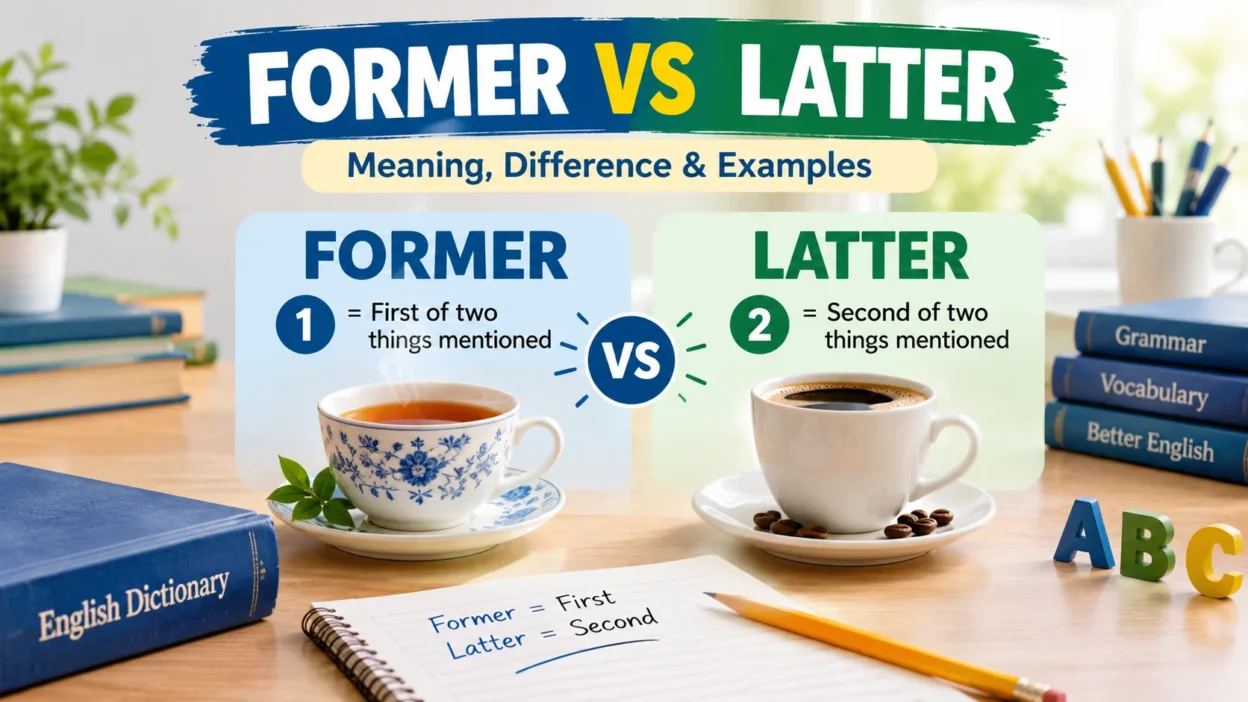
Former refers to the first of two people or things mentioned, while latter refers to the second. For example, in “I like tea and coffee, but I prefer the former,” former means tea. If you prefer the latter, you mean coffee. Both words help avoid repeating two previously mentioned choices.
Why Do People Confuse Former and Latter?
People often confuse these words because they serve a similar purpose: referring back to two things already mentioned. Both can replace a noun or noun phrase, making sentences shorter and less repetitive.
However, their meanings are opposite in terms of order.
- Former: The first item mentioned.
- Latter: The second item mentioned.
Consider this example:
“Sarah can travel by train or bus. She prefers the former.”
Here, the former means the train because it was mentioned first.
Now consider this sentence:
“Sarah can travel by train or bus. She prefers the latter.”
In this case, the latter means the bus because it was mentioned second.
The key is to pay attention to the order in which the options appear, not which option seems more important or preferable.
What Does Former Mean?
Former refers to the first of two people, things, options, or ideas previously mentioned. It can also mean something or someone that held a position or status in the past.
These two meanings are related to different uses of the word, so context matters.
Former Meaning the First of Two Things
When comparing two items, former identifies the first item mentioned.
Examples:
- “I enjoy swimming and cycling, but I prefer the former.” The former means swimming.
- “We can meet on Monday or Tuesday. The former works better for me.” The former means Monday.
- “She considered buying a laptop or a tablet, but chose the former.” The former means the laptop.
Former Meaning Previous or Past
Former can also describe a person, position, or situation that existed in the past but may no longer exist.
Examples:
- He is a former teacher.
- She met her former manager yesterday.
- The former president attended the ceremony.
- They visited their former home.
In these examples, former does not mean the first of two choices. It means previous or past.
Important: When you use former to mean the first of two things, make sure the two items have already been clearly mentioned.
What Does Latter Mean?
Latter refers to the second of two people, things, options, or ideas previously mentioned. It is especially useful when you want to avoid repeating the name of the second item.
Examples:
- “I enjoy swimming and cycling, but I prefer the latter.” The latter means cycling.
- “You can pay by cash or card. The latter is more convenient.” The latter means card.
- “She likes science and mathematics, but she prefers the latter.” The latter means mathematics.
Unlike former, latter does not normally mean a previous person or thing in the same way. It primarily identifies the second of two items or refers to the later part of a period.
Latter Meaning the Later Part of a Period
The word latter can also refer to the later part of a period, stage, or process.
Examples:
- In the latter half of the year, sales increased.
- He became more confident in the latter stages of the competition.
- The latter part of the book was more interesting than the beginning.
Here, latter means the later portion of a period or sequence, rather than the second of two previously named choices.
Former vs Latter: Comparison Table
| Feature | Former | Latter |
|---|---|---|
| Main meaning | The first of two things mentioned | The second of two things mentioned |
| Other common meaning | Previous or past | The later part of a period |
| Refers to | First item in a pair | Second item in a pair |
| Example | I prefer the former. | I prefer the latter. |
| In “tea and coffee” | Tea | Coffee |
| Common contexts | Comparisons, past roles, previous situations | Comparisons, later stages, periods |
| Opposite in a pair | Latter | Former |
The easiest way to distinguish them is to remember that former comes first in the pair, whereas latter comes last.
When Should You Use Former and Latter?
Use former and latter when you have mentioned two things and want to refer to one of them without repeating its name.
When to Use Former
Use former in these situations:
1. When referring to the first of two options
“I can study English or French, but I prefer the former.”
Former means English.
2. When describing a previous role or position
“She is a former employee of the company.”
Former means she worked there in the past.
3. When identifying the first of two ideas
“Both honesty and kindness matter, but the former is essential in this situation.”
Former means honesty.
When to Use Latter
Use latter in these situations:
1. When referring to the second of two options
“We could travel by car or train. The latter is cheaper.”
Latter means train.
2. When discussing the later part of a period
“The latter half of the match was exciting.”
Latter means the second half.
3. When referring to the second of two ideas
“Success requires planning and patience. The latter is especially important during difficult times.”
Latter means patience.
Former vs Latter: 12 Practical Examples
The following examples show how these words work in everyday English, academic writing, and professional communication.
- Tea and coffee: “I drink tea and coffee, but I prefer the former.”
Meaning: I prefer tea. - Reading and writing: “Both reading and writing are important, but I enjoy the latter more.”
Meaning: I enjoy writing more. - Walking and driving: “Walking and driving are both options, but the former is healthier for short trips.”
Meaning: Walking is healthier. - Summer and winter: “I like summer and winter, but the latter is my favorite.”
Meaning: Winter is my favorite. - Books and movies: “Books and movies can tell powerful stories, but I prefer the former.”
Meaning: I prefer books. - Online and classroom learning: “Online and classroom learning have different benefits. The latter offers direct interaction with teachers.”
Meaning: Classroom learning offers direct interaction. - Apples and oranges: “Apples and oranges are available, but I will take the latter.”
Meaning: I will take oranges. - Teaching and research: “She works in teaching and research, with the latter taking most of her time.”
Meaning: Research takes most of her time. - Manager and employee: “He was a manager before becoming a consultant, but he still speaks with his former employees.”
Meaning: He speaks with employees from his previous job. - First and second quarters: “The company performed well in the first quarter and even better in the latter half of the year.”
Meaning: The later half of the year performed even better. - Honesty and loyalty: “Honesty and loyalty are important, but the former builds trust through truthful communication.”
Meaning: Honesty builds trust. - Saving and investing: “Saving and investing are both useful financial habits, but the latter can involve greater risk.”
Meaning: Investing can involve greater risk.
These examples demonstrate why it is important to identify the original pair before interpreting former or latter.
Common Mistakes When Using Former and Latter
Even advanced English learners sometimes misuse these words. Here are common mistakes and how to avoid them.
Mistake 1: Reversing Their Meanings
Incorrect: “I like apples and mistaken , but I prefer the former,” when the intended choice is mistaken.
Correct: “I like apples and mistaken , but I prefer the latter.”
The former refers to apples; the latter refers to mistaken.
Mistake 2: Using Them Without a Clear Pair
Unclear: “The latter is more effective.”
If the reader does not know which two things are being discussed, the meaning is uncertain.
Better: “We compared email and phone calls. The latter is more effective for urgent matters.”
Mistake 3: Using Former and Latter for Long Lists
Confusing: “I like apples, mistaken , oranges, grapes, and pears. I prefer the latter.”
The reader may not know which item you mean because five items were listed.
Better: “I like apples, mistaken , oranges, grapes, and pears. I prefer pears.”
Although these words can sometimes be used when a longer list is involved, they are clearest when referring to two items.
Mistake 4: Confusing Former With Latter’s Time-Related Meaning
Incorrect: “The former part of the year was busy,” if you mean the later part.
Correct: “The latter part of the year was busy.”
For the earlier part of a period, use early, earlier, or first half, depending on your intended meaning.
Mistake 5: Treating Former as Always Meaning the First Item
Incorrect interpretation: “She is a former doctor” means she was the first doctor mentioned.
Correct interpretation: “She is a former doctor” means she previously worked as a doctor.
Always consider the context.
How to Remember Former vs Latter
A simple memory trick can help you remember the difference.
- Former = First. Both words begin with the letter F.
- Latter = Last. Both words contain the idea of the later or second item in a pair.
For example, consider “pizza and pasta.”
- The former = pizza.
- The latter = pasta.
Remember that the order of the words in the original sentence determines the answer.
You can also use this quick practice exercise:
Sentence: “Ali likes cricket and football, but he prefers the latter.”
What does the latter mean?
Answer: Football, because it was mentioned second.
Former vs Latter in American and British English
There is no important difference between American and British English in the standard meanings of former and latter. Both varieties use these words to identify the first and second items in a pair.
| Usage | American English | British English |
|---|---|---|
| Former = first of two | Yes | Yes |
| Latter = second of two | Yes | Yes |
| Former = previous or past | Yes | Yes |
| Latter = later part of a period | Yes | Yes |
Both varieties also use these terms in formal writing, academic discussions, and professional communication.
However, former and latter can sound formal in everyday conversation. In casual English, repeating the noun or using the first one and the second one may be clearer.
For example:
Formal: “I considered tea and coffee, but I preferred the latter.”
Conversational: “I considered tea and coffee, but I preferred coffee.”
Both are correct.
Similar Words Related to Former and Latter
Several English words are related to the ideas of order, time, and previous situations.
Former vs Previous
Former can describe someone who held a position in the past. Previous generally refers to something that came before another thing.
- Former: She is a former employee.
- Previous: My previous job was more demanding.
The words sometimes overlap, but their usage depends on the sentence.
Latter vs Later
Latter usually identifies the second of two things or the later part of a period. Later means after a particular time.
- Latter: The latter option is more affordable.
- Later: I will call you later.
Do not confuse these two words simply because their spellings are similar.
Former vs First
Former identifies the first of two things already mentioned. First has a broader use and can identify the beginning of a sequence containing two or more items.
- Former: Of tea and coffee, I prefer the former.
- First: She finished first in the race.
Latter vs Last
Latter usually identifies the second of two things. Last often identifies the final item in a sequence, especially a longer one.
- Latter: Of the two plans, the latter is better.
- Last: The last chapter explains the conclusion.
These distinctions help you select the most precise word for your meaning.
Final Verdict: Former or Latter?
The choice between former and latter depends on the order in which two things are mentioned.
Use former for the first item and latter for the second item. Use former separately when you mean someone or something that existed in the past. Use latter when referring to the later part of a period or process.
For example, in “I like tea and coffee, but I prefer the former,” the preferred drink is tea. In “I like tea and coffee, but I prefer the latter,” the preferred drink is coffee.
When clarity matters, especially in long sentences or complicated discussions, repeating the noun is often better than using former or latter.
Frequently Asked Questions
1. What is the difference between former and latter?
Former refers to the first of two things mentioned, while latter refers to the second. For example, in “cats and dogs,” cats are the former and dogs are the latter.
2. Does former mean first or last?
Former means the first of two things mentioned. It can also mean previous or past when describing a role, position, or situation.
3. Does latter mean second or last?
Latter usually means the second of two things mentioned. It can also refer to the later part of a period or process.
4. Can former and latter be used for more than two things?
They are clearest when used for two things. Although they may occasionally refer to items in a longer list, doing so can confuse readers. For three or more items, naming the intended item is usually better.
5. Is former the opposite of latter?
Yes. When referring to a pair of items, former identifies the first and latter identifies the second.
6. Can I use former and latter in everyday conversation?
Yes, but these words are more common in formal writing and structured explanations. In casual conversation, using the actual names of the items is often more natural.
7. What is the difference between latter and later?
Latter usually refers to the second of two things or the later part of a period. Later means after a particular time. For example, “the latter option” refers to the second option, while “I will arrive later” refers to a future time.
Remember This
- Former = First of two things mentioned.
- Latter = Second of two things mentioned.
- Former employee = someone who worked for an organization in the past.
- Latter half = the later part of a period.
- Later = after a particular time.
Always check the order of the original items before using former or latter.
Conclusion
Former and latter are useful English words that help you avoid repetition and express comparisons clearly. Former refers to the first of two things mentioned, while latter refers to the second. Former can also describe something from the past, and latter can describe the later part of a period.
To use these words confidently, practice identifying the first and second items in example sentences. Remember the simple trick—former means first, and latter means the second—and use the original nouns whenever your sentence might confuse the reader.