
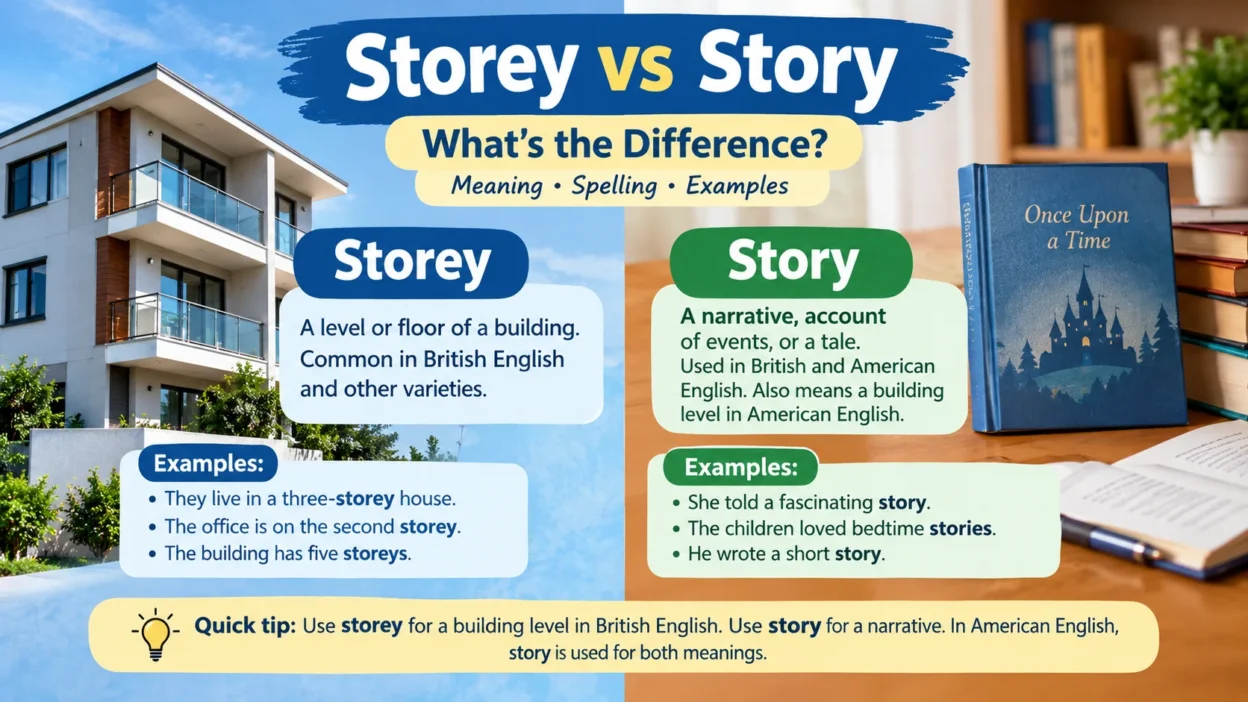
The words storey vs story can be confusing because they look almost identical and share the same pronunciation in many varieties of English. However, their meanings and uses can differ depending on the context. If you are writing about a building, a novel, or an event, choosing the correct word helps make your writing clear and accurate.
The main difference is that storey refers to a level of a building in British English and other varieties that use this spelling, while story can mean a narrative, an account of events, or a level of a building in American English. British English commonly uses storey for a building level and story for a narrative. American English generally uses story for both meanings. Understanding this distinction will help you avoid spelling mistakes and choose the right word for your audience.
Quick Answer
Storey means a level of a building and is commonly used in British English. Story means a narrative or account of events, and it also means a building level in American English. For example, British English uses “a three-storey house,” while American English uses “a three-story house.”
Why Do People Confuse Storey and Story?
People confuse storey and story for three main reasons:
- Similar spelling: The words differ by only one letter.
- Same pronunciation: In standard usage, both words are pronounced the same way.
- Different regional conventions: British English distinguishes between storey for a building level and story for a narrative, whereas American English uses story for both.
The context usually makes the intended meaning clear. If someone writes about a building, the word may refer to its height. If someone discusses a book, personal experience, or fictional event, story refers to a narrative.
What Does Storey Mean?
Storey is a noun that refers to one level or floor of a building. It is commonly used in British English, Australian English, and other varieties that follow this spelling convention.
A building can have one storey, two storeys, or several storeys. The word is especially common in descriptions of houses, apartments, offices, hotels, and other structures.
Examples of Storey in Sentences
- They live in a two-storey house.
- The office occupies the third storey of the building.
- We rented a flat in a five-storey apartment block.
- The old library has four storeys.
- Their new home is a single-storey building.
In British English, the plural of storey is storeys.
What Does Story Mean?
Story is a noun with several meanings. Most commonly, it refers to a narrative about real or imaginary events. It can describe a fairy tale, a novel, a news report, a personal experience, or an account of something that happened.
In American English, story also refers to a level of a building. This means that American writers use the same spelling for both a narrative and a building level.
Examples of Story in Sentences
- My grandmother told me a fascinating story.
- The children enjoyed reading a bedtime story.
- She shared a story about her first day at school.
- The newspaper published a story about the new school.
- They bought a three-story house in the city.
In American English, the plural is stories for both narratives and building levels.
Storey vs Story: Comparison Table
| Feature | Storey | Story |
|---|---|---|
| Main meaning | A level of a building | A narrative or account |
| Building usage | Common in British English | Standard in American English |
| Narrative usage | Not used for this meaning | Used in British and American English |
| Pronunciation | Same as story | Same as storey |
| Plural form | Storeys | Stories |
| Example | A four-storey house | A fascinating story |
| Common variety | British English | American English and all varieties for narratives |
When Should You Use Storey or Story?
The easiest way to choose is to consider what you want to describe and which variety of English you are using.
Use Storey for a Building Level
Choose storey when describing a building level in British English or another variety that follows this convention.
Examples:
- The hotel is a ten-storey building.
- We moved into a two-storey house.
- The fire started on the fourth storey.
Use Story for a Narrative
Use story when discussing a tale, an account, or a sequence of events in both British and American English.
Examples:
- He wrote a short story.
- That is an interesting story.
- The story has a surprising ending.
Use Story for a Building Level in American English
American English generally uses story when describing a building’s levels.
Examples:
- They live in a two-story house.
- The office is on the fifth story.
- The city approved a twelve-story apartment building.
Writing tip: If you are writing for a British audience, use storey for building levels and story for narratives. If you are writing for an American audience, use story for both.
12 Examples of Storey vs Story in Sentences
These examples show how the words work in different contexts.
- British English: They bought a three-storey house near the park.
- American English: They bought a three-story house near the park.
- Narrative: The teacher read an exciting story to the class.
- British English: The restaurant is on the second storey of the building.
- American English: The restaurant is on the second story of the building.
- Narrative: Her story inspired everyone in the room.
- British English: The new hospital is a six-storey structure.
- American English: The new hospital is a six-story structure.
- Narrative: I heard a funny story about their holiday.
- British English: The old school has three storeys.
- American English: The old school has three stories.
- Narrative: The author published a collection of short stories.
Notice that examples 1 and 2 describe the same kind of building but follow different regional spelling conventions. Examples 3, 6, 9, and 12 use story to mean a narrative.
Common Mistakes with Storey and Story
Even fluent English speakers can make mistakes when switching between British and American spelling conventions.
Mistake 1: Using Storey for a Narrative
Incorrect: She told me an interesting storey.
Correct: She told me an interesting story.
Why? A narrative is always a story, regardless of whether you use British or American English.
Mistake 2: Mixing British and American Building Spellings
Inconsistent British usage: They live in a three-story house, but the neighbouring building has four storeys.
Consistent British usage: They live in a three-storey house, but the neighbouring building has four storeys.
Consistent American usage: They live in a three-story house, but the neighbouring building has four stories.
Why? Choose the spelling convention appropriate for your audience and follow it consistently.
Mistake 3: Using the Wrong Plural
Incorrect in standard British building terminology: The building has five storeies.
Correct: The building has five storeys.
American English: The building has five stories.
Why? The plural of storey is storeys, while the plural of story is stories.
Mistake 4: Assuming Story Always Means a Narrative
Incorrect assumption: The word story can only refer to something someone tells.
Correct understanding: In American English, story can refer to either a narrative or a building level.
Why? The meaning depends on the context and regional spelling convention.
Memory Trick: How to Remember Storey vs Story
Use this simple memory trick:
- Storey = structure: The extra letter e can remind you of a building.
- Story = something told: Think of a storybook or a bedtime story.
- American English = story for both: American writers generally use story for narratives and building levels.
Remember that the first trick is only a memory aid, not the origin of the word. Both spellings are legitimate; the correct choice depends on meaning and regional usage.
American vs British English: Storey or Story?
The main difference between American and British English is the spelling used for a building level.
| Context | British English | American English |
|---|---|---|
| Building level | Storey | Story |
| Narrative | Story | Story |
| One building level | One storey | One story |
| Several building levels | Several storeys | Several stories |
| A fictional narrative | A story | A story |
| Multiple narratives | Stories | Stories |
For example:
- British: The building has eight storeys.
- American: The building has eight stories.
- Both: The writer created eight stories for the collection.
Neither spelling is universally correct for building levels in every variety of English. Regional conventions determine which one is preferred.
Similar Words to Storey and Story
Understanding a few related words can help you describe buildings and narratives more precisely.
- Floor: A level of a building, or the surface you walk on.
- Level: A particular height or section of a building.
- Tale: A narrative, often fictional or imaginative.
- Narrative: An account of connected events, either real or fictional.
- Account: A description of something that happened.
- Plot: The sequence of events in a novel, film, or other narrative.
- Chapter: A main division of a book or written work.
Although floor and storey can refer to related building concepts, they are not always interchangeable. For example, British and American systems may number building floors differently, particularly when a ground floor is involved.
Final Verdict: Storey vs Story
The difference between storey and story is mainly about meaning and regional spelling.
- Storey: A level of a building in British English and other varieties that use this spelling.
- Story: A narrative or account in all major varieties of English; also a building level in American English.
If you are writing about a building for a British audience, choose storey. If you are writing about a narrative, always choose story. For an American audience, story is the standard spelling for both meanings.
Frequently Asked Questions
1. Is storey or story correct?
Both are correct. Storey is commonly used for a building level in British English, while story is used for narratives in all major varieties of English and for building levels in American English.
2. What is the difference between storey and story?
Storey refers to a building level in British English. Story refers to a narrative and also describes a building level in American English.
3. Is it a two-storey house or a two-story house?
Both are correct, depending on the regional convention. British English generally uses two-storey house, while American English generally uses two-story house.
4. What is the plural of storey?
The plural of storey is storeys. For example: “The apartment building has six storeys.”
5. What is the plural of story?
The plural of story is stories. For example: “She writes short stories.” In American English, stories is also the plural for building levels.
6. Do British people use the word story?
Yes. British English uses story for a narrative, such as a fairy story or a news story. It generally uses storey when referring to a building level.
7. Is storey used in American English?
Storey is understood, but American English generally prefers story for a building level. American writers typically use story and stories instead.
8. How do you pronounce storey and story?
Both words are pronounced the same way in standard English, usually as STOR-ee. Their spelling and meaning, rather than their pronunciation, distinguish them.
Remember This
- Storey: A building level in British English.
- Story: A narrative in British and American English.
- Story: Also a building level in American English.
- Storeys: The British English plural for building levels.
- Stories: The plural for narratives and for building levels in American English.
Conclusion
Understanding storey vs story is easy once you remember the difference between British and American English. Use storey for a building level in British English, and use story when referring to a narrative. In American English, story is standard for both meanings.
When in doubt, look at the context and consider your audience. Choosing the appropriate spelling will make your writing clearer, more consistent, and more natural for your readers.