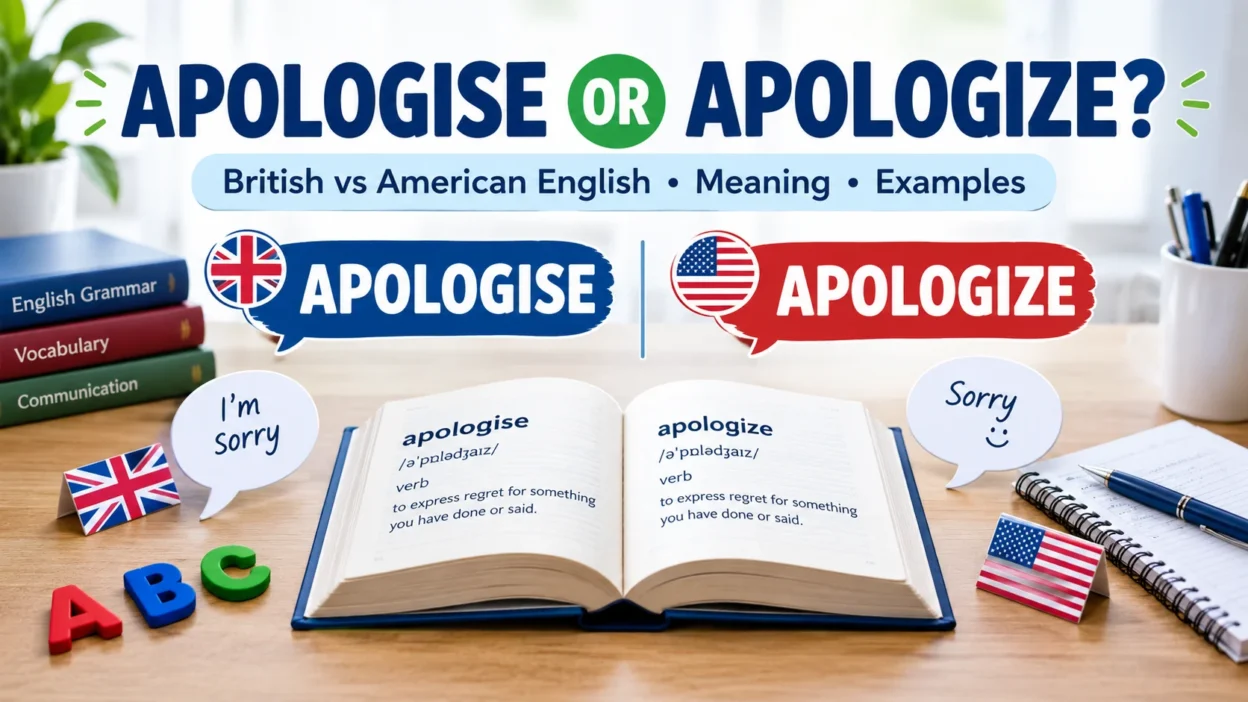
The words “apologise” and “apologize” are both correct spellings of the same verb. They mean to express regret for something you have done or said, especially when you have hurt someone, made a mistake, or caused a problem. The main difference is regional spelling: apologise is commonly used in British English, while apologize is the standard spelling in American English.
Choosing between these two words can be confusing for English learners because they look almost identical and have the same pronunciation and meaning. However, knowing which spelling to use can help you write more consistently in school assignments, professional emails, business documents, and everyday conversations.
In this guide, you will learn the meaning of each spelling, when to use it, how American and British English differ, and how to avoid common mistakes. You will also find practical examples, a comparison table, and answers to frequently asked questions.
Quick Answer
Apologise is the British English spelling, while apologize is the American English spelling. Both mean to express regret or say sorry. British English also accepts apologize, so the difference is mainly a matter of regional spelling preference. Choose the spelling that matches your audience and use it consistently.
Why Do People Confuse Apologise and Apologize?
People confuse these words because only one letter changes: s in apologise and z in apologize. Both forms have the same meaning, pronunciation, and grammatical function.
The confusion also comes from differences between British and American spelling conventions. British English often uses -ise endings, whereas American English generally prefers -ize for words such as organize, realize, and recognize.
However, British English can also use -ize spellings. Therefore, it is not always accurate to say that every British word must end in -ise.
First Word: Apologise
Apologise is a verb commonly used in British English and many other varieties of English, including Australian and New Zealand English.
It means to express regret for an action, mistake, or situation. You can apologise directly to someone or apologise for something you have done.
Examples:
- I need to apologise to my friend for being late.
- She decided to apologise for her rude comment.
- The manager apologised for the inconvenience.
- You should apologise if you hurt someone’s feelings.
- He refused to apologise for his decision.
Different Forms of Apologise
The verb changes according to tense and grammatical use.
- Present: apologise
- Third-person singular: apologises
- Past tense: apologised
- Present participle: apologising
Example sentences:
- I apologise for the mistake.
- She apologises whenever she is wrong.
- They apologised to their teacher yesterday.
- He is apologising to his colleague now.
Second Word: Apologize
Apologize is the standard spelling in American English. It has exactly the same meaning as apologise: to express regret or acknowledge that you have done something wrong.
This spelling is preferred in American newspapers, schools, businesses, and most other American writing.
Examples:
- I want to apologize for my mistake.
- She apologized to her brother.
- The company apologized for the delay.
- You should apologize when you make a mistake.
- He is ready to apologize to his customers.
Different Forms of Apologize
The verb follows the same grammatical pattern as apologise.
- Present: apologize
- Third-person singular: apologizes
- Past tense: apologized
- Present participle: apologizing
Example sentences:
- I apologize for arriving late.
- He apologizes when he makes a mistake.
- We apologized to our neighbors.
- She is apologizing for the misunderstanding.
Apologise vs Apologize: Comparison Table
| Feature | Apologise | Apologize |
|---|---|---|
| Main spelling association | British English | American English |
| Meaning | Express regret | Express regret |
| Pronunciation | Same | Same |
| Part of speech | Verb | Verb |
| Past tense | Apologised | Apologized |
| Present participle | Apologising | Apologizing |
| Third-person singular | Apologises | Apologizes |
| Correct in British English? | Yes | Yes |
| Correct in American English? | Not the usual standard | Yes |
The key point is that neither spelling is inherently more correct than the other. The best choice depends on the English variety you are following.
When Should You Use Apologise or Apologize?
Choose your spelling based on your audience, location, and writing style.
Use Apologise in British English
Choose apologise when writing in a style that follows the common British -ise convention.
Examples:
- I would like to apologise for the confusion.
- The airline apologised to its passengers.
- She is apologising for her behaviour.
This spelling is also widely used in Australian and New Zealand English.
Use Apologize in American English
Choose apologize when writing for an American audience or following American English spelling rules.
Examples:
- I would like to apologize for the confusion.
- The airline apologized to its passengers.
- She is apologizing for her behavior.
Notice that American and British English can differ in other words within the same sentences, such as behavior and behaviour.
Use One Style Consistently
If you are writing an essay, article, report, or business email, consistency is important.
For example, avoid switching between these forms in the same document:
- The manager apologized for the delay.
- Later, she apologised for the inconvenience.
Instead, select one spelling convention and follow it throughout your writing.
12 Examples of Apologise and Apologize in Sentences
These examples show how both spellings work in everyday English.
- British English: I apologise for forgetting your birthday.
- American English: I apologize for forgetting your birthday.
- British English: She apologised to her teacher for arriving late.
- American English: She apologized to her teacher for arriving late.
- British English: The company apologised for the technical problem.
- American English: The company apologized for the technical problem.
- British English: You should apologise for your careless remark.
- American English: You should apologize for your careless remark.
- British English: He is apologising to his colleague.
- American English: He is apologizing to his colleague.
- British English: They apologised for the inconvenience caused.
- American English: They apologized for the inconvenience caused.
All 12 sentences are grammatically correct. The spelling changes according to the preferred regional convention, not the meaning of the sentence.
Common Mistakes to Avoid
Although apologise and apologize are both correct, learners sometimes make mistakes when using them.
Mistake 1: Thinking One Spelling Is Always Wrong
Incorrect assumption: “Apologise is wrong because American English uses apologize.”
Correction: Both spellings are correct. Apologise is common in British English, while apologize is standard in American English.
Mistake 2: Mixing British and American Spellings
Inconsistent writing:
- The company apologised for the delay.
- It later apologized for the inconvenience.
Better approach: Choose one spelling style and use it consistently.
Mistake 3: Using the Wrong Verb Form
Incorrect: She apologize for her mistake yesterday.
Correct: She apologized for her mistake yesterday.
The past tense is apologised or apologized, depending on the spelling convention.
Mistake 4: Forgetting the Correct Preposition
Incorrect: I apologise you for my mistake.
Correct: I apologise to you for my mistake.
Use apologise/apologize to someone for something.
Examples:
- He apologized to his mother for his behavior.
- She apologised to the customer for the delay.
Mistake 5: Confusing Apologise With Apology
Apologise is a verb, while apology is a noun.
- Verb: I apologize for the error.
- Noun: Please accept my apology.
Both are useful, but they perform different grammatical functions.
Memory Trick: How to Remember the Difference
Use this simple trick:
S for British spelling, Z for American spelling.
- Apologise → British English
- Apologize → American English
Think of the s in apologise as a reminder of the spelling used in many British English style guides. Think of the z in apologize as the spelling preferred in American English.
Remember that British English also permits -ize spellings in some established styles, so this is a useful guide rather than an absolute rule.
American vs British English: What Is the Difference?
The main difference between apologise and apologize is spelling preference.
American English generally uses -ize, while British English commonly uses -ise in words such as apologise, organise, and recognise. Some British dictionaries and style guides also accept -ize spellings.
Here are a few related examples:
| British English | American English |
|---|---|
| Apologise | Apologize |
| Organise | Organize |
| Recognise | Recognize |
| Realise | Realize |
| Apologised | Apologized |
| Apologising | Apologizing |
There are other regional differences beyond spelling. For example, British English commonly uses behaviour, while American English uses behavior.
If you are learning English as a second language, neither variety is universally better. Choose the one that suits your education, workplace, or intended readers.
Similar Words You Should Know
Understanding related words can help you expand your vocabulary and use apologise or apologize more naturally.
Apology
An apology is a statement expressing regret.
Example: She offered an apology for arriving late.
Apologetic
Apologetic is an adjective describing someone who feels or expresses regret.
Example: He sounded apologetic after the misunderstanding.
Apologetically
Apologetically is an adverb that describes how someone expresses regret.
Example: She smiled apologetically and explained her mistake.
Regret
Regret means feeling sorry about something you have done or a decision you have made.
Example: I regret making that comment.
Say Sorry
Say sorry is a common, informal expression that means to apologise.
Example: You should say sorry to your friend.
Make an Apology
Make an apology means to offer an expression of regret.
Example: The director made an apology to the employees.
These expressions are related, but they are not always interchangeable in every sentence.
Final Verdict: Apologise or Apologize?
Both apologise and apologize are correct. They have the same meaning and pronunciation, but their spelling preferences differ by region.
- Use apologise when following the common British English -ise convention.
- Use apologize when following American English spelling.
- In British English, apologize is also accepted by many dictionaries and style guides.
- Keep your spelling consistent throughout a piece of writing.
If you are writing for an American audience, choose apologize. If you are following a British English style guide that prefers -ise, choose apologise.
Frequently Asked Questions
1. Is apologise or apologize correct?
Both are correct. Apologise is commonly used in British English, while apologize is the standard American English spelling.
2. Is apologise British English?
Yes. Apologise is a common British English spelling. However, apologize is also accepted in British English by many dictionaries and style guides.
3. Is apologize American English?
Yes. Apologize is the standard spelling in American English and is commonly used in American writing, education, and professional communication.
4. Do apologise and apologize mean the same thing?
Yes. Both verbs mean to express regret or say sorry for an action, mistake, or situation. The difference is spelling, not meaning.
5. Is apologised or apologized correct?
Both forms are correct. Apologised is common in British English, while apologized is standard in American English.
6. Is apologising or apologizing correct?
Both are correct. Use apologising when following a British -ise spelling style and apologizing when following American English.
7. How do you use apologise or apologize in a sentence?
Use the verb with to for the person receiving the apology and for for the action or situation.
Examples:
- British: I apologise to my friend for being rude.
- American: I apologize to my friend for being rude.
Remember This
- Apologise = common British English spelling.
- Apologize = standard American English spelling.
- Both words have the same meaning and pronunciation.
- British English accepts both spellings in many contexts.
- Use one spelling style consistently in formal and informal writing.
Conclusion
The choice between apologise and apologize is simple once you understand regional spelling conventions. Both words express regret and are grammatically correct. The main difference is that British English commonly uses apologise, while American English prefers apologize.
When writing for school, work, or an international audience, follow the spelling style expected by your readers. Most importantly, use the correct verb form and remember the pattern apologise to someone for something. With these rules in mind, you can use both spellings confidently.