When you are learning English, “have had” and “has had” can be confusing because both contain two forms of the verb have. However, the correct choice depends mainly on the subject of the sentence. Understanding this small grammar rule can help you speak and write more naturally.
Both have had and has had are commonly used in the present perfect tense. They can describe experiences, situations that started in the past and continue into the present, or actions that have happened at an unspecified time. The difference is not about meaning alone; it is also about which subject comes before the phrase.
Quick Answer: Have Had or Has Had?
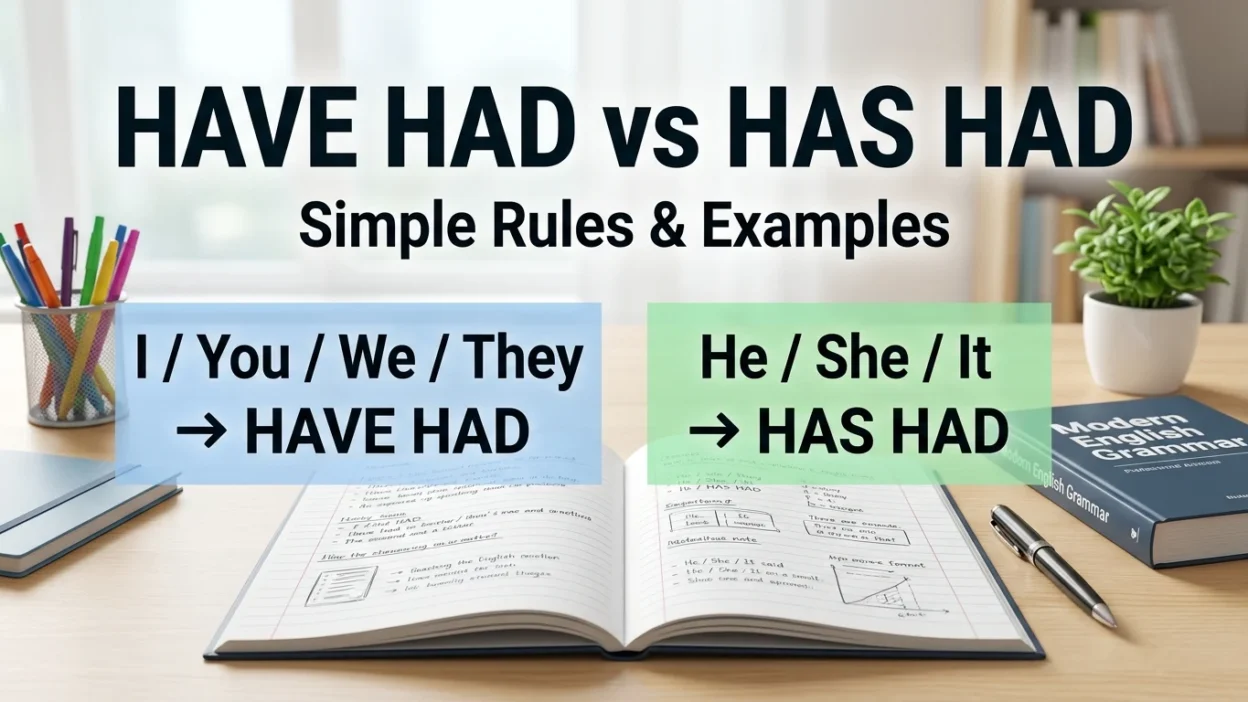
Use “have had” with I, you, we, they, and plural nouns. Use “has had” with he, she, it, and singular third-person nouns. In both expressions, had is the past participle of have. For example: “They have had lunch,” but “She has had lunch.”
Why Do People Confuse “Have Had” and “Has Had”?
The confusion happens because have and has are both forms of the same verb, while had is also a form of have.
In these expressions, the first word is the helping verb, while had is the past participle.
- I have had enough time.
- You have had a busy day.
- They have had several opportunities.
- He has had a difficult week.
- She has had many experiences.
The key is to look at the subject, not the word had.
First Word: “Have”
Have is used as the present perfect helping verb with:
- I
- You
- We
- They
- Plural nouns
Examples:
- I have had breakfast.
- You have had enough practice.
- We have had several meetings.
- They have had a great experience.
- The students have had three tests this month.
Notice that you takes have whether it refers to one person or several people.
Second Word: “Has”
Has is used with:
- He
- She
- It
- Singular third-person nouns
Examples:
- He has had breakfast.
- She has had enough time.
- It has had a major impact.
- Maria has had several opportunities.
- The company has had some problems.
The important point is that has had is perfectly grammatical when the subject is singular and third person.
Have Had vs Has Had: Comparison Table
| Expression | Used With | Example |
|---|---|---|
| I have had | I | I have had a busy day. |
| You have had | You | You have had enough time. |
| We have had | We | We have had several meetings. |
| They have had | They | They have had many opportunities. |
| He has had | He | He has had a difficult week. |
| She has had | She | She has had some experience. |
| It has had | It | It has had a positive effect. |
| Singular noun + has had | Singular third person | John has had lunch. |
| Plural noun + have had | Plural noun | The children have had lunch. |
When Should You Use “Have Had” or “Has Had”?
Use “Have Had” With I
Use have had when I is the subject.
- I have had enough.
- I have had a long day.
- I have had this phone for two years.
- I have had several chances to explain.
Use “Have Had” With You
- You have had plenty of time.
- You have had a difficult experience.
- You have had enough practice.
- You have had several opportunities.
Use “Have Had” With We and They
- We have had a productive meeting.
- We have had many problems.
- They have had a successful year.
- They have had enough food.
Use “Has Had” With He, She, and It
- He has had a busy morning.
- She has had several jobs.
- It has had a significant effect.
- He has had enough time to decide.
Use “Has Had” With Singular Nouns
- Ahmed has had lunch.
- The teacher has had a meeting.
- My sister has had a difficult week.
- The company has had some financial problems.
10+ Examples of “Have Had” and “Has Had”
Here are practical examples showing the difference clearly:
- I have had breakfast already.
- You have had enough time to finish the task.
- We have had several discussions about the problem.
- They have had a wonderful experience.
- I have had this book for many years.
- We have had some difficulties recently.
- He has had a very busy week.
- She has had three cups of coffee today.
- It has had a major impact on our lives.
- The student has had enough time to prepare.
- My parents have had many experiences abroad.
- The company has had several changes recently.
Common Mistakes
Mistake 1: Using “Has Had” With “I”
Incorrect:
I has had a busy day.
Correct:
I have had a busy day.
Mistake 2: Using “Have Had” With “He”
Incorrect:
He have had enough time.
Correct:
He has had enough time.
Mistake 3: Thinking “Had” Changes With the Subject
The word had stays the same.
The first verb changes:
- I have had
- You have had
- He has had
- She has had
- We have had
- They have had
Mistake 4: Confusing “Had” With “Has Had”
Had alone is commonly used as the past form of have:
She had a car.
Has had is a present perfect construction:
She has had the car for five years.
These sentences describe different time relationships.
Memory Trick
Remember this simple rule:
I/You/We/They → HAVE HAD
He/She/It → HAS HAD
You can shorten it to:
Plural or I/you = have had
He/she/it = has had
For example:
- They have had lunch.
- She has had lunch.
If you remember the basic have/has subject rule, choosing between have had and has had becomes much easier.
American vs British English
There is no major difference between American and British English in the basic grammatical rule for have had and has had.
Both varieties use:
- I have had
- You have had
- We have had
- They have had
- He has had
- She has had
- It has had
Differences between American and British English can sometimes appear in related uses of the present perfect, particularly when discussing recent events, but the subject-verb agreement rule remains the same.
Similar Words and Structures
Understanding related forms can make have had and has had easier to recognize.
Have
Have can be a main verb:
They have a car.
Has
Has is the third-person singular form of have:
She has a car.
Had
Had is the past form of have and is also its past participle:
We had lunch earlier.
Have Had
This is commonly a present perfect construction:
We have had lunch.
Has Had
This is also a present perfect construction:
She has had lunch.
Had Had
This can occur in the past perfect:
They had had dinner before the guests arrived.
Although had had may look unusual, it is grammatically correct when the context requires the past perfect.
Final Verdict: Have Had or Has Had?
The choice is straightforward: use have had with I, you, we, they, and plural nouns. Use has had with he, she, it, and singular third-person nouns.
The word had does not change. The important word is the first one: have or has.
Frequently Asked Questions
Is “have had” grammatically correct?
Yes. Have had is grammatically correct and is commonly used with I, you, we, they, and plural nouns.
Is “has had” grammatically correct?
Yes. Has had is correct with he, she, it, and singular third-person nouns.
Is it “I have had” or “I has had”?
The correct form is “I have had.” The pronoun I always takes have in this construction.
Is it “she has had” or “she have had”?
The correct form is “she has had.” She is third-person singular, so it takes has.
What is the difference between “had” and “has had”?
Had generally refers to a completed past situation, while has had connects a past situation or experience to the present.
- She had a car.
- She has had the car for five years.
Can “you” be followed by “have had”?
Yes. You have had is correct whether you refers to one person or multiple people.
Is “they has had” correct?
No. The correct form is “they have had.” They takes have, not has.
Remember This
The easiest rule is:
I, you, we, they → have had
He, she, it → has had
For nouns, ask whether the noun is singular or plural:
- The boy has had lunch.
- The boys have had lunch.
Once you identify the subject, the correct form is usually easy to choose.
Conclusion
Have had and has had are both correct expressions, but they are used with different subjects. Have had goes with I, you, we, they, and plural nouns, while has had goes with he, she, it, and singular third-person nouns.
The most useful thing to remember is that had stays the same. Only the first helping verb changes according to the subject. With this simple rule and a little practice, you can confidently choose between have had and has had in everyday English.