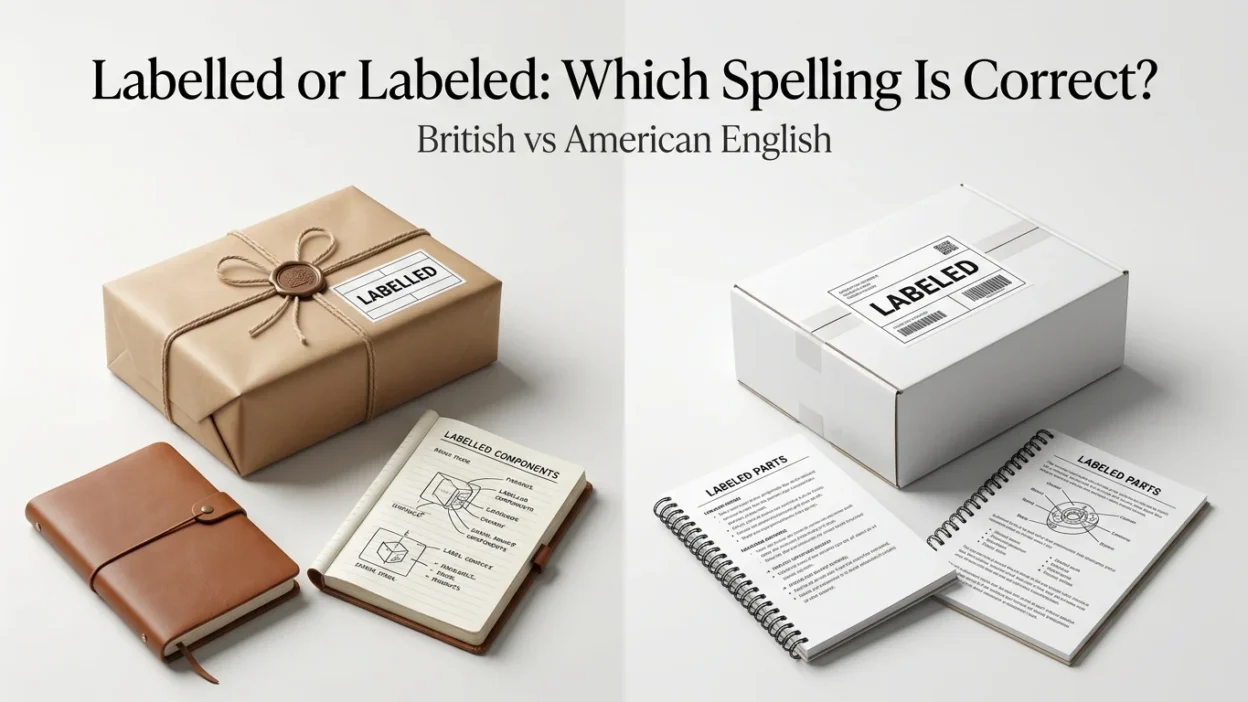
When deciding between labelled or labeled, you may wonder if one spelling is incorrect. The good news is that both “labelled” and “labeled” are correct. The difference is mainly based on the variety of English you are using. Labelled is the standard spelling in British English, while labeled is the standard spelling in American English.
This spelling difference comes from how British and American English handle words ending in a consonant plus -el when adding a suffix. British English commonly doubles the final l, giving forms such as labelled and labelling. American English usually keeps one l, producing labeled and labeling. Understanding this simple pattern can help you choose the right spelling for schoolwork, professional writing, websites, and everyday communication.
Quick Answer
Labelled and labeled are both correct spellings. Labelled is preferred in British English, while labeled is preferred in American English. They have exactly the same meaning: marked, identified, or given a label. Choose the spelling that matches the variety of English you are using.
Why Do People Confuse It?
People often confuse labelled and labeled because the words have the same pronunciation and meaning. The only noticeable difference is the extra l in labelled.
The confusion becomes more common when people read both British and American English. For example:
- British English: The boxes were labelled clearly.
- American English: The boxes were labeled clearly.
Neither sentence is grammatically wrong. The spelling simply follows a different English convention.
This is similar to other spelling differences such as:
- cancelled / canceled
- travelling / traveling
- modelling / modeling
- signalled / signaled
Labelled: The First Word
Labelled is the standard spelling in British English and is also commonly used in other varieties influenced by British English.
It is the past tense and past participle of label.
For example:
The package was labelled “Fragile.”
Here, labelled means that someone marked the package with a particular description.
You will commonly see labelled in British publications, educational materials, and writing from countries that generally follow British spelling conventions.
Examples of Labelled
- The bottles were labelled correctly.
- Each folder was labelled with a date.
- The diagram was clearly labelled.
- The products were labelled before shipping.
- The shelves were labelled by category.
Labeled: The Second Word
Labeled is the standard spelling in American English.
It has exactly the same meaning as labelled. The difference is simply the spelling.
For example:
The package was labeled “Fragile.”
American English generally uses a single l before the -ed ending in this word.
Examples of Labeled
- The bottles were labeled correctly.
- Each folder was labeled with a date.
- The diagram was clearly labeled.
- The products were labeled before shipping.
- The shelves were labeled by category.
Labelled vs Labeled: Comparison Table
| Feature | Labelled | Labeled |
|---|---|---|
| Meaning | Marked or identified | Marked or identified |
| Spelling | Double l | Single l |
| Main variety | British English | American English |
| Pronunciation | Same | Same |
| Grammar | Correct | Correct |
| Present form | Label | Label |
| Past tense | Labelled | Labeled |
| -ing form | Labelling | Labeling |
When Should You Use Each?
The best choice depends on the variety of English you are writing.
Use “Labelled” When Writing British English
Choose labelled when your audience follows British spelling conventions.
For example:
The chart was labelled with the names of each country.
This spelling is appropriate in contexts where British English is expected.
Use “Labeled” When Writing American English
Choose labeled when following American English conventions.
For example:
The chart was labeled with the names of each state.
If you are writing for an American audience, labeled will generally be the expected spelling.
Be Consistent
The most important rule is to avoid switching spelling systems unnecessarily.
If your document uses British English, write:
- labelled
- labelling
- cancelled
- travelling
If your document uses American English, write:
- labeled
- labeling
- canceled
- traveling
Consistency makes your writing clearer and more professional.
Labelled or Labeled: 10+ Examples
Here are examples showing how both forms work in sentences.
1. Package
British: The package was labelled as fragile.
American: The package was labeled as fragile.
2. Diagram
British: The diagram was carefully labelled.
American: The diagram was carefully labeled.
3. Files
British: All the files were labelled with their dates.
American: All the files were labeled with their dates.
4. Bottles
British: The bottles were labelled according to their contents.
American: The bottles were labeled according to their contents.
5. Boxes
British: We labelled every box before moving.
American: We labeled every box before moving.
6. Products
British: The products must be properly labelled.
American: The products must be properly labeled.
7. Map
British: The teacher labelled the important cities on the map.
American: The teacher labeled the important cities on the map.
8. Folders
British: She labelled each folder by subject.
American: She labeled each folder by subject.
9. Drawers
British: The drawers were labelled alphabetically.
American: The drawers were labeled alphabetically.
10. Diagram Parts
British: Students were asked to label and then explain the labelled parts.
American: Students were asked to label and then explain the labeled parts.
11. Evidence
British: The researcher labelled each sample carefully.
American: The researcher labeled each sample carefully.
12. Containers
British: The containers were labelled with safety information.
American: The containers were labeled with safety information.
Common Mistakes
Mistake 1: Thinking “Labelled” Is Wrong
Some American English users may see labelled and assume it is misspelled. It is not. It is the standard British spelling.
Mistake 2: Thinking “Labeled” Is Wrong
Likewise, labeled is not incorrect. It is the standard American spelling.
Mistake 3: Mixing Spelling Systems
A document can look inconsistent if it uses labelled in one paragraph and labeled in another without a reason.
Mistake 4: Changing the Meaning
The extra l does not change the meaning.
Labelled = labeled
Both mean marked, identified, or given a label.
Mistake 5: Confusing “Label” With “Labeled”
The base verb is label in both British and American English.
The difference appears when a suffix is added:
- British: labelled
- American: labeled
- British: labelling
- American: labeling
Memory Trick
A simple way to remember the difference is:
British English = labelled with two Ls
American English = labeled with one L
Think of the British spelling as giving the final l a “double” treatment:
label → labelled
American English simplifies it:
label → labeled
Remember that this is a spelling convention, not a difference in meaning or pronunciation.
American vs British English
The distinction is straightforward:
- British English: labelled
- American English: labeled
British English tends to double the final l in words such as label when adding -ed or -ing.
American English generally does not double the final l in this situation.
Compare:
| British English | American English |
|---|---|
| labelled | labeled |
| labelling | labeling |
| cancelled | canceled |
| travelling | traveling |
| signalling | signaling |
There are exceptions and additional spelling rules in both varieties, so it is better to learn the pattern rather than assume that every word behaves identically.
Similar Words
Several words follow a similar British-American spelling pattern.
Cancelled vs Canceled
Cancelled is standard in British English, while canceled is standard in American English.
Travelling vs Traveling
British English generally uses travelling, while American English uses traveling.
Modelling vs Modeling
British English commonly uses modelling, while American English uses modeling.
Signalled vs Signaled
British English uses signalled, while American English uses signaled.
These examples help explain why labelled and labeled look different even though they mean exactly the same thing.
Final Verdict
Labelled and labeled are both correct. Use labelled when following British English spelling and labeled when following American English spelling.
The difference is purely a spelling convention. There is no difference in meaning, pronunciation, or grammatical function. The key is to choose one form according to your audience and remain consistent throughout your writing.
FAQs
Is “labelled” or “labeled” correct?
Both are correct. Labelled is the usual British English spelling, while labeled is the usual American English spelling.
Is “labelled” British or American?
Labelled is primarily the British English spelling. It is also used in other varieties of English that follow British spelling conventions.
Is “labeled” American English?
Yes. Labeled is the standard American English spelling.
Do labelled and labeled mean the same thing?
Yes. Both words mean marked, identified, or given a label.
Is “labelling” or “labeling” correct?
Both are correct. Labelling is the British spelling, while labeling is the American spelling.
Which spelling should I use in an American essay?
Use labeled if you are following American English spelling conventions.
Which spelling should I use in British English?
Use labelled in British English.
Remember This
Labelled = British English
Labeled = American English
Both are correct, and both have the same meaning. The extra l is simply a difference between spelling conventions.
Conclusion
The choice between labelled or labeled depends on the type of English you are using. British English generally prefers labelled, while American English generally prefers labeled. Neither spelling is inherently more correct than the other.
For clear and professional writing, identify your target variety of English and stay consistent. Once you remember British: labelled and American: labeled, this common spelling question becomes easy to solve.