
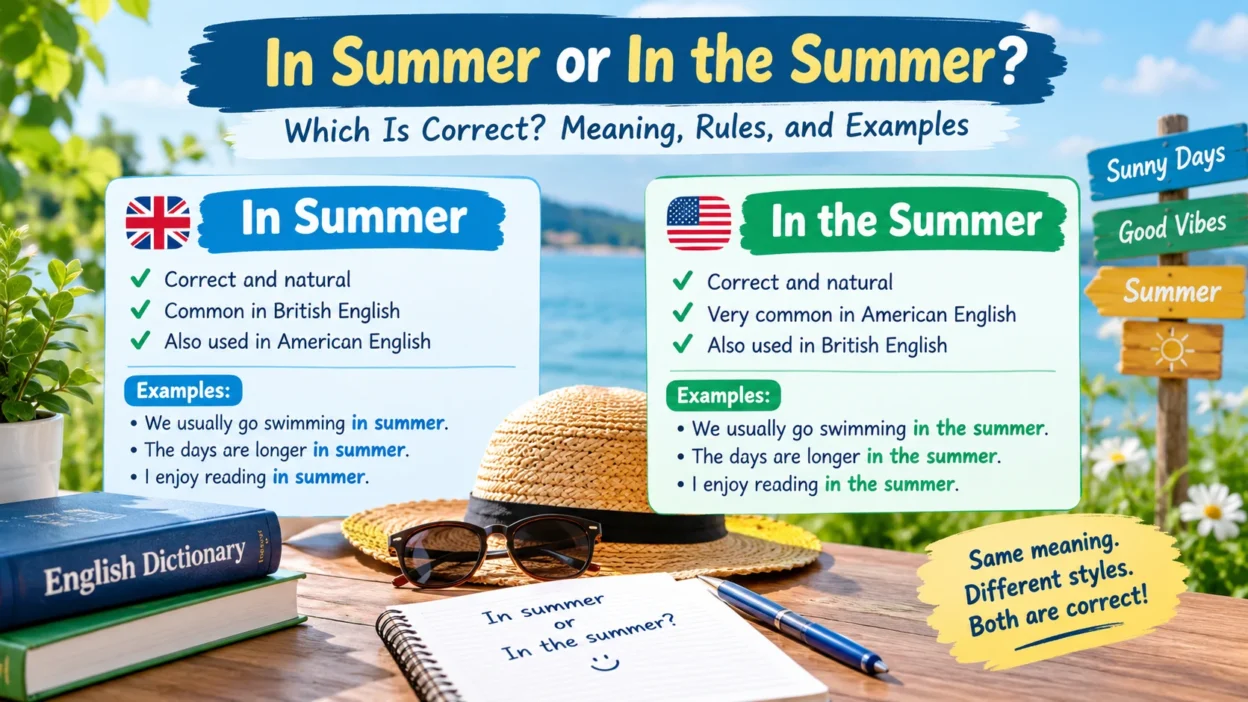
Choosing between “in summer” and “in the summer” can be confusing for English learners because both expressions are grammatically correct. The difference is mainly about how people refer to the summer season, and usage can vary between American and British English.
If you are wondering if to say “I enjoy swimming in summer” or “I enjoy swimming in the summer,” the good news is that both sentences are correct. The expression “in summer” is especially common in British English, while “in the summer” is very common in American English. However, both forms are used in both varieties of English.
In this guide, you will learn the meaning of each expression, when to use it, how American and British speakers differ, and how to avoid common mistakes. You will also find practical examples and simple memory tips to help you use these phrases naturally in everyday conversations, school assignments, and professional writing.
Quick Answer
Both “in summer” and “in the summer” are correct ways to refer to the summer season. “In summer” is often used in British English, while “in the summer” is especially common in American English. The choice usually depends on regional preference and personal style, not a difference in basic meaning.
Why Do People Confuse “In Summer” and “In the Summer”?
People often confuse these expressions because English sometimes uses the definite article “the” before the names of seasons and sometimes leaves it out.
For example:
- We travel more in summer.
- We travel more in the summer.
- Flowers bloom in spring.
- Flowers bloom in the spring.
All these sentences can be correct. The meaning remains essentially the same: the activity happens during a particular season.
The confusion often comes from learning a single grammar rule and assuming it applies to every situation. In reality, both forms are accepted, and regional conventions influence which one sounds more natural.
What Does “In Summer” Mean?
“In summer” means during the summer season. It is a common expression in British English and is also understood and used by American English speakers.
The phrase does not need the article “the” to be grammatically correct.
Examples:
- We usually visit our grandparents in summer.
- The days are longer in summer.
- Many students take vacations in summer.
- I enjoy walking in the countryside in summer.
- It gets very hot here in summer.
In each example, “in summer” refers generally to the season rather than emphasizing a specific summer.
When Should You Use “In Summer”?
Use “in summer” when you want a natural, concise way to talk about seasonal habits, general facts, or activities that usually happen during summer.
For example:
- Birds are active in summer.
- I prefer wearing light clothes in summer.
- Our school sometimes organizes trips in summer.
This expression is particularly natural in British English, although it is not exclusive to British speakers.
What Does “In the Summer” Mean?
“In the summer” also means during the summer season. It is especially common in American English and is widely understood in British English, too.
The word “the” identifies the season as a familiar or contextually understood period. However, it does not necessarily mean that you are talking about one specific summer.
Examples:
- We usually visit our grandparents in the summer.
- The days are longer in the summer.
- Many students take vacations in the summer.
- I enjoy walking in the countryside in the summer.
- It gets very hot here in the summer.
These sentences have essentially the same meanings as their versions without “the.”
When Should You Use “In the Summer”?
Use “in the summer” when it sounds natural in your variety of English, particularly in American English.
Examples:
- We go camping in the summer.
- My children enjoy swimming in the summer.
- The city attracts many tourists in the summer.
- I usually read more books in the summer.
You can also use the phrase when the context points to a particular summer.
For example: “We met in the summer of 2024.”
Here, the phrase refers to a specific period, identified by the year.
In Summer vs In the Summer: Comparison Table
| Feature | In summer | In the summer |
|---|---|---|
| Basic meaning | During summer | During summer |
| Grammar | Correct | Correct |
| American English | Used | Very common |
| British English | Very common | Also common |
| General seasonal habits | Yes | Yes |
| Specific summer with a year | Possible, but less typical | Very natural |
| Formal and informal use | Both | Both |
The key point is that neither expression is universally more correct than the other. Choose the form that fits your audience, context, and preferred style.
When to Use Each Expression
Use “In Summer” for General Seasonal Statements
This expression works well when describing activities, habits, and facts associated with the summer season.
Examples:
- People often eat more ice cream in summer.
- The weather is usually warmer in summer.
- We spend more time outdoors in summer.
Use “In the Summer” in Everyday American English
American speakers frequently include “the” when discussing summer activities or seasonal conditions.
Examples:
- We visit the beach in the summer.
- I take a vacation in the summer.
- The park is crowded in the summer.
Use “In the Summer of…” for a Particular Year
When identifying a specific summer, “in the summer of” is a natural and widely used construction.
Examples:
- They moved to Canada in the summer of 2022.
- We first met in the summer of 2019.
- The project began in the summer of 2025.
You can also say “in summer 2025,” particularly in concise writing and some varieties of English.
Follow a Consistent Style in Formal Writing
Both forms are suitable for most types of writing. If you are writing an essay, article, or report, choose the version that sounds natural for your intended audience and use it consistently where practical.
15 Examples of “In Summer” and “In the Summer”
Here are examples showing how both expressions work in everyday English.
- In summer: We usually go swimming in summer.
- In the summer: We usually go swimming in the summer.
- In summer: The weather becomes very hot in summer.
- In the summer: The weather becomes very hot in the summer.
- In summer: My family often travels in summer.
- In the summer: My family often travels in the summer.
- In summer: Many flowers bloom in summer.
- In the summer: Many flowers bloom in the summer.
- In summer: I enjoy drinking cold lemonade in summer.
- In the summer: I enjoy drinking cold lemonade in the summer.
- In summer: The days are longer in summer.
- In the summer: The days are longer in the summer.
- In summer: We sometimes visit our cousins in summer.
- In the summer: We sometimes visit our cousins in the summer.
- In the summer of 2024: We moved into our new house in the summer of 2024.
Notice that the paired examples have essentially the same meaning. The main difference is the inclusion or omission of “the.”
Common Mistakes to Avoid
Although both expressions are correct, learners sometimes make mistakes when using seasonal phrases.
Mistake 1: Thinking “In Summer” Is Always Wrong
Incorrect assumption: “You must always use ‘the’ before summer.”
Correct examples:
- We travel in summer.
- We travel in the summer.
Both are acceptable.
Mistake 2: Thinking “In the Summer” Refers Only to One Specific Year
The phrase does not always identify a particular year.
For example:
– I enjoy reading in the summer.
This sentence describes a general preference. It does not necessarily refer to one particular summer.
Mistake 3: Mixing Regional Styles Without a Reason
Using both forms is not a grammar error. However, maintaining a consistent style can make formal writing feel more polished.
For example, if you prefer British English, “in summer” may fit your writing style. If you are writing for an American audience, “in the summer” may sound more familiar.
Mistake 4: Using the Wrong Preposition
For general references to a season, “in” is the usual preposition.
- Correct: We go hiking in summer.
- Correct: We go hiking in the summer.
- Incorrect for the intended meaning: We go hiking on summer.
However, you can use “on” in expressions such as “on a summer morning” because it refers to a particular type of day or time.
Mistake 5: Confusing Seasonal References With Specific Dates
Use “in” for seasons and months, but normally use “on” for specific dates.
- We traveled in summer.
- We traveled in July.
- We traveled on July 10.
These preposition patterns help make your sentences clearer.
Memory Trick: How to Remember the Difference
Here is a simple way to remember these expressions:
- In summer: Think of summer as a season in general.
- In the summer: Think of the same season with “the,” a common choice in American English.
- In the summer of 2026: Think of a particular summer identified by a year.
Remember that these are helpful usage patterns, not strict rules that make one expression correct and the other incorrect.
A quick test is to replace the phrase with “during summer.” If the sentence keeps its intended meaning, both expressions may work.
For example:
“I enjoy swimming during summer.”
You can naturally say either “I enjoy swimming in summer” or “I enjoy swimming in the summer.”
American vs British English: Which Form Is More Common?
Both expressions are used in American and British English, but their relative frequency differs.
American English: “In the summer” is a particularly common choice in everyday conversation.
Example: “We usually visit the lake in the summer.”
British English: “In summer” is especially common when discussing seasonal activities or general conditions.
Example: “We usually visit the lake in summer.”
These are tendencies rather than exclusive rules. You will hear and read both forms in both countries.
If you are learning English for an exam, follow the variety of English required by your course or examination. If no variety is specified, either form is generally acceptable in an appropriate sentence.
Similar Words and Seasonal Expressions
The same article pattern appears with other seasons, although usage can depend on context and regional preference.
| Expression without “the” | Expression with “the” | Example |
|---|---|---|
| In spring | In the spring | Flowers bloom in spring. |
| In summer | In the summer | We travel in the summer. |
| In autumn | In the autumn | Leaves change color in autumn. |
| In fall | In the fall | School starts in the fall. |
| In winter | In the winter | It often snows in winter. |
Both versions are possible in many of these examples.
One useful regional difference is that “fall” is especially common in American English, while “autumn” is especially common in British English. Both words are understood in both varieties.
You may also encounter expressions such as “during the summer,” “over the summer,” and “throughout the summer.”
- During the summer: At some time or times within the summer period.
- Over the summer: Across the summer period, often referring to an activity or change that happens during it.
- Throughout the summer: During the whole summer or at many points across it.
These expressions overlap in meaning, but they are not always interchangeable.
Final Verdict: In Summer or In the Summer?
Both “in summer” and “in the summer” are grammatically correct. Neither is universally better, and the basic meaning is the same.
Choose “in summer” if you prefer a concise expression that is particularly common in British English. Choose “in the summer” if you prefer the form especially common in American English or if you are referring to a specific summer, such as “in the summer of 2026.”
The most important thing is to use the phrase naturally and clearly. You do not need to worry that adding or omitting “the” automatically makes your sentence wrong.
Frequently Asked Questions
1. Is it correct to say “in summer”?
Yes. “In summer” is grammatically correct and means during the summer season. It is especially common in British English, but it is also used in American English.
Example: “We often go hiking in summer.”
2. Is “in the summer” grammatically correct?
Yes. “In the summer” is correct and widely used in both American and British English. It is particularly common in American English.
Example: “We often go hiking in the summer.”
3. Which is better: “in summer” or “in the summer”?
Neither is always better. Both communicate the same basic meaning. Your choice can depend on regional usage, personal preference, and the context of your sentence.
4. Do Americans say “in summer”?
Yes. Americans do use “in summer,” although “in the summer” is especially common in everyday American speech.
5. Do British people say “in the summer”?
Yes. British speakers use both expressions. “In summer” is particularly common, but “in the summer” is also natural and correct.
6. Should I say “in the summer of 2026” or “in summer 2026”?
Both can be correct. “In the summer of 2026” is a natural, widely used expression. “In summer 2026” is also used, particularly in concise writing and certain varieties of English.
7. Can I use “during summer” instead of “in summer”?
Yes. “During summer” is another correct option. Depending on context, it can emphasize that an event or activity takes place within the summer period.
Example: “The museum offers special tours during summer.”
Remember This
- In summer: Correct; especially common in British English.
- In the summer: Correct; especially common in American English.
- In the summer of 2026: A natural way to refer to a specific summer.
- Both expressions: Usually have the same basic meaning.
You can confidently use either “in summer” or “in the summer” when talking about seasonal activities, habits, and weather.
Conclusion
The difference between “in summer” and “in the summer” is mainly a matter of usage and regional preference. Both expressions are grammatically correct, and both can describe general activities, weather conditions, and events that happen during the summer season. British English often favors “in summer,” while American English frequently uses “in the summer,” but neither form belongs exclusively to one variety.
For everyday conversations and writing, choose the expression that sounds natural to you and suits your audience. When referring to a particular year, “in the summer of 2026” is a clear and natural choice. Once you understand that both forms are acceptable, you can use them confidently without worrying about making a grammar mistake.