
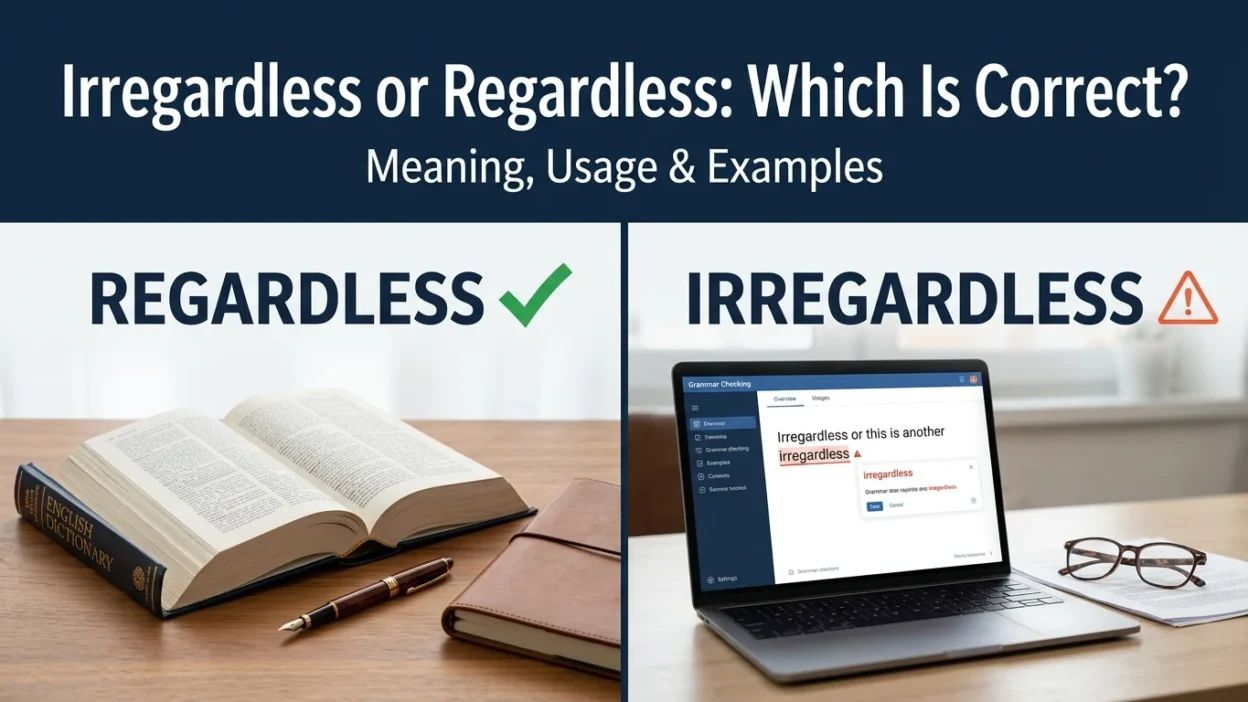
If you are unsure whether to say “irregardless” or “regardless,” you are not alone. These two words look and sound similar, but they do not have exactly the same status in standard English. Regardless is the standard and widely accepted word, while irregardless is generally considered nonstandard or informal, although it is widely used in speech.
In this guide, you will learn the meaning of regardless, why people use irregardless, when each form appears, and how to avoid mistakes. We will also look at examples, American and British English usage, similar expressions, and an easy memory trick. By the end, you will know which word to choose in formal writing, everyday conversation, exams, and professional communication.
Quick Answer
Regardless is the standard word and means “despite something” or “without considering something.” Irregardless is widely used in informal speech but is generally regarded as nonstandard. For formal writing, academic English, exams, and professional communication, use regardless.
Why Do People Confuse “Irregardless” and “Regardless”?
The confusion happens because irregardless looks like a natural combination of ir- and regardless.
The prefix ir- often creates a negative meaning. For example:
- regular → irregular
- relevant → irrelevant
- responsible → irresponsible
Because of this pattern, some speakers assume that irregardless is a stronger or more emphatic form of regardless.
However, regardless already expresses the intended meaning. Adding ir- does not create a useful grammatical distinction.
The word irregardless has nevertheless been used for a long time, particularly in informal American English. It appears in dictionaries, but that does not mean it is equally appropriate in every context.
First Word: Regardless
Regardless is the standard form.
It means “despite something,” “without considering something,” or “in any case.”
Examples
- Regardless of the weather, we will go hiking.
- She continued working regardless of the difficulties.
- Regardless of what happens, I will support you.
- He decided to attend regardless of the cost.
The most common structure is:
regardless of + noun/pronoun
For example:
We will continue regardless of the result.
It can also be followed by a question word:
- regardless of what
- regardless of who
- regardless of where
- regardless of when
- regardless of how
Example
Regardless of where you live, you can learn English.
Second Word: Irregardless
Irregardless is a word that is widely encountered, especially in informal American speech, but it is generally considered nonstandard.
It is often used with the same meaning as regardless:
Irregardless of the weather, we went outside.
However, in standard formal English, regardless is the safer and preferred choice.
You may hear irregardless in conversation, on television, online, or in informal writing. Its presence in dictionaries reflects its actual use, but dictionary inclusion does not necessarily mean that it is recommended for formal contexts.
Irregardless vs Regardless: Comparison Table
| Feature | Regardless | Irregardless |
|---|---|---|
| Standard English | Yes | Generally no |
| Meaning | Despite something; without considering it | Usually the same as regardless |
| Formal writing | Recommended | Avoid |
| Academic writing | Recommended | Avoid |
| Professional communication | Recommended | Avoid |
| Informal speech | Common | Common in some varieties |
| Exams | Use this | Avoid |
| Common structure | regardless of | irregardless of |
| Best choice for learners | Yes | No |
When Should You Use Each?
When to Use “Regardless”
Use regardless when you want your English to sound standard, clear, and appropriate in almost any situation.
It works well in:
- Academic writing
- Business emails
- Formal letters
- Essays
- Reports
- Exams
- Professional conversations
- Everyday speech
When You May Hear “Irregardless”
You may encounter irregardless in:
- Casual conversations
- Informal online discussions
- Regional speech
- Some forms of American English
- Quoted speech
If someone uses irregardless, the intended meaning is usually easy to understand.
However, if you are learning English and want to choose the form that is accepted broadly in standard English, regardless is the better choice.
10+ Examples of “Regardless”
Here are practical examples using the standard form.
- Regardless of the weather, the event will continue.
- I will finish the project regardless of how long it takes.
- She remained calm regardless of the situation.
- Regardless of his age, he is very experienced.
- We should respect people regardless of their background.
- He went to work regardless of feeling tired.
- Regardless of what she says, I trust my decision.
- They continued playing regardless of the rain.
- You can contact me regardless of the time.
- Regardless of the outcome, we learned something valuable.
- The rule applies to everyone regardless of their position.
- Regardless of where you are, you can practice English every day.
Common Mistakes
Mistake 1: Using “Irregardless” in Formal Writing
Incorrect choice for formal standard English:
Irregardless of the circumstances, the policy remains unchanged.
Better:
Regardless of the circumstances, the policy remains unchanged.
Mistake 2: Thinking “Irregardless” Means the Opposite
Some learners assume that the prefix ir- makes the word mean something opposite to regardless.
That is not how the word is normally used.
In actual usage, irregardless is generally intended to mean the same thing as regardless.
Mistake 3: Using “Regardless” Without “Of” Incorrectly
When followed by a noun, regardless of is normally used.
Correct:
Regardless of the cost, we bought it.
Not standard in this meaning:
Regardless the cost, we bought it.
Mistake 4: Assuming Dictionary Inclusion Means Formal Approval
A dictionary may document a word because people actually use it. That does not automatically mean the word is the preferred choice in formal English.
This distinction is particularly important with irregardless.
Memory Trick
Remember:
Regardless = reliable standard choice.
If you are writing an essay, email, report, application, or exam answer, choose:
REGARDLESS
You can also remember:
“Regardless” works regardless of the situation.
If you are ever unsure, use regardless.
American vs British English
Regardless is standard in both American and British English.
Irregardless is especially associated with informal American usage, although it can be encountered elsewhere as well.
The important distinction is not simply American versus British English. The bigger issue is standard versus nonstandard usage and the level of formality.
For learners, regardless is the safest choice in both varieties of English.
American English
You may hear:
Irregardless of what happens, we’ll continue.
But in careful or formal American English, regardless is preferred.
British English
Regardless is the normal standard choice:
Regardless of the circumstances, we must continue.
Similar Words and Expressions
Several expressions have a meaning similar to regardless.
Despite
Despite means “without being affected by something.”
Despite the rain, we went outside.
In spite of
This has essentially the same meaning as despite.
In spite of the rain, we went outside.
Nevertheless
Nevertheless means “despite that” or “even so.”
It was raining. Nevertheless, we went outside.
No matter
No matter can introduce a situation that does not change the result.
No matter what happens, stay calm.
Anyway
Anyway can sometimes express the idea of continuing despite circumstances, particularly in conversation.
It was late, but we went anyway.
Final Verdict: Irregardless or Regardless?
For standard English, regardless is the word to choose.
Irregardless is widely understood and commonly used in informal speech, but many style guides, editors, teachers, and language professionals regard it as nonstandard. Its use can therefore distract readers or make formal writing appear less polished.
So, if you are writing an essay, taking an English exam, preparing a professional document, or communicating formally, use regardless of.
Frequently Asked Questions
Is “irregardless” a real word?
Yes. Irregardless is an established word in actual English usage and appears in dictionaries. However, it is generally classified as nonstandard or informal, so regardless is preferred in formal English.
Is “regardless” correct English?
Yes. Regardless is the standard English word meaning “despite something” or “without considering something.”
Is “irregardless” grammatically correct?
It is widely used and understood, but it is generally considered nonstandard. For formal and standard English, use regardless instead.
Can I use “irregardless” in an essay?
It is best to avoid irregardless in academic essays. Use regardless instead.
Is “regardless” used in British English?
Yes. Regardless is standard and commonly used in British English.
Is “irregardless” more common in American English?
Irregardless is particularly associated with informal American English, although it is not limited exclusively to the United States.
What is the correct phrase: “regardless” or “regardless of”?
When followed by a noun or noun phrase, use regardless of:
Regardless of the cost, we will buy it.
Regardless can also be used without of when its grammatical context allows it:
He decided to go regardless.
Remember This
- Regardless = standard English
- Irregardless = widely used but generally considered nonstandard
- Use regardless in formal writing
- Regardless of means “despite” or “without considering”
- Regardless works in both American and British English
- If you are unsure, choose regardless
Conclusion
The difference between irregardless and regardless is mainly about standard usage rather than meaning. Both are generally intended to express the idea of doing or accepting something despite a particular condition. However, regardless is the established standard form and is appropriate for virtually every English-speaking context.
Although you may hear irregardless in informal conversation, it is safer for English learners to avoid it in formal situations. Whether you are writing an academic essay, sending a professional email, or preparing for an English exam, choose regardless.