
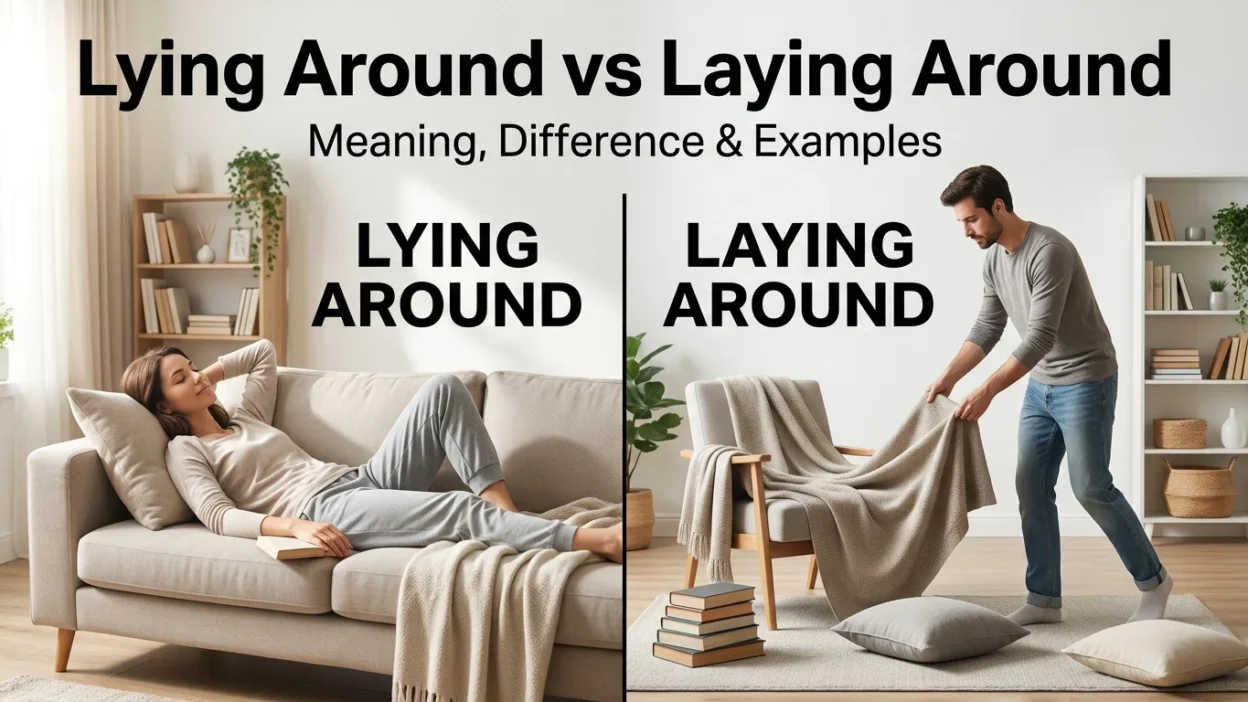
English learners often hesitate between “lying around” and “laying around” because the verbs lie and lay have confusing forms. Both expressions can appear in everyday English, but they do not mean exactly the same thing. The key is to ask whether someone or something is resting in a position or putting something somewhere.
In most situations where you mean that a person is relaxing or that something is simply left in a place, “lying around” is the correct expression. “Laying around” can also be grammatically correct, but it normally needs a direct object: someone is laying something around somewhere. Understanding this small difference makes the choice much easier.
Quick Answer
“Lying around” is usually correct when you mean resting, remaining in a place, or being scattered somewhere. “Laying around” is correct only when laying comes from lay, meaning to put or place something somewhere. For example, “I was lying around all afternoon” is correct.
Why Do People Confuse “Lying Around” and “Laying Around”?
The confusion comes from the verbs lie and lay, which have different meanings but similar forms.
- Lie means to rest or be in a horizontal position.
- Lay means to put or place something somewhere.
- The present participle of lie is lying.
- The present participle of lay is laying.
This creates a common problem because lying can look unusual, while laying sounds familiar.
Compare:
I was lying around the house.
Here, I am resting or doing very little.
I was laying books around the room.
Here, I am putting books in different places.
What Does “Lying Around” Mean?
“Lying around” means being in a resting position, remaining somewhere, or being left somewhere without being used or organized.
It can describe people, objects, or situations.
For a person
I spent the afternoon lying around and watching TV.
The person is relaxing rather than putting something somewhere.
For an object
There are old newspapers lying around the office.
The newspapers are simply present or scattered in the office.
Important Point
“Lying around” does not necessarily mean that someone is literally lying flat.
It can also suggest relaxing, doing nothing, or staying somewhere without a particular purpose.
What Does “Laying Around” Mean?
“Laying around” comes from the verb lay, which means to put or place something somewhere.
Because lay is normally a transitive verb, it generally takes an object.
For example:
She was laying books around the room.
Here, books is the object of laying.
Another example:
He was laying blankets around the children.
He was putting blankets in different places.
Why “I Am Laying Around” Sounds Wrong
If you say:
I am laying around all day.
you probably mean that you are relaxing or doing nothing.
In that meaning, the standard expression is:
I am lying around all day.
The problem is that laying and lying are forms of two different verbs.
First Word: “Lying”
Lying is the present participle of lie when lie means “to rest” or “to be situated.”
The basic forms are:
| Form | Verb |
|---|---|
| Base form | lie |
| Past tense | lay |
| Past participle | lain |
| -ing form | lying |
Examples:
- I lie on the sofa.
- Yesterday, I lay on the sofa.
- I have lain on this bed before.
- I am lying on the sofa now.
This is one reason English learners find lie confusing: its past tense is lay.
Second Word: “Laying”
Laying is the present participle of lay, meaning “to put” or “to place.”
Its forms are:
| Form | Verb |
|---|---|
| Base form | lay |
| Past tense | laid |
| Past participle | laid |
| -ing form | laying |
Examples:
- I lay the book on the table.
- Yesterday, I laid the book on the table.
- I have laid the book there before.
- I am laying the book on the table now.
Notice that laying normally involves something being placed.
Lying Around vs Laying Around: Comparison Table
| Expression | Verb | Basic meaning | Usually needs an object? | Example |
|---|---|---|---|---|
| lying around | lie | resting or remaining somewhere | No | The clothes are lying around. |
| laying around | lay | putting or placing something around | Yes | She is laying clothes around the room. |
The simplest distinction is:
Lying = resting or being somewhere.
Laying = putting something somewhere.
When Should You Use “Lying Around”?
Use “lying around” when the subject is resting, remaining in a place, or simply present somewhere.
Use it for people
The children were lying around in the living room.
Use it for objects
There are shoes lying around the house.
Use it for something unused
We have some old equipment lying around.
Use it for a relaxed activity
I spent Sunday lying around at home.
In all these examples, the subject is not placing something. That is why lying works.
When Should You Use “Laying Around”?
Use “laying around” when someone is actively putting or placing something in various places.
Examples:
She was laying flowers around the room.
He was laying towels around the pool.
They were laying cables around the building.
The workers were laying materials around the construction site.
Here, there is an object being placed: flowers, towels, cables, materials.
Without an object, laying around often sounds incomplete or means something different from what the speaker intended.
12 Examples of “Lying Around”
- I was lying around all morning.
- The dog was lying around in the yard.
- There were books lying around the bedroom.
- We spent the afternoon lying around at home.
- Several toys were lying around the floor.
- He was lying around on the sofa.
- Old magazines were lying around the office.
- The children were lying around in the grass.
- I found some coins lying around the kitchen.
- She spent the weekend lying around and reading.
- There were clothes lying around everywhere.
- Don’t leave dirty dishes lying around the kitchen.
10 Examples of “Laying Around”
- She was laying blankets around the room.
- He was laying towels around the pool.
- They were laying flowers around the entrance.
- The workers were laying cables around the building.
- We were laying mats around the room.
- She was laying decorations around the hall.
- He spent the morning laying newspapers around the floor.
- They were laying traps around the area.
- The gardener was laying stones around the path.
- She was laying cushions around the seating area.
The important feature in these examples is that laying has an object.
Common Mistakes
Mistake 1: Using “laying” for relaxing
Incorrect:
I am laying around all day.
Better:
I am lying around all day.
Mistake 2: Forgetting that “lay” takes an object
Incorrect in the intended meaning:
She is laying around.
Better:
She is lying around.
Or, if she is placing things:
She is laying books around the room.
Mistake 3: Confusing “lay” and “lie” in the past tense
This is especially tricky.
Yesterday, I lay on the sofa.
Here, lay is the past tense of lie.
But:
Yesterday, I laid the book on the table.
Here, laid is the past tense of lay.
A Simple Memory Trick
Remember this:
Lie = no object.
Lay = an object.
Think:
I lie down.
But:
I lay the book down.
So:
I am lying around.
But:
I am laying books around.
Another useful shortcut is:
Lying = being somewhere.
Laying = putting something somewhere.
American vs British English
The distinction between lie and lay exists in both American and British English.
There is no major American-versus-British difference that makes “laying around” the standard replacement for “lying around.”
In both varieties, when you mean relaxing or remaining somewhere, “lying around” is the normal choice.
For example:
I spent the afternoon lying around at home.
This works naturally in both American and British English.
Similar Words and Expressions
Several expressions are related to lying around and laying around.
Lying down
Means being in a horizontal resting position.
I am lying down because I am tired.
Lying about
Can mean remaining somewhere without doing anything, depending on context.
He was lying about the house all day.
Hanging around
Means staying somewhere, often without a specific purpose.
We were hanging around the park.
Sitting around
Means remaining seated and often doing little.
They were sitting around talking.
Laying something down
Means putting or placing something down.
She was laying the book down on the desk.
Be careful, however: in standard English, “laying down” and “lying down” are not interchangeable.
Final Verdict
If you mean resting, relaxing, remaining somewhere, or being left somewhere, use “lying around.”
I was lying around all afternoon.
If you mean putting or placing something in different places, use “laying around” with an appropriate object.
She was laying blankets around the room.
The easiest rule is to remember that lie describes the position of a person or thing, while lay describes the action of putting something somewhere.
Frequently Asked Questions
Is “lying around” correct?
Yes. “Lying around” is correct when you mean resting, relaxing, remaining somewhere, or being left somewhere.
Is “laying around” grammatically correct?
Yes, but it normally means placing or putting something around a particular area and therefore usually has an object.
Should I say “I am lying around”?
Yes, if you mean that you are relaxing or doing very little.
I am lying around at home today.
Should I say “I am laying around”?
Usually not if you mean relaxing. In that situation, “I am lying around” is the standard choice.
What is the difference between lying and laying?
Lying comes from lie, meaning to rest or be situated. Laying comes from lay, meaning to put or place something.
Is “lying around the house” correct?
Yes. It can mean relaxing around the house or, depending on the subject, being scattered or left around the house.
Is “laying around the room” correct?
It can be correct when someone is placing objects around the room.
She was laying cushions around the room.
Remember This
Lying around = resting or being somewhere.
Laying around = putting something somewhere.
If you can ask “What am I putting?”, laying may be appropriate.
If there is no object being placed and you mean resting or remaining, choose lying.
Conclusion
The difference between “lying around” and “laying around” becomes much easier once you separate the verbs lie and lay. Lying describes resting or being in a position, while laying describes putting or placing something.
For everyday expressions about relaxing, staying somewhere, or things being left around, “lying around” is generally the phrase you need. Use “laying around” when someone is actively placing objects around a location.