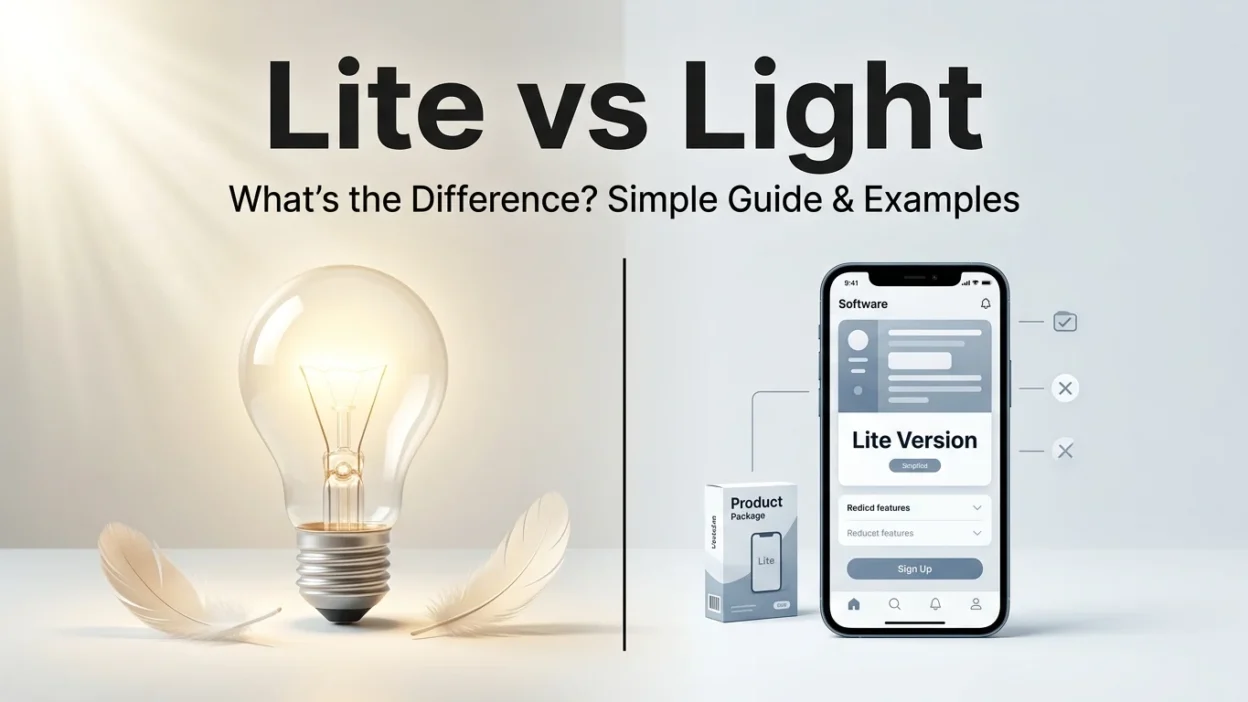
“Lite” and “light” look and sound similar, but they are not interchangeable in every situation. Light is the standard English word and has many meanings, while lite is a nonstandard or specialized spelling commonly used in product names, advertising, food labels, and technology.
Understanding lite vs light becomes much easier when you know what each word is used for. In this guide, we’ll explain the difference between lite and light, show you when to use each spelling, and provide simple examples you can remember.
Quick Answer
Light is the standard English spelling and can describe brightness, weight, color, food, or something that is not heavy or intense. Lite is a specialized spelling often used commercially to suggest a reduced, simpler, lower-calorie, or less-featured version of something. In normal writing, choose light unless “lite” is part of an established name or label.
Why Do People Confuse Lite and Light?
People often confuse these words because lite and light are pronounced the same in many varieties of English. They can also communicate a similar basic idea when referring to something reduced, less heavy, or less intense.
The main difference is spelling and usage. Light is the ordinary English word. Lite is generally used as a specialized spelling, especially in commercial, informal, or branded contexts.
For example:
- This bag is light. → Standard English.
- This is a lite version of the software. → A reduced or simpler version.
- I want a light meal. → Standard English.
- This product is labeled “lite.” → Specialized product wording.
First Word: Light
Light is the standard spelling and one of the most useful words in English. It can function as a noun, adjective, adverb, or verb depending on the sentence.
As an adjective, light can mean not heavy:
- This suitcase is light.
- I bought a light jacket.
It can also describe something with little intensity:
- We had a light rain.
- She did some light exercise.
Light can also refer to brightness:
- Turn on the light.
- The room needs more light.
Another common meaning relates to color:
- She wore a light blue dress.
- I prefer light brown furniture.
Because light has so many meanings, it is the correct choice in most ordinary English sentences.
Second Word: Lite
Lite is a specialized spelling of “light.” It is often used to describe something that has been reduced, simplified, or made less substantial.
You may see lite in:
- Food and drink marketing
- Product names
- Software and apps
- Services with fewer features
- Commercial advertising
- Informal brand language
For example:
- lite beer
- lite version
- lite plan
- lite software
In these contexts, lite often suggests “a reduced or simplified version.”
However, you should not replace light with lite simply because they sound alike.
For example:
- The box is light. ✓
- The box is lite. ✗
The second sentence would normally be incorrect unless “Lite” is part of a specific product or brand name.
Lite vs Light: Comparison Table
| Feature | Light | Lite |
|---|---|---|
| Standard English spelling | Yes | No, generally specialized |
| Common in everyday writing | Very common | Less common |
| Refers to brightness | Yes | No |
| Means not heavy | Yes | Usually not |
| Used for colors | Yes | No |
| Used for food products | Yes | Sometimes |
| Used for reduced versions | Yes | Very common in commercial contexts |
| Used in software names | Sometimes | Common |
| Used in brand/product names | Yes | Yes |
| Best choice in normal writing | Yes | Only when appropriate |
When Should You Use Light?
Use light when you are writing normal English and mean something such as:
- Not heavy
- Brightness
- A lamp or source of illumination
- Pale in color
- Not strong or intense
- Small in amount
- Not serious or substantial
- A reduced amount of food or drink
- Something that weighs little
Examples
- This box is very light.
- The light in the hallway is broken.
- She chose a light blue shirt.
- We had a light lunch.
- There was light rain in the afternoon.
- He prefers light exercise.
- The bag feels light.
- Please turn off the light.
In ordinary sentences like these, light is the natural choice.
When Should You Use Lite?
Use lite when the spelling is intentionally used to identify a reduced, simplified, or specially marketed product or version.
For example:
- Lite version of an app
- Lite plan with fewer features
- Lite beer on a product label
- Lite edition of software
- Lite package offered by a company
The spelling may be part of a product’s official name or marketing language.
For instance, if a company calls a product its “Lite Plan,” changing it to “Light Plan” could change the official name.
Important Rule
Do not use “lite” simply because you mean “light.”
Use light for standard English. Use lite when the specialized spelling is intentional or established.
10+ Examples of Lite and Light
Here are practical examples showing how the two words work.
1. Weight
The suitcase is light. ✓
Here, “light” means it does not weigh much.
2. Brightness
The light is too bright. ✓
Here, “light” refers to illumination.
3. Color
She painted the walls light green. ✓
“Light” describes a pale shade of green.
4. Food
We had a light dinner. ✓
This means the dinner was not heavy or substantial.
5. Rain
There was light rain this morning. ✓
“Light” means the rain was not heavy.
6. Software
I downloaded the lite version of the program. ✓
“Lite” indicates a simplified or reduced version.
7. Product Plan
The company offers a Lite plan for new users. ✓
Here, “Lite” is being used as a product-plan label.
8. Exercise
The doctor recommended light exercise. ✓
“Light” means exercise that is not strenuous or intense.
9. Product Label
The drink is marketed as a lite beverage. ✓
“Lite” is functioning as specialized commercial wording.
10. Seriousness
It was only a light conversation. ✓
“Light” can describe something that is casual rather than serious.
11. Weight of Clothing
I packed a light jacket. ✓
The jacket is relatively thin or not heavy.
12. Reduced Features
The Lite edition has fewer features. ✓
“Lite” indicates a reduced version.
Common Mistakes With Lite and Light
Mistake 1: Using “lite” for everything
Some learners assume that lite is simply a shorter spelling of light.
It is not appropriate in ordinary sentences.
Incorrect:
- This bag is lite.
- The room needs more lite.
Correct:
- This bag is light.
- The room needs more light.
Mistake 2: Thinking “lite” is always incorrect
The opposite mistake is also common.
Lite can be perfectly appropriate when it is used as a specialized product or marketing term.
For example:
- Lite version
- Lite plan
- Lite beer
The context determines whether the spelling is appropriate.
Mistake 3: Changing an official product name
If a company officially uses Lite in a product name, keep the original spelling.
For example:
- Basic Lite Plan ✓ if that is the official name
- Basic Light Plan ✗ if you are changing the official name
Mistake 4: Confusing “light” with “lite” in formal writing
In essays, schoolwork, professional communication, and general prose, light is usually the correct spelling when you mean the ordinary English word.
Memory Trick: Lite Is the “Reduced” One
A simple way to remember the difference is:
Light = the normal English word.
Lite = a specialized “reduced” version.
Think of lite as a marketing-style spelling that often signals less, simpler, or fewer features.
For example:
- light bag → low weight
- light meal → not heavy
- lite software → fewer features
- Lite plan → reduced service
So when you are unsure, choose light unless the context clearly calls for lite.
American vs British English
The basic distinction between light and lite is not simply an American-versus-British spelling difference.
Light is the standard English spelling in both American and British English.
Lite appears in specialized commercial, product, and brand contexts in English-speaking markets. Its use is strongly associated with branding and informal or simplified product terminology rather than being a standard alternative spelling of the everyday word “light.”
For learners, the safest rule is simple:
Use light in normal English writing unless lite is part of a specific name, label, or specialized expression.
Similar Words
Understanding related words can make the distinction even clearer.
Lightweight
Lightweight means having little weight.
- This laptop is lightweight.
- I need a lightweight backpack.
The standard spelling is lightweight, not “liteweight” in ordinary English.
Lighter
Lighter is the comparative form of “light.”
- This phone is lighter than my old one.
- The second bag is lighter.
Lightest
Lightest is the superlative form.
- This is the lightest suitcase here.
- She chose the lightest option.
Lightweight vs Lite
These words are not interchangeable.
Lightweight usually describes physical weight:
- a lightweight jacket
- a lightweight bicycle
Lite often describes a reduced product or service:
- a Lite app
- a Lite subscription
- a Lite edition
Final Verdict
Light is the standard English word and should be your default choice. It can describe weight, brightness, color, intensity, food, weather, and many other concepts.
Lite is a specialized spelling generally associated with products, brands, marketing, simplified versions, or reduced features. It is useful when that spelling is intentionally part of the expression or name.
When writing a normal sentence, choose light. When you see Lite as part of an established product, plan, edition, or label, keep Lite.
Frequently Asked Questions
Is “lite” the correct spelling of “light”?
Usually, no. Light is the standard spelling. Lite is a specialized spelling commonly used for certain products, brands, and reduced versions.
Is “lite” a real English word?
Yes, lite is used in English, especially in commercial and product contexts. It does not generally replace the standard word light in ordinary writing.
Is it light or lite food?
Light food is standard English when you mean food that is not heavy. Lite may appear on a commercial food or drink label as a marketing term.
Is it light or lite version?
Both can appear, but they can have different purposes. Lite version is common when referring to a reduced or simplified product or software version. Light version may be used descriptively in ordinary prose.
Is “lite” acceptable in formal writing?
Use lite when it is part of an official name, product label, or established term. Otherwise, light is generally the safer choice in formal writing.
Does “lite” mean low calorie?
Not necessarily. “Lite” is often used in food marketing to suggest a reduced characteristic, but the exact meaning depends on the product and its labeling. Check the specific product information rather than assuming what “lite” means.
Are light and lite pronounced the same?
In many varieties of English, light and lite are pronounced the same. This is one reason learners often confuse their written forms.
Can I write “lite” instead of “light” in an essay?
Generally, no. In an essay or other normal writing, use light unless Lite is part of a proper product name, quotation, or specific term.
Remember This
Light = standard English.
Lite = specialized spelling.
Use light for ordinary meanings such as:
- not heavy
- brightness
- pale color
- mild or not intense
- a small or less substantial amount
Use lite mainly when referring to a deliberately simplified, reduced, branded, or commercial version.
If there is no special reason to write lite, light is usually the right choice.
Conclusion
The difference between lite vs light is mainly about standard spelling and context. Light is the normal English word with many meanings, while lite is a specialized spelling often used for products, brands, food labels, software, and reduced versions.
For everyday English, remember one simple rule: choose “light” unless “lite” is intentionally part of a product name, label, or specialized expression. This rule will help you avoid most spelling and usage mistakes.