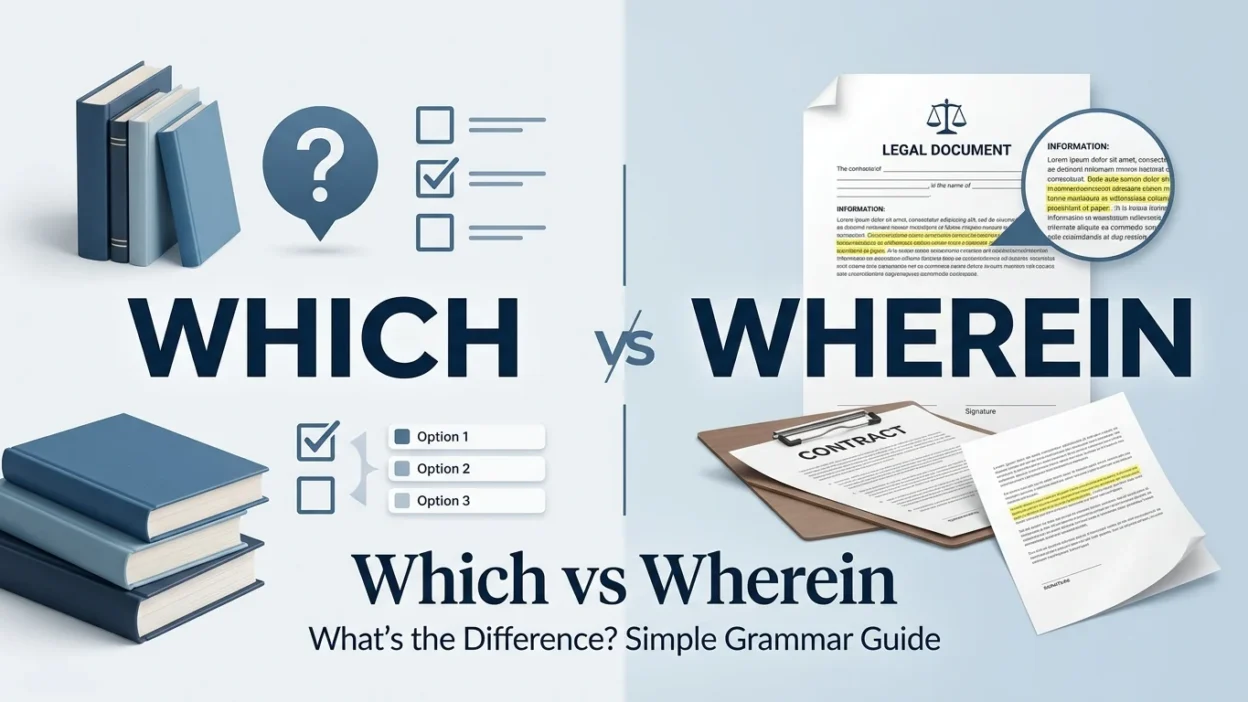
Choosing between which vs wherein can be confusing because both words can introduce information about something previously mentioned. However, they do not have the same meaning or grammatical function. Which is commonly used to ask about a choice or to introduce a relative clause, while wherein is a formal word meaning “in which” or sometimes “in what.” For example, “Which book do you want?” asks someone to choose, while “the agreement wherein the terms were stated” means “the agreement in which the terms were stated.”
Understanding the difference becomes much easier when you look at the role each word plays in a sentence. Which is common in everyday English, whereas wherein is much more formal and is often found in legal, academic, technical, or traditional writing. This guide explains when to use each word, with clear examples and practical rules.
Quick Answer
Which is used to ask about a person or thing from a group or to introduce a relative clause. Wherein means “in which” and describes something contained, included, or occurring within a situation, document, place, or system. In modern everyday English, which is far more common than wherein.
Why Do People Confuse Which and Wherein?
People often confuse which and wherein because both can connect a noun with additional information.
Consider these examples:
- Which option do you prefer?
- The document wherein the information appears is confidential.
The first sentence uses which to ask someone to choose an option.
The second uses wherein to mean “in which.” It tells us that the information appears inside the document.
The main difference is therefore meaning:
- Which = asks about or identifies a particular person or thing.
- Wherein = in which; within which; in what.
Another reason for the confusion is that wherein looks like a combination of where + in, but it does not normally refer only to a physical location. It can describe an abstract situation, process, agreement, or system.
For example:
The company created a system wherein employees could submit suggestions.
This means:
The company created a system in which employees could submit suggestions.
First Word: Which
Which is a very common English word with several grammatical uses.
1. Which as a question word
We use which when choosing between two or more known or possible options.
Examples:
- Which color do you like?
- Which restaurant should we visit?
- Which route is faster?
- Which answer is correct?
- Which laptop do you want?
Here, which means something like “what one” or “what ones.”
2. Which as a relative pronoun
Which can also introduce a relative clause and provide more information about a thing or idea.
Examples:
- I bought a car which has excellent fuel efficiency.
- She read the book which you recommended.
- The house, which was built in 1920, is beautiful.
- He missed the train, which caused a delay.
In these examples, which connects the noun with additional information.
3. Which in formal questions
Which can also appear in more formal questions.
- Which proposal should we accept?
- Which candidate submitted the application?
- Which method produces better results?
It is still a normal and widely used English word.
Second Word: Wherein
Wherein is a formal English word meaning “in which.”
It is most commonly used to describe a situation, document, agreement, system, process, or context in which something happens or exists.
Examples:
- This is the contract wherein the terms are explained.
- They developed a system wherein users could access their accounts remotely.
- She described a situation wherein nobody knew what to do.
- The agreement wherein the responsibilities were defined was signed yesterday.
In each case, wherein can usually be replaced with “in which.”
For example:
The contract wherein the terms are explained.
becomes:
The contract in which the terms are explained.
Is Wherein Common in Everyday English?
Not usually.
Wherein is grammatically correct, but it sounds formal, old-fashioned, legal, or literary in many contexts.
In ordinary conversation, people normally prefer “in which.”
Instead of:
The situation wherein we found ourselves was difficult.
Most speakers would naturally say:
The situation in which we found ourselves was difficult.
This makes wherein useful to recognize, even if you do not use it frequently yourself.
Which vs Wherein: Comparison Table
| Feature | Which | Wherein |
|---|---|---|
| Basic meaning | What one/ones; a relative pronoun | In which |
| Main use | Questions and relative clauses | Formal relative clauses |
| Common in conversation | Yes | Rarely |
| Formality | Neutral | Formal |
| Can introduce a choice? | Yes | No |
| Can mean “in which”? | Sometimes only through a different construction | Yes |
| Common contexts | Everyday, academic, professional | Legal, formal, literary, academic |
| Example | Which book do you want? | The document wherein the details appear |
When Should You Use Each?
The easiest way to choose between which and wherein is to ask what you want the sentence to mean.
Use “Which” for Choices
Use which when you are selecting something from a group.
- Which dress should I wear?
- Which answer is correct?
- Which movie did you watch?
- Which road should we take?
You cannot replace which with wherein in these sentences.
Incorrect:
Wherein movie did you watch?
Correct:
Which movie did you watch?
Use “Which” to Add Information
Use which to introduce information about a previously mentioned thing.
- I bought a phone, which was on sale.
- She visited Paris, which is famous for its museums.
- He missed the meeting, which surprised everyone.
Use “Wherein” for “In Which”
Use wherein when you could naturally use “in which.”
For example:
The agreement wherein the rules were established…
can become:
The agreement in which the rules were established…
Both are grammatical, but in which is more natural for most modern readers.
Use “Wherein” Carefully
Because wherein is formal, it can make an ordinary sentence sound unnecessarily complicated.
Instead of:
We entered a room wherein several people were waiting.
A more natural sentence is:
We entered a room where several people were waiting.
Or:
We entered a room in which several people were waiting.
Which vs Wherein: 12+ Examples
Examples with “Which”
- Which book should I buy?
- Which color do you prefer?
- Which answer did you choose?
- Which train goes to London?
- She bought a dress which was on sale.
- I watched the movie, which was surprisingly funny.
- He chose the option which seemed safest.
Examples with “Wherein”
- They signed an agreement wherein both sides accepted the conditions.
- The report describes a situation wherein several problems occurred.
- The company developed a system wherein customers could track orders.
- The contract wherein these conditions appear is legally binding.
- He explained a process wherein each stage depends on the previous one.
- They created an environment wherein students could learn independently.
- The policy establishes a framework wherein employees can report concerns.
Compare the Meaning
Consider these two sentences:
Which system do you use?
This asks the listener to identify or choose a system.
Now compare:
The system wherein users can store their files is easy to use.
Here, wherein means “in which.” It describes what happens inside the system.
Common Mistakes
Mistake 1: Using “Wherein” for a Choice
Incorrect:
Wherein option do you prefer?
Correct:
Which option do you prefer?
Wherein does not mean “which.”
Mistake 2: Thinking “Wherein” Means Only a Physical Place
Wherein can refer to abstract situations.
Correct:
The situation wherein the error occurred was unusual.
Here, there is no physical place. Wherein means “in which situation.”
Mistake 3: Using “Wherein” When “Where” Is More Natural
Formal:
We visited the laboratory wherein the experiment was conducted.
More natural:
We visited the laboratory where the experiment was conducted.
Or:
We visited the laboratory in which the experiment was conducted.
Mistake 4: Assuming “Which” Always Means “In Which”
Which and in which are not interchangeable in every sentence.
Compare:
The book which I bought was expensive.
Here, which is the object of “bought.”
But:
The book in which I found the note was expensive.
Here, the note was found in the book, so in which is required for that meaning.
Wherein could replace “in which” in the second example:
The book wherein I found the note was expensive.
However, that version sounds much more formal.
Memory Trick
Remember:
Which = choice or identification.
Think:
Which one?
For example:
Which shirt do you want?
Wherein = in which.
Think:
Wherein → in which
For example:
The box wherein the documents were stored…
means:
The box in which the documents were stored.
A simple formula is:
Which = which one?
Wherein = in which?
If you can replace the word with “in which,” then wherein may be grammatically appropriate.
American vs British English
There is no major difference in the basic meanings of which and wherein between American and British English.
Which is common in both varieties.
Wherein is also understood in both varieties, but it is relatively formal in modern English. It appears more often in legal documents, formal writing, academic prose, historical texts, and literary language than in casual conversation.
In both American and British English, in which is generally a more neutral alternative.
For example:
Formal:
The agreement wherein the conditions were specified…
Neutral:
The agreement in which the conditions were specified…
Everyday:
The agreement where the conditions were specified…
The most suitable choice depends on the context and the level of formality you want.
Similar Words
Several words and phrases are related to which and wherein.
Which vs That
Both which and that can introduce relative clauses in certain situations.
- The book that I bought was expensive.
- The book which I bought was expensive.
However, their use can differ depending on whether the clause is restrictive or nonrestrictive and on the style guide being followed.
Where vs Wherein
Where often refers to a place or situation:
This is the house where I grew up.
Wherein means “in which” and is more formal:
This is the situation wherein the problem occurred.
In Which vs Wherein
These two are closest in meaning.
- The document in which the information appears…
- The document wherein the information appears…
The first is neutral and common. The second is formal.
What vs Which
What can refer more generally to something unknown or unspecified:
What do you want?
Which normally asks someone to choose or identify something from a known or limited set:
Which do you want, tea or coffee?
Final Verdict
Which and wherein are not interchangeable in ordinary sentences. Which is a common word used for choices, questions, and relative clauses. Wherein is a formal relative adverb meaning “in which.”
If you are writing everyday English, which, where, or in which will usually be more natural depending on the sentence. Use wherein when its formal style fits the context and when you genuinely mean “in which.”
Frequently Asked Questions
Is “wherein” the same as “which”?
No. Wherein means “in which,” while which can ask someone to identify or choose a person or thing, or introduce a relative clause.
Can “wherein” replace “in which”?
Yes. Wherein can often replace “in which.” For example, “the system in which users work” can become “the system wherein users work.” The second version is more formal.
Is “wherein” grammatically correct?
Yes. Wherein is a standard English word. However, it is formal and less common in modern everyday speech.
Is “which” more common than “wherein”?
Yes. Which is extremely common in both spoken and written English. Wherein is much less common and tends to appear in formal, legal, academic, or literary writing.
Can I use “where” instead of “wherein”?
Sometimes. If where refers naturally to a place or situation, it can often sound more natural than wherein.
For example:
The house where I grew up.
This is more natural than:
The house wherein I grew up.
What does “wherein” mean in simple English?
Wherein simply means “in which.” It tells you that something happens, exists, or is contained within the thing being discussed.
Which is better: “wherein” or “in which”?
Neither is universally better. In which is more neutral and widely used, while wherein is more formal. Choose according to the context and your intended style.
Remember This
- Which asks about a choice: Which book do you want?
- Which can introduce a relative clause: The book, which was expensive, sold quickly.
- Wherein means “in which.”
- Wherein is formal and relatively uncommon in casual English.
- In which is usually a natural alternative to wherein.
- Do not use wherein when you simply mean which one.
- When in doubt, remember: Which = which one; wherein = in which.
Conclusion
The difference between which vs wherein is mainly about meaning and function. Which is a versatile and common English word used for questions, choices, and relative clauses. Wherein, on the other hand, means “in which” and is generally reserved for more formal styles of writing.
For clear everyday English, you will usually want which, where, or in which. Use wherein when you specifically mean “in which” and a formal tone is appropriate. Once you remember “which = which one” and “wherein = in which,” the distinction becomes much easier.